the pleasingness of knowing sources

Two friends at Yeshivat Hadar are learning about tzitzit, specifically the extent to which women are permitted* to engage in the mitzvah. One of them comes over to me:

“We’re learning about women and tzitzit, and whether women are allowed to make tzitzit, and there’s a famous Tosafot, maybe in Gittin, that talks about that…?”

And I admit to being rather pleased at myself being able to go “Right, Gittin 45b, Rabeinu Tam has a whole thing about it…”

I only wish I knew the entire body of Tosafot so well that I could do that for any subject!

Of course, the reason I know that particular reference is because Gittin 45b is where the Talmud stashes the main bit about why women (and children and non-Jews etc) can’t write Torahs.

Here’s the text:

כל שישנו בקשירה ישנו בכתיבה – מכאן אומר ר”ת דאין אשה אוגדת לולב ועושה ציצית כיון דלא מיפקדה ואין נראה דהא מדפסלינן בריש התכלת (מנחות דף מב.) ציצית בעובד כוכבים דדריש בני ישראל ועשו ולא בעובדי כוכבים מכלל דאשה כשרה ואמרינן נמי סוכת גנב”ך כשרה בפ”ק דסוכה (דף ח:) ודוקא בס”ת ותפילין ומזוזות דכתיב וקשרתם וכתבתם דרשינן הכי.*

And here’s me pontificating:

Rabeinu Tam (Gittin 45b, s.v.”Kol”) applied ruthless logic to the ruling that women may not write tefillin since they are not obligated to lay tefillin, and ruled that since women are not obligated in the mitzvah of tzitzit, they may not tie tzitzit for men; since women are not obligated to take up a lulav, they may not bind together lulavin for men. This was rejected by the anonymous Tosafist, who cited baraitot in Menaḥot 42a and Succah 8b which permit women to tie tzitzit and build succot, despite being exempt from both. The general position is that one who is not obligated in a mitzvah may create the objects associated with the performance of that mitzvah, and Tosafot conclude that the case of tefillin (and its associates sifrei Torah and mezuzot) is anomalous in that those not obligated in this particular mitzvah may not create the objects required for its fulfilment.

So, good news for a piecemeal approach to egalitarianism re tzitzit, not so good re sifrei kodesh; and it’s really really cool to know your stuff well enough that you can point other people to references when they want them. Now if I could only do that for a couple hundred pages of gemara instead of just a couple pages, I’d be doing well.

Back to work.


* Permitted is a term hovering in an egalitarian no-mans’-land. Must get round to talking about that sometime or other. Someone remind me plz.
** fair use copied and pasted from the Bar-Ilan text database at Spertus’ Feinberg E-collection; access to many resources only $35/year, recommended as very much worth it


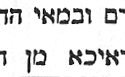
Stretchy letters in print

We talk about stretchy letters in Torah, now and again. Here’s a post about stretchy letters in print.

You know this icon. In the universal language of word processors it means “right-aligned text.” Lines run level down the right side of the page; if a line doesn’t fit perfectly, there’ll be a little bit of white space at the end of the line, and the left edge of the page will be ragged. This paragraph is left-aligned (and made narrower than the rest of the page, so the justifying will show up better), so the right edge is ragged.
If you don’t want a ragged edge, you use this one, the icon for justified text. The word processor does its clever tweaking so that the lines come out nice and straight down each side of the page. This paragraph is justified, so both edges are straight.
Computers accomplish this by averaging out the amount of space between each word, so that the words are evenly spaced along the lines. We don’t usually notice that the spaces between words are different sizes on each line, unless the variation is noticeably huge. The variation is rather pronounced in the couple of lines to the left, for instance.

This is actually a rather involved process. Computers can do it because they are rather good at sustaining hundreds of calculations per second, and it is easy for them to add or remove bits of space here and there. It is not so easy when you are a compositor using movable type.

So there are tricks printers, and manuscript scribes, use to keep their lines manageable. Abbreviating is one. Too many letters in a line? Knock a few letters off common words, the sort peo. will be able to rea. anywa.
Or initialising – turning common phrases into acronyms. P. G. Wodehouse does this, although probably not for the same reasons – Mix me a b.-and-s., Jeeves – perhaps he had learned rabbinic texts and knew the despair of sentences which end with i.o.u.a.* (And perhaps not.)
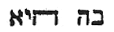
Or sometimes they stretch letters. Here’s some stretchy letters in movable type – compare the two sizes of hey, especially.
Printers like symmetry in their stretchy letters. You don’t see stretched reish in print much, but you see it all the time in sifrei Torah; you don’t see stretched final-mem in sifrei Torah much, but you see it in print.
More symmetry – when they stretch lamed, they bring its foot faaar forward and bend its neck right back, so that it’s more or less balanced. Scribes don’t do this. I think this has to do with where your eye is drawn – in Ashkenazi Torah scripts the horizontal carries far more weight than the vertical, so your stretch is mostly concerned with its horizontals; but in print both dimensions are roughly equal, and you want to stretch letters that are going to stay balanced despite that.

Not a definitive list of Letters Stretched In Print by any means – just I went to a shiur, and the handout was a photocopy from a page typeset in this way, and it caught my eye.

* Brandy-and-soda, and “impossibly obscure unguessable acronyms,” of course!


Proofreading, part 30

The very observant will note that this series has talked a lot about letters, but really not about layout at all. The reason for this is that while letter forms are relatively inflexible and easy to get wrong, layout is relatively very flexible and (these days) pretty hard to screw up, so it’s not part of the proofreading process.

If you were making a chair, you wouldn’t need to check that it had four legs; you’d know darn well if it didn’t have four legs. These days, layout errors for scribes like me are of that order of magnitude.

It was not always so. More about that in a week or two.

In the meantime, I will just note that I generally proofread a little faster than I correct, so the proofreading gets ahead of the correcting, and thus it was a couple of weeks ago that I was learning leyning in Bereshit, correcting in Shemot, proofreading in Vayikra, and writing in Bemidbar. Heh.


Proofreading, part 29

I summarised my attitude towards women writing Torahs by saying that the full citizen, the adult male in good standing, may participate in the transmission of the community’s symbolic centre, and the adjunct classes of women, children, and slaves, may not; today, it is a matter of principle that women not be an adjunct class and therefore may participate on the same basis as men.

This is not how the language of halakha expresses itself, naturally. Halakhically, the issue is framed in terms of the mitzvah of tefillin – those who are Biblically-commanded and socially-accepted as tefillin-wearers may write the sacred scrolls; others may not. Women are not Biblically commanded to wear tefillin, therefore they may not write the scrolls.

It seems simplistic to say that in communities where halakhic validity and gender equality are equally indispensable, women do wear tefillin, and that said wearing is held by said communities to be equivalent to men’s. Simplistic, but when an immutable principle meets an overwhelming imperative, on some level the answer is simple. The community says in its actions “this is what we do, this is what we expect of people, this is how it’s going to stay” – and once that sentiment is in the heart of a community, we don’t wrench it out, so the halakha must perforce adjust to accept it.

You can’t run a religion like that, changing the rules of the society every time you sniff hurt feelings. This is a halakhic sledgehammer, and swinging it too freely will destroy the halakhic structure. But societies where gender equality is well-grounded and gaining demonstrate that gender equality does not render a society inherently unstable (on a century of evidence; give it another five centuries and we’ll be better placed to tell), and thus one may say with a fair amount of certainty that applying the halakhic sledgehammer to the principle of gender equality will not render the halakhic structure inherently unstable either.

We’ve got off the topic of proofreading rather, but there again, proofreading is the process that ensures the stability of the Torah text, which itself is symbolically the stability of the Jewish people, so it’s vaguely associated. Anyway, that’s about all I’ve got to say concerning proofreading at the moment.


Proofreading, part 28

Most readers here, I imagine, live in countries where rights and responsibilities in the social plane are officially not apportioned with reference to gender. Broadly, this is because it is a matter of principle that women and men function as equal members of society. How well this actually plays out in practice is another matter, but in principle, that’s how it is.

It is then implausible to expect the religious plane to stand orthogonal to the social plane. To function as a full citizen in one plane and an adjunct citizen in another plane requires either a superhuman suspension of disbelief or an impaired existence in one or both planes.

This isn’t good for religion’s chances – if you’re used to functioning fully in a social plane, you’re not going to take kindly to being told you have lesser status in a religious plane. But further, it encourages the idea that the religious and social planes are and must be distinct. As someone who sees religion as an enhancement to, not a removal from, the social plane, this doesn’t work for me.

Like it or not, social climate filters into Jewish life, and in social climates which foster egalitarianism, there will exist egalitarian Jewish life, in which the idea of women as an adjunct class is in principle both redundant and repugnant. Given such a change in the makeup of society, it is not implausible for its women to write Torahs. Naturally there are communities in which women are, and are content with being, adjuncts, and certainly these communities shouldn’t have women writing their Torahs, but these are not communities I choose to live in.

The halakhic aspect to follow.


Proofreading, part 27

Of course, people say “um, no actually” to me, being female. It wasn’t the handless guy’s fault he had no hands, it’s not my fault I’m female. He just didn’t have the physical makeup to write a valid Torah and that was too bad; I don’t have the physical makeup to write a valid Torah and that’s too bad also.

Really, I do know a lot of decent people who have to say “um, no actually” to me, and they do act like yesterday’s posited rabbi – feeling really sorry that he’s got to say “um, no actually” to this person who’s put in so much effort and so badly wants to be part of the community and it isn’t their fault they can’t participate through this activity.

So why’s it different? why am I expecting the handless guy and the Braille-writer to suck it up, while I go right ahead and write Torahs?

You could say I’m just a hypocrite, a case of “one rule for us, one rule for them.” Some people do say that. I see where they’re coming from.

Way I see it, women doing men’s things isn’t exactly a physical makeup thing, it’s about how gender affects one’s communal status. Women are barred from Torah writing in the context of societal strata; some classes of people may participate, some may not. In particular, the full citizen, the adult male in good standing, may participate in the transmission of the community’s symbolic centre, and the adjunct classes of women, children, and slaves, may not.

This is perfectly sensible as far as it goes, except that in our days it is a matter of principle that women not be an adjunct class.

Such a statement requires some unpacking. More on that tomorrow.


Proofreading, part 26

Backtracking a bit to the experience of writing.

I talked about producing letters as not necessarily being writing. Specifically, embossing (the process of creating a shape by pressing up from the other side) isn’t really writing.

We might say: ah, but Braille is created by embossing, and today there are lots of people for whom writing in Braille is experientially the same as writing. So why couldn’t you emboss letters and make a Torah for the blind? At any rate, a Braille Torah?

Leaving the technical difficulties aside (rolling an embossed document into a scroll is asking for trouble), it’s an interesting proposal.

There’s a case recorded – I forget the reference, I’ll look it up if anyone cares deeply – where a guy with no hands wrote a Torah with the pen held in his teeth, and the Torah was ruled invalid, because holding the pen in one’s teeth is not what most people perceive experientially as writing.

The guy had written a whole Torah, remember. That’s a hell of a lot of work – I mean, it takes me a whole year, and I’ve got two perfectly good hands. He’s written a whole Torah with the pen in his teeth, and he’s got no hands – I would speculate that the rabbi who ruled his Torah invalid felt like a real heel. You couldn’t be any kind of decent person and feel really sorry that you’ve got to say “um, no actually” to this person who’s put in so much effort and so badly wants to be part of the community and it isn’t their fault they can’t participate through this activity.

But you’ve got to, and I think that’s also the case for Braille Torahs. Holding the pen in one’s teeth, or writing Braille, is definitely some people’s experience of writing, but that doesn’t mean it’s the cultural experience of writing, and it seems that that’s what matters here.

Ramifications of this attitude tomorrow.


Proofreading, part 25

I also have to deal with a certain amount of, let’s say, cognitive dissonance. In my travels, I’ve given scrolls (usually megillot) I’ve written to various traditional-Orthodox types, and the response is, quite often, “Goodness me, this is very nice, very nice indeed…” until they discover that I wrote it. Then their opinion abruptly changes; suddenly it is not aesthetically pleasing, the writing is not nice, and so forth. This is a) obvious and b) tiresome.

A story by way of example. One of my proofreading go-betweens also sells Torahs, and once I collected a scroll from him – it’d been written in Israel and I was to take it to its new home after sewing on some rollers and other details.

Well, some colleagues and I opened up that scroll and we were horrified. The writing was appalling. By no stretch of the imagination could it have been described as kosher.

So back it went to Mr Go-Between, who insisted that it was completely fine. No problems at all, he said. 100% kosher, he said. He sent it back to us. We sent it back to him. Repeat a couple of times; he was adamant that this scroll was absolutely kosher with no problems at all.

Eventually he was persuaded to examine it in daylight, and he conceded that there were more than one hundred critical errors per column. Completely fine, hm? 100% kosher? No problems at all? Right.

Subsequent investigation revealed that the sofer had taken the commission despite his failing sight. He had written the scroll practically blind, and while that’s quite an achievement, it doesn’t make for a kosher scroll.

But we digress. This was Mr Go-Between insisting that a really dreadful Torah was totally fine. Later, I took him my scroll for scanning, and he insisted that the writing was deeply deeply problematic in assorted ways.

Clearly I’m not unbiased, but at least mine didn’t have a hundred critical errors per column.

I certainly have scope for improvement, but that seemed like some pretty intense cognitive dissonance to me. I just have to bite down and count myself lucky that he’ll deal with me at all. Oh, and watch out for my own biases making me behave similarly in other areas of my life – nasty experience, good lesson, anyway.


Proofreading, part 24

Talking of inaccessible. This part of the proofreading process is hard for me to access. I don’t own the fancy software, not many people do since it’s so expensive (multiple thousands of dollars, I understand). Most people send their scrolls away to have someone else do the scanning part.

Well, that’s hard for me, because the people who have the software are all people who don’t hold with women writing Torahs. If I take my Torah to one of them and ask them to scan it, they refuse, saying they can’t have anything to do with it, it’s bad for their reputations, etc. Which I understand, but it doesn’t exactly make me leap for joy. So I send my work to someone who sends it to someone who sends it to someone and eventually it’s anonymised enough that it can go to the scanner without anyone directly violating anyone else’s principles or reputation.

Sigh; not the way I’d choose to work, given the choice, but until there are enough liberal scribes to make buying the software a sensible investment, it’s going to stay as it is.


Proofreading, part 23

The misplaced expectation that a computer can infallibly check a Torah also touches on a deeper concept, that of the experience of writing.

What does it mean to write? is a question that has always been part of the Torah-writing rules. Could you, for instance, embroider the Torah? Is that writing? What about carving letters into plaster-covered monoliths? Embossing them onto metal headbands? What about printing? Jewish communal narrative recognises these processes as producing letters, more or less, but also recognises that this is not how people normally write: you wouldn’t embroider your account book, and if you were embroidering accounts you wouldn’t say you were writing. Experientially, producing letters is not necessarily the same as writing.

By axiom, the Written Torah has to be written, and if it’s going to be a proper written document, it needs to be properly written. It’s got to be produced by someone having the experience of writing, not someone simply having the experience of doing embroidery or whatever.

But for your average North American Jew,* the experience of writing involves a keyboard. It makes absolute intuitive sense that computers would feature in any act of writing, not excluding that of writing a Torah. Computers are how we write things. Handwritten material is positively extraordinary; the skill of penmanship is practically unknown. No-one would expect to see an embroidered book; similarly, people frequently assume Torah scrolls are printed – no-one expects to see a handwritten book. Intuitively, it makes a twisted sort of sense that the Torah should be typed.

Fortunately, we don’t take it that far; even though typing is the more common writing experience these days, pen-and-ink is still, culturally, the more authentic writing experience. Pen-and-ink is associated with real writing in a way that typing is not.**

Indeed, way way back in the days of the first Torahs when literacy was limited to an elite few, a Torah scroll – a written document – probably had an air of mystique about it simply because so few people could write, so few people could conceive of producing one. Nowadays also, a Torah has mystique by virtue of being written, because again so few people can write in this way.

An interesting example of history coming full circle, there. Writing the Torah starts as a skill limited to a small group of people; as literacy spreads but before printing is invented, writing sifrei Torah becomes less remote, such that some authorities even equate sifrei Torah with printed books containing Torah material. Then, once printing is ubiquitous, writing again becomes a rare skill and Torahs are elevated back into the inaccessible.

* By way of example, not by way of exclusion

** Which is one reason I’m not keen on silk-screening Torahs. Halakhically it’s justifiable – ink in the forms of letters is, technically, laid down onto the klaf by hand – but intuitively it isn’t right, because any fool knows that silk-screening isn’t really writing.