Reclining on couches

The first cup of wine is drunk whilst reclining

This, they tell you, is because formal meals during the classical rabbinic period were conducted in the format of the classical world. Diners reclined on couches to take the Meal of Freedom, in the manner of the aristocracy of the time.

Nowadays we sit up to table for the Meal like usual, but we “recline” by leaning on our elbows on the table just like our mothers always told us not to. Sometimes with cushions, which knock over glasses and bang into one’s neighbour.

Ever since I was told this, I’ve wanted to conduct a seder reclining, with couches, but that is hard when you are always a guest at someone else’s seder.

This year, however, planning seder with Mar Gavriel, I said “I’ve always wanted to make seder on couches,” and he, being similarly geeky and eccentric, bounced and said “Me too!”

So we did. We dismantled the dining table and made couches from mattresses. We draped many drapes, found tiny tables, arranged cushions upon which to recline, and presented a seder in Ancient Greek style.
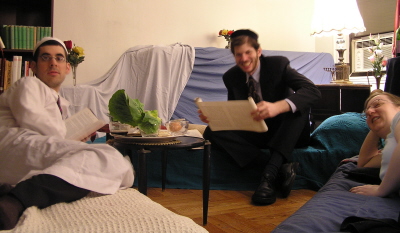

No Festivals were harmed during the taking of these photographs

At a certain point in the seder, the seder plate, with its various accoutrements, is removed from the table, as part of the ritual theatrics of the night. But the earliest sources do not say that the plate is removed, no, they say that the table is removed. And why? Because the earliest sources are speaking of the kind of incidental table which can be removed bodily from the room.

And so, since we had that kind of table…at the point where the gemara says “The table is removed,” we removed the table.

This sort of thing is deeply satisfying when you are a text geek. There is something delightful about living in a text-based religion and actually acting out parts of the foundational texts.

Of course, this is what Passover is about – those who eat matzah and bitter herbs are acting out the text. Those who eat the meal hastily, shod and girded of loin, are acting out the text. Every year we re-enact the journey of the first exodus to create annual resonances, marking the circling back of the year and forming the links in the chain of generations. These are resonances with the biblical text.

But we are not a biblical religion. Our authoritative text on one level is the Torah, and on one level it is good to resonate with that. But our authoritative text on another level is the Talmud, and as such, it is good to resonate with that also, where we can. Thus it is that the haggadah, the re-telling of the Exodus story, contains relatively little biblical narrative and a relatively great amount of Talmudic narrative. We resonate with our biblical ancestry and we resonate with our talmudic ancestry.

Text geeks delight in the closeness a close understanding of a text gives them with the ever-circling layers of rabbinic Judaism. Finding one’s Judaism in a text gives a text geek the sharp joy of recognition – “Yes, this is me! This is mine!” which the Pesach seder aims to stimulate by whatever means possible, even if only in the recognition of childhood tunes.

And thus it is that doing a seder where we really reclined on couches and really removed the table doesn’t make our seder cooler or more authentic than yours (except insofar as it does, obviously (joke)), but it acts out the Talmudic text in the act of acting out the Biblical text, and we can create that, and thus see ourselves not only coming out of Egypt but also reclining with the rabbis, resonating with the Jewish identity cycle and forging our link in our generation.
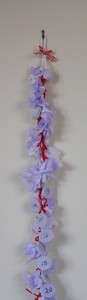

The Edible Omer Counter returns. Updated for 2010!

Back by popular demand, the Edible Omer Counter. Notable for being the only omer counter that gives you motivation to see the Omer right the way through, this one’s got chocolate.
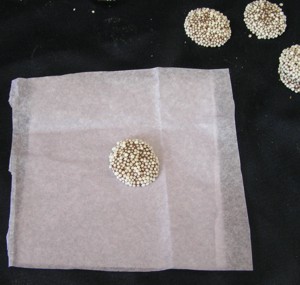
You will need: kosher-for-Pesach choccies, tissue paper, yarn, scissors, pen.*

Cut squares of tissue paper. I used purple over white here (these pictures are from a couple years ago, I haven’t taken pictures since then). Of course you could also use wrapping paper, fabric, foil, whatever takes your fancy.
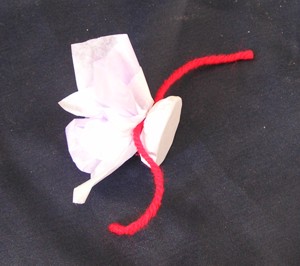
Scrunch the paper up around the choccy and tie it with yarn. You can’t really see the colours so well in the photo – sorry; I’ve got a nice layered purple-and-white look going, by having the inside square, the purple one, be slightly bigger than the white outside one.
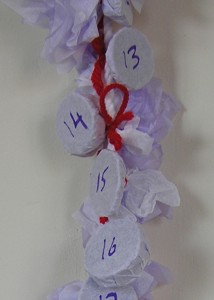
Write the numbers 1-49 on the bottoms of the choccy packages, and use the yarn ties to attach them to one long piece of yarn. You could make it more fun (for kids, naturally – right?) by doing them out of order, and/or by having different sorts of choccies in the packages. Or little toys.

Then hang it on the wall. It ends up being pretty long, so you might have to loop it festively over something.

Starting at the second seder, after dark each night, count the Omer (helpful chart) and eat your choccy.

2010 expansion…now with kabbalah!

In Kabbalah, each of the Omer weeks is associated with one of the seven lower sefirot: Chesed, Gevurah, Tiferet, Netzach, Hod, Yesod, and Malchut. The days of the week are also associated with the sefirot, in the same order, and then you get each day of the Omer having a different combination – so day 1 is chesed in chesed, day 2 is gevurah in chesed, and so on. See wikipedia for more, if you care to.

The interesting bit here is that the sefirot also have associated colours. Swiping from a random internet source, we have Chesed – silver with a bluish tinge; Gevurah – red; Tiferes – light green, like a ripening etrog (citron); Netzach – light pink; Hod – dark pink; Yesod – rainbow of hues including blue, red, yellow; Malchut – dark blue with purple tinge. Almost black.

Now.

The book Kabbalah: an introduction to Jewish mysticism (another random internet source; kabbalah isn’t my thing, particularly) talks about how one form of kabbalistic practice is to meditate on the colours of two different sefirot and then combine the two into a coalescent colour.

So here’s your challenge this year – go and design your own Omer counter which responds to this idea. Share your pictures. There may even be a small prize (a real one, not internet cookies) for the one that makes me go “squee” loudest.


* Strictly speaking, I suppose only the first seven choccies need to be kosher for Pesach, as long as the rest don’t contain actual chametz. But if you’ve bought a whole package of Pesach candies, what are you going to do with the rest of them?

JOFA conference – on writing. Part 2

Session blurb: If one writes a sefer Torah, say the Sages, it is as if he had himself received it on Mount Sinai. How can the simple act of writing take someone to such heights? By transcribing small amounts of text, we will explore how writing Torah can be experientially very different from reading or learning or leyning; how the pace of transcription can give one fascinatingly different perspectives on the text, and how the act of transcription can cause one to process it differently.

I started with a bit of me-background – what I do, how I learned to do it, where I’m holding professionally, that sort of thing. Why, in an orthodox framework, what I do is a problem. The session blurb said “This session will not include halakhic discussion,” because that wasn’t what I was interested in talking about. There’s only so much time you can spend on sources that basically say “No…uh, no” and I’m not into spending time that way, at present.

So I asked the group (fifteen or so people, counting one who left halfway because she’d got the Quills workshop mixed up with the Quilting workshop) who’d read Torah the previous day. Sure enough, someone had, so I passed over a tikkun sheet and had her read a few verses, to make the point: this is what these verses sound like when we read them in shul.

Then I asked if anyone had heard a dvar Torah this week, with the idea of getting people to focus on another way of interacting with the text, that of using it as a starting-point for an idea or a halakha.

I talked a bit about how the Sages mandate writing, rather than inheriting or buying, a sefer Torah, and about how they say of one who writes an entire Torah that it is as if he’d himself received it at Sinai. I asked people to think about how writing a text is different than reading or, say, printing – handwritten envelopes and thank-you cards featured, and I brought up writing as a learning technique also, in its role as a way of getting information into your brain.

Then we did a spot of practical calligraphy. I most particularly didn’t want this to be a calligraphy workshop; I wanted people to experience writing at the Torah-scribe pace of three or four words per minute and to focus themselves within that. So I gave a quick demonstration of how one might write words in ordinary handwriting and then adorn them with colour, or alternatively how one can trace letters from a tracing sheet. Both of these don’t require much in the way of calligraphic expertise, but they entail about as much engaging with the letters and words as more practiced calligraphy does. I thought this would be the best way of simulating the experience I was after.

I gave out tikkun sheets from the parsha the Jews had read the previous day – most people there, if they hadn’t heard it the previous day, had heard it or read it at some time or another, I figured, and I wanted the contrast fresh in people’s minds as far as possible. Then I just had everyone write what was in front of them for a good twenty minutes.

This is the bit where you can tell if it’s working or not. If people are engaged, you can tell, and if they’re bored, that infects the others and everything falls apart. Happily, people seemed engaged, and got into it.

I picked everyone up, when I judged we’d had time enough, and asked people to compare their experiences of writing to their experiences of reading or otherwise engaging with the text. Which they did, most satisfactorily – it was very interesting.

I could do another post on what people said, but this’d be more interesting if you went away and did it yourselves, and came back and commented. Don’t you think?


JOFA conference – on writing. Part 1

Fun times at JOFA yesterday.

That’s the intermittently-annual conference of the Jewish Orthodox Feminist Alliance, for those not au fait with Modern Orthodox slang. I admit I was rather surprised when they asked me to present, given that I don’t identify as Orthodox, but I said as much and they were still interested, so I guess whatever I am, it’s closely-related enough that they figured the conference attendees would be interested.

I very much like opportunities to talk about my work that aren’t the standard Look At The Torah Scroll or My Life Story that constitutes 90% of the public presentation I do. Last month I was in Boston, at Tufts University, talking to undergraduates, and that was great fun – undergrads tend to be deliciously interested in thorny issues, and they’ve often just discovered the joy of tussling with a problem, puppy-like, so undergrads are one of my favourite groups to work with.

Then, as now, I was using presenting as a forum to tackle the following question: classical halakha says there’s basically no way to argue that what I do is okay. My present justification is based on emunat hakhamim – community leaders whose learning and integrity I respect seem to think it’s okay, and since egalitarian practice is in large part a matter of communal acceptance, that’s something upon which to rely.

However. When I contract to write a sefer Torah, and we specify that the sefer is to be written in full accordance with normative Ashkenazi halakha with the exception of the gender of the scribe, it’s kind of analogous to someone who provides meat, which has been selected and slaughtered in full accordance with normative Ashkenazi halakha with the exception of the species of animal. That is to say, sometimes I feel rather like unto one who performs ritual slaughter on pigs.

All this leaves me wide open to the question “So why write sifrei kodesh?”

The workshop I was presenting at JOFA attempted to give an experiential perspective on that question. I wanted to convey the manner in which writing out verses of the Torah gives you a very particular and close relationship to them.

Session blurb: If one writes a sefer Torah, say the Sages, it is as if he had himself received it on Mount Sinai. How can the simple act of writing take someone to such heights? By transcribing small amounts of text, we will explore how writing Torah can be experientially very different from reading or learning or leyning; how the pace of transcription can give one fascinatingly different perspectives on the text, and how the act of transcription can cause one to process it differently.

I’ll continue in Part 2 shortly.


Further to the conversation we’re having about Jewish education, rabbis, etc

(This conversation. The one about Rabbi Barbie.)

A question about tzitzit

I get a question in my inbox.

Hi, Jen. I have a question and I have been told that you might know the answer. I am wondering if there are any rules about what to do with old tzitzit (arbah canfot). I want to get some new ones but I don’t know what to do with the old ones. Do they have special significance requiring some special treatment, or can they be discarded like any other fabric?

“Ask around and find someone who knows” is a perfectly valid way of getting a question answered, naturally, modulo the risk of misinformation (especially when asking Auntie Google).

The Text Model of finding the answer

Still…the way endorsed by the communities I hang out with, particularly the yeshiva ones (I would say “yeshivish,” but that’s got other connotations), goes like this.

1) There are rules about everything. So where do I find the rules about tzitzit?

2i) Orach Hayim deals with everyday sorts of things. Let’s try there.
OR 2ii) You just know that hilkhot tzitzit are in Orach Hayim.
OR 2iii) Ask Wikipedia, which will tell you “Orach Chaim 8-25”.

3) Fish out your Mishnah Berurah. Find the bit of the contents page which says HILKHOT TZITZIT.

4) Skim down the chapter heads until you find something that looks promising. You don’t have to be able to translate all the words, you can do it by deduction, when you know a little bit about how the contents are arranged. For instance, it’s probably not going to be near the beginning, because the question “what do I do with an old tallit” presupposes a lot of “tallit” concepts which have to be defined first. It’s also probably not going to be in a section called “Zman…” (“Time…”) or a section with a root meaning “sell.” Keep skimming. The section with the words “Talitot yeshanim” – that looks promising, since “yeshanim” means “old.”

Yes, it’s freaking intimidating to skim a table of contents in a halakha sefer. I know. But once you have a bit of vocabulary, a bit of navigational skill, and a dollop of confidence, you can do it.

5) Read the section.

6) Now you know the answer.

The Cheese Model of finding the answer

It’s like shopping in a foreign supermarket, kind of. You want to buy cheese. Okay, you can ask someone “where’s the cheese?” and that’s fine. But if you want to find it yourself, what do you do?

You know it’s not going to be in the vegetable section or the peanut butter section. You know it’s going to be in a fridgy sort of place, so you find the fridgy places and look through them till you find cheese.

So far, you’ve not really needed any language skills at all; maybe you read the aisle labels. You needed cultural skills – knowing that this is the sort of shop that contains cheese, knowing that cheese lives in fridges, knowing what cheese tends to look like.

Then you’re going to need some language skills to make sure you aren’t buying goat cheese, yes. But the point is, you don’t need to know how to read every single word on every single package in the store, and you don’t need to know where every single item in the store is, and you don’t need to know where all those items came from – you found the cheese, and if you have a dictionary you can probably figure out what you need to know.

Of course it’s not always that simple, and of course there are lots of ways you can get off track, and we could explore that in the cheese metaphor or in the context of halakha, but let’s save that for another post, because that’s not the point right now.

Point is, with some really basic vocabulary and navigational skills, we found our way to the rules about “What to do with broken-off tzitzit and old tallitot.”

Now, this is where we get to start questioning the educational model.

Why halakha isn’t cheese

I have enough vocabulary now that I can read through that section, pretty much (with dictionary) and work out that it’s telling me, I can get rid of an old tallit katan by putting it in the garbage, but I can’t use it for something gross like a snot-rag, and a good person detatches the tzitzit and puts them in geniza.

But. There are plenty of instances – communal prayer is a better example – where we don’t, in fact, do precisely what’s written in the book, since a good many years have passed since then and ritual evolves – and adhering to the book won’t help you or anyone.

The book will keep you from completely screwing up – if you put your old tallit in a plastic bag in the garbage you won’t have done anything hideously wrong. But you need some input from the community to find out, what do we do? For which one needs conversation, tradition, mimetics – all sorts of things.

Which, by the way, is why it’s okay to ask me, even though I’m not a rabbi. Because here the question, fundamentally, is “What do we do,” and I’m as much “we” as the next person.

And when it’s a vast, complicated issue like marriage or death or something, one needs someone who knows the bigger picture – the book, and the other book, and the commentaries, and the conversations, and the tradition, and the other tradition. Learning the bigger picture takes time, and helping people work out which bits of the bigger picture pertain to their situation takes time, and that’s what we have scholars and rabbis for.

That is to say. The model where anyone vaguely interested in referring to the Mishnah Berurah for answers becomes a rabbi is deeply unsatisfactory. But likewise, the model where we don’t need rabbis and everyone can use the Mishnah Berurah – is also deeply unsatisfactory.


Soferet at play

soferet at play

Why, what would you do if you found a mangled laptop in the garbage room?


Guestblogging at JWA – crosspost

“You know Barbie’s getting a new job,” says my friend Mimi to me. “People can vote for her new career.”

I put tefillin on a Mattel Barbie doll in 2006, unwittingly creating the Jewish icon now known as Tefillin Barbie. Tefillin Barbie has a frum-girl denim skirt, a T-shirt, the tallit and tefillin more generally worn by Orthodox men during morning prayer, and a volume of Talmud; a whimsical activity for a vacation morning, she generated a vast and wholly unanticipated amount of reaction, positive and negative.

“Hurrah,” people say. “Now we can have Rabbi Barbie!”

But why, people? Why? Barbie put on tefillin and picked up a gemara, so now she has to be a rabbi? Why can’t she be an IT engineer who prays with tefillin and learns gemara in her lunch break?

Read the rest of this post at http://jwablog.jwa.org/tefillin-barbie%27s-new-career.


Holocaust Torah scrolls, and judging favourably

Hatam Soferet’s inbox today twinkled with forwards of this Washington Post article.

Basically, there’s a guy, R’ Youlus, whose shtick is rescuing sifrei Torah from Nazi-stricken Europe – removing them, restoring them to usable condition, and rehousing them in America. (As someone with a personal interest in resurgent European Jewry I have my reservations regarding the idea that the appropriate way to “rescue” a sefer Torah is to remove it to America, mind you.) Jolly good. He’s been doing this for some years.

This article suggests that perhaps all is not quite as it should be in the realm of R’ Youlus’ sifrei Torah, that these are no more genuine Holocaust-surviving sifrei Torah than they are splinters of the True Cross.

In particular, certain highly-coloured, heartwrenching tales of dramatic Torah-scroll rescues don’t appear to stand up so well to close examination.

There was a legend of a Torah scroll that had been hidden under the floorboards at Bergen-Belsen…[R’ Youlus] came to Bergen-Belsen on a tour and literally fell into a hole in the corner of the floorboards, felt something strange, suspected that this might be where it was. It was dug up. Indeed it was the Torah, fully there. After some negotiations, Rabbi Youlus was able to purchase the Torah…

But Youlus’s discovery at Bergen-Belsen comes as news to the historian at the camp museum. “I can definitely exclude that there could have been a find of the Torah scroll on the grounds of the Bergen-Belsen Memorial” in recent years, writes Thomas Rahe.

That sort of thing. Well, you can read the article yourselves and see what you think. Wouldn’t be the first time a pious-looking person has fleeced people by selling fake relics.

But. Read More »


A bit of boundary-setting

Generally I like when people share stuff with me. “Have you seen this?” they say, and usually I haven’t and it’s interesting. Thanks, sharers – keep it coming, I much appreciate your thoughtfulness.

Sometimes, though, people share jokes, and I’m observing a trend – when total strangers share jokes (sometimes by internet, sometimes by phone), it’s always men, and the jokes are always about sex.

It’s not that I mind rude jokes per se, but this is getting a bit creepy. I’m famous for having a vagina; that doesn’t mean I want to share it.

So, if you’re a man and you’re thinking about sharing a rude joke with me, please remember that so doing will make you look like a creep, and think again. If you absolutely must share your rude joke with me, get your mom to send it. Thanks.


Atheists daven too…

The Forward’s got an article this week about an atheist siddur.

My knee-jerk reaction to that is “eww, what?!” but I know myself for a liturgical conservative, so when the nice Forward people asked for an illustration, I got out my special Mental Crowbar I use for inducing open-mindedness, and came up with the piece you see here.

See how it works? It’s a well-known phrase from the liturgy, both expressing the idea that every living thing has the urge to commune with the divine, and leaving the viewer to contemplate just what that means.

Note, by the way, that we say “every living being,” not “every living person,” or similar. This surely consciously includes living beings who don’t have theology, like fish, say, or deer, and why not atheists? The idea of non-theistic beings seeking spiritual communion is hard-coded into theistic liturgy, so really an atheist siddur is not such a bizarre idea as all that.

You can’t really see from the picture, but the pen-flourished decoration is an old manuscript adornment done in a très modern ice-blue metallic ink, a visual echo of what the siddur is attempting.

It’s for sale, make me an offer :)