Ketubah drafting part 2 – on ketubah texts

Ketubah texts come in three varieties.

The most common variety up until just a few years ago was a tenth-generation photocopy from the Rabbi’s Manual, the text so blurry you could barely distinguish the letters, and GIANT DOTTED LINES whose giant dots rendered semi-invisible the names, scribbled in pencil by a rushed rabbi. It didn’t really matter that the names were semi-invisible, because it is a criterion for graduating rabbinical school that you have to have illegible Hebrew script,* so you always had to phone and check anyway.

Today, most rabbis have access to computers which can handle Hebrew, so you can email them a .doc of the standard text (sometimes they even already have one, such is the progress we have made!), and they will fill in the names and send it back to you. This is super.

The third category is really a subset of the second – rabbis who fax you back a bit of shul notepaper with the names scribbled on it because they can’t type in Hebrew. A fun variation is the set of rabbis who can’t type in Hebrew but think they can type in Hebrew, so you get names like יןסף and you have to edit judicially.

Editing judicially is a double-edged sword, of course, because on the one hand you know perfectly well that no-one spells Yosef with a terminal nun in the middle, but on the other hand you can’t just go around correcting rabbis, that destroys the illusion that they’re infallible and is a Threat to the World Order causing volcanoes and suchlike. So you phone them and double-check.

I realise at this point that you might have been expecting “three varieties” to mean something like “Orthodox, Conservative and Reform,” but this is an art series, so I was speaking as an artist – and as an artist, that’s what you need to know.

* This is also important when you are writing out the names of the sick to be prayed for. It isn’t a proper prayer for the sick if the prayer leader can read all the names. It is especially important to have terrible writing if you are transliterating English names of non-Jews.


Ketubah drafting part 1 – on 4mm-high letters

Or more, or less.

I don’t really even know why I’m writing about this, except that I spent a little while working it out, and it seems a pity to deprive the internets of my vast wisdom (<= HUMOUR).

So. There’s a category of fountain pen nib called “Broad.” I don’t know what that corresponds to in millimetres or anything…pen nibs have a special set of measurements all of their own. “Broad,” “Broad Broad” (that’s B2), “Broad Broad Broad” (B3)* and so forth. When you get up to about B6 they shift paradigm into C nibs, don’t know what that’s all about, maybe they were worried that more than two digits wouldn’t fit onto a fountain-pen nib, they are pretty small after all.

Anyway, the point is, I find that when I’m writing with a B nib, I like to have a 4mm wide line for the lettering, with 5mm lines between. This is a matter of taste and pragmatics – 4 and 6 is easier to mark up, but that makes the text block too big to fit nicely on 18*24 paper. Of such considerations is art made – being too lazy to think about the nine-times-table (and I have a degree in mathematics you know), and being forced into it regardless because the paper isn’t big enough.

So you get out your portable drafting board that you bought off Craigslist, and your ruler and your set-square, and you mark out 4- and 5-mm lines. How do you know how wide to make the lines, and how many of them to make? That’ll be part 2.

*I did those in bold for the joy of typing<B>B2</B>…


doodles

Soferet doodles

Soferet doodles

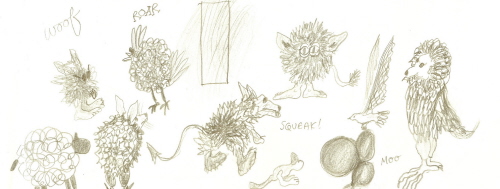
You know when you have a nice soft pencil and a nice fat sketchpad and your fingers just sort of run away with you? Like that.


La vie soferet

The soferet is taking a couple of days to make an enormous batch of Tefillin Barbies, with some American Girl size tefillin thrown in, just in case anyone’s interested.

Breakfast is served chez soferet

Breakfast is served chez soferet

They’ll be on sale shortly at the soferet’s Etsy store, should you be interested. Not just yet though, I still have to go buy ribbon for the straps. Sunday, probably.

Tefillin on a plate

Tefillin on a plate


you could help save my friend’s life

I’ve got a friend at shul.

He’s a lovely guy, he’s got a lovely family, and he’s got leukemia.

A bone marrow transplant could save his life. But so far, no-one on the bone marrow registers is a match for him.

Registering is a matter of a cheek swab. Actual donating, should you be a match, isn’t quite as simple (in a nutshell, this is why one isn’t halakhically obligated to register for these things), but…but you save someone’s life.

Information for people in all locations is at http://www.mattfenstercircle.org/

Information for people in New York, especially if you are going to the Salute to Israel Parade in New York City on Sunday, May 23, under the cut… Read More »


Couch


shatnez gatz

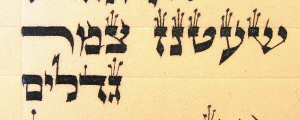
One of the few places in Torah where all the letters with crowns – שעטנז גץ – are within a few millimetres of each other. Pretty, isn’t it?

This one’s in Devarim, 22:11-12:לא תלבש שעטנז צמר ופשתים יחדו: גדלים תעשה לך על ארבע כנפות כסותך אשר תכסה בה.


Monday was Yom Ha’Atzma’ut at YU…

Mar Gavriel tells us:

Most of the world is observing Yom Ha’Atzma’ut (Israel’s Independence Day, that is) on Tuesday, because Yom HaZikaron is the day before Yom Ha’Atzma’ut and when Yom HaZikaron is due to be on a Sunday we push the whole lot up a day – Yom HaZikaron on Monday and Yom Ha’Atzma’ut on Tuesday – so as not to encourage people to drive to the memorials when it is still Shabbat.

Consideration 1: According to Rav Hershel Schachter (top bod at Yeshiva University), halakhic Yom Ha’Atzma’ut can never fall on any date other than 5 Iyyar, because that is the actual date on which the miraculous event occurred. So no pushing it off to Tuesday – if 5 Iyyar is a Monday, Yom Ha’Atzma’ut is a Monday, end of story.

Consideration 2: But this Monday was Ta‘anit Behab. Almost no one today still fasts, but a number of communities still recite the associated Selichot.

So — on Monday, the main YU Beis Medresh minyan recited Selichot AND Hallel. Not something one generally sees.


The USCJ reveals what it thinks about women

Everyone knows that to find out what kind of person your date is, look at how they treat the waiter.

That is to say, it is our unthinking actions which betray our deep-rooted assumptions, and I’m afraid I’ve got some pretty miserable assumptions to discuss here.

You may have seen, of late, reference to the Rabbinical Council of America and its gracious permission for women to occupy “appropriate leadership roles” just so long as they remember they have no business trying to be rabbis or respected Torah scholars or synagogue executives. This has garnered some indignation in feministic Orthodox circles, but at least the RCA’s honest. The Conservative Jews, nominally egalitarian in all regards, have to resort to more subtle ways of reminding us ladies what our proper place is.

The USCJ, the United Synagogue of Conservative Judaism, sends out packets of greetings cards periodically, as a marketing thing. Cards you will be Proud to Send, the cover blares.

Oh really?

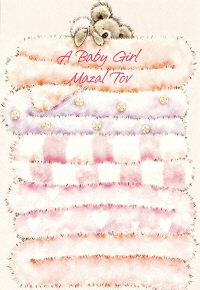
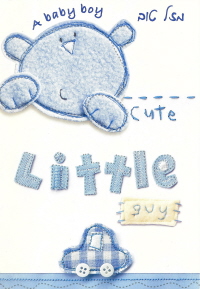
Compare the latest “Mazal Tov” cards for “A Baby Girl” and “A Baby Boy.”

The Girl card depicts a diaper-clad koala, sweetly asleep on a huge pile of fluffy pink-shaded blankets. The Boy card is a collage showing a wide-awake bear, a blue car, and the words “cute little guy.”

I accept that our society has different roles for boys and girls, and that training in those roles starts at birth. Of course cards acknowledging births are likely to reflect incipient gender training. But let’s unpack the symbolism a little bit. This, after all, is the USCJ thinking it is just speaking to the waiter – just sending us some nice greetings cards. Let’s see what it’s saying.

The little boy is wide awake – he’s engaging with you, the viewer, with his world, He already has a personality – “cute little guy” – and his “Mazal tov” is in Hebrew. And we’re associating him with a car – an expensive machine, and one which imparts freedom and independence like no other. This boy has the will, the tools, and our societal permission to do as he likes. This boy is going places.

The little girl, on the other hand, is completely passive. Not only is she asleep, she doesn’t even have control of her bowels. Her diaper-clad behind is certainly cute, but does it need to be stuck so pertly in the air? We don’t see the little boy’s behind. Princess-and-the-Pea-style, the baby girl is so delicate that she needs a huge pile of blankets – fluffy, domestic, nurturing – to sleep upon. Indeed, the blankets dominate the page – the little girl is more or less incidental.

Now, at this point you’re at liberty to say “Good grief, Soferet, aren’t you over-reacting a bit?” After all, it’s only some greetings cards. It’s only speaking to the waiter.

The problem is that the active, important little boy with his car and the passive, insignificant little girl and her heap of blankets grow up to be adults. And the USCJ nominally accords equality to men and women.

But now look at the bar and bat mitzvah cards, celebrating the child’s entry into the adult Jewish community.
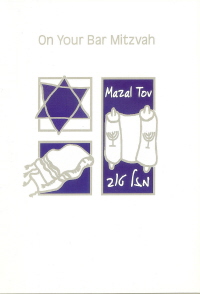
The bar mitzvah card, for the young man, is heavy with Jewish motifs. A Star of David, the public symbol of Jewish identity. A tallit, the ritual garb of the synagogue, its knotted strings symbolising the commandments. And a sefer Torah, the holiest object in Judaism, representing Judaism past, present, and future, God’s connection with the Jewish people.

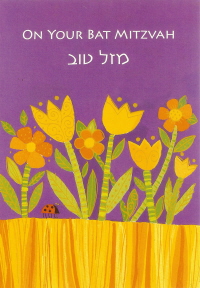
And the young woman? What does her bat mitzvah card show? Is it a similar collection of symbols, redolent of entry into the world of grown-up Judaism? Does it depict Torah, mitzvot, Jewish identity, participation in the community as an adult?

Does it heck. “Screw you, waiter,” says the USCJ, reminding us that whatever other good qualities they may have, we should have some serious reservations about sustaining a relationship with them.

That other flagship Conservative Jewish institution, the Jewish Theological Seminary, is perfectly happy to proclaim its commitment to traditional women’s roles – in that particular case, promoting an event where the women’s role was sexual object intended to titillate (reference, if you will, that diaper-clad behind we mentioned earlier) – so it shouldn’t surprise us that the USCJ represents an adult woman’s Judaism thus.

Yes.

Pretty flowers and a ladybug. That’s your Judaism, ladies. Hope you enjoy it.


yom hazikaron

I wrote this bit today. Very appropriate. I don’t plan it this way, you know.

When you go to war against your enemies and see horses and chariots and an army greater than yours, do not be afraid of them, because the LORD your God, who brought you up out of Egypt, will be with you. When you are about to go into battle, the priest shall come forward and address the army. He shall say: “Hear, O Israel, today you are going into battle against your enemies. Do not be fainthearted or afraid; do not be terrified or give way to panic before them. For the LORD your God is the one who goes with you to fight for you against your enemies to give you victory.”