A couple of days ago, I said this episode would deal with considered selection of wires and strings – that is to say, how we assess what parts of our halakhic lives are (or should be) immovable, and which parts are more easily adjusted. But then I thought about some stuff, and actually I want to come at that idea via another route.
Mishnah, Rosh haShana, 4:4
Context: the Temple staff have been counting the days and watching the moon, and they know Rosh haShana is due. But they can’t actually get on with the official business of Rosh haShana until they’ve taken official testimony that the new moon has appeared. So they observe Yom Tov just-in-case, and when witnesses turn up, they can make it official. Okay? Onward.
| Originally, they used to accept testimony about the new moon all day | בראשונה, היו מקבלין עדות החודש כל היום |
| One time, the witnesses took their time about turning up, and the Priestly Song was messed up [the witnesses arrived too late in the day for them to make it Rosh haShana]. | פעם אחת נשתהו העדים מלבוא, ונתקלקלו הלויים בשיר |
| So they made an enactment: they would only accept testimony about the new month until mincha-time [roughly mid-afternoon]. | התקינו שלא יהו מקבלין עדות החודש, אלא עד המנחה |
| And if witnesses came at or after mincha-time, [that was too bad;] they kept that day as holy [see above; they had kept the day as holy just in case, but it turned out to be not-needed], and the next day was also holy [i.e. the official Rosh haShana, from which they would start to count the calendar and so on]. | ואם באו עדים מן המנחה ולמעלן, נוהגים אותו היום קדש ולמחר קדש |
| After the Temple was destroyed | משחרב בית המקדש |
| Rabban Yohanan ben Zakkai made an enactment: they would accept testimony about the new moon all day. | התקין רבן יוחנן בן זכאי, שיהו מקבלין עדות החודש כל היום |
I like these Temple examples, by the way, because the taking-away of the Temple was rather like removing a pin from a string-diagram – sudden, and relatively clean-cut.
So, how can we represent this mishnah within the metaphor we’ve been developing? And is that useful?
 Originally, they used to accept testimony about the new moon all day which triggered the Priestly Song, which is sort of the trigger for its being properly Rosh haShana.
 One time, the witnesses took their time about turning up, and the Priestly Song was messed up and that messed up the accounting of the days – they didn’t know if it was Rosh haShana or not, so they didn’t know which sacrifices to do, and everything went Horribly Wrong.
 they would only accept testimony about the new month until mincha-time, and if witnesses came at or after mincha-time, they kept that day as holy, and the next day was also holy. Something like this diagram.
 And if you look at it from a bit of a distance, it’s basically the same as it was before, see? But it’s been adjusted to protect Rosh haShana, in that now there will always be time to do the Priestly Song.
 This is kind of a big deal, since it affects what day Rosh haShana is. The SAME DATA now gives a DIFFERENT RESULT. But we decide to accept a bit of variation in the possibility of when exactly Rosh haShana officially is, so as to ensure that the Priestly Song never gets messed up.
 And indeed the rabbis found this kind of disturbing. Once the Priestly Song was no longer a consideration, because there was no Temple Service, rabbinic Judaism found other ways of expressing “Today is officially Rosh haShana” – and a safeguard for the Priestly Song was no longer needed.
 So they accepted testimony all day again: After the Temple was destroyed, Rabban Yohanan ben Zakkai made an enactment: they would accept testimony about the new moon all day.
(Pin graphic from Just Mousing Around.)
So is this a useful way of looking at the mishnah? Yes, in a limited fashion. I don’t want us to fall into the trap of trying to map out the huge enormous complicated string diagram that would be the entirety of halakha, with its variations for different points in history. I don’t think that would be useful (or feasible). I also don’t think one should generally try to conceive of mishnayot in such terms; this exercise is intended only as a way to see how mishnayot such as the one above fit into the metaphor we’ve been developing, not as a general method of Mishnah-learning.
The useful thing I think we get here is seeing how our texts treat some things as hugely important – not messing up the Priestly Song on Rosh haShana – and other things as less important – being precise about which day exactly the new moon actually was – and how that affects the relationships between other data points in the halakhic universe. Some pins-and-strings we are okay moving; some pins-and-strings we are not okay moving, and the question of which is dependent on the broader circumstances.
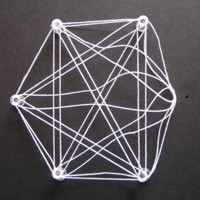 In other words, what happens if we remove the Temple from the world? To what extent can we – should we – still behave as though there is a Temple? Rabbi Yohanan is apparently saying the Temple’s effects – in this respect, at any rate – are permanent; Resh Lakish is saying that we can’t go around behaving as though the Temple is still there when it isn’t.
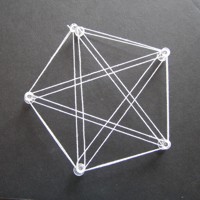
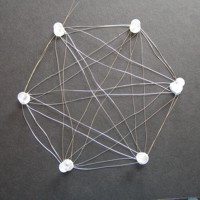 Rabbi Yohanan and Rabbi Yehoshua both seem to be saying, in a sense, that the halakhic system is made not of string, but of wire. (Excuse the wobbliness of the wires in this picture. Wire’s harder to work with than string, and I didn’t take the time to fetch out hammer and pliers. Imagine them beautifully non-wobbly, if you would.)
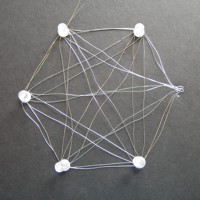 With wire, when you remove a pin, everything stays in the same place. You can continue with everything pretty much as it was before, and indeed you should. You should offer sacrifices even when there is no Temple. The rules about offering sacrifices outside the sacrifice-zone should apply even when those zones don’t really exist any more.
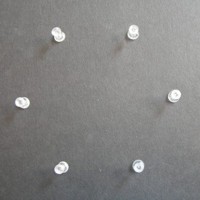 Halakhic data points. They might be any of a number of things – biblical verses, perhaps; facts of life (“men cannot give birth”); real objects (“this woman”); theoretical constructs (“love,” “justice”); combinations thereof (“my husband;” “the Temple”). They seem to be pretty independent of one another.
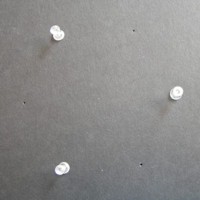 Indeed, you might think you can remove a data point here and there (“this woman,” say, or “the Temple”) and the others will be pretty unaffected, although of course you’ll still be able to see the holes where they were.
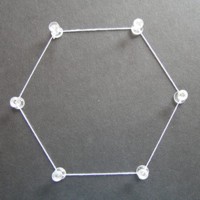 This is where we start to get a little abstract. I am winding string around the pins to create string-patterns, to represent the connections that exist between halakhic data points. The connections could be exegetical, or theoretical, or they could just be other halakhic data points. Together, the strings and the pins represent the mass of laws and ideas and facts that together make up the halakhic system, and I am asking you to consider the mashal, the parable, on its own terms, without trying overly hard to work out exactly what represents what. The halakhic data points are all connected, is what we are saying here.
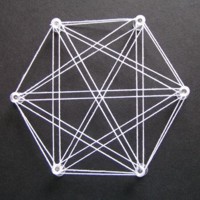 Indeed, they are all interconnected, each one to every other. This is a lesson of yesterday’s Tanhuma. (Now do you get why I titled these posts “halakhic string theory”?)
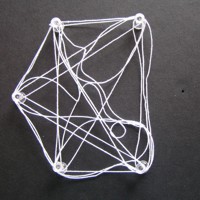 …but so do other things that weren’t apparently connected at all. You wouldn’t have thought adultery would be connected to violating Shabbat, but we make the effort to show that it is, and that’s because we don’t want to forget about all the knock-on effects.
 With a bit of tweaking, you can create something that works pretty well, even minus the missing data points. We do this all the time when people die. “It’s not proper Judaism without my parents,” you might say. “Life isn’t the same any more.” And you go through mourning, and you rearrange the remaining datapoints in your halakhic world, and you come up with something workable, and life goes on.
 In the meantime, check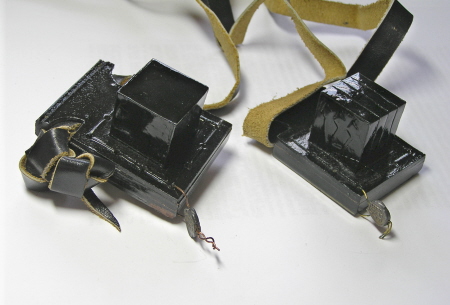
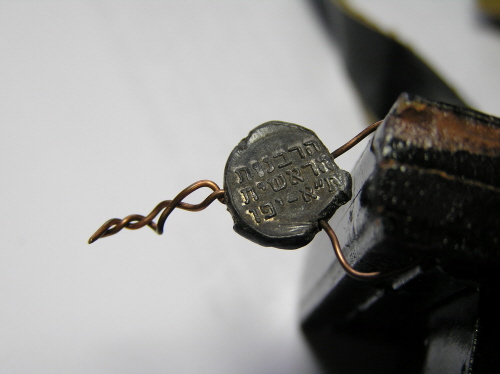
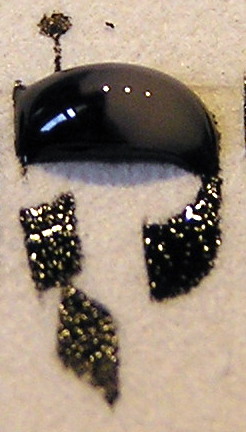
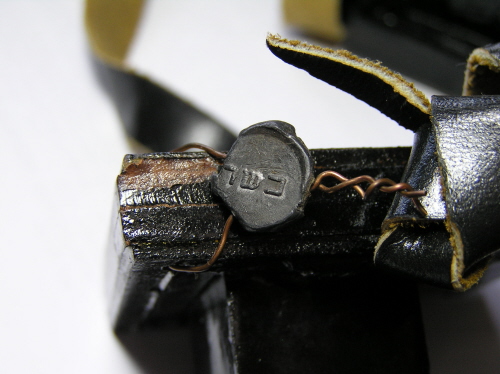 Here are close-ups. They’re little seals, stamped into blobs of lead. One side reads “כשר” and the other side reads “הרבנות הראשית ת”א-יפו” – kosher: chief rabbinate of Tel-Aviv-Yaffo.