Eicha reading in Washington Heights

I’m having a home reading of Eicha – from a klaf – *because* of reading from a klaf, yay – in Washington Heights, on leyl 9 Av, 9pm.

If a minyan of people are interested, there could also be maariv, kinot, etc.

Normally I would append “and watermelon, cookies and so forth” to such sentiments, but not for leyl 9 Av :-/

Email me if interested so’s a) I can give you the address b) I know how much floor space to clear.


הגויה של תשעה באב

MarGavriel points us to a little Agnon story. A story appropriate for the season:

סיפר לי ר’ אהרן פריימן ז”ל משמו של ר’ אליהו פלנסר ז”ל. ר’ איציק אייכל וחבריו מצאו להם נכרית אחת שבישלה להם לתשעה באב. שבאותו הדור קשה היה ליהודי בברלין למצוא תבשיל בתשעה באב. היו קוראים לאותה נוכרית הגויה של תשעה באב. Aaron Freiman, of blessed memory, told me the following in the name of Elijah Palnser, of blessed memory. Itzik Eichel and his friends found themselves a certain gentile woman who would cook for them on the Ninth of Av. For in those days, it was difficult for a Jew in Berlin to find food on the Ninth of Av. They used to call that gentile woman “di tishebov goyte”.
ערב תשעה באב באו והודיעו לר’ איציק אייכל שהגויה של תשעה באב מתה. אמר להם לחבריו, חברי בואו ואומר לכם, אי אפשר שבין היום למחר נמצא ערלית אחרת שתבשל לנו לתשעה באב, אם כן מאחר שמתה הגויה של תשעה באב נתענה בתשעה באב זה עם כל ישראל על חורבן ירושלים. One year, on the eve of the Ninth of Av, Itzik Eichel was informed that the Tishebov Goyte had died. He said to his friends: “My friends, come and let me tell you something. Between today and tomorrow, it is not going to be possible for us to find another gentile woman who will cook for us on the Ninth of Av. Since this is so, for the Tishebov Goyte has died, let us fast on the Ninth of Av this year, and mourn, together with all Israel, over the destruction of Jerusalem.”

תכריך של סיפורים, ע’ 159
trans. MarGavriel

It seems to me interesting that the non-Jewish woman is in the role of Jerusalem.

I wonder – what do you make of this? Especially those of you who have studied Agnon in college and so forth. It is so short that it cannot be so simple, it seems to me, but I do not have literary-analysis tools to explore it.


Hachnasat sefer Torah

I finished writing the sefer Torah for Dorshei Emet. You might have worked this out, from the lack of Torah-writing posts of late, but I didn’t actually get round to making a post about it yet.

I tweeted the final stages of putting the sefer together on May 11 and 12, and it was delivered to its new community on May 16.

You may remember that I spent a couple of days a week writing at Yeshivat Hadar, being the unofficial soferet-in-residence. Being in a friendly, welcoming, Torah-filled environment was a tremendous boost.

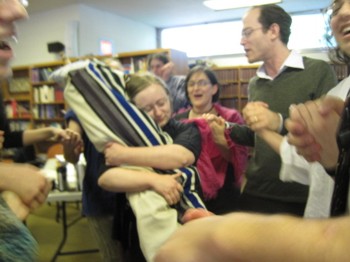
So, when I’d finished writing, we celebrated together, and there was cake for breakfast.

Then the sefer Torah got collected by someone driving from New York to Montreal, and driven to Montreal. This is safer than trying to come through Montreal aiport customs early on Sunday morning with a sefer Torah, a process liable to take an indefinite amount of time.

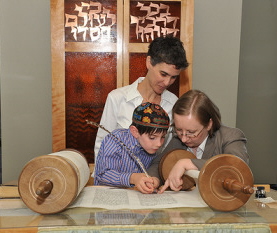
Because I had what to be doing on Sunday morning, namely, writing letters with congregation members:

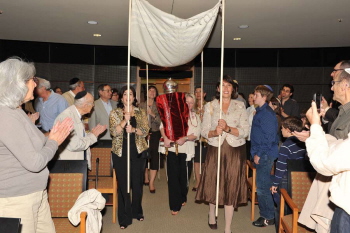
In the afternoon, the sefer Torah was brought in under a chuppah with much rejoicing:

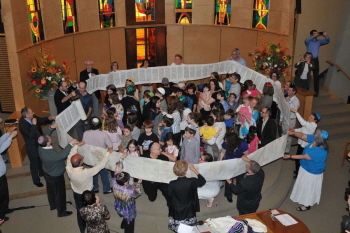
Then there were miscellaneous speeches, the filling in of the very last word, dancing and so on, and the sefer got its new clothes, and it was unrolled around the children of the congregation. Who were possibly slightly bemused, but it was all terribly symbolic and meaningful and so on.

I heard from a Torah reader a few weeks later. Apparently they had had a nice time reading from it. Good to hear.

This was my third sefer Torah.


17 Tammuz – a snippet of liturgy

(Joint post from me and MarGavriel)

I don’t know about you, but when someone says “Selihot,” my heart sinks, because in my experience, selihot are Hebrew Text Walls of Doom, muttered incomprehensibly and far too fast, punctuated by wails of Divine Attributes which are the only bits I actually recognise. Sound familiar?

Apparently (who knew?) when done properly, they’re actually poems with actual meaning. Not just text walls of doom. More on one verse of one of them in just a moment, but first – liturgically, what exactly are selihot?

Selihot are poems originally recited by the cantor, in his repetition of the Amidah. On weekday fasts, they form part of the berakha סלח לנו, and on Yom Kippur, part of the middle berakha, the Yom Kippur one. Before, after, and between the poems, the 13 Attributes of Divine Mercy (ה’ ה’ אל רחום וחנון) are recited, prefaced by eitherאל ארך אפים or אל מלך יושב.

In recent centuries, almost all our communities have removed the Selihot liturgy from its original context, and placed it after the whole Hazzan’s Repetition, presumably because of concerns of hefsek [thought-train derailment]. Some few communities resist the urge to destroy, and retain the original structure; if yours does, feel free to leave a note in the comments for the edification of others.

In recent years, communities have also removed the Selihot liturgy from the prayerbook and placed it instead on grubby photocopied handouts, but you can find this one (by Solomon ibn Gabirol) in Artscroll, on page 868. Here’s a sound file of the stanza.

גְּדוֹר פִּרְצִי בְּבֶן פַּרְצִי / וּמֵחֶדֶק לְקוֹט שׁוֹשָׁן Repair my breach with the descendant of Peretz [i.e., the Messiah], / and collect the lilies [Israel] from amidst the brambles.
בְּנֵה בֵּית זְבוּל וְהָשֵׁב גְּבוּל / הַכַּרְמֶל וְהַבָּשָׁן Build the Temple Dwelling, and restore the borders / of Carmel and Bashan.
וְעַיִן פְּקַח וְנָקָם קַח / מֵאֵצֶר וּמִדִּישָׁן Keep thine eye alert, and take vengeance / from Etzer and Dishan [Biblical Edomite groups, i.e. Roman-Christians].
שְׁפוֹט אִלֵּם וְאָז יְשַׁלֵּם / הַמַּבְעֶה וְהַמַּבְעִיר Bring justice to the mute one [the Jewish people], and then / may the destroyer and burner pay back —
יוֹם גָּבַר הָאוֹיֵב וַתִּבָּקַע הָעִיר The day when the enemy overpowered [us], and the City went under siege.

17 Tammuz, by the way, is the only Minor Fast to be mentioned in the Mishna (m. Taanit 4:6), where it is juxtaposed to 9 Av:

חמישה דברים אירעו את אבותינו בשבעה עשר בתמוז, וחמישה בתשעה באב. בשבעה עשר בתמוז נשתברו הלוחות, ובטל התמיד, והובקעה העיר, ושרף אפסטמוס את התורה, והעמיד צלם בהיכל… Five things befell our ancestors on 17 Tammuz, and five on 9 Av. On 17 Tammuz, (a) the Tablets were smashed, (b) the Tamid-offering ceased, (c) the City was besieged, (d) Apostomos burned the Torah-scroll, and (e) an idol was set up in the Temple…

This kind of text isn’t unknown in the Mishnah, but it’s perhaps a trifle unexpected. The Mishnah is the realm of legalese, of rulings, of law. Why here does it speak of history, of identity, of nonlegal matters?

The poem’s line שְׁפוֹט אִלֵּם וְאָז יְשַׁלֵּם / הַמַּבְעֶה וְהַמַּבְעִיר (bring justice to the mute one, and then / may the destroyer and burner pay back) is very clever language, when you look at it. In just a few words, the poet invokes huge swathes of Talmudic discourse, all developing very central Jewish ideas of justice and obligation – where people play fair, and bring disputes to the court, and things are settled properly.

But that’s just the problem. Our enemies, whether Titus or anyone else, don’t play fair. And they get away with it. And we can’t judge them in human courts. And it’s beastly unfair.

So we pray to God: שפוט אלם – “give fair judgment to the mute [‘Am Yisra’el], and only then will the מבעה ומבעיר pay up”. Bring the judgements the court would render, if we could only get these people into court.

…בתשעה באב נגזר על אבותינו שלא ייכנסו לארץ, וחרב הבית בראשונה, ובשנייה, ונלכדה ביתר, ונחרשה העיר. משנכנס אב, ממעטין בשמחה. …On 9 Av, (a) it was decreed that our ancestors would not enter the Land [at the time of the Spies], and the Temple was destroyed (b) the first time, and (c) the second time, and Bethar was captured [by the Romans, from Bar Kosiva’s insurgents, in the year 135], and (e) the City was plowed [to utter destruction]. Once the month of Av enters, we decrease our joy.

So these are the Three Weeks of Doom, starting now and culminating on 9 Av, in the destructions of Jewish direction, spirituality, hope, pride, identity. This is the time of year when we remind ourselves what it is like to have nothing.

Nothing save what’s inside. The voice of the poet, calling from the brambles, praying for God to bring us justice. “God – we are Jews, and we try to play by the rules – the Torah’s שלם ישלם המבעיר את הבערה and Bava Kamma’s ארבעה אבות נזיקין: השור והבור והמבעה וההבער and that sense of fairness and justice is part of what makes us Jewish. Take that away, and we are disoriented unbearably. Restore that. Please.”


pretty

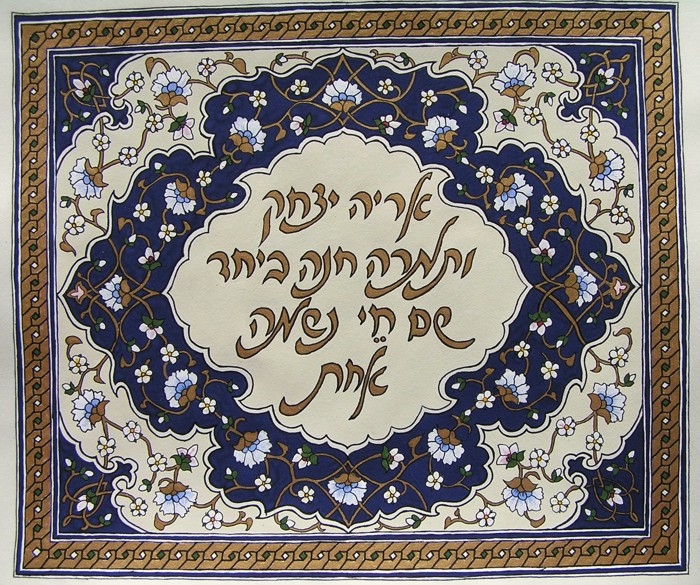
This is the piece of artwork I was working on the week before last, a little piece of illuminated poetry. I had the most glorious time with it; waking up in the morning and bouncing out of bed going “ooh!” with anticipation, working long, long days at it because it was so delicious I didn’t want to stop.

As you can see from the text, it was for the wedding of Aryeh Yitzhak and Tamara Hana – if you’re reading this, I hope your marriage will always be as filled with delighful anticipation and fulfilling potential as this artwork was.

Clicky image to see bigger

I love it. I love how the blue and cream balance each other; I love how the flowers dance through the bands of background colour. I love how the edges of the bands are so bubbly and graceful. I love the curves and curls of the foliage, and how it looks so colourful but yet so light and fresh. I love the little touches of greenery, and how those are echoed in the border. I love the border, how it’s so rich and regular but also so simple. I love how the symmetry plays against the dense knot of golden letters in the middle. I love how the letters flow and snuggle together and together stand forth in glory.

I’m especially happy with it because when I look at it I have the sense that my eye is being led into a state of pleasureable befuddlement, which I think is the point of this sort of artwork – it’s commonly used in Islamic contexts, where it induces the slightly meditative state of mind contingent on being sensually overloaded. I feel as though I’ve really achieved something artistically.

Indeed, I enjoyed it so much that I am going to make one for myself, just as soon as I choose a suitable text. And I am going to make a maximum of three more, for prices which are not inconsiderable, but also not insulting; email me for more info.


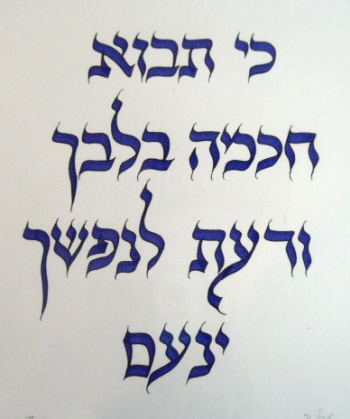
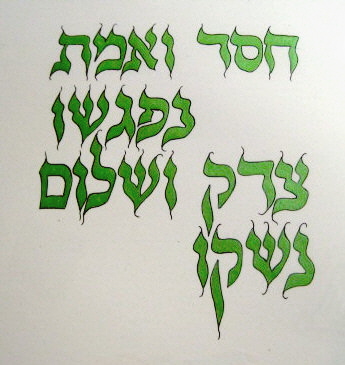
Fun with markers

Here’s a rudimentary calligraphy worksheet, which you can use with ordinary calligraphy markers.

To do things like this:

Clicky for more… Read More »

More from Gabriel

Another interesting titbit from Eisenberg, absolutely courtesy of Gabriel, because Jen is not in the habit of reading long Hebrew introductions to random books, and Gabriel is.

Remember that Eisenberg dissed Edomites, and said that they were sexually iniquitous. Well, there is an “Important Disclaimer” (מודעה רבה) in the front of the book:

To anyone who reads this book: Note that any time I mention the following words:
‫עכו”ם, גוי, ישמעאל, עמלק, אדום‬ [Akum/Star-Worshipper, Goy, Ishmaelite, Amalek, Edom], I am referring to the ancient peoples who lived at the time of the Targumim and the Mishna and the Talmud, who used to worship stars and constellations, and did not believe at all in the Creator and His providence, as Maimonides wrote in the Yad Ha-Hazaqa, הלכות עבודה זרה, and in the More Nevukhim, section 3, chapters 29-30. He calls them Sabaeans.

However, none of this has anything to do with the nations today, in whose midst we live. On the contrary, they recognize God, and the Sages commanded us to pray for the wellbeing of their state, and we still do so even today, each Sabbath. This is especially true about Russia. We can make an a fortiori argument from Egypt. For we lived in Egypt for only 210 years, and nevertheless the Torah commanded us “You must not abhor an Egyptian”, and Rashi comments: “At all – even though they threw your sons into the River. Why? Because they gave you hospitality when you were in need.”

And all the more so, yes, quite, all the more so about the hospitality which Russia has provided us For it has been expansive hospitality for the Jewish people, for almost 1,000 years. Therefore, we are obligated to pray for their welfare, and the welfare of their state.

Recall he said – …there is nothing which hurts one’s fellow more than telling him the truth. Therefore, the King of Edom became furious at Moses.

And compare today’s disclaimer, which may be summarised Any time I say rude things about non-Jewish rulers, any similarity to real-life characters is totally accidental.

And form your own conclusions about what’s going on there.


Parashat Hukkat

Joint post from Jen and Gabriel

Part 1 – Gabriel writes:

When Moses sends messengers to the King of Edom, requesting passage for the Israelites through his land, their message includes the following line:

נעברה נא בארצך, לא נעבר בשדה ובכרם ולא נשתה מי באר

May we please pass through thy land? we will not pass through fields or vineyards, and we will not drink water from the wells. (Numbers 20:17)

The Palestinian family of Targumim (“Targum Yerushalmi”), however, understands this figuratively:

נעיבר כען בארעך לא נינוס אניסן (נ”א אריסן) ולא נשרגנא בתולן ולא נבעי (נ”א נבעול) נשי גוברין:

May we please pass through thy land? we will not we will not bonk betrothed babes, nor will we violate virgins, nor will we make merry with married matrons.

And the paytan Yannai renders the verse thus, in his liturgy for the relevant Sabbath:

חָדוֹל נַחְדּוֹל מִשָּׂדֶה וְרָחוֹק נִרְחַק מִכֶּרֶם
מִלְּפַתּוֹת בְּתוּלוֹת וּמִלֶּאֱנוֹס אֲרוּסוֹת
טָעוֹם לֹא נִטְעַם מִמֵּימֵי הַבְּאֵר
הַבְּעוּלוֹת אֲשֶׁר מְשׁוּלוֹת בְּמֵי בְאֵר

We shall surely keep away from the field, and stay far from the vineyard,
Won’t seduce virgins, nor rape betrothed women;
We shall surely not taste from the waters of the well –
The married women, who are compared to the waters of a well.

Part 2 – Jen asks:How does that play out when Moses says in verse 19 “and if we drink from the wells, we’ll pay for it”? “We might accidentally have sex with your women, but if we do, we’ll totally pay you for them”?

Part 3 – Gabriel responds: I’ll have to find a less fragmentary version of a Palestinian Targum, and see how it translates verse 19.

Then Gabriel went to the library, and came back with the following:

All the Targumim seem to translate verse 19 literally.

So, why the first part, verse 17, nonliterally, and the second one, verse 19, literally?

We find an answer of sorts in the works of one Yochanan Eisenberg, in ינחנו לשלשה תרגומים (Warsaw, 1900). He, like us, wants to know – where on earth did that come from? He’s working with the Targum of Jonathan:

Why did Moses ask the same question twice? The general claim about verse 19 [see, e.g., Rashi] is that Moses’s offer to the king of Edom said that the Israelites would refrain from drinking from the Miraculous Well [which travelled the wilderness along with Israelites], and buy water from the Edomites, so as to give them business – but the King of Edom did not agree. If this interpretation is correct, then why did he ask a second time, saying “and if we drink your water, we will pay”? The Jonathan is responding to this question.

Moreover, it is problematic that the text uses different expressions in verses 17 and 19. The first time, it says “water of the well”, and the second time, it says “your water;” the first time, it says: “we will walk on the King’s Road”, and the second time, “we shall ascend on the highway.” Moreover, why does verse 17 say that “Moses” asked him, and verse 19 say “the Israelites” asked him? And why did they say, the second time, “I and my flock”? And the expression “I shall pass through with my feet” is odd. And the word “to him” in verse 18 is redundant. And why did the King of Edom say the first time “You may not pass through me”, and the second time just “You may not pass through”, without saying “through me”? Finally, it is odd that he says: “Lest I greet you with the sword” — why lest? after all, if they trespass his land without his permission, he is definitely going to greet them with the sword.

These, in case you’re not used to the style, are the sorts of questions a certain kind of commentator concerns himself with. There is a sort of theological principle that no words in the Torah are superfluous; therefore, variations such as those cited must have meaning.

Another sort of commentator will look at the text and say “Huh, that’s oddly repetitious. Must be two narratives being merged by the redactor.” This is an interesting, but much less fruitful, kind of approach. We are taking the fruitful approach here, trying to find some meaning in the variations within the text.

Back to Eisenberg. He’s finished outlining the difficulties he sees with the text, to which he thinks the Targum is responding, and now he’s going to explain how the Targum’s non-intuitive translation answers all those difficulties.

The Jonathan had a deep intent with all this. Namely,

Moses wanted to uproot from the heart of the King of Edom any concerns that Israel would perform the activity which he himself was accustomed to do, and which was an inheritance from his ancestor Esau: “He used to hunt men’s wives and sexually afflict them” (Bereshit Rabba 61) – and as R. Jochanan says in Bava Bathra 16: “[Esau] slept with a betrothed maiden.” Therefore, [Moses] sent a message to [the King of Edom] which could be interpreted on two levels.

Now, there is nothing which hurts one’s fellow more than telling him the truth. Therefore, the King of Edom became furious at Moses. This is why verse 18 says “the King of Edom said to him,” where the word “to him” seems redundant. What it means is that his wrath was directed specifically at Moses, who had made a clever double entendre at him; it was not befitting the honour of a king to hear such language. And then, the second time, he was forced to greet him with the sword, on account of this.

This is why he said לא תעבר, an expression meaning עֶבְרָה (wrath), [thus meaning “don’t be wrathy at me!”]. And it also explains why he said בי, specifically at me – for I am the king. As it says in Proverbs 20: “The fear of a king is as the roaring of a lion: whoso provoketh him to anger sinneth against his own soul.” And because he had raged at Moses, the Israelites [and not Moses] needed to speak to him the second time. They needed to use language which was unambiguous, and eliminate any reference to the double entendre. This is why the language is different in verse 19. And the king’s response to that was simply לא תעבר, “you may not pass through”, without the word בי.

Gabriel finds this frightfully clever, but utterly unconvincing as an explanation of the targum, saying “Eisenberg is making his own ‘medrash,’ as it were.” (This, by the way, is what I mean by “fruitful.”)

On reflection, I’m inclined to take a lesson from an exchange I heard in the Hadar kitchen between an Israeli and an American. They were arguing over the proportions of water and soap to use when doing dishes. The American, used to thinking of water as an unlimited resource, used little soap and much water. The Israeli, used to thinking of water as a valuable and expensive resource, used little water and comparatively much soap.

How’s that work? Well, if you’re used to thinking of water as plentiful, you are inclined to look at the exchange between Moses and the King of Edom and think “What’s all the fuss? It’s only water. They’re even going to pay for it.” But what is as ubiquitous as, yet more valued than, water? Women. This Targum Yerushalmi suggests to me, at any rate, that for the King of Edom, water is as guarded a commodity as women. Perhaps he is reluctant to let a horde of Israelites drink up his limited water supplies. Just as you can’t offer to pay him for his women, so too you can’t offer to pay him for his water.

Not as elegant a solution, perhaps.


A Lady’s Guide to Headcoverings

Very egalitarian, my synagogue. Ladies can do practically anything on the bima. Anything that gentlemen can do. And since we’re so very egalitarian, our dress rules are egalitarian too. Gentlemen on the bima must sport headcoverings and therefore so too must ladies.

The headcovering of choice for your standard American Jewish gentleman is a kippah. Like a suit and tie, a kippah sends Messages to those who observe it. “I am a Respectable Gentleman,” it says. “I comply with a certain set of social mores. Please interact with me accordingly.”

And like a suit and tie, transporting that mode of dress wholesale across gender boundaries results in awkwardness. A suit and tie are all very well if you’re an air hostess or a waitress at a five-star establishment, maybe even if you’re in Big Business if you have a special ladyfied suit and tie, but I personally would feel like a bit of a pillock wearing them in the street. They’re just not clothes I wear.

Likewise kippot. Some ladies wear kippot and it seems to suit them just fine. I’ve got no quarrel with them. I just personally feel that in my circles, a kippah says “I am a Respectable Gentleman,” and I have no particular desire to go around saying “I am a Respectable Gentleman.”
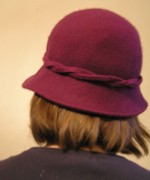
But I am on the right-wing side of my synagogue, for better or worse. Kippot in my synagogue sometimes mean “I am a Respectable Jewish Gentleman” – that’s men who wear kippot all the time – and sometimes they mean “I am in Shul, and Respectable Men Cover Their Heads In Shul.”

That is to say, “covering our heads is how we show that now we are Doing Religion.” And since egalitarianism means “now the ladies may and must do everything the gentlemen do,” we have definitively proved that Respectable Jews Cover Their Heads In Shul. Serious God Business Needs Hats, as we say. And accordingly, if the ladies are to be permitted to join in with the Serious God Business, they must cover their heads, because we know that it is not proper religion unless you have your head covered.

Happily, I am not the only lady who dislikes wearing kippot. Yes! There are other head-covering options open to a lady in the synagogue.

These fall into three categories.

1. The Respectable Lady’s Shul-Going Hat.
You know. If you don’t own one, your mother does, and she wears it to weddings.

Respectable Lady Hats are no fun when it is ninety degrees out.

Orthodox Married Lady hats also fall into this category – the berets, diamente-adorned baseball caps, and headscarves beloved of the Modern Orthodox. These aren’t exactly Respectable Lady Hats, but the logic goes like this: the Orthodox wear these things all the time, and everyone knows the Orthodox are terribly authentic and do religion constantly, so these are obviously acceptable religion-indicating hats.

A sub-category here is the “Oh, hey, look, my head is covered!” Stealth Headcovering, when the hair is tied back with a wide bandana, such that a kippah-sized area of the head is covered.

2. The Feminised Kippah.

On the model of the little-round-Jewhat, but manufactured of beads, or pink material, or otherwise embellished such that no man could respectably wear it. The problem is, of course, that unless your feminised kippah has been your religion-inducing hat of choice for two decades (such things are exempt under the heading Hallowed Traditions), it is an inherently doomed exercise. After all, the point of Ladies’ Headcoverings is to replicate the kippah’s function across the gender boundary. The Feminised Kippah merely produces a kippah which no man would ever wear, thus (arguably) defeating the object entirely. Or (perhaps) accomplishing it perfectly.

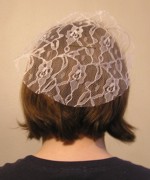
3. The Doily.

Cousin to the kippah, someone at some point had the bright idea of replacing the knitted circle with a lace circle, thus accomplishing “Little Round Jew Hat For Wearing Whilst Doing Religion” and “Totes Feminine, It’s Made Of Lace” simultaneously. Brilliant.
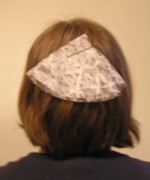
There are two ways of wearing the doily.

a). Flat, otherwise known as the “Where are the petits fours?” mode of wear. (Incidentally, I once saw a lady visiting a shul which did not supply doilies. But she obviously very much felt that it is not religion unless you are covering your head, so she improvised a doily substitute from a paper towel from the bathroom. This was not so much “Where are the petits fours?” as “Now Wash Your Hands.”)

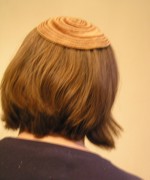
b). Folded, otherwise known as the “Damned if I want to look like a tea-table” mode. At Events, folded doilies are frequently hot-glued onto combs. The model displayed here is the kind provided gratis by the shul and held to the head with a bobby pin.
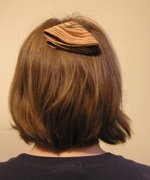
Folding renders the doily approximately the same size as a kippah, which gives it the advantage of increased authenticity. So we see that a folded doily is a) authentic religion-inducing headgear and b) feminine.

But it is still undeniably a doily. Now, maybe I feel like a pillock wearing a kippah, as it’s assuming a mode of dress more generally associated with gentlemen. But a doily is a mode of dress generally associated with a) ladies from 1950s North America b) aspidistras. You see the difficulty.

So this is my latest Absolutely Brilliant Solution To All Problems Caused By Misapplied Gender Binaries In Jewish North America. Wear a kippah, because we are not a grandmother. But fold it into quarters, because wearing a round headcovering folded into quarters is obviously a distinctively feminine act.
Honestly, sometimes I amaze myself. Not only does this accomplish head-covering according to the rules of my shul, but it is obviously a profound statement about American Jewish egalitarianism. “Aha,” people will say. “Here is someone who obviously wants to challenge gender roles in dress as defined by her synagogue, but in quintessentially-feminine passive-aggressive fashion, as expressed by this highly-original act of sardonic sartorial subversion. Marvellous. By such brave acts as these the patriarchy will crumble.”

It’d be simpler to wear a suit and tie really. Or an aspidistra. If anyone wants me, I’ll be at the florist’s.

Further reading on kippot.


Ketubah drafting part 4 – fitting to shapes

Fitting text into shapes, the bane of ketubah artists everywhere.

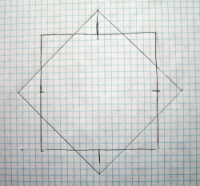
First thing with funny shapes is to check them out with the officiant. Some officiants are DEAD AGAINST funny shapes – anything that doesn’t have four sides and right-angled corners. Others are okay with it so long as the lines are horizontal and any added words would look obviously wrong.

Today we’re fitting text into an eight-pointed star, and the question I most need to answer is “What size nib? what line height?” (This is one question, today.)
Playing around with my word processor (re-read Part 3 if you’ve forgotten), I can see that if I was using my beloved B nib, with its 9mm lines, this text would occupy 30 lines of 18cm each (for pity’s sake don’t forget the lines for the witnesses, and it’s a good idea to add a line or so’s worth of space just for security). That’s 486cm2.

Now I want to work out the area my funny-shaped text actually needs to occupy. If all mathematical formulae fail, you can do it out on squared paper and count the squares, just like we did for GCSE. Make sure you don’t screw up the units. You do remember your high school maths, don’t you?

I like using metric because I hate working in idiotic fractions of inches. Eight-pointed star based on a 4.5-inch square…translate into metric, figure the area… I can’t use the bottom point of the star, because the witnesses have to fit in at the bottom one underneath the other…looks like my area here is 154cm2.

Find the length scaling factor. GCSE maths again – when areas are scaled a:A, lengths are scaled √a:√A. My areas are scaled 154:486. 154/486=0.3168, so I can also say my areas are scaled 0.3168:1. So my lengths are scaled √0.3168:√1, that is 0.56:1.

So, to get the line height – if I was using my B nib, I would be using a 9mm line height. The length scaling factor is 0.56, and 0.56*9mm = 5mm, near as dammit. So I need to be using a 5mm line height, and a nib to match.

In my case, that means a quill something less than a millimetre wide, and in your case, well, you’ll figure out what you need to be doing.

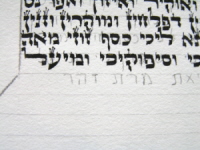
I lightly write each line in pencil first, so as to get an idea of how to space the words on the line. Not all the lines, just each line as I get to it, until the last five or ten lines – then I pencil in the whole lot, to make sure that they’ll fit nicely. Sometimes doing this on tracing paper is better, so that you don’t do too much pencil-erasing on the Actual Ketubah. Depends how forgiving your surface is.
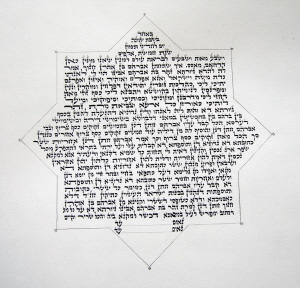
Erase the messy pencil lines, draw in a bit of a border, et voilà. Perfect.

So there you go. Now you know how to fit a ketubah text into any shape you like. Enjoy. Send me pictures.