Little Letters in Eicha, part 1

I’ve not posted much on the Big and Little Letters in Torah, have I? And now I’m posting on the Little Letters in Eicha – well, I’m between Torahs at the moment, and indulging in a spate of megillot, Eicha amongst them, which has something to do with it.

1:12
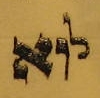
Little Lamed in Eicha
(Sofer Boyfriend wrote this one.)
לוא אליכם כל עברי דרך הביטו וראו אם יש מכאוב כמכאבי אשר עולל לי אשר הוגה יקוק ביום חרון אפו Is it nothing to you, all ye that pass by? behold, and see if there be any sorrow like unto my sorrow, which is done unto me, wherewith the LORD hath afflicted me in the day of his fierce anger.

There’s a whole tradition of interpreting the Big and Small letters. A few of them are in the Gemara, where the context is Explaining Something Everyone Knows more than Telling You How To Do This New Thing; the rest of them have been around for something like a thousand years but mostly we didn’t write down explanations, so they’ve suffered the usual fates of verbal explanations — ambition, distraction, uglification and derision — as you might imagine.

Anyway. Sometimes a Little Letter is interpreted as suggesting a particular Littleness. You may be familar with one from Torah, explained thus: “The conceits of the Cabalistic writers are most curious; for instance, they suppose that Abraham wept but little for Sarah, because a remarkably small letter — “Caph” — is used in the Hebrew word which describes Abraham’s tears, thus evincing that his grief was also small.” (That’s a footnote in a book from 1862 about anagrams; don’t take it too strongly to heart. I just liked the style.)

What would be the Littleness here? I’m going to quote from a book by one Tzvi Ron, ספר קטן וגדול, Gush Etzion, 2006, translated by G. Wasserman:

R. Shelomo Alqabes explains that the allusion is to the smallness of the Jews’ prayer to be spared from punishment: “Their prayer was not offered בעין טובה [generously], for there is no goodness for the wicked.” In Sefer Elyashiv, it explains the smallness as being the smallness of learning a lesson, for the gentile nations did not learn a lesson from seeing that God had punished the Jewish people for their sins.

Tzvi Ron also says “According to Midrash R. ‘Aqiva, it is a hint to words which begin with lamed, for the Jewish people had once been לראש, and now were לזנב.”

You might reasonably point out that lots of words begin with lamed and this concept cannot be uniformly applied, yes. So you might reasonably conclude either that there’s more to it than that but we’ve lost the tradition, or that you should go read the Midrash R. ‘Aqiva and see if it addresses that point.

What I want to take away from this particular point is the idea that a Little Letter is not just a mouseover interpretation, it’s a sort of ambiguation — like a Wikipedia disambiguation, but the other way over — the suggestion that there are vague links here to other instances of that letter. This point to be developed in part 2, coming soon.


Eicha pictures

Tisha b’Av seems a long time ago, now that Yom Kippur is on us, but I am finally posting those pictures of Megillat Eicha I promised you all those weeks ago.

First – Eicha scroll, bodaciously swathed in black.

Eicha scroll

Next – reading from the scroll, mostly backlit by candlelight. The candles were very atmospheric, but very HOT.

Eicha scroll

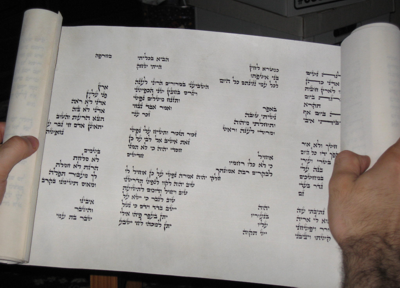
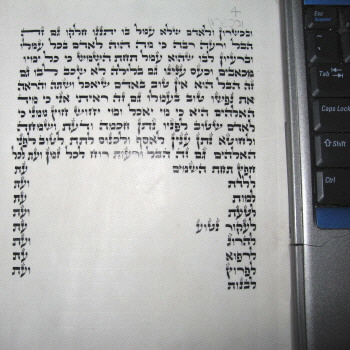
Now, a picture with the light on, so that you can see the most interesting part of the layout – the third chapter. In this tikkun, the verses are arranged in a sort of descending staircase form, which I find rather powerful. We have psalms which start “Shir haMaalot” – “A Song of Ascent” – associated (so tour guides always tell you) with the ascents of the Temple steps. This is the scroll of the destruction, and here the stairs go down.

Eicha scroll

Craft project – candle jars

Yahrzeit candleIt’s the time of year again when we use a LOT of yahrzeit candles. What to do with the pots afterwards?

This is a post about how to jazz up yahrzeit candle jars using glass paints, wrapping paper, and ingenuity.

Save up your yahrzeit candles. After yom tov, boil a kettle of water, and pour the boiling water into the pots. This makes the wax melt and float to the top; as the water cools, the wax will harden, and you can take it all out in a nice neat lump instead of scrubbing at it for hours or getting wax caked under your fingernails.

Then wash the pots inside and out with soapy water just like for dishes. Nice clean surfaces are better for working on.

Yahrzeit candle jars reusedWrapping paper jars are the easiest ever. You take out those scraps of wrapping paper that you saved because they were too pretty to throw away, you cut a strip the width of the jar, and you glue it on.

If you’re feeling extra fancy, you can glue on a strip of contrasting paper by way of trim, or some lace, or some such.

When the glue is dry, varnish the paper with a couple coats of acrylic varnish. This makes all the difference. Makes it even shinier and happier, and stops it getting scuffy.

Yahrzeit candle jars reusedGlass-painting pots are scrumptious too.

For glass painting, you need a tube of fake lead for glass-painting, and some colours (unless you’re inspired to use drippy designs, then you don’t need the fake lead). You’re going to have a lot of yahrzeit jars if you have one for each day of yom tov, so it’s fun either to use a variety of colours in the same design, or a variety of designs in the same colour. Makes them look like a set.

What design? Basically anything you can draw with a Sharpie and colour in, a total beginner can do on glass. Flowers, stripes, dots, bubbly letters, stars…

You might choose to sketch your design first on paper. Then put the paper inside the glass and trace over it with the fake lead. Helps keep things straight in your mind.

Following the instructions on the tube, now you let it dry. This is why it’s cool to do a lot of jars all at once; the first ones dry while you’re doing the others.

When the lead is dry, you get out the paints and colour in the design. This makes a mess, so use lots of newspaper, and use Q-tips instead of paintbrushes, because this stuff ruins paintbrushes. The paint has a tendency to run, so lie your first glass on its side and paint the side thus rendered horizontal; then go on to the others, then give the first glass a quarter-turn and paint the next side.

After you’re done, follow the instructions on the paint pot – you generally bake them in the oven for a period of time, which hardens the paint and renders the jars washable. The wrapping-paper ones you can’t really wash out, but glass-painted ones you can, so you can use them for flowers or salad dressing or kiddush or — novelty — candles! or whatever.

My new idea this year is using wire and lumps of glass like Rav Elie’s kiddush glasses, all coils and squiggles of wire, and pretty chunks of coloured glass, all glued on – mmm!


tea-break

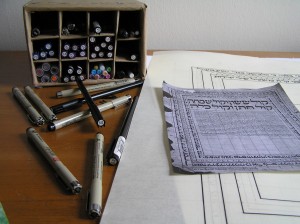
Soferet desktopWhile I’m waiting for the kettle to boil, a quick post about how much I love pens.

Really. When the Soferet is miserable or grouchy, a trip to the art store is almost always a good plan. Pens are little tubes of potential, and they don’t cost much, so they’re good happy-making things.

Then you keep them in your pen-holder, and then when you want to create something, you’ve just — whee! — got all the pens you need, right there on hand. It’s very happy.

That’s my pen-holder there. Old shoebox, brown paper, and tape, and it holds a marvellous litter of pens for art projects.

I’m working on a rather exciting ketubah. More about that later; I also want to write you a few posts about liturgy and the High Holy Days here in New Frankfurt-upon-Maine, and about the Kohelet scroll I’m working on, and I think I still owe you pictures of Eicha, and I want to write various other fun things too, but at the moment it’s the ketubah, the other ketubah, the two other other ketubot, proofreading someone else’s Torah, writing Kohelet, and having masses of Yom Tov. Oh, and that Torah repair I still need to finish. Oy.

Tea’s ready. Back to work.


The Maker of THE peace – oseh ha-shalom; a liturgical post for the Ten Days

A Livejournal friend mused:

During the Ten Days of Repentance, we change the wording “Oseh shalom bimromav” (The One who creates peace on high) to “Oseh HA-shalom bimromav” (The One who creates THE peace on high) in two places — at the end of Amidah and at the end of Kaddish. But apparently we don’t do it in the third place where this sentence appears in our liturgy, towards the end of Birkat ha-Mazon. I wonder: why not?

I asked Gabriel about this, and his answer merits a post to itself, judiciously edited into prose by me.

In very brief, the answer is:

The phrase oseh HAshalom starts as a Ten Days of Repentance Amidah Blessing implant from ancient Palestinian liturgy, gains independent meaning in the realm of the Hasidei Ashkenaz, is axed in the eighteenth century by well-meaning championers of liturgical authenticity, is sorely missed by those who liked the extra layer of meaning from the Hasidei Ashkenaz, is adopted into the Kaddish by way of compromise, is well-established there and has spread into the Amidah meditation by the twentieth century, and incidentally some Ashkenazim never accepted its axing from the Amidah Blessing in the first place.

It’s a phrase grounded in the Amidah and extended awkwardly to Kaddish, not a wholesale theological search-and-replace on the concept of “the maker of peace” for the Ten Days. We could do that if we liked, but there’s no particular reason to, for reasons which will become clear in the long version.

So here’s the long version.

If you open up a siddur for ordinary weekday davening, you notice that there are four supplemental sentences in the Amidah, which are said only during the Ten Days of Repentance. One in each of the first and last two blessings of the prayer.

These supplemental sentences are from the Geonic era — the Geonim debate just how okay it is to say them, but they make it into virtually all modern rites.

During the year, the theme of the last blessing is שלום, and during the year, Jewish communities today conclude the blessing with the words ברוך אתה ה’ המברך את עמו ישראל בשלום. This is a Babylonian version, quite an old one; it appears in the Siddur of Rav Saadia Gaon, for instance. But there were other versions of this blessing, too. From the Palestinian liturgy, we have ברוך אתה ה’ מעון הברכות ואדון השלום, or possibly מעון הברכות ועושה השלום, or simply ברוך אתה ה’ עושה השלום. Look familiar? This version is very old, at least as old as המברך את עמו ישראל בשלום, if not older.

The Supplemental Sentence for this, the last blessing of the Amidah, is בספר חיים ברכה ושלום ופרנסה טובה נזכר ונכתב לפניך אנ(חנ)ו וכל עמך בית ישראל לחיים טובים ולשלום, and it seems to have been adopted from a liturgy which concluded the blessing ברוך אתה ה’ עושה השלום; the Conclusion got chopped and pasted along with the Supplemental Sentence. The other three Supplemental Sentences are inserted into the middles of their respective blessings; this one is right at the end. The theme of the Supplemental Sentence is שלום, and the theme of the Conclusion is שלום.

So, for the 800 years following the Geonic era, Ashkenazim happily continue saying ברוך אתה ה’ עושה השלום, just ten days a year.

(Unlike, for instance, Sephardim, who say the Supplement בספר חיים ברכה ושלום, but keep the Conclusion from the rest of the year — unclear whether they tried oseh HAshalom and then stopped, or whether they never tried it at all.)

Anyway, the eighteenth century arrives, and with it a certain quest for authenticity. The phrase שינוי ממטבע שטבעו חכמים makes an appearance – the concept of divergence from the fixed text instituted by the Legendary Sages. Since the text of the blessing is המברך את עמו ישראל בשלום on the other 355 days a year (and always, for Sephardim), that had to have been the correct version.

(Ignoring the fact that עושה השלום appears in earlier sources, because the implications of that are much worse, namely, we NEVER have it right except during these ten days.)

So. Some innovators among the Ashkenazim decided to change the concluding text of the blessing back to the regular one, thus bringing their text in line with that of the Sephardim. No more ברוך אתה ה’ עושה השלום; back to ברוך אתה ה’ המברך את עמו ישראל בשלום.

Now, among Ashkenazim in the Diaspora, this didn’t catch on, for the most part. But where it did, therein lay a problem.

The problem had its roots with the Hasidei Ashkenaz, in the 12th-13th centuries. The דורשי רשומות, “seekers of hidden things”, would find all sorts of messages in the numerical values of words, and the acronyms and other letterplays of the liturgy. And at some point, somebody noticed that the numerical value of השלום is that of ספריאל. Safri’el – that must be the angel who inscribes us in the books, just as we’ve been praying for!

So how, we might ask the innovators, how can you possibly pray בספר חיים ברכה ושלום ופרנסה טובה נזכר ונכתב לפניך אנ(חנ)ו וכל עמך בית ישראל לחיים טובים ולשלום and NOT conclude it ברוך אתה ה’ עושה השלום? How can you ask to be inscribed and cut out the reference to the inscribing angel? Ridiculous! But on the other hand, if ברוך אתה ה’ המברך את עמו ישראל בשלום is the Correct Original Sage-Instituted version, how CAN you conclude otherwise? An intractable problem.

By way of solution, Efrayim Zalmen Margolies, the מטה אפרים (late eighteenth century), suggested that instead, one could change the last line of Kaddish — עושה שלום במרומיו — to עושה השלום במרומיו. The last line of Kaddish isn’t a Blessing, so it’s much less problematic to mess with it, but it’s enough part of the liturgy that people would be consoled.

Even though, of course, this change would be completely made-up, whereas the one in the last blessing of the Amidah was actually not a change at all, but a retention of a really ancient nusach. It was a solution of sorts, and the consideration of “retention of really ancient nusach” wasn’t on the radar anyway.

So, that became a Thing in the 18th-19th centuries, among some groups: to change עושה שלום במרומיו in Kaddish to עושה השלום במרומיו. And all the New! Frum! Siddurim in the 1970s and afterwards started printing it, and then everyone was doing it.

Some siddurim, in fact, printed עושה השלום במרומיו, whilst still instructing you to conclude your Amidah ברוך אתה ה’ עושה השלום, thus bringing in Safri’el twice, completely redundantly. But even the siddurim which got rid of ברוך אתה ה’ עושה השלום in the Amidah sometimes kept it in the Kaddish. (Check out a few different siddurim, see the different combinations – it’s interesting.)

This would have annoyed the Hasidei Ashkenaz no end, by the way, because their original problem would have remained — how can you ask to be inscribed but cut out the reference to the inscribing angel? What good does it do to bring him up in Kaddish, eh?

Which is perhaps why, once people started doing oseh HAshalom in Kaddish, they took also to doing it in the meditative section at the end of the Amidah. Okay, it’s not where it used to be, in the text of the blessing, where Safri’el would be most relevant, but it’s kind of nearby.

So the phrase oseh HAshalom starts as a Ten Days of Repentance Amidah Blessing implant from ancient Palestinian liturgy, gains independent meaning in the realm of the Hasidei Ashkenaz, is axed in the eighteenth century by well-meaning championers of liturgical authenticity, is sorely missed by those who liked the extra layer of meaning from the Hasidei Ashkenaz, is adopted into the Kaddish by way of compromise, is well-established there and has spread into the Amidah meditation by the twentieth century, and incidentally some Ashkenazim never accepted its axing from the Amidah Blessing in the first place.

Now we can see why it isn’t theological search-and-replace on the concept of “the maker of peace” for the Ten Days. We could take that step, I suppose — change it in Grace After Meals, prayers while lighting candles, prayers while giving tzedakah, write to Artscroll and request a special Ten Days version of the song “Oseh Shalom Bimromav — Ya’ase shalom, ya’ase shalom, shalom alenu ve’al kol yisrael,” etc. — but there’s no reason to. If nothing else, then there wouldn’t be that interesting inconsistency, which wouldn’t lead to people asking questions, which would mean you’d never have read this blog post.

A peaceful and historically-accurate New Year to you all.


Feathers, we use them to fly

Jen and Julie, quill-wearing soferot

Jen and Julie, soferot

I’ve mentioned, from time to time, my student Julie.

Julie came to meet me one day in Manhattan a couple years ago, looking oh-so-very timid. I recognise the look; it’s the one I wear when I’m in the presence of a Great Brain, where I cannot quite believe my own temerity in bothering the August Personage with my vastly trivial affairs. Except of course I do not expect people to wear that look around me, so I made haste to be as friendly and lovely as I possibly could.

Once she realised I don’t bite, she worked hard as hard, and just shot ahead. You could see her progress from week to week, and she’s got a rare head for halakha as well. She even enjoyed learning the really hard parts with me, the bits that I’ve never learned with anyone before because they’re so convoluted it takes a particularly clear head to get through them.

That was a treat for me, an absolute treat – but Julie’s also an incredible feminist; she insisted on paying me for lessons even though I was probably getting as much out of them as she was half the time. In so doing she taught me some very important things about how getting paid and feminism interrelate.

So it was my utter pleasure to receive a phonecall a while back from the Contemporary Jewish Museum of San Francisco, who were looking for a scribe for a rather exciting exhibition, because I could recommend Julie most wholeheartedly.

And actually it’s rather lovely; people I know vaguely keep coming up to me – at shul or in the supermarket or wherever – and going “I was in San Francisco last month and…” and they tell me about how they saw Julie and how super she was, and I get to go “squee bounce I know!!!”

And she’s working her way through the Torah, slow and steady, just as you might expect; and I hear great things about how she gives presentations and talks to people and explains everything ever so clearly and nicely. All good.

So why this post today?

Because today I’m helping her and her NEXT employer write a contract, and there’s a certain bittersweet feeling when you wouldn’t have minded being in further negotiations with that project yourself! But this is the true success – when your students become your colleagues, your equals, your competition. And that is, ultimately, wholly sweet.


La vie soferet – fun and games at the NYPL

The New York Public Library is having an exhibition this winter, about Three Faiths And Manuscripts, or some such. Judaism, Islam, and Christianity, and their various adventures with calligraphy.

I’d link you to the relevant Library page, but the exhibition is not on the website yet, not even under “Upcoming.”

Anyway, part of the exhibition is going to be films of various calligraphers doing their various calligraphic things, and one of the calligraphers is me.

The Library is this gigantic building on 42nd St. I got out of the train at Times Square and walked across town, because I don’t do that very often and it’s sort of picturesque, in a startling kind of way. It was chucking it down with a) rain b) tourists; I contemplated taking pictures of both, but I was running a little late, so I got you that image from Wikimedia instead, and you’ll have to fill in the rain and the tourists from your imagination.

We were working in a large panelled room with large panelled doors and a large marble doorway and a lot of fancy-pants lights, some part of the museum’s setup and some part of the photographer’s kit. He was the best sort of photographer, the kind that just films and lets you get on with writing. The annoying kind keep going “Can you do that again? -Can you dip the pen again? Now can you kind of hold it like that?”. I don’t take that sort of direction while I’m writing any more; either you let me write, or I do something fake, but you don’t get to tell me how you think me doing writing should look, because that messes up the writing, and I decided some time ago that my priority is always my work and never the camera – but I didn’t have to explain that to this chap, which was a treat and a half.

The Library were most emphatic that if they had to have a lady scribe, she had to be doing something politically acceptable, so that orthodox visitors wouldn’t freak out. Personally I think that once you have a Reform scribe in your video (which they do) you’ve got no reason to exclude a female scribe, but that just goes to show that the concern is not so much Orthodox Legal Sensibilities as Icky Girl Cooties. Then again, they could have chosen to exclude me completely, so I guess I’m mostly grateful.

Anyway, that meant I didn’t do anything Torah-related for their film, nor even the mezuzot I’m presently working on, no, I wrote some of the Megillah of Kohelet.

I’m sort of writing Kohelet and thinking maybe I’ll finish it in time to read on Succot – at the present rate that doesn’t seem very likely, but we’ll see – anyway, as it turned out, I was writing this bit that day. Good for being filmed, because of the distinctive pattern.

It’s the bit – you probably remember it, it’s the only thing anyone remembers from Ecclesiastes – “a time to be born, and a time to die; a time to plant and a time to uproot; a time to kill and a time to heal; a time to tear down and a time to build…” It’s poetry, obviously, and the rhythm of the words is reflected in the rhythm of the layout.

Side of computer included in image for size comparison and general pleasingness of contrasting media.

I did not take any pictures of me writing, on account of, I was busy writing. But afterwards, I took a picture of the view out of the window. And I took some photos of the tourists who kept trying to come in, for amusement’s sake, but they didn’t come out so well.

Days like that are rather funny to blog. I go to whatever location it is, and set up, and do my thing as I would at home, and someone hovers around with a camera, and then they go home and cut and paste and eventually they turn it into something that is splendid video but looks most unlike how I was feeling. I guess maybe an egg feels like that when it gets made into a cake. So too with blogging – I think you’re sort of expecting to hear about the cake, and I’m more inclined to write about it from the perspective of the egg.

Thus it is that I can write a whole post about “Today I went to the NYPL to be filmed doing writing” and have no pictures of Teh Soferet Writing.
It was cool to go to the fancy-pants library, and see the pretty pretty architectural details, and swan nonchalently through doors labelled “Staff Only,” but I’m most excited about this photo of the view from the window.

Never mind, eh? When the exhibition opens, I’m sure they’ll have something online, and I’ll tell you about it then. In the meantime – this is what it’s like being an egg.


La vie soferet – moving house; Thursday

Downstairs neighbour has spent the afternoon in the garden in a deckchair.

I come in through the garden carrying a sefer Torah.

You see I left the sifrei Torah in the old apartment. First and foremost because I didn’t want to put the sifrei Torah in the moving truck, in boxes as if they were just anything, and second because this way, I could set up the aron kodesh for them so they would have a fitting place to rest as soon as they arrived. Flatmate had a car today, so we went to fetch them.

(Yes, sifrei Torah plural. One I own, and one I have because I’m repairing it.)

Anyway, there I am walking through the garden with a sefer Torah.

“A sefer Torah in my house!” says Downstairs Neighbour. “I can’t believe it!”

She opens the door for the Torah.

“What kehilla?” she asks. (Kehilla means congregation – she’s asking “to which community does this sefer belong?”)

“It belongs to me,” I say, slightly embarrassed, because owning a sefer Torah is rather like owning an original Da Vinci or something. It’s just not really something normal people do.

“I never heard of such a thing!” says she, calling the elevator.

I make the kind of smiley face that means “Well, now you have!”

“You must be very religious,” is her next comment.

This makes me want to laugh my socks off, because I’m wearing cargo pants rolled to mid-calf, ratty sneakers, and a v-necked T-shirt. I don’t feel very religious at all. So I mumble “Uh…I guess so…” or something similarly inarticulate, and thankfully bid her a good evening as we reach her floor.

Perhaps I should have dressed more thoughtfully (religiously?) to transport the sefer Torah, come to think of it. But it’s boiling hot outside so sober trousers, etc., didn’t even cross my mind, and my Becoming Clothes for Summers aren’t very good for navigating stairs with heavy objects, carrying as they do the risk of tripping on the billowy skirts and falling over. This, you understand, I did not want to do with a sefer Torah in my arms.

Anyway, the aron kodesh was made ready the previous day, and the sifrei Torah are now sitting inside it, quite as if they’d never moved. Downstairs Neighbour now lives below a sefer Torah, and my apartment is back to normal, just in New Frankfurt (a.k.a. Washington Heights) and not in Totally Manhattan (a.k.a. Riverdale)


La vie soferet – proofreading with accomplices

Well, that was fun. An afternoon at Hadar working with one of my accomplices apprentices on Elementary Proofreading.

No, I don’t really have apprentices. Just the occasional afternoon teaching here and there; the sort of thing that I would do more of if I had apprentices. Anyway, we were doing some sheets of a sefer that needed proofreading. It was the soferet’s first Torah work, I think, and the client, for doubtless good and valid reasons, had decided not to have a computer check.

The computer check, you remember, is the one that super-reliably checks that you’ve got all the letters in place – no missing vavs or extra yuds or homophones or accidental switches. Lacking that, apprentice and self have to do that job, which means checking each letter, several times, against the tikkun.

Me, I have my lovely scribomatic program to help me with that, but Apprentice hasn’t bought a copy of it (yet), so I was taking her through the old-fashioned method, reading each letter off the tikkun and checking it that way. First I read and she checked; then we swapped places and I checked while she read. We marked in pencil everything that seemed to need attention, and compared notes afterwards.

It’s very easy, when proofreading someone else’s work, to get into one of those superior “dear me, my daughter-in-law has dust on top of her bookshelves!” mindsets. Proofreading is an inherently critical process – it’s your job to look for mistakes – and accordingly I’m trying to get into the habit of, if I’m criticising, to turn it into a lesson – not “this is bad” but “here is how to improve this.” “This is pasul,” sometimes, but not “therefore you suck,” rather “here is how to make it kosher.” I didn’t have anyone to do that for me, so if I do it for other people, the world is a better place, right? So I was trying to model that for Apprentice, and I’ll also be sending an email version (with photographs) to the Soferet.

Apprentice is taking some sheets home with her to work on, and we’ll meet again and look them over in a few weeks’ time. The first thing she needs to do is do the Thing with the Tikkun; this is relatively easy. The more subtle details – is this kosher, is that kosher, what about this detail – she’ll have a go at, and we’ll meet again in a few weeks and see how she got on. If she was a full-time apprentice she’d do that with me checking in pretty often; as is, we’ll have to save all the checkups until we next meet.

Anyway, after several hours, I needed to leave the Apprentice and go buy shoes – my sandals are falling to bits on my feet, not good – but the Apprentice didn’t want to start driving to Boston in rush hour. So – we were at Yeshivat Hadar – I cast about the beit midrash, and propositioned a likely-looking person – one of those people whom you rather suspect would get a kick out of being asked to help – and left the pair of them sitting and doing the Thing with the Tikkun.

This pleased me rather. There’s me, with a fair bit of experience, leaving Apprentice, who has a little bit of experience, working with Yeshiva Girl, who has no experience fixing Torahs but can perfectly well read letters from a tikkun. And she’ll ask questions of Apprentice, who asks questions of me, and everyone moves up a step.

Except me because I didn’t find any sandals, but hey, can’t have everything.


More literature from MarGavriel

We have just emerged from the doom and gloom of the Ninth of Av. In the various Ashkenazic Rites, as well as in the Italian and the old Byzantine (“Romanioti”) rites, the largest and most central piece of the morning service of this day is the Qinoth (poems of lamentation) by the great poet Eleazar be-Ribbi Qallir (“the Qalliri”). These poems are excruciatingly difficult to follow – the poet has weighed down his own artistry with literary structures which leave little room for comprehensible content: the poems contain backwards alphabetical acrostics, forwards alphabetical acrostics, acrostics of the poet’s name; allusions in each line to each sequential verse in the biblical book of Ekha; allusions in each stanza to the 24 groups of priests (משמרות כהונה), and more. Moreover, they contain unexplained, opaque allusions to rabbinic literature, and difficult, rare Hebrew words.

The excruciatingly difficult structure and language of these poems surely must be intentional and inherent: they are meant to be painful to read, for they are written for the Ninth of Av, a painful day [They’re Vogon poetry, basically – JTF]. Moreover, the communities recite so many of them. The Shaharith service on the Ninth of Av can easily last five and a half hours, as it did at my synagogue yesterday, and at many other synagogues around the world.

Alas to those for whom these Qinoth are the totality of their acquaintance with Qallirian piyyut! If only they knew about his other work, they would have a much fuller, and more positive, picture.

For in fact, the Qalliri, who gave us the pain of the Qinoth, also gave us the antidote. For each of the seven Sabbaths of Consolation which follow the Ninth of Av, he wrote beautiful, lyrical Qedushtaoth. (A Qedushta is a sequence of piyyutim which adorns the first three berakhoth of a Shaharith ‘Amida for a Sabbath or festival, and culminates with the recitation of the Qedusha.)

The greatest living scholar of piyyut, Professor Shulamit Elizur, writes the following about these compositions:

In the Qallirian Qedushtaoth for the Sabbaths of Consolation, we see the smiling face of the paytan. Rather than linguistic tricks and copious allusions to midrashim, which are characteristic of a large subset of Qallir’s piyyutim, these piyyutim are written in clear, flowing language, based primarily on Biblical Hebrew.

Moreover, at least in the surviving sections, there is a complete lack of any reference to apocalyptic midrashim about redemption, which we would have expected in piyyutim about the redemption and consolation of Jerusalem. Bits and pieces from the Pesiqtoth and other midrashim do show up here and there, complementary to the biblically-based structure; but the main novelty of these piyyutim is in the paytan’s creative composition, in which he skillfully builds up delicate lyrical passages of sorrow and mourning for the troubles of the exile, and then erodes them with waves of joy and consolation that uncontrollably drown out the sorrow.

Interspersed between descriptions of Zion sitting poor and storm-tossed [עניה סוערה], and claiming “the Lord hath forsaken me” [עזבני יי], we find delicate passages of consolation, which come to soften her, comfort her, and calm her down. And beyond these, there are passages of unmixed consolation and hope, overflowing with “double joy, and double, and double more” [שמחה כפולה בכפלי כפלים]. All this is written in clear, readable, fluent Hebrew, such that the poems are in need of practically no explanation at all.
(קדושה ושיר, Jerusalem, 1988, p. 102)

Let us look at the first stanza of the Qalliri’s Qedushta for Nahamu, the first of the Seven Weeks of Consolation. It is addressed entirely to a personified Jewish People, in the feminine singular (except for the concluding stanza, addressed to God, which is in the masculine singular, leading into the conclusion of the first berakha of the ‘Amida). Already in the first two words, the poet alludes to Song of Songs 4:8 (“With me, O bride, come from Mt. Lebanon!”), and thus places us in the context of the Song of Songs, where God is addressing His bride, the personified Jewish People, with love.

Finally, note that the Qallir uses one word in this poem which is Aramaic, rather than Hebrew, namely the root שפר (beautiful). Aramaic was the everyday spoken language of his audience, and perhaps the use of this word is meant to reach out to them, using a familiar word.

אִתִּי מִלְּבָנוֹן לֹא תֵבוֹשִׁי
בִּגְדֵּי עֻזֵּךְ בְּכָבוֹד לִבְשִׁי
גּוֹיִם בְּרַגְלַיִךְ תִּדְרְכִי וְתָדוּשִׁי
דְּגָלַיִךְ אַעֲדֶה שֵׁשׁ וָמֶשִׁי
With Me, from Lebanon, you shall not be shamed;
Your raiments of strength you will don with honor;
Nations you will trample with your legs, and trod over them;
Your flags I shall adorn with linen and silk.
הִתְנַעֲרִי בַּת צִיּוֹן מֵעָפָר
וְקוּמִי עֲטִי מַלְבּוּשׁ שְׁפָר
זֵרֵךְ הָאַחֲרוֹן מִן הָרִאשׁוֹן יְשֻׁפַּר
חֶטְאֵךְ יוּתַם וּכְעָב יְכֻפָּר
Rouse yourself up, O daughter of Zion, from the dust,
And get up and enrobe in beautiful clothing!
Your later halo will be more beautiful than your first;
Your sin will be over, and atoned like [the passing of] a cloud.
טִירוֹתַיִךְ אֲשֶׁר בְּאַפִּי הוּעָמּוּ
יָקְדוּ בְחֵמָה וּבְכָלָה הֻזְעָמוּ
כָּבוֹד יַעֲטוּ וּמִפִּי יְרֻחָמוּ
לָהֶם יַשְׁמִיעוּ נַחֲמוּ נַחֲמוּ
Your palaces, which were dimmed due to My fury,
Burned in anger, and with destruction were wrathed –
They shall be robed in glory, and given compassion from My mouth.
Announce to them: “Give ye comfort, give ye comfort!”
ככתוב: נחמו נחמו עמי יאמר אלהיכם As it is written: Give ye comfort, give ye comfort to my people, saith the Lord. (Isaiah 40:1)
ונאמר: ברב שרעפי בקרבי תנחומיך ישעשעו נפשי And it is written: Though there be a multitude of [anxious] thoughts within me, thy consolations charm my soul. (Psalm 94:19)
ונאמר: וּתהי עוד נחמתי ואסלדה בחילה לא יחמל, כי לא כִחדתי אמרי קדוש And it is written: And let this be my consolation, though I be anxious with unsparing fear: I have not rejected the words of the Holy One. (Job 6:10)
ונאמר: שמחו את ירושלם וגילו בה כל אהביה, שישו אתה משוש כל המתאבלים עליה And it is written: Rejoice with Jerusalem, yea, be glad with her, all who love her; celebrate a celebration with her, all who mourn for her. (Isaiah 66:10)
ונאמר: למען תינקו ושבעתם משֹׁד תנחומיה, למען תמֹצּו והתענגתם מזיז כבודה And it is written: So that ye may nurse, be satisfied from the teat of her consolations; so that ye may suck, and enjoy the breasts of her glory. (ibid.,
verse 11)
כְּבוֹדָהּ עַל כֹּל יִתְעַלֶּה
וּכְבוֹדָךְ בָּהּ כְּאָז תְּגַלֶּה
יָמֵינוּ כִּימֵי קֶדֶם תְּמַלֵּא
וּבְעֹז מָגִנָּךְ בְּכָבוֹד נִתְעַלֶּה
Her glory will be elevated above all,
And Thy glory shalt Thou then reveal in her.
Our days – may you fill them, like the days of yore,
And in the strength of Thy shield may we be uplifted in glory.
ברוך אתה ה’ מגן אברהם Blessed art Thou, O Lord, shield of Abraham.