mazal tov, women’s torah project

Mazal tovs to the Women’s Torah Project on finishing their Torah!

“The first Torah written and embellished by an international community of women,” as they say. I’ve written three Torahs at this point, so I know well how nice it feels to finish writing a Torah.

The Women’s Torah Project started about ten years ago when a Reconstructionist congregation in Seattle decided it wanted a new Torah-scroll, and moreover, one written by a Woman. With commendable energy, they set about creating a suitable Woman, underwriting training for a soferet, and then set about creating a suitable Torah.

This was about the same time as I was learning, to give you an idea.

Their project encountered stormy waters, poor things, and they hove to just about the time I started writing my first Torah. I was fortunately-placed in smooth waters with calm winds, and made steady progress with writing my own Torah as they were trying to get back on course.

This would have been of no consequence, except that there was a prize in sight; the unclaimed territory of Torah Written By Woman. As with much unclaimed territory, it had (almost certainly) been occupied some centuries before by other ladies, but history didn’t write their names down, so as with indigenous occupants, they go more or less unregarded, poor dears. So I reached my goal of writing a Torah, and incidentally set foot on the land of Torah Written By Woman – and the Women’s Torah Project, having announced its intention of capturing this territory in a blaze of publicity some years earlier, was becalmed – I’d taken the wind out of their sails, as it were, by completing a Torah first.

Oops.

So I felt kind of sorry for them, and I was glad for them when they found a new goal. They redefined themselves as a project envisioned by Shoshana Gugenheim some years before, a project in which a team of women collectively write the Torah, as a sort of symbolically feminine endeavour.

This is Not My Sort Of Thing at all, so I didn’t participate, although they most graciously invited me. Anyway, I had another Torah commission by that time. And then another. But I sent them a couple of my students who I thought would benefit from being part of the project, and over the years I’ve given them quite a lot of general advice and mentoring born of experience; it’s nice to be able to do that.

Raised glasses in particular to the project’s organisers, who thought they were undertaking a two-year project, and gamely kept fundraising and organising for the best part of a decade. Takes a particular kind of dogged fortitude, that.

Other news in the world of Women’s Torahs – my superstar student Julie Seltzer, who did a bit of work for the Women’s Torah Project, but is now employed by the Contemporary Jewish Museum of San Francisco, writing a Torah for them as part of an exhibit; this Torah is also approaching completion, and I’m jolly pleased about that too.
La vie soferet – spare-time activity

I’m taking Prof. Steiner’s Intro to Biblical Hebrew class at Yeshiva University this semester, and I like it a whole lot.

It’s a standard biblical grammar course, but it’s presented in a way I’ve never heard grammar described, and as a result, I’m finding myself actually rather excited about it. This, you understand, is an exceptionally refreshing feeling.

I’m used to thinking of Hebrew grammar as a set of Rules, rather like a function in x. But — if I may get technical here for a moment — instead of f(x)=x2 or something similarly straightforward, f(x) is x2 when 1-400, x9+4ix3+7.35 when -400mad arbitrary. You might think that I, with my mathematical brain, would like madly arbitrary rule systems, but actually in linguistic contexts I really don’t. Mathematics may be a language, but language isn’t mathematics.

So, what I like about Prof Steiner’s course is that it talks about Biblical Hebrew as a language! Isn’t that wild?

Here’s a bit from the introduction to the textbook (Lambdin’s Grammar).

Our knowledge of Biblical Hebrew is directly dependent on Jewish oral tradition and thus on the state of that tradition during and following the various dispersions of the Jews from Palestine. This dependence arises on the peculiarly deficient orthography in which the biblical text was written; it is essentially vowelless, or at most, vocalically ambiguous (see below, ch. 8). The actual pronunciation of the language was handed down orally, and as the Jews left or were expelled from Palestine and formed new communities in Babylonia, Egypt, and eventually throughout most of the civilized world, the traditional reading of biblical texts diverged gradually from whatever norm might have existed prior to these diversions. The written consonantal text itself achieved a final authoritative form around the end of the first century A.D. This text was successfully promulgated among all the Jewish communities, so that texts postdating this time do not differ from one another in any important particulars.

I came out of the first class feeling rather as though my brain had been dipped in bleach, with the revelation that grammar describes and does not define a language. The vocalised Hebrew of the Bible was notated by the Masoretes, who were describing the language they heard.

Okay, that probably sounds trivial to most of you, but it was a big deal to me, okay? I’d just never thought of it that way. I kind of thought the Masoretes inherited the rule systems all in place, and their contribution was to write them down — when actually, they were making the observations that were the groundwork for building rule systems. Of course they noticed patterns and so forth, but their role was very much an observational one, not a prescriptive one.

More from the textbook:

Modern printed versions of the Hebrew Bible derive from several essentially similar sources, all reflecting the grammatical activity of Jewish scholars (or Masoretes, traditionalists in Tiberias, who during the 9th and 10th centuries perfected a system of vowel notation and added it to the received consonantal text. Because the vowel system reflected in this notation is not exactly the same as that of the tradition used in other locales, we must recognise that Hebrew grammar, as based on the vocalized Tiberian Masoretic text, is no more or less authentic than that which would derive from other traditions: it is simply the best preserved and has received, by universal adoption the stamp of authority.

Prof. Steiner also uses words like fricative and labiodental, which are not part of my regular discourse, so they sound excitingly foreign. Seriously though — it’s another part of looking at Biblical Hebrew as a language, and going from there — using various tools of linguistics and grammar to describe it. I’ll say again – this just isn’t a way I’m used to thinking about Biblical Hebrew, and I rather like it.


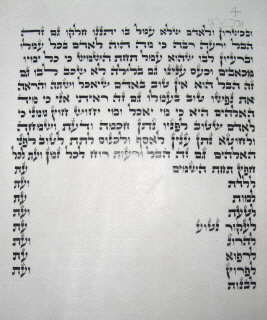
Blank space in Kohelet

kohelet2

Here’s the white space in Kohelet – chapter 3, and the poetry a time for bearing and a time for dying; a time for planting and a time for uprooting…. The repetitive structure of the words is reflected in the structured layout.

(Did I show you this one before? Oh well, won’t hurt to see it again, right?)


Back to School – safrut-learning

Now all the holidays are safely over (I’M LOOKING AT YOU, COLUMBUS DAY), it’s time to get down to the semester in earnest.

What about making this the year you get round to learning safrut? Especially if you’re in NYC and you want to learn it with me, because I’m thinking about taking a few years out of NYC starting next year, so carpe diem, etc.

There are a bunch of you out there who’ve been sort of thinking about it for a while. If a critical mass of people are interested, I’ll arrange halakah-learning, halakha-review, and practice-sessions.

By the end of the year, you could – if you give it your best effort – know enough to write your own mezuzot more or less independently, for instance. You would also have the basic skills to identify and repair pesulim in your community’s sifrei Torah, and the ability to determine whether that’s appropriate.

Logistics – I’m thinking Tuesdays p.m. from 5-8.30 or so; informal skills and chevruta from 5-7.30 and class-review of the week’s halakha 7.30-8.30. Unless no-one at all can do Tuesdays, in which case we’ll arrange Monday or Sunday by democratic process.

Cost – much as I would love to teach for nothing, there will be a cost. A semester’s fee paid in advance does wonders for keeping your motivation up, anyway. I think $250 for the seven weeks left of this semester, three and a half hours a week, but if that’s impossibly beyond you, say so when you email me and we’ll figure something out.

If you’re interested, email me this week or next, and we’ll start on the 26th Oct.


Little Tet, Big Tet; Eicha and Kohelet

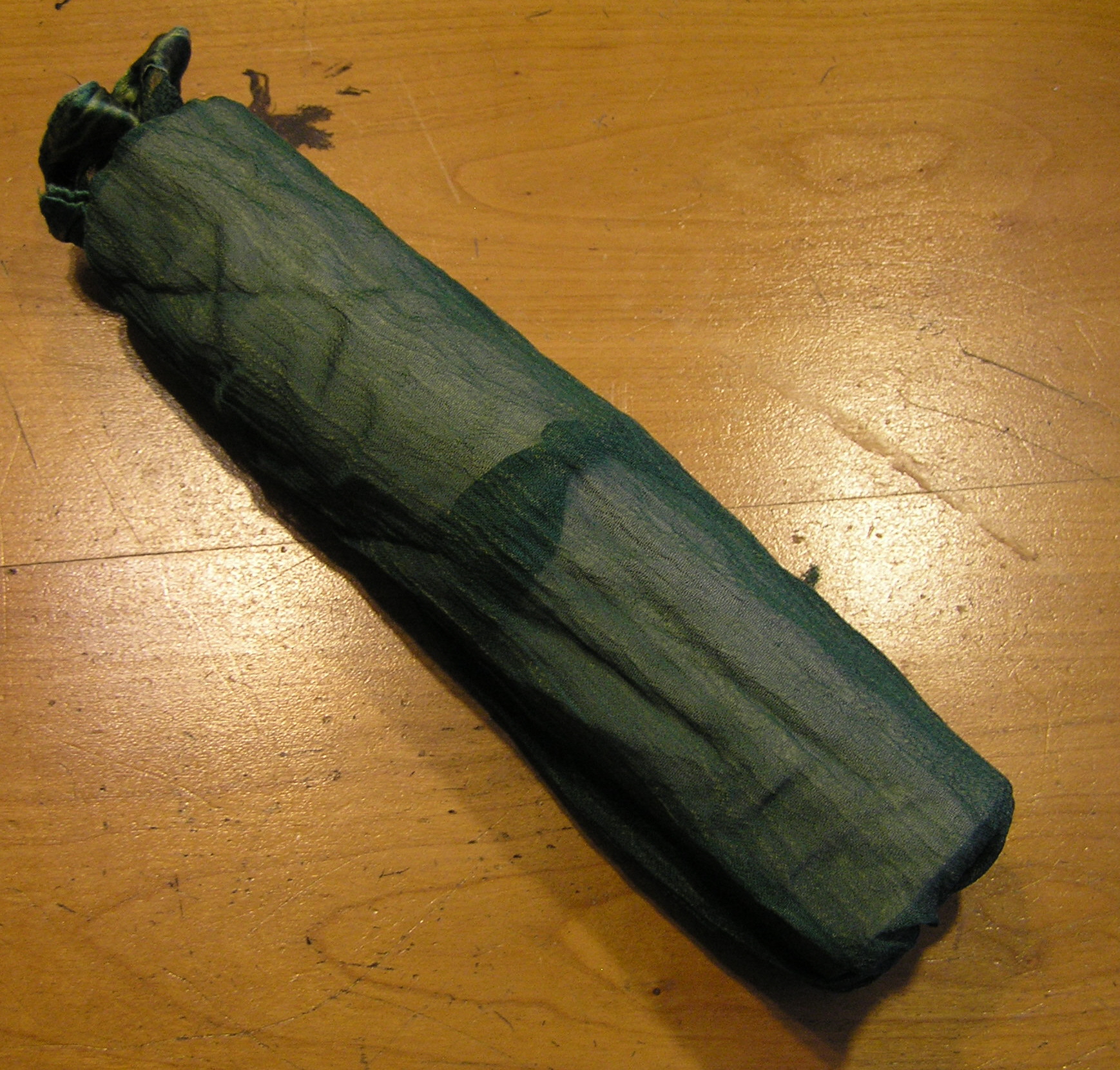
Kohelet scroll, wrapped

Kohelet scroll, wrapped

In Little Letters in Eicha, parts one and two, I talked about lamed, ayin, and tet.

The little lamed was serving as a reminder-flag, telling you to recall other, relevant, words beginning with lamed. The little ayin had to do with numerical symbolism.

The little tet had numerical symbolism and reminder-flagging, all of it connected to the destruction of the Temple in various ways.

That recap over, let’s move to Kohelet, pictured here in a festive green wrapping (you recall Eicha was wrapped in bodacious black…Megillot are fun like this, you can dress them up in seasonal clothes).

Eicha, if you remember, had a lot of white space. Kohelet has barely any. There’s one break right at the beginning, a good deal in the Song of Times (I’ll do a picture of that later), and then it’s just a Text Wall of…well, I was going to use internet parlance and say a Text Wall of Doom, but it’s not really Doom. A Text Wall of Gloom, perhaps? A Text Wall of Gloom Tempered With Hedonistic Pragmatism?

We digress. The point is that Kohelet has basically no section breaks; one at the beginning, none in the middle, and none at the end either.

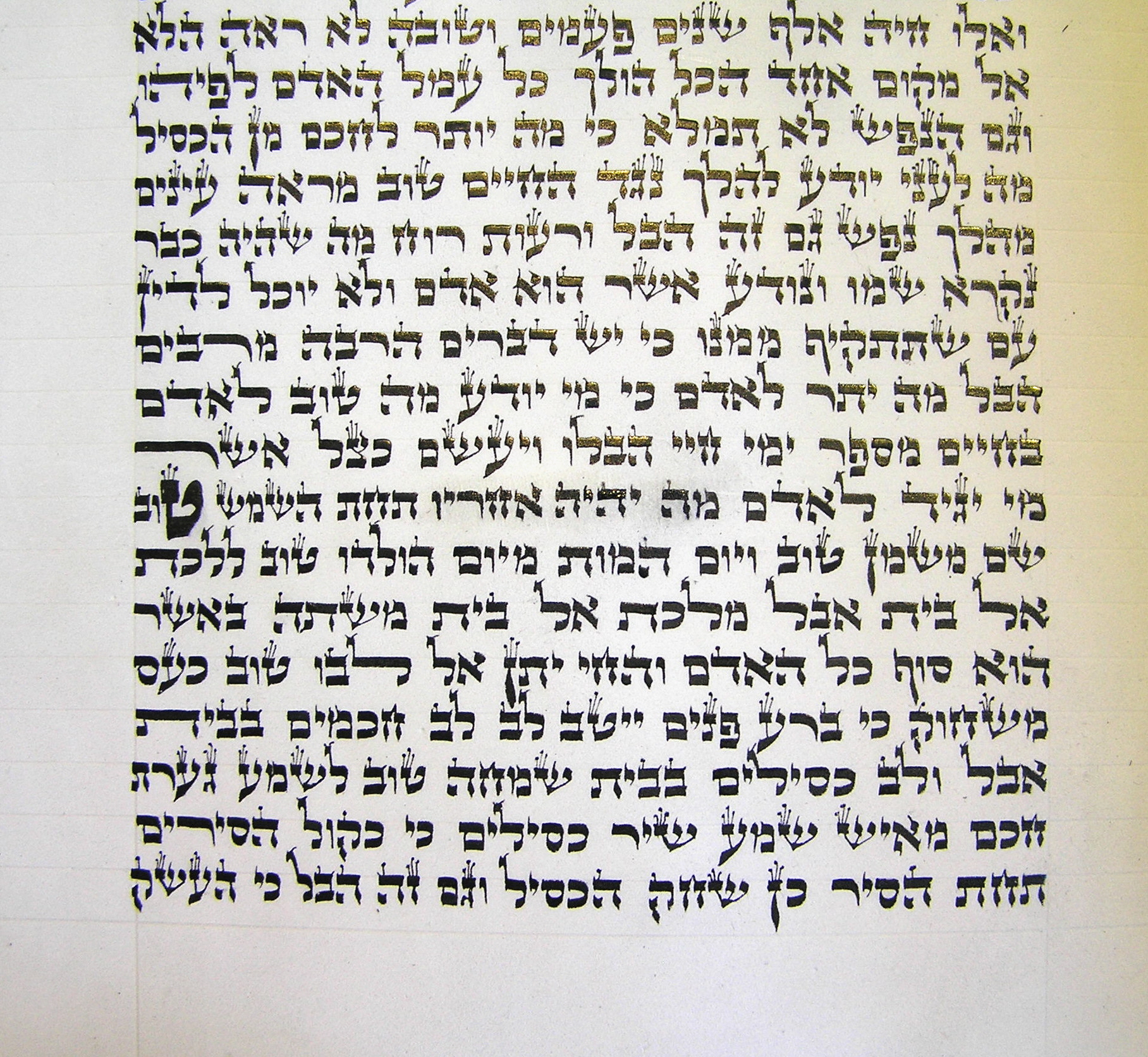
Big Tet in KoheletWhat it does have, at the end, is a Big Tet.

(The writing’s not great. I was rushing rather, to get it finished before yom tov – I only had ten days, and it’s not a short book.)

So, the big tet? Quite possibly just a way of saying “New section, chaps!”

But that’s far too prosaic.

Back to Tzvi Ron and his Sefer Katan v-Gadol (and G. Wasserman’s translation).

The Big Tet is in the phrase טוב שם משמן טוב – a Good name is better than good oil.

The Rokeiach (חסידי אשכנז) says: טוב שם משמן טוב — the tet is large, because a good name has a LOT of good.

There’s another large tet in Tanakh, in Job: יסר מעלי שבטו- “Let him take his rod away from me.”

Job is complaining about his great suffering, being beaten by God’s staff. מסורת הברית הגדול, section 1518, says that that big tet links to our big tet here in Kohelet, and demonstrates that suffering is ultimately good.

On the other hand, Rav Dovid Tevele (17th- or early 18th-century Hamburg) says that the large tet in טוב שם משמן טוב is a hyperlink to the small tet in Ekha, טבעו בארץ שעריה‬, with a popup from the Midrash.

tov2

Remember the bit when Tamar was going to be burned for whoring around?

According to the Targum Yerushalmi, she lost Judah’s pledge (his seal and staff and cord), and she prayed to God to let her find it, and thus rescue herself from being burnt, so that she might ultimately be the ancestor of three tzaddikim who would be untouched by fire – namely, Hananiah, Mishael, and Azariah, from the book of Daniel.

According to Shemot Rabba 48:1, our verse טוב שם משמן טוב — a good name is better than good oil — means that the “good name” of Hananiah, Mishael, and Azariah was better than the “good oil” with which Nadav and Avihu were anointed, when they first became priests.

So, R’ Tevele comments:

When the temple was destroyed (טבעו בארץ שעריה, with a small tet) and the anointing-oil of the priests was no more — nevertheless, in that cold exile, three tzaddikim arose, Hananiah, Mishael, and Azariah, and their good name (large tet) overwhelmed the destruction of the temple (small tet).

So, God paid us back for the loss of the Temple, by giving us tzaddikim, who were even greater. And hopefully, in the merit of further tzaddikim like them, נזכה למלך המשיח ויעלה השערים הנטבע בעו”ה ויקים סוכת דוד הנופלת במהרה אמן‬, may God send the Messiah, who will bring up the gates of the Temple, which had sunk (טבעו, with small tet) deep into the ground, at the time of the Destruction.


The Back to School Niggun

Rosh Chodesh guest post from MarGavriel

In many Jewish communities, part of the blessing for each upcoming month is sung in a tune which is emblematic of that month. In the South German tradition, it is typically the last words of the prayer, beginning with לחיים ולשלום, which are chosen for this purpose. The cantor sings these words to the theme-tune of the month, and the congregation concludes the tune by responding אשרי יושבי ביתך עוד יהללוך סלה.

Thus, when blessing the month of Nisan, the words are sung to the Passover theme tune (Addir Hu); Sivan, the Shavuoth theme tune (Aqdamuth), etc.

But what about the month of Marheshvan? We typically do not associate any specific tune with this month. And thus, at KAJ of New York City today, the words in the blessing for the month of Marheshvan are simply sung to a neutral tune, associated with Psalm 126 (שיר המעלות בשוב ה’ את שיבת ציון). This was the case yesterday, when this prayer was recited.

However, in 19th-century Germany, there was a tune associated with this occasion. Shelomo Zalmen Geiger tells us the following, in דברי קהלות (a diary of the synagogal customs of the Frankfurt community for each day of the Jewish year), published in 1862, p. 363:

ונהגו החזני[ם] לנגן נגון שיש בו כעין נגון למוד גמ[רא], בברכת חדשי מרחשון ואייר, כי אחר סכות ואחר פסח היה דרך הרב להודיע לבחורי ישיבה הלכה בש”ס שילמדו בשקידות עם תוס[פות] ופוסקי[ם] ומפרשי[ם], ואחרי שבוע אמר הוא וכן לומדי[ם] אחרי[ם] לפני הבחורי[ם], מה שחדשו בהלכה הזאת. והמנהג הזה נקרא: הוצאת הלכה ותוספות. וע”כ נקרא גם הנגון הזה: נגון הלכה ותוס[פות].

And the cantors have the custom to sing a tune which is similar to the tune used in studying the Gemara, in the blessings for the months of Marheshvan and Iyyar. For after Sukkoth and after Pesah, the practice was for the rabbi to inform the young men studying in the yeshiva what halakha [=tractate] they should study diligently [in the upcoming semester], with Tosafoth and posqim and commentators. After a week, he and other scholars would tell the young men what innovative ideas they had come up with regarding this halakha. This custom was called hotza’ath halakha ve-thosafoth [“the bringing out of halakha and Tosafoth”], and therefore this tune is called “Niggun Halakha Ve-thosafoth” [“the tune of halakha and Tosafoth”].

In other words, the theme of the month of Marheshvan (and of Iyyar) is “Back to School”, after the long holiday break. And thus, the theme tune is the “Back to School” tune.

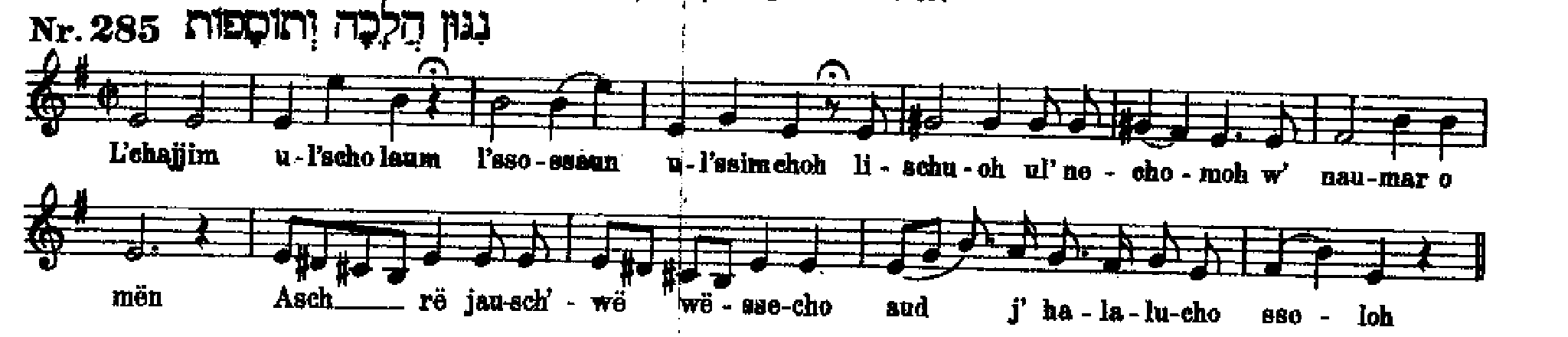
Here is the tune, as notated by Fabian Ogutsch, in his book Der Frankfurter Kantor (J. Kauffmann Verlag: Frankfurt am Main, 1930):

marheshvan
Click to see bigger.


Limmud 30

The Soferet is going to Limmud 30, people!

What do you think I should present?


Sifrei Torah captive and mutilated

This eBay item makes me want to cry.

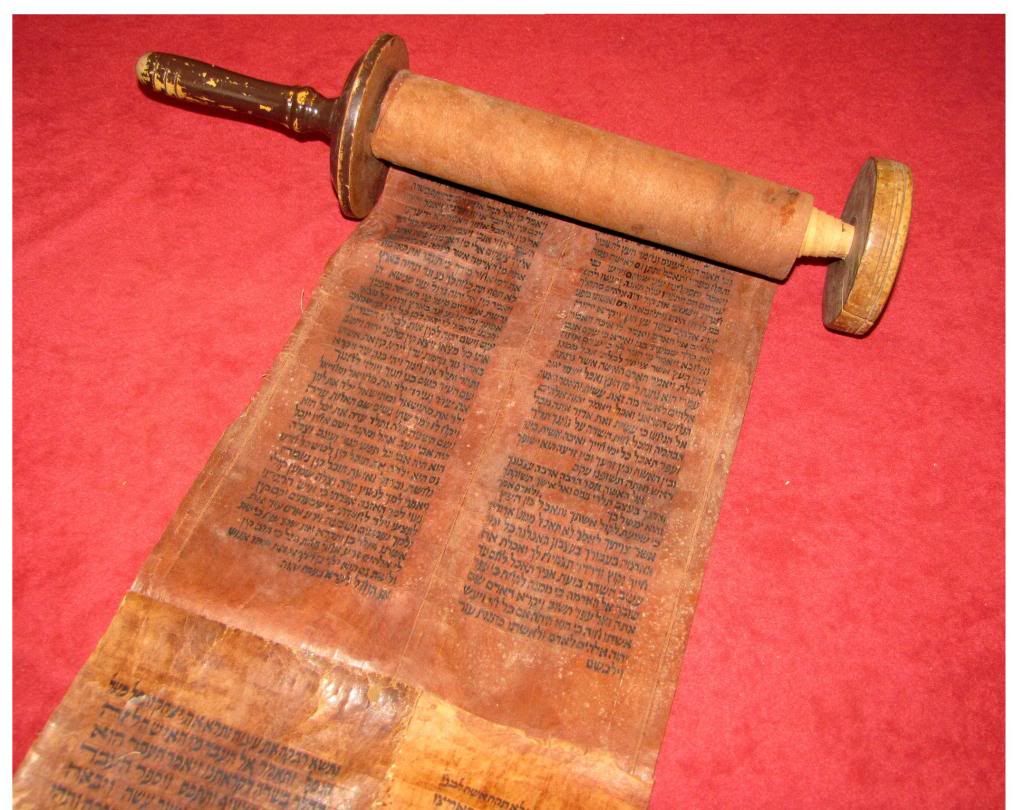
It’s advertising a “Torah Scroll 400 Years Old Approx 10.8 Feet Long” and you can see from the picture that something’s seriously, seriously wrong.

People have been selling pieces of sifrei Torah on eBay for years. They get old sifrei Torah, hack them into pieces, and sell the pieces to goodness-knows-who on eBay. (Not that this is anything new; Jews have been buying and selling talisman pieces of holy books for centuries. But just cos it’s an old custom doesn’t mean we have to respect it.) I used to cruise eBay with some regularity looking at them, but I don’t do that any more because it makes me too sad. Poor little lonely pieces of a Torah scroll being sold off as artwork or curios, ugh.

This one makes me even sadder, though. Not only are the poor pieces of Torah chopped up and being sold on eBay, they’ve been sewn to other pieces, arbitrarily and sideways, and attached to a (single) roller, to make it resemble, vaguely, a sefer Torah. Foreign writing on parchment and rolled up! That’s a Torah, right?

Imagine some hero of yours died. Let’s say my Queen died. It’d be really horribly distasteful if parts of her body were removed and sold on eBay for mementoes, wouldn’t it? And yet there are people in the world who would buy such a thing, and you know it.

Now imagine if several body parts were stitched together – say, a finger, a rib, six inches of skin from the calf, and a lock of hair – to make a Royal Queen Dolly Relic. Maybe attached to a lightbulb, so it’s a Royal Queen Dolly Relic Table Lamp. As a good Brit and decent human being, I find that mental exercise pretty freaking distressing on so many levels.

This business with the poor mutilated sefer Torah is something like that. It’s tacky and violent and it horrifies me and makes me sad. At least with the single sheets you can sort of hope it’s going to be bought by some well-meaning if ignorant, bookish, manuscript-loving Jew who will treat it like Torah — here, you can’t even hope that, because it’s no longer even sheets of Torah, it’s sheets of Torah sewn together into a Royal Queen Dolly Relic Table Lamp that ought to horrify any Jew who sees it.

It says that the seller is in Ramat Gan. Trading in body parts is probably illegal in Israel, but trading in mutilated Torah parts probably isn’t. There are legitimate reasons for buying and selling parts of sifrei Torah, after all.

Indeed, we are supposed to redeem captive sifrei Torah, to prevent ghastliness like this, but not if so doing would simply encourage the Torah pirate to keep going. Perhaps buying up all their stock would be a good thing because then they could have a decent burial, but equally it might encourage them to mutilate more sifrei Torah in the hopes of more money, and if that’s so, we aren’t supposed to buy back the captive Torahs, we’re just supposed to be sad.

As Kohelet says, there is nothing new under the sun, and the only thing you can do is keep on living as best you can regardless, but please, people — don’t encourage this sort of thing. As you wouldn’t buy parts of human beings, don’t buy parts of sifrei Torah.


Sights from the Supermarket

ETA: Lethargic_man points out that he too lives in a Jewish neighbourhood, in London, and none of this applies in his neighbourhood. I did not mean to imply that all Jews drink death-defying amounts of carbonated water on festivals, nor that all Jews are so environmentally oblivious that they use plastic for every meal – no, indeed. Just the ones near me!

Back to the post:

I live in rather a Jewish neighbourhood.

This is how you know the Jews are having a holiday:

Perfectly terrifying quantities of seltzer.

This is how you know the holiday is Succot:

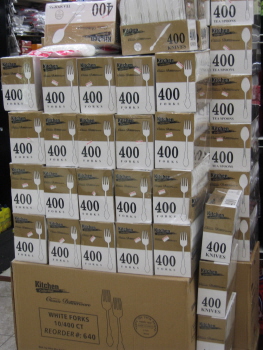
Mind-boggling quantities of plastic forks.


Little Letters in Eicha, part 2

Little Letters in Eicha, part 1

3:36
Little Ayin in Eicha
לעות אדם בריבו אדני לא ראה To subvert a man in his cause, the LORD approveth not.

Tzvi Ron in Sefer Katan u-Gadol again (trans. G. Wasserman): “The small ‘ayin in the word לעות (verse 3:36) is explained as a reference to the numerical value of the letter, namely seventy. This verse says that God did not agree with the perversion of justice, and the number 70 is associated with this if we relate it to the seventy judges of the Sanhedrin, or the seventy years of Babylonian exile which God’s justice decreed for the Jewish people.”

Now call me a sceptic, but this sounds a bit forced to me. Surely there’s more to it than that? But if so, we’ve forgotten what it ever was (or Tzvi Ron didn’t find it yet, anyway). By way of compensation, someone more recent (like, in the last 1000 years) came up with this one. Numerical symbolism is a tool in the interpretative toolbox.

2:10
Little Tet in Eicha
טבעו בארץ שעריה אבד ושבר בריחיה מלכה ושריה בגוים אין תורה גם נביאיה לא מצאו חזון מיקוק Her gates are sunk into the ground; he hath destroyed and broken her bars: her king and her princes are among the Gentiles: the law is no more; her prophets also find no vision from the LORD.

The numerical symbolism here is a date – Tet is 9, and “In Midrash Haseroth Vi-yetheroth, it says the allusion is to the destruction of the Temple, which took place on the date 9 (i.e., ט) Av; this explanation appears also in the Minhath Shai and in the book Yesod Ohel Mo‘ed.” Okay, very nice, but it gets much better.

A whole big collection of mouseover interpretations follows. Choose your mouseover, really.

Other commentators have explained the small teth as being a reference to some particular smallness in the sinking of the gates. Thus, in Mesoreth Ha-berith Ha-gadol, it says: “The reference here means that they did not sink very deeply, but only a small sinking.”

In the book Em La-miqra ve-la-Masoreth, it says that the small teth is an allusion to the word טוב, good: “It hints that their sinking was not to their disadvantage, but for their own good – it was so that the enemy’s hands would not have control over them.” In the same book, it lists a number of allusions associated with the word טוב – the goodness which was decreased at the time of the Destruction, the good Torah which the Jews had abandoned, and more.

In Sefer Elyashiv, it says that the reference is to טוב רואי, the one good in appearance, i.e., the handsome King David, in whose merit the gates were not destroyed, but merely sank into the ground. In the book Yesod Ohel Mo‘ed, the same connection to טוב רואי is mentioned, except that here, it is explained as referring to the fact that the gates, which now sank, had originally been made by King David.

So – a small letter tet, with all kinds of allusions about the destruction of the temple floating around it. In the next post, we’ll see how this isn’t just a mouseover tet, it’s actually a hyperlink tet, connected to a tet in Kohelet.