Messianic sofrot…

http://soferet.webs.com/aboutme.htm

Oy…

A messianic soferet (who thinks the plural of “soferet” is “soferetim”).

Okay, people. This is a good example of why you need to know who your scribe was. This person’s work will probably look exactly the same as a Jew’s work. Looking at the site, you might think it was completely okay – and then you see words like “messianic,” and you start to wonder.

And yes, exactly the same principle applies for Orthodox Jews who look at my site. They might think it was completely okay, and buy from me, and that would be just as bad. This is why a) I try to make sure my clients are aware of the consequences of buying from me b) I write blog posts like this. Consumer education, it is good.

(Another warning sign, by the way, is the mezuzot on paper – selling paper mezuzot is not something done by people who care about Jews. The implausibly low prices are another red flag – if you see sta”m going for really low prices, someone’s getting screwed, and that someone is probably you.)

When buying mezuzot, or tefillin, or megillot, or sifrei torah – BE AWARE.

The sifrei kodesh are intimately connected to our communal identity. In having communal identity, we necessarily define some sorts of people as not members of our community. By their nature, we want our sifrei kodesh to be written by people inside our communities. Given any Jew, there exists a scribe who is outside that Jew’s communal boundaries; therefore that Jew could buy scrolls that aren’t kosher for her to use, and if she isn’t an informed consumer, there’s a fair chance that she will, by accident.

This example came my way because she’s female, but there have been Messianic scribes out there for simply ages (in our generation, of the Christian and Chabad varieties, but for a couple thousand years before that also). I often point to them as evidence that I, the Lady Scribe, am not the first person to make scroll-buying a dicey process for Orthodox Jews – scroll-buying, like used-car-buying or house-buying, is a dicey business, and that’s the way of the world. Be aware.

Paper for calligraphy

For what it’s worth, this is the paper I’m presently recommending to my students.

Scribes write on parchment, but parchment is mad expensive, and it’s foolish to take your first tottery strokes with a quill on the most expensive medium available. Much better to get started on paper.

But what sort of paper? You don’t want paper that’s too rough, because a quill won’t do smooth lines. You don’t want paper that’s too absorbent, because a quill won’t do crisp lines. You want a nice smooth – but not too smooth – paper that doesn’t absorb too much ink. And ideally, you want to be able to run it through the printer to print guidelines, because drawing your own guidelines is horribly boring.

Well, this stuff works. It’s not the only stuff that works, but you can buy it in the art store that’s nearest to the Drisha Institute, by whose courtesy and in whose classrooms I am holding my scribe class this semester, so it’s the stuff I’m using at the moment. And if you’re wondering what to buy, you could certainly do worse than this.

The picture links to Cheapjoes.com, which I use periodically; they are quite satisfactory.


Poetical interlude

I went to a talk at the Jewish Theological Seminary a while back, on the poetry of Yehuda haLevi. Specifically, two translators were talking about their approaches to translating haLevi’s poetry.

Those of us who work with Bible translations frequently have occasion to remark that translations are necessarily also commentaries, and this talk emphasised the commentarial nature of any translation, but from a more artistic perspective, which I found striking.

In particular, one got a fine sense of how these two translators take a poem and get inside it, inside the language and the words and as far as they can inside the mind of the poet – and having got there, they then describe what they see.

Here’s the first lines of the example they used:

הבא מבול ושם תבל חרבה
ואין לראות פני ארץ חרבה
ואין אדם ואין חיה ואין עוף
הסף הכל ושכנו מעצבה

Of course, what they see from the inside of the poem depends upon who they are, so what they choose to communicate and the manner of said communication varies tremendously. Scheindlin translates “Is this the Flood, and has the world been drowned? / You can’t see land, or beast, or bird, or man. / Are they all finished, lying in the pit of sorrow?” But Halkin translates “Has a new Flood drowned the land / And left no patch of dry ground, / Neither bird, beast, nor man? / Has nothing remained?”

This was interesting of itself, but it also gave me a perspective on artistic representation that is probably standard fare for any fine arts undergraduate, but since I make a living as an artist of sorts without the benefit of a university education in the arts, I had to learn it this way.

Specifically, the Hebrew poem spoke to these two translators in different ways. One was most struck by, and most focused on conveying, the poet’s use of rhythm and meter, and in his translation he tried to represent that. The other was more focused on the images and the power in the poem, and his translation spoke of that.

Accordingly, it made me think about illustrating a poem – as an artistic calligrapher, one’s job is to convey a piece of text visually, and one goes through a similar process. Sometimes you might want your writing to convey the imagery and feeling you get from the text, but sometimes you might want to use pattern and structure to convey a visual echo of the text’s own structure. A calligraphic rendition of something is also a translation, in a way, and as such it is also a form of commentary.

The sifrei kodesh, of course, have a strongly-defined mode of rendition, meaning that a scribe-artist’s capacity for commentary is severely limited. In ancient times, when the concept of writing was still new, I understand that the scribe’s role was frequently one of embellisher as well as transmitter, but today’s scribe does not have that aspect. Scribes do have some room for individual expression, and in fact I shall be exploring that in a session at Limmud UK, subsequently appearing on this blog, but on the whole, not nearly as much as does an artist-calligrapher.

In any case, I had not conceived of, or articulated, my calligraphic activities in quite this way before, and I shall be bearing it in mind next time I do something creative I’m not expecting anything profound, but perhaps it will serve towards understanding whatever it is I presently do instinctively. Cheers, JTS.


Essay questions

I get these by email every so often.

1. What is your favorite part of your job?

If you’re very lucky, in your life you’ll find an activity – maybe something physical, or intellectual, or creative, or none of those – that is just *right* for you. When you start doing it, everything feels good and right and comfortable. When I’m writing, that’s how I feel. That’s my favourite part of my job.

2. How long did you have to study to become a soferet?

I studied about three years, but not full-time.

3. How many Sifrei Torah have you written?

Three so far.

4. What is the hardest part of your job?

Often, when a scribe makes a mistake, they can fix it with their knife, and no harm done. But just sometimes, a scribe will make a mistake in God’s name, and you aren’t allowed to use your knife on God’s Name. That means that if you make a mistake in God’s Name, you have to bury the sheet, because there’s nothing you can do to fix it. Maybe it’s four or five days’ work, and it’s going to be difficult and expensive to catch up. The hard part is when you are sitting, all alone, and you think “No-one would ever know if I just fixed it with my knife.” And it’s true. No-one would ever know. That’s when you have to face up to your mistake, accept that you’re going to lose a week’s work, and start over – and that’s hard. It’s very hard.

5. How old were you, when you knew you wanted to be a Soferet?

It wasn’t a Goal I had. It just sort of happened one step at a time.

6. Can you describe how it feels to be a Soferet – perhaps the first in history?

I think it’s important to remember the words of Kohelet – “There is nothing new under the sun.” We remember that the sacred scrolls, the Torah in particular, represent the Judaism we live for, and it is very special when a community trusts you to transcribe that Torah. Of course it’s exciting to do something unusual, but from a historical perspective the important thing is the sefer, and not the sofer.


Field trip – Holocaust Torah-scroll

The Czech Memorial Scrolls were originally collected up by the Jews of Prague, in the wake of Nazi devastation. As the Jews of Bohemia disappeared, the Prague Jews collected up their scrolls to keep them safe, hoping to give them back to their owners after the war. But their owners were all murdered – and then the Prague Jews were murdered too. After the war, the Czech government didn’t want them – so Westminster Synagogue bought 1,564 sifrei Torah and brought them to London. Their website is really excellent and a fascinating read (see also the USA associate site).

sev-flaking Now many of the scrolls have been given foster-homes in the United States, and their new communities want to make them part of the family – so they look at the possibility of having the sefer repaired, so that it can be read from once more. That’s where I come in.

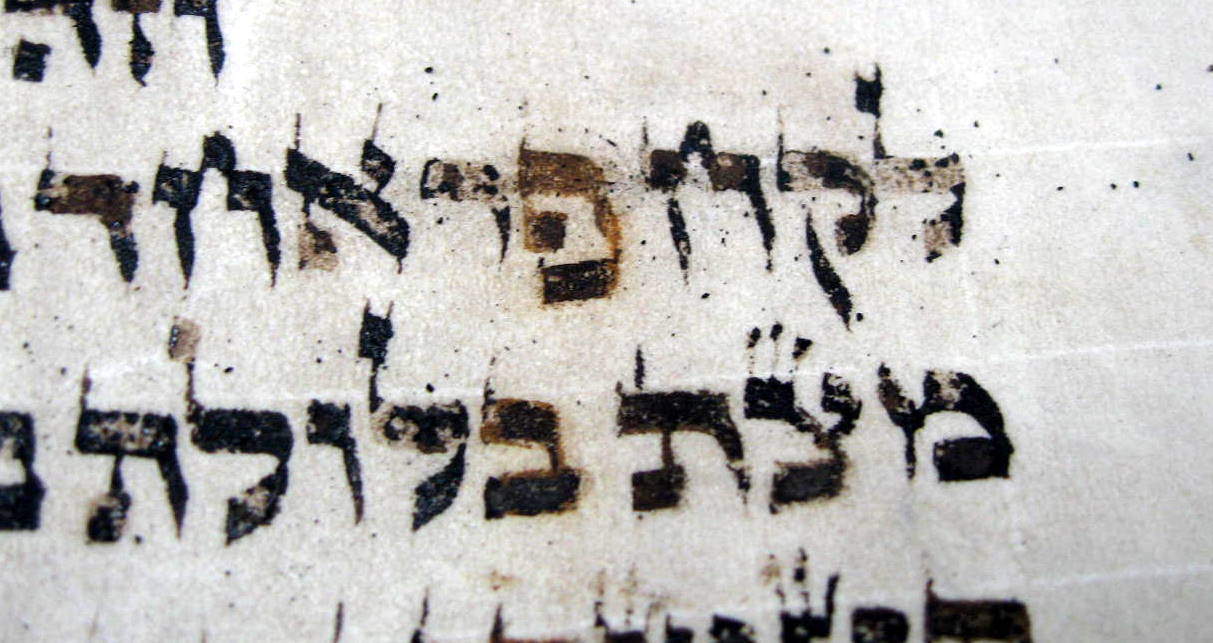
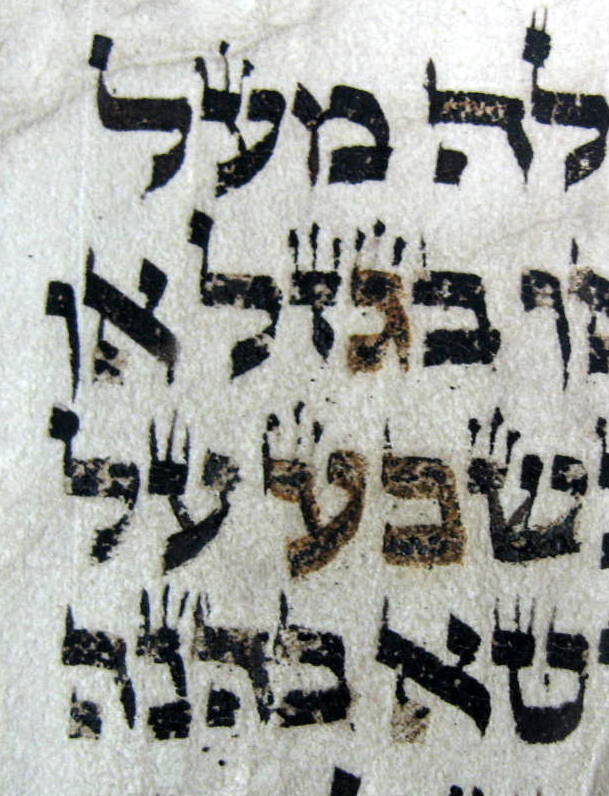
The story is usually the same – it was clearly a beautiful sefer once, but the Holocaust left its mark on it. Time has dried out the parchment and ink so that now the letters are just crumbling into nonexistence with the barest touch, even just the touch of the parchment as the scroll is rolled and unrolled. The little black splots in the picture are ink crumbles. (The orange colouration is rust. See below.)

I think these Holocaust sefarim are like the father character in the book Maus. They’re so damaged by the Holocaust that they simply aren’t really capable of functioning normally any more. Just like people, it’s normal for all sifrei Torah to age to a point beyond which it’s no longer practical or kind to keep fixing them up so they can stay at work, but it’s so much sadder with the Holocaust ones.

oldrepairsOver time, most sifrei Torah go a bit flaky in places. When it’s just a few letters here and there, we apply another coat of ink to the scuffy parts – like that hey in the top line, you see where it’s just a bit white? We’d colour those bits black, and continue as normal.

You can see, in places, where this Holocaust sefer has actually had that kind of repair, years and years ago – look at the brown letters; see how they’ve got black patches on them? The brown will be what remains of the original ink, gone reddish because of oxidisation in the iron compounds – rust, in other words – and the black is a more recently-applied coat of ink, applied where once the letter was just a bit scuffy in the middle.

But now it’s not just a letter here and there, it’s basically all the letters. You can restore a sefer in this condition, but it’s difficult to do well because they’re so very flaky. Either you have to remove all the flakes and basically start over, or you have to apply a stickier ink than usual to try and glue the remaining flakes into place; both of these are rather delicate processes.

One can try using fixatives such as artists use, to hold what remains in place and retard decay, but they’re limited in their effect, they make the sefer much heavier than it already is, and you still won’t have a kosher sefer unless you put in all the time repairing the poor flaky flaky letters.

There are people who will re-ink every letter on a sefer like this, spray it with fixative, and tell you to come back for a checkup in five years, at which point you’ll probably have to do a lot of it over again. This course of action is sometimes appropriate, for instance in a community that really can’t invest in a new sefer, or a sefer which has enormous emotional significance to the community in some way. It’s still often exceedingly expensive, say upwards of $5000, if the sefer is starting out in very poor condition, like this one. And it seems to me that – especially with these poor sad Holocaust scrolls – that it’s often just kinder to accept that this sefer has aged and sustained damage beyond telling, and instead of applying severe restorative therapies to make it “normal” again, let it have a dignified retirement.

Which was the advice I gave this community, sadly enough.


A1 Soferim – Good Reports

I get emails like this on average twice a month:

If you have advice about what I should do with my ancient tefillin, that would be great. They were my great-grandfather’s and I would love to use them, but they are tiny, and the man I talked to at [Big Judaica Store] told me that it was likely the parchment would no longer be kosher and that there would be no way to replace it.

Memento of relative – check. Tiny tefillin – check. Female owner – check. Discouraging story from Big Judaica Store – check. General despondency – check.

So I say, go to A1 Soferim – Aharon Lichter, 212-254-1400, 473 FDR Drive on Grand St, New York, New York.

Last week’s email:

Mr Lichter is a total mensch! Not only did he check the tefilin, but he showed me everything he was doing on them and all sorts of other stuff he had around. It was fascinating. Even I could see that the writing was beautiful and not faded, & he said they were easy to check and kosher for another 50 years. I’ve had them for over a decade, but I never really thought about the sofer who wrote the words, or who selected this particular set (my great-great grandfather? Mr Lichter was nice to say that though the batim are not the best quality, the writing is so good that they must not have been cheap), or who wore them, or their trip over from Europe. It was pretty awe-inducing.

This week’s email:

I wanted to send you back a glowing report about Aharon Lichter. He was incredibly polite and kind to me, and I was so appreciative of it. While I was waiting as he checked the tefillin he was telling me all kinds of great stories and anecdotes about being a sofer. He really was wonderful. Thank you so, so much for the recommendation!

So – Aharon Lichter. Earning a reputation as a Man Ladies can Take Their Tefillin To. Glad to hear it.


Fun with ketubot – Fruit of the Spirit

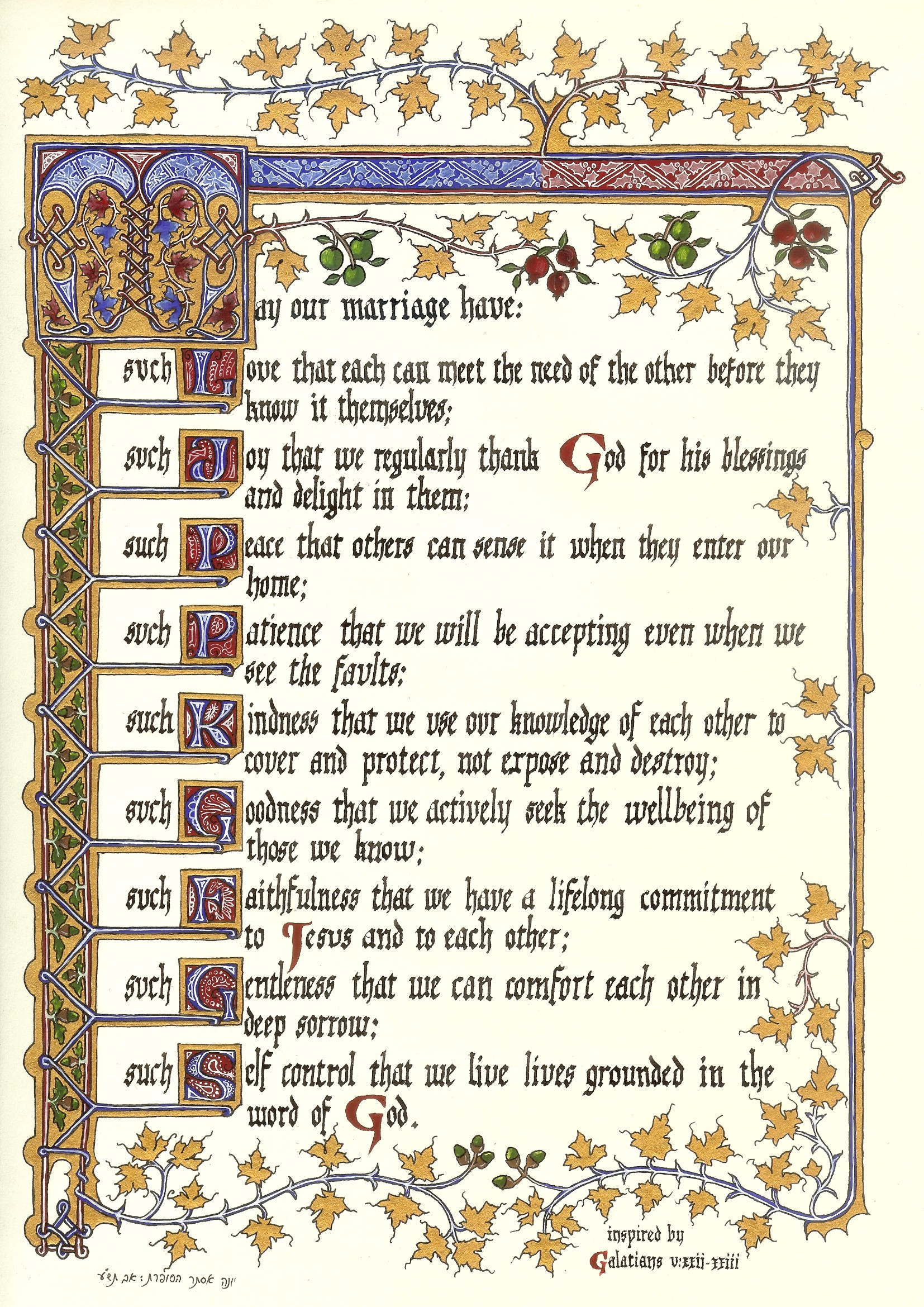
non-ketubah450…the fruit of the Spirit is love, joy, peace, patience, kindness, goodness, faithfulness, gentleness and self-control…

And the bride and groom took that and turned it into wishes for their marriage. Isn’t that nice?

My black-letter script isn’t all it could be, but I’m very happy with how the illumination turned out. As well as vine leaves, the fruit motif is carried by apples, pomegranates, acorns, and holly berries – vines for general good biblical symbolism, apples for love and because they stay good in storage, pomegranates for commandments and fruitfulness, acorns for the strength and endurance of the oak, and holly berries because they are fruitful even in the depth of winter. India ink and gouache on paper.

OK people, yes, this is not actually a ketubah. And it has Jesus in it, on account of it wasn’t for a Jewish wedding but for a Christian one. Old friend of mine. But I’m still calling it “Fun with ketubot,” because it totally counts as a sweet wedding document :-P

Click to see it bigger. Large file; be warned.


Lines per column in a sefer Torah…

How many lines to a column?

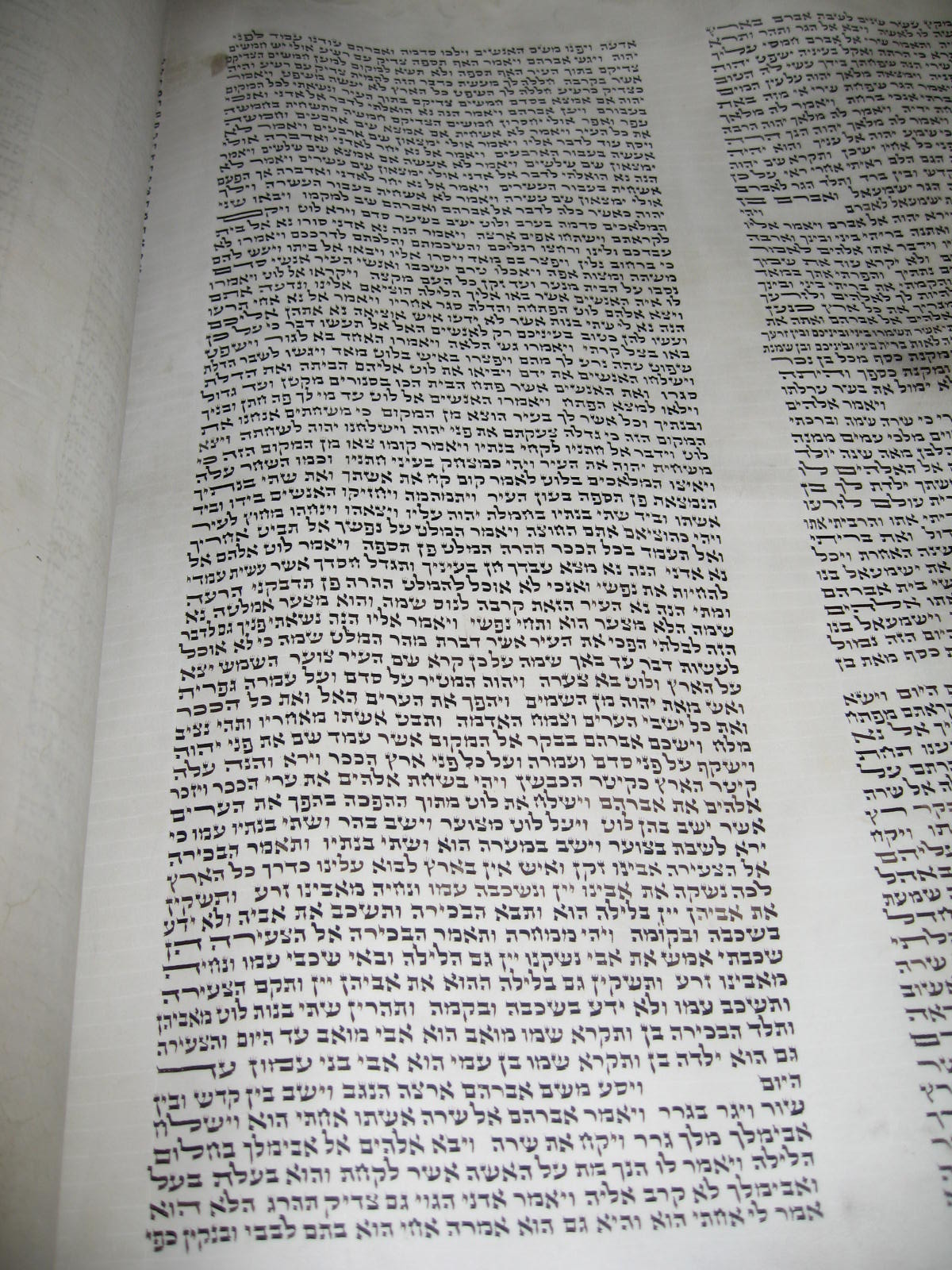
It varies. Torah scrolls tend not to have fewer than 42 lines per column. Some Megillot will have eleven lines per column, so as to have the Sons of Haman occupy a column to themselves but still have only one on each line.

The Keset ha-Sofer:

It is the custom to have no fewer than 48 lines, representing the journeys of Israel, and some say no fewer than 42, because of what God did in the Sinai wilderness at Kadesh. Also, we don’t have more than 60 lines, representing the 60 myriads of Israel who received the Torah. This is because the beginnings of sanctity start at 48 or 42 (the wanderings in the wilderness) and continue to 60 (the giving of the Torah). If one makes it different it isn’t invalid.

Good thing too, that last bit – I saw a 70-liner this afternoon.

See? 70-line Torah Column of Doom at left; compare to 42-line Regular Column at right. I would need to stand on a chair to read from that big one.

70-line-columnrandom column


MUGS

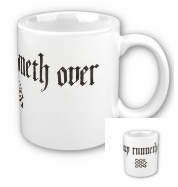
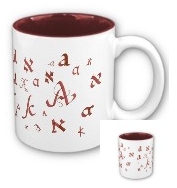
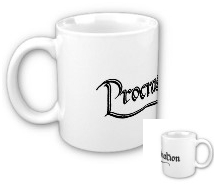
I may have spent the evening putting artwork onto mugs. Click mug images to buy at Zazzle.

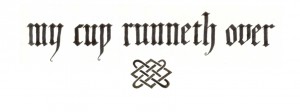
My cup runneth over: This one’s particularly fine, I think, for hot drinks on chilly Shabbat afternoons at seudah shelishit, when people are singing “kosi revaya” anyway. Also good for people like me who tend to overfill their teacups from an excess of enthusiasm.

mug - my cup runneth over

run

Aleph and A: These are just pretty. I also have reish and shin, but not other letters. Maybe if someone were to ask nicely for a particular letter, I could do it.

mug - aleph

al

Procrastination: Because I totally am, and so are you.

procrastination

pro


Fun with ketubot – 1830s Modena, part 5/5

So the last thing to do is fill in the text.

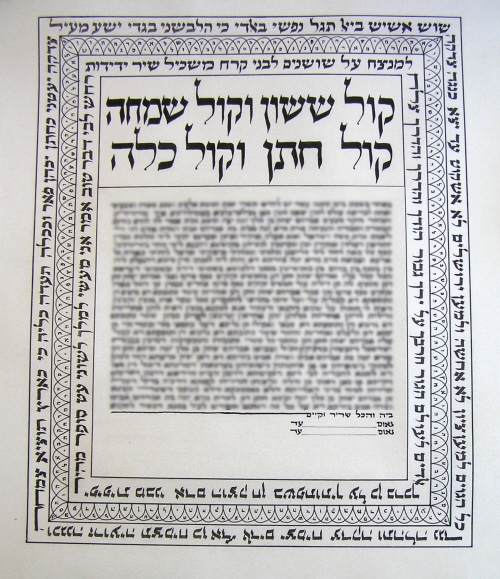
First I learned the script, copying the original quite carefully. Then I used the techniques I talked about last summer, for fitting ketubah texts into given shapes, to fit the text into the available space. Exact text blurred for privacy reasons, but you get the general idea.

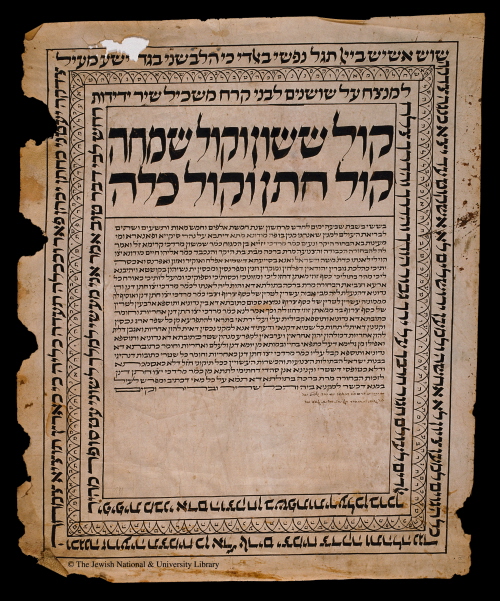
kol-sassonKetubah, Modena, 1831

We didn’t use the archaic version, with its interesting currency, highly-specific place-naming conventions, and fulsome honorifics. Such things tend to scare today’s rabbis, unless they happen to have a passion for ketubot, and you don’t want to be dealing with a scared rabbi, they’re a lot of work. So we did a very standard modern text, with Lieberman clause.

If you click on the above image of the new version, you’ll be able to see the final mem, whimsically extended to bring the text into an exact rectangle. Rather fun. The original stretches the last few words; this is another way of accomplishing the same thing, that’s all.

So now we have a new incarnation of this old ketubah, spotted in an archive by my client and envisioned by him as a fresh, shiny, new ketubah. The whole thing is really rather happy and lovely. I hope someone else wants a border like this; it was jolly good fun to do, and very interesting.