Notes on checking mezuzot

I was going to give a class on checking your own mezuzah, but it got prevented by weather. Today I found the notes I’d made for it, so I’m typing them up.

But I’m not putting in the pictures here because that’ll take hours of scanning and photographing; if you want those you’ll have to get me to come give the class.

Anyway, this is what we would have covered:

Is the mezuzah written on parchment, or printed on paper?
Does it have all the words? (checking using a tikkun; checking using the internet)
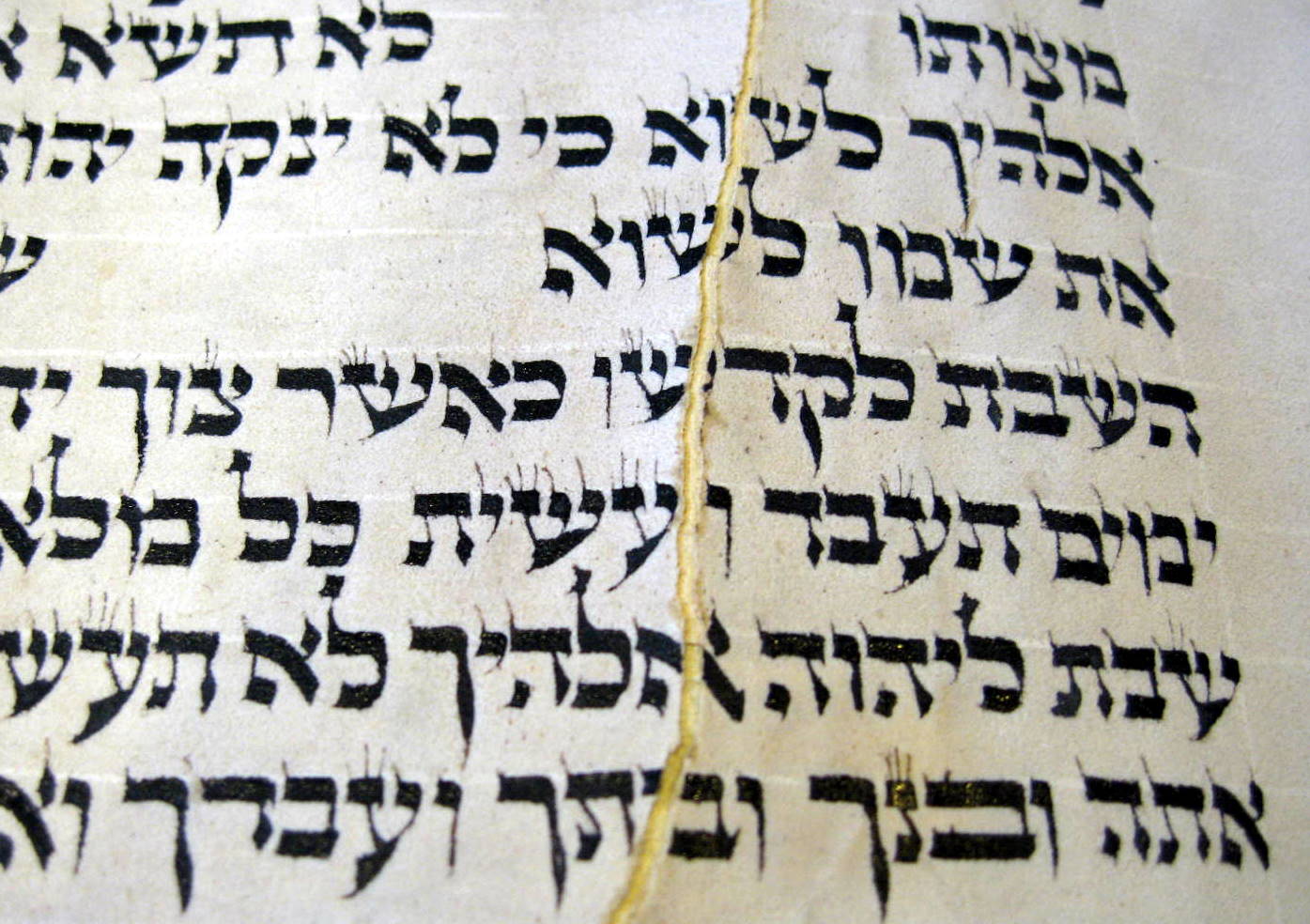
Are all the original letters there? (flaking, damage)
Are they still in good repair? (cracking)
Theoretical interlude: why repairing letters out of order is problematic
Technical bit: checking to see if the letters have their proper form (this is the bit that requires lots of training and practice, but there are some things that you can see straight away, like letters which are connected, or really egregious malformations).

Such a class is not going to equip the average mezuzah-user to say “Yes, this mezuzah is definitely kosher,” but it will equip said user to know if their mezuzah is not kosher, or if they should be worried.

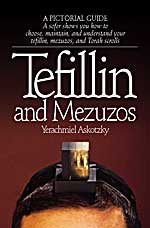
As ever, for more information I heartily recommend the book Tefillin and Mezuzos: A Pictorial Guide by Yerachmiel Askotzky. You can buy it here at his site.


your student doesn’t finish her first sefer Torah every day

My beloved student Julie has been writing a Torah in San Francisco at the Contemporary Jewish Museum for the past year, and once she’d finished writing (yay) it came time to sew it together and have a bit of an Event.

So I went out there to help with the sewing and to be part of the Event, because your student doesn’t finish her first sefer Torah every day. I mean wow, seriously.

And I learned…that sewing a Torah together is a lot more fun when there’s two of you doing it. (Here’s a description of sewing a Torah.) It’s pretty fun anyway, but it’s even better when shared.

First we took awls and punched holes down the edges.

Then we took burnishers and folded over one edge.

Then we sorted all the sheets into order.

Then we each took part of the pile

laid two sheets right sides together (this is Sewing 101)

checked that they were the CORRECT two sheets (this is Sewing 101 section 1.1.1)

cut lengths of gid

threaded needles

tied knots

and SEWED

and SEWED

and SEWED

knotted off the threads

cut them

smoothed the seams

and rolled the new sheet up

and continued

and the rolls grew and grew and grew!

until there was a whole Torah

just sitting there

where before there had been a pile of sheets of parchment.

Pretty magical eh?

The museum isn’t a shul. It doesn’t have Torah readings. But don’t you think it’s awfully sad to write a whole Torah and then not have it read from? Julie did, and so did the museum. So they arranged for the Torah to visit Netivot Shalom in Berkeley, and on Shabbat we read from it.

Now, the funny thing is, that you write a Torah, and everyone involved is all, whoop-de-hey! amazingcakes! spiffettydoo!, but once you’re reading from it, it’s just like any other Torah. Kind of like pouring water into a lake. The water you’re pouring may be terribly special to you, but once you pour it into the lake, it’s part of the lake, and it doesn’t matter that once it was your special water. It becomes essentially anonymous, just part of the greater body.

No-one would know, to look at it, unless you told them that it was your special Torah. It acquires a life of its own, independent of you (it’s not a mixed metaphor if you start a new paragraph, right?). It’s rather beautiful, in a funny sort of way.

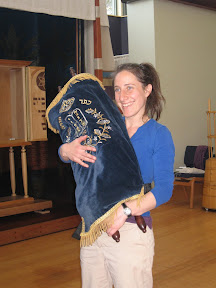
Julie looking slightly surprised, rather relieved, and altogether joyful to have written a Torah.


Little fat kings

IMG_4867aI like challenges. This challenge was to cook up illuminations for a Megillah being given as a bar mitzvah present.

Bar mitzvahs are tricky – you want something appealing to a 13-year old, but it also needs to be something they won’t hate in twenty years’ time.

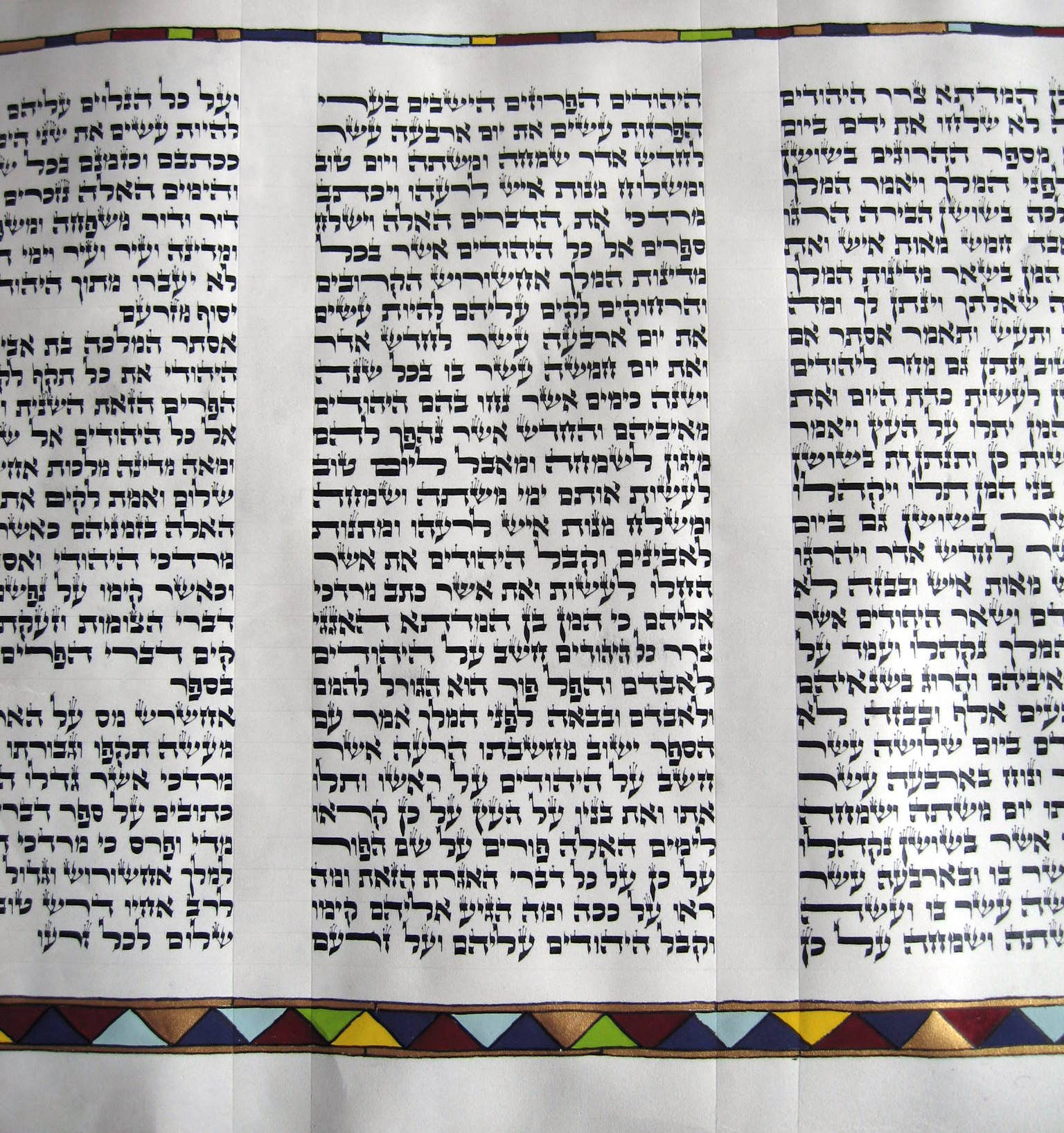
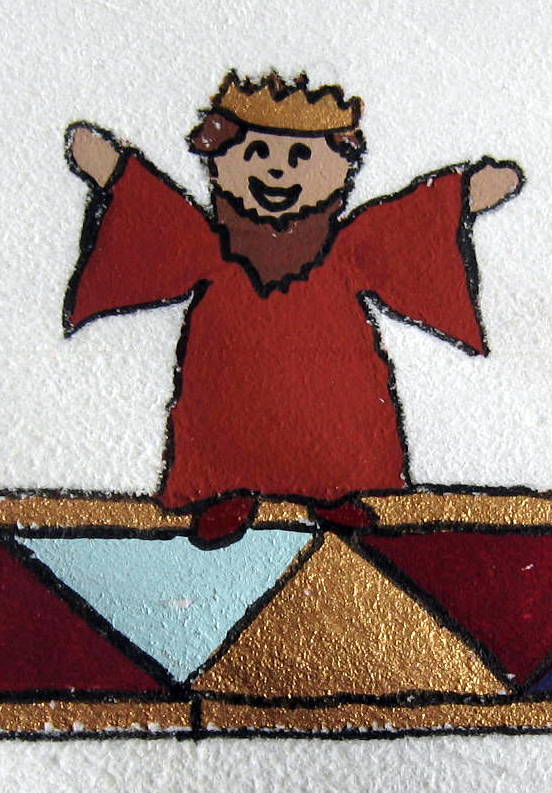
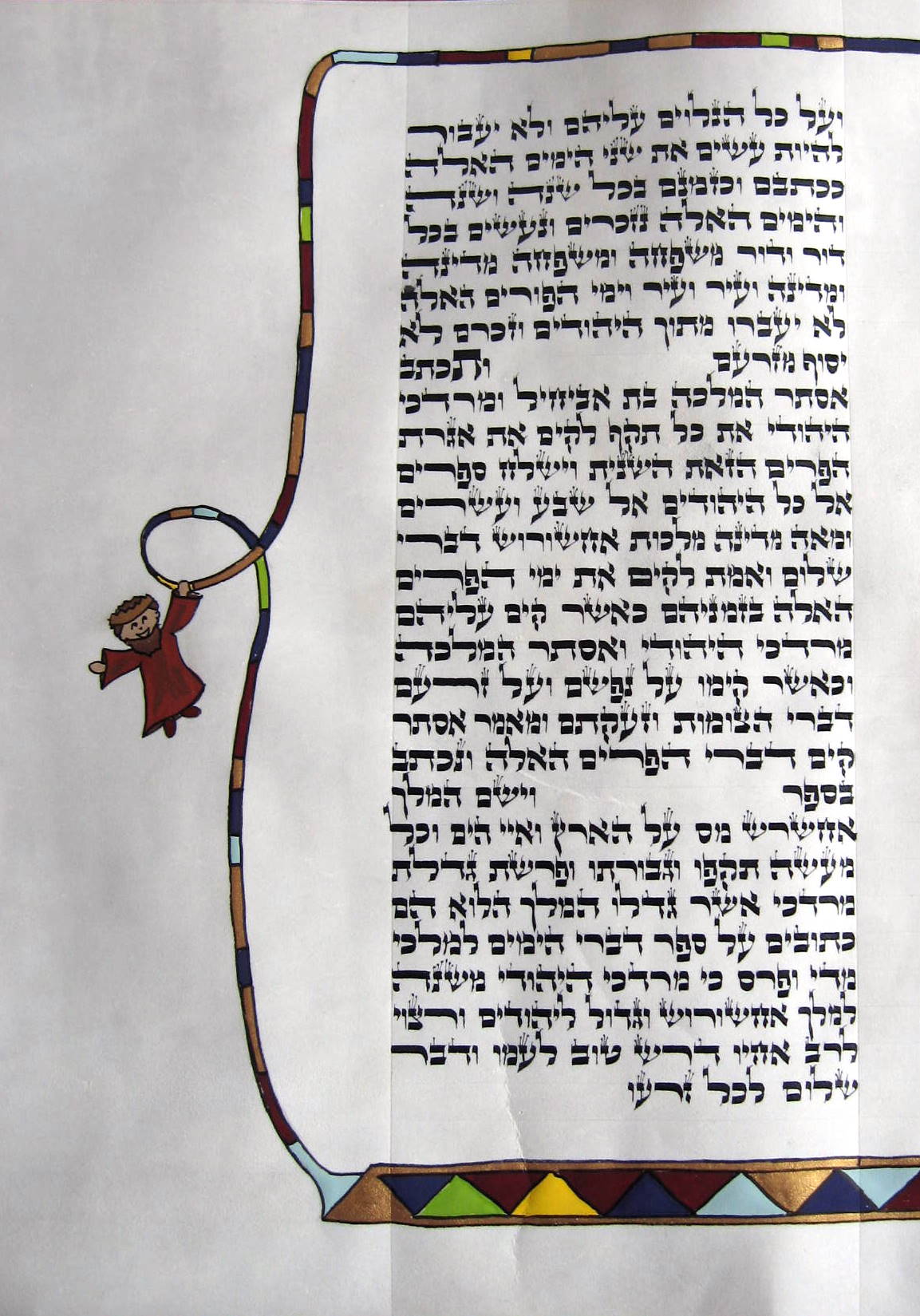
The family sent me pictures of things – pictures, shapes, colours – he found pleasing, and it seemed to me good to give the megillah a colourful frieze along the bottom, and a ribbon of colour and gold along the top, in the narrower margin there. (Click image to see bigger.)

In addition to various kinds of cheerful images, the phrase “little fat kings” came up in conversation with the family, and little fat kings I was jolly well going to do.

“It is just perfectly perfect,” said someone close to the family. Hooray!

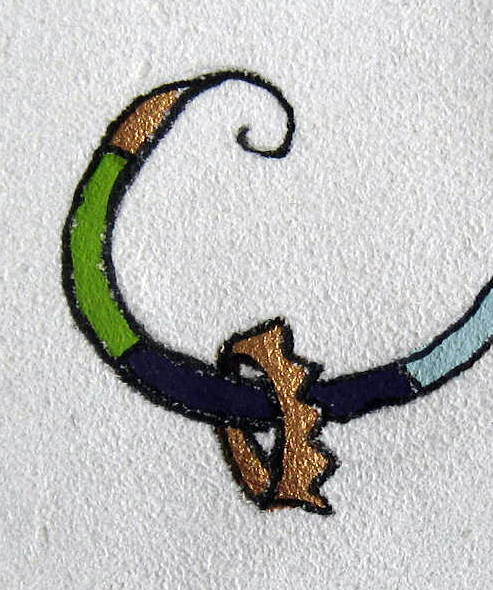
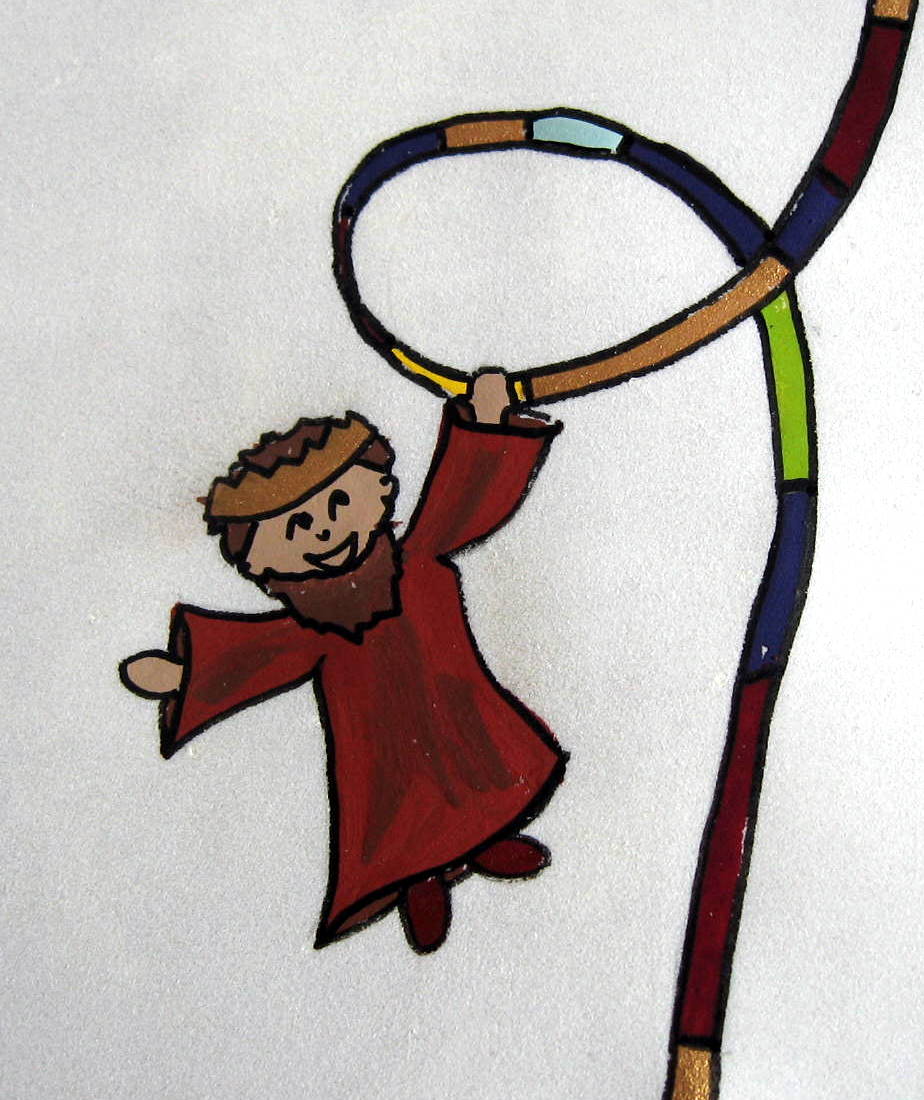
At the front of the megillah, the ribbon curls up, and a little crown hangs from it.

At the front of the megillah, the ribbon curls up, and a little crown hangs from it.

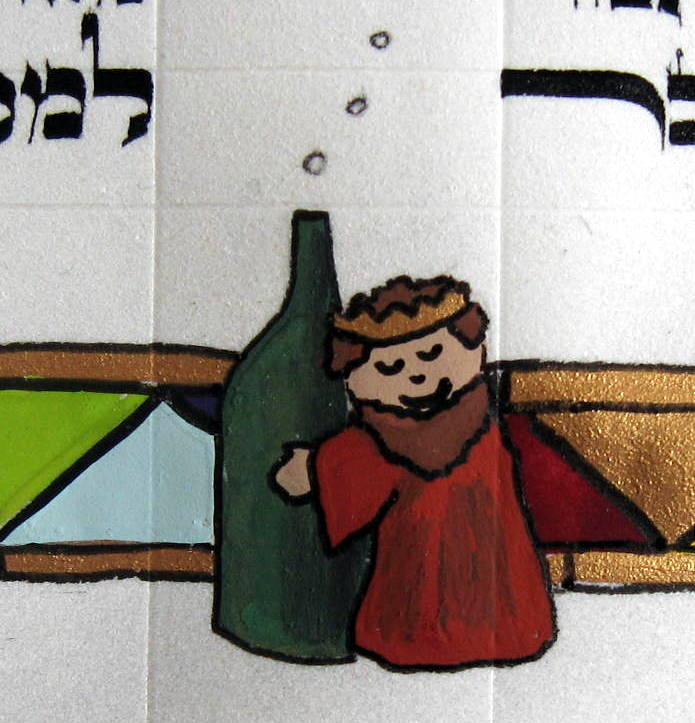
Image for Achashverosh's party...

Image for Achashverosh's party...

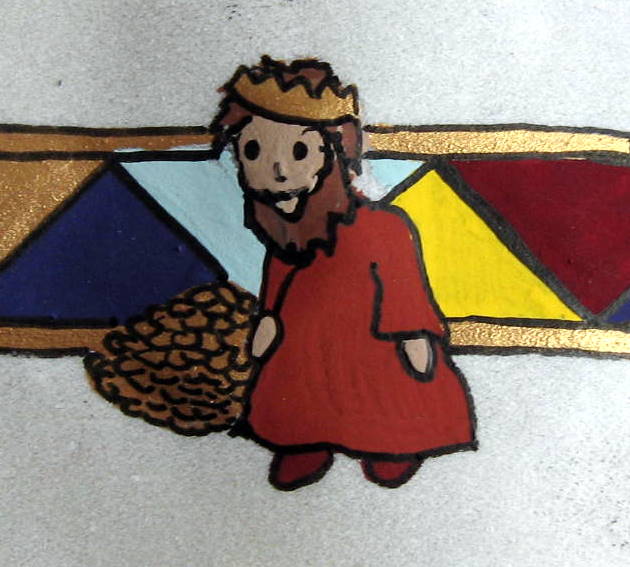
Achashverosh thrilled by enormous pile of money

Achashverosh thrilled by enormous pile of money

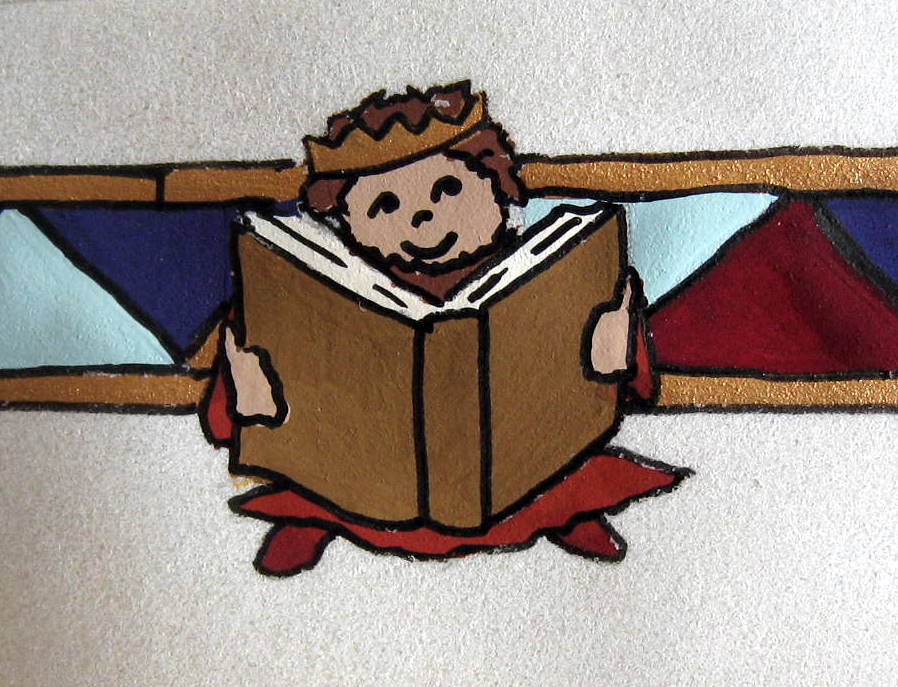
Anachronistic Achashverosh reading his journal-book. Codices are just cuter than scrolls.

Anachronistic Achashverosh reading his journal-book. Codices are just cuter than scrolls.

Apparently the frieze bends when you try and climb on top of it.

Apparently the frieze bends when you try and climb on top of it.

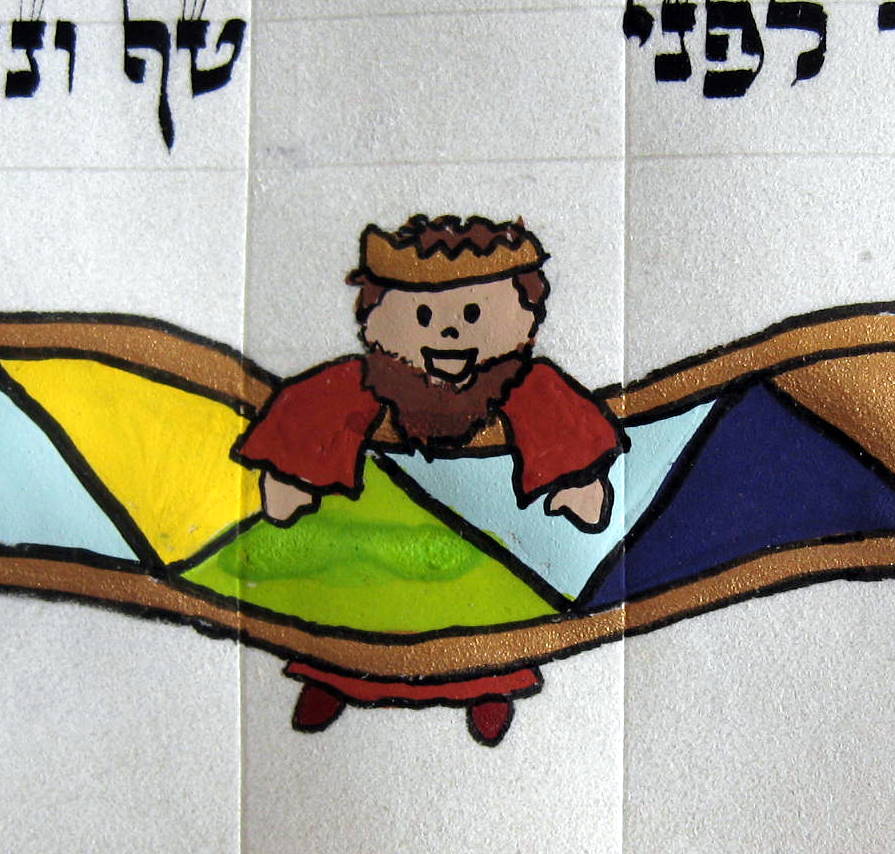
Success! Achashverosh applauds the hanging of Haman's sons.

Success! Achashverosh applauds the hanging of Haman's sons.

The king swings from the ribbon at the end of the Megillah.

The king swings from the ribbon at the end of the Megillah.

Clicky to see bigger.

Clicky to see bigger.


A megillah case

case

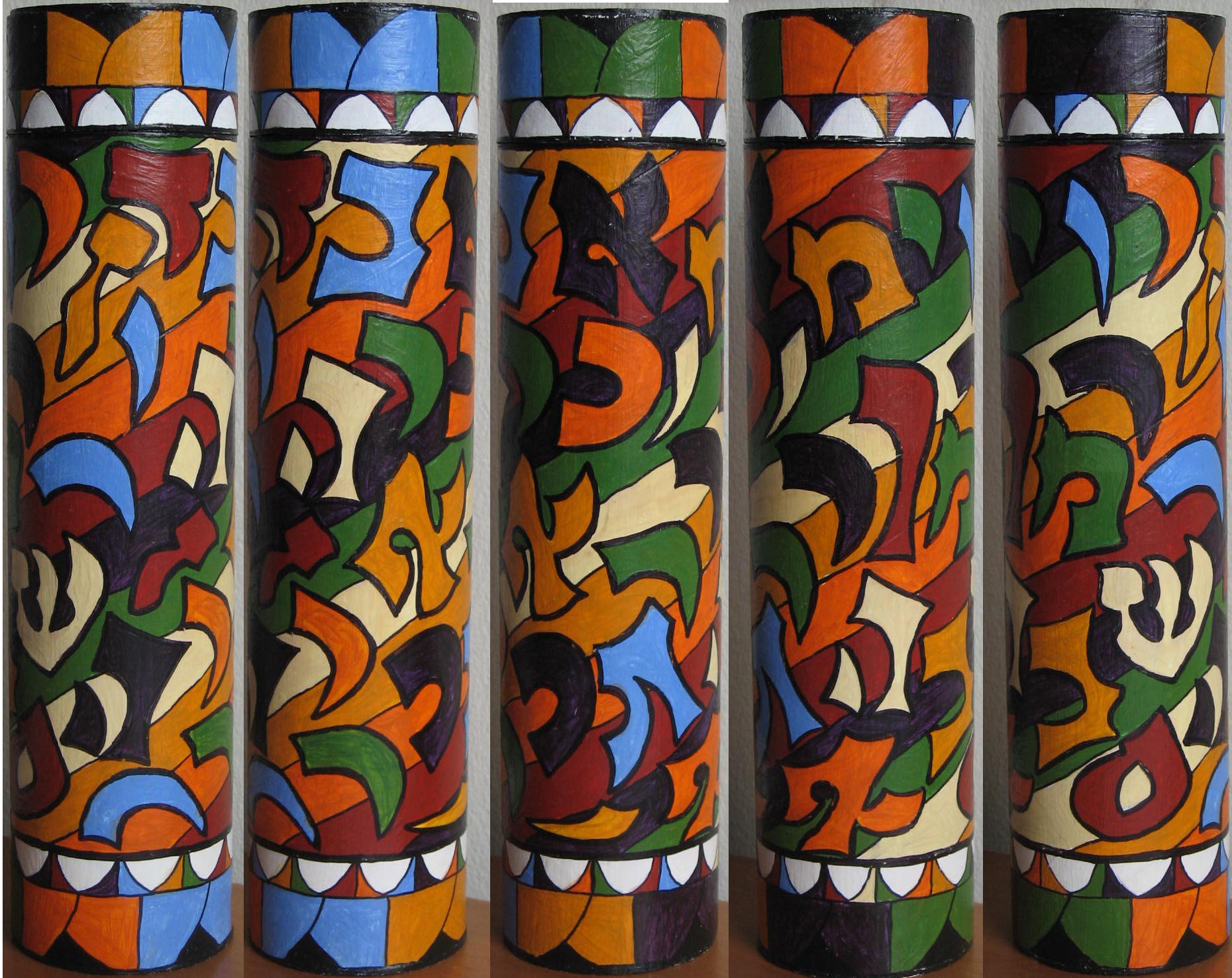
This Purim, I was commissioned to write a megillah for the Abramson Center for Jewish Life, and not just create a megillah, but also a case for it to live in. The Center’s rabbi asked if I could make a design that drew on the Center’s existing artwork, and that’s what you see above.

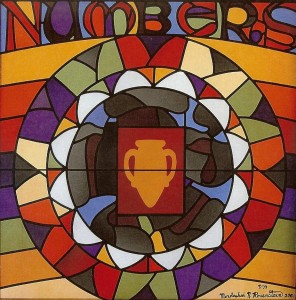
The Abramson Center has stained-glass windows by the artist Mordechai Rosenstein. I used elements from the Book of Numbers window, pictured here.

Why Numbers? Well, the book of Esther is quite interested in numbers, have you ever noticed? Listen up when you hear it this year – you’ll see. Also, in Numbers, the Israelites complain about המן, which is part of the Purim narrative also.

More seriously, the Shabbat before Purim is known as Shabbat Zachor, because it is on this Shabbat that we remember what Amalek did to the Israelites in the wilderness. The Amalek story is also brought up in the Book of Numbers, in Balaam’s oracle: Amalek was the first among the nations, but its end is utter destruction – and the future of Amalek is (albeit obscurely) what the Purim story is about.

So it is appropriate that the Megillah case draws its colouring and background elements, these energetic stripes of oranges, green, and purple, with white accents, from the Book of Numbers window.

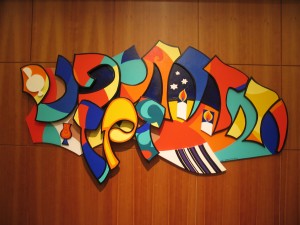
The letters are inspired by another Mordechai Rosenstein piece at the Abramson Center, pictured here, where they spell out והדרת פני זקן – honour the elderly.

What are the letters on the Megillah case spelling out?

The Numbers window depicts an amphora, and on Purim an amphora means one thing – wine. The rabbinic dictum is that one should drink עד דלא ידע – until he can no longer distinguish between “Blessed be Mordechai” and “Cursed be Haman.”

The Megillah case takes the words ברוך מרדכי and ארור המן, and adds the pairing “Blessed be Esther” and “Cursed be Zeresh” from the piyut Shoshanat Yaakov – and then mixes all the letters up, all over the case, until it’s all jumbled and scrambled and עד דלא ידע indeed.

The word translated “honour,” above, has the Hebrew root הדר, which we know in another context, הידר מצוה – hidur mitzvah, beautifying or honouring a mitzvah. This Megillah and its case were donated in memory of Eugene Winston, by Ira, Flaura, Andrew, and Zachary Winston, and they will have the satisfaction every year of knowing that the Center’s Megillah reading is beautified in Eugene’s honour. We wish them joy.

case

Since it’s only a week to Purim…

The original stone tablets were written by the finger of God, etzba Elohim.

Nowadays we write their less cumbersome representations, the Torah-scrolls, with quills, but what most people today don’t know is that ideally you don’t use a quill to write sifrei kodesh.

You’re supposed to use the index finger of your dominant hand — why the index finger? because Jewish tradition holds that there is a vein in the index finger leading directly to the heart; this is why in the wedding ceremony we put the ring on the index finger — you grow the nail, and then you shape it into a nib and write with that.

As well as representing the etzba Elohim, this also brings the scribe closer to the mitzvah. The Torah-scroll represents the marriage contract between God and the Jewish people; now, Jewish law states that one may contract a marriage by emissary, but it is obvious to all that it is better to attend one’s own wedding in person, since there is something rather glaringly inappropriate about contracting this closest of bonds by means of an intermediate agent. Similarly, writing a Torah-scroll with a quill, an intermediate agent, is permitted, but it is much better, if one can, to perform the act in person.

Most scribes today aren’t particular about this method of beautifying the mitzvah, and indeed it is hard to observe.

One reason quills are a decent technological substitute for fingernails is because they have very similar mechanical properties, both being made largely from keratin, rendering them tough but flexible, easily shaped but holding that shape. We’ve seen before in these pages that quills need frequent sharpening if they are to write well, and the same is true of fingernails. We’re used to cutting our fingernails, because they grow faster than we wear them down, but if you use your fingernail to write on parchment, it will wear down faster than your body can replace it, and you will run out of pen.

Since the invention of acrylic nail-tips, which are attached to the shortened nail, some scribes have been experimenting with using these prosthetic fingernails as writing tools. Interestingly, it’s following this line of thought that plastic nibs have recently been developed. Like nail-tips, these nibs are attached to one’s regular writing instrument and are designed to be longer-lasting than the original.

I’ve said before that plastic nibs definitely have their place, but they just aren’t capable of the subtlety of the keratin-based originals. Acrylic nibs are ingenious, but they really aren’t ideal. It follows that the careful scribe is forced to observe prolonged rest periods in which the fingernail must re-grow. One may, if pressed for time, use the other fingers of the hand, but this often results in reduced writing quality, given the lesser dexerity of the fourth and fifth fingers, so the truly careful scribe will plan his work such that he does not need to do this. This generally means he writes Torah one day a week and does some other job the rest of the time while his nail is re-growing.

This is why it takes such a long time to write a sefer Torah. If fingernails didn’t wear down with use, it would be possible to write a sefer Torah in an hour or so.

For consider this. We know that Moshe Rabbeinu died on Shabbat afternoon (R. Yosé in Seder ‘Olam Rabba 11), and we also know that Moshe Rabbeinu wrote thirteen Torah-scrolls on the last day of his life (R. Yannai in Devarim Rabba Vayyelekh §9).

Now, writing on Shabbat is a Biblically-forbidden activity, which Moshe Rabbeinu would not have done. But writing with one’s non-dominant hand is only prohibited on a Rabbinical level, at a much later date, which means that in Moshe Rabbeinu’s time it would have been permitted. So, we know that Moshe Rabbeinu wrote thirteen Torah-scrolls with his non-dominant hand in one day. (Clearly, had he been using his dominant hand, he would have been able to write far more Torah-scrolls, perhaps as many as forty.)

We also know that Moshe Rabbeinu had an unusually fast rate of keratin production, because his face had horns, which are, like fingernails, made from keratin. Normal people don’t produce keratin fast enough that they have horns; the best most of us can manage is hair and nails. But Moshe Rabbeinu was special. That’s why his Torah-writing wasn’t hampered by his fingernails wearing down, and how it is that he was able to produce thirteen sifrei Torah on one Shabbat.

Interestingly, the cantillation phrase traditionally used for the words etzba Elohim is a very rare one (occurs only once in Torah) called karnei Moshe – “the horns of Moses” – and this is why.

Wasn’t that educational?


From the scribe school

What happens when you let the nose on your dalet get out of control: it turns into an elephant.


Dog Torah

In honour of its being Adar, I give you Dog Torah.

I have a puppy.

Parts of her are tan-coloured like parchment, and parts of her are black and shiny like Torah ink.

She likes to squirm around on the couch.

I am a sofer stam.

Now read on…

Read More »


la vie soferet: yiddish

Tuesday night, I was teaching at my scribe school, as is my wont on Tuesday nights.

Three-quarters of the room was speaking Yiddish.

Now, I posted recently about the surreal experience of being at a party of young, egal-type Jews where three-quarters of the room was speaking Yiddish. That was strange, yes. But having three-quarters of my scribe school chatting on in Yiddish, well, my brain felt as though it was being turned inside out. I think this is what cognitive dissonance feels like.

That is – if I tell you that here’s a sofer class mostly speaking Yiddish, what do you expect? I expect a lot of black clothing, a lot of peyes, a complete lack of women, a lot of right-wing Orthodoxy and a lot of nineteenth-century Europe ambience. (Yes, my YU friends, this doesn’t describe you. I know. But you know the stereotype I’m carrying in my head, don’t you.)

So here’s a sofer class mostly speaking Yiddish, but it’s taking place in a women’s yeshiva,* there’s no right-wing Orthodoxy in sight,** it’s midtown Manhattan, it’s all women,*** there are no peyes, no Yentl, but it’s certainly a sofer class, and they’re certainly speaking a lot of Yiddish, and dear goodness cognitive dissonance on a grand scale makes it hard to teach a class, you can’t say anything for gaping wordlessly as your cognitive abilities try to catch up.

Possibly a good thing. As they say, aider me zogt arois s’vort, iz men a har; dernoch iz men a nar.****

* Not on principle, more because Drisha are nice and give us a classroom.
** Also not on principle. Orthodoxim are welcome, we just don’t have any Orthodoxim this semester.
*** Also not on principle, we just don’t have any men this semester.
**** Google, and only because I don’t know enough Yiddish to come up with a proper witty punchline.


Disaster in the Torah repair mines

Tears in Torahs are scary, people. I know. You see a big tear, you want to STICK IT BACK TOGETHER REALLY HARD so it WON’T TEAR ANY MORE. Nobody could be calm about finding this in their Torah, for instance:

tear1

But for the love of all things holy, don’t whip out the duck tape and do this:

IMG_4612

The amount of tape used is directly proportional to the amount of trauma someone’s trying to fix. But think about it for a second – it’s torn already. Tape isn’t going to fix it. You’re only trying to make yourself feel better with all that duck tape.

Go have a cup of tea instead. When you’ve calmed down, come back. The job of the tape is not to fix the sefer or to assuage your guilt at having let it get torn; tape is to stop things getting any worse until it can be fixed properly with parchment. Duck tape is for pipes and trucks. A Torah is neither. For a Torah we use artists’ tape to stop something getting worse, while we’re working on getting it fixed.


More from the Torah repair mines

Some repairs you don’t need a sofer for. You just need wood glue.

IMG_4692

Yes, folks – if your rollers are falling apart, get yourself some wood glue and jolly well stick them back together. Just don’t get the glue on the Torah, but you figured that out already. No scribal training required.