Jews of Aragon – Assis notes

I’ve been reading Yom Tov Assis’ books about the Jews of Aragon (for Gabriel’s orals: The Golden Age of Aragonese Jewry and Jewish Economy in the Medieval Crown of Aragon).

On the one hand, he describes the period 1210-1327 as a Golden Age for the Jews. On the other hand, he presents it as a time of extreme tension and social unrest, building all the time to the doom of 1391-1492 (1391: the Church really gets stuck into the Jews. 1492: expulsion of the Jews from Spain).

His basic project is to do a systemic survey of the materials in civil sources e.g. court archives and Jewish sources e.g. responsa literature of the Rashba, the Ritva, the Ramban, the Ran, etc., and the two books are the pictures he paints with them – one economic, the other more social.

He reminds us at several points that we tend to have documentary evidence for when things go wrong, not for when they go right. He is also aware that his data is rather extensively based in tax records, so his picture is necessarily rather weighted towards matters financial.

So, here’s the picture I have from Assis:
————————-

This period covers four kings – Jaime I, Pedro III (his son), Alfonso III (his son), and Jaime II (Alfonso’s brother). The Crown of Aragon is a scattery bunch of territories, which are constantly being ceded, seized, and whatnot. This is terrifically expensive, and the king always needs money.

Christian society is basically feudal, but the Jews are outside Christian society, in that they belong to the king. They aren’t slaves, but they and all their stuff belong to him.

They’re like a herd of cash cows, seriously. He wants them to be basically pretty happy and healthy and engaging in commerce and suchlike (trading in wheat, oil, spices, cloth, Muslim slaves, real estate; moneylending), so that he can milk them regularly – that is, he can tap them for money frequently and heavily. He uses financial enticements to get them to settle in newly-conquered territories, as well – useful.The Jews are a major source of income for the king (although Assis only once, in two books, uses a percentage figure, grr).

One of the first things I learned was about this system of privileges. You need a privilege for practically everything in the Crown of Aragon. Examples: building a wall around the Jewish quarter, repairing the synagogue, having a bakery, moving to a new city. Also, being allowed to have gates in the wall, and to close the gates when Christian mobs come howling by. Not being stoned in the street by Christians is a privilege too.

Privileges cost money. This suits the king. Like this:
JEW, to KING: Can I please have the right not to be stoned in the street?
KING, to JEW: Sure. That’ll be £500.
CHRISTIAN, to KING: Hey, what if we give you £600, can we have the right to stone Jews?
KING, to CHRISTIAN: Oh, okay, sure.
KING: Yay, status quo is preserved and I have £1100! Smithers, make an appointment for the Jews next week.

The king is doing this continual balancing act between the Church and the Jews. On the one hand, the Jews are his cows and they mean money, which he needs. On the other hand, the Church thinks the Jews are disgusting and should be converted or otherwise got rid of. So the king placates the Church, letting them impose sermons and compulsory disputations and the like upon the Jews, but he’s giving the Jews all sorts of getout clauses, such as the right not to listen to the sermons, or the right to field a good rabbi in the disputations. Pragmatically, he doesn’t want them converting; they aren’t cash cows once they’ve converted.

Over time, the Jews become less useful to the king (more about that soon!) and the Church (independently) becomes a great deal more a) zealous b) powerful, so the balance strikes in the church’s favour more often, until 1492. Until then, the king is always trying to prove that he’s a good Christian whilst simultaneously keeping his Jews healthy so that they’ll keep making money for him.

CHRISTIANS, rampaging at the gates: Let’s kill the Jews!
KING: Hell no! MY JEWS OK
JEWS: Phew!
KING: Spare a tenner till Tuesday?
JEWS: *tinkle tinkle clink* (that is the sound of a cash cow being milked)
CHRISTIANS: *disperse grumbling*
JEWS: Truly, this a golden age!

Detail: in some places, the Jews don’t have a bakery of their own, so they use the Christian bakery nearby. Over Pesach week, the Jews aren’t using the Christian bakery, and the Christians are annoyed that they take less profit that week. So the Jews have to give money to the bakery for the bread they aren’t buying so that the Christians won’t be discommoded.

The Jewish communities (defined by area; theoretically every Jew was answerable to some community or other. There was a nice bit where a Jew got fined for having a breakaway minyan in his house one Yom Tov) were basically autonomous–the Jews may have belonged to the king, but he didn’t want the tedious jobs of running the communities; he left that to them–but the king got involved rather often. There were lots of Jews at court (sometimes as physicians, diplomats and the like; sometimes as merchants and moneylenders) and if they weren’t happy with the way the community was treating them they tended to get the king involved, thus:

RICH JEW: I want the third aliyah on Yom Kippur.
COMMUNITY: But you beat your wife. We want to give it to Dan, who has donated a new roof this year.
RICH JEW: WAAAAHHHHH!!!!!! King king they’re not being NICE TO ME! By the way, do you want a tenner till Thursday?
KING: Dammit Jews, give him the third aliyah on Yom Kippur.
COMMUNITY: Damn, we have no power. Sucks to be us.

So there was this rather awkward situation where all the Jews were cows, but there were strata: Rich Cows With Influence At Court, and Poor Cows With Taxation But Basically No Representation.

(The rich cows are doing okay. There’s quite a lot of scholarship, art, music, and other Golden Age type stuff going on. And it’s certainly a hell of a lot better than the situation in e.g. France, even for the poor cows.)

Enter taxes.

The Jewish quarter is quite often near the king’s quarters (and in places without palaces, the king rather often does an Elizabeth I and goes On Progress, staying with the Jews:
KING: Hey, we’re spending April by you, okay?
100 COURTIERS: And us!
1000 SERVANTS AND HORSES: And us!
JEWS, to KING: Hullo again. Seems like no time since last year, eh?
JEWS, to COURTIERS: Could you please not take all the beds?
JEWS, to their families: Guess we’re sleeping in the stables again this month, kids.
CHRISTIANS: Let’s go see the king, and mob a few Jews on the way!
RICH JEWS: Let’s hang out in the court so we don’t get killed!
POOR JEWS: Sucks to be us.) so that he can keep an eye on the Jews. He also has a collection of tax-assessors, so that he can have an idea of how much money the community can drum up.

Tax time works like this:
KING, to the JEWS OF BARCELONA: You lot have to give me £50,000 this year.
THE COMMUNITY LEADERS: Okay. Rich Reuven and Swanky Shimon and Lush Levi can pay £10,000 each and the 200 poor people can pay £100 each and we’ll be good.
RICH REUVEN: Oh hell no, I’m not paying taxes.
RICH REUVEN, to KING: Hey king. Can I have a privilege to be exempt from taxes please? Here’s £5000.
KING: Sure! This is great, now I get £55,000!
THE COMMUNITY LEADERS: Rats. Now all the poor people have to pay £150 each because we have to come up with the £50,000 somehow.
POOR JEWS: That’s not fair! King, ki–
KING: If you lot don’t behave I’m going to start taking away your privileges.
POOR JEWS: Sucks to be us.

The communities are continually scrambling to come up with the tax money, in addition to having to pay for privileges (like the right to not be killed by rampaging Christians). They tax pretty much anything you can think of (sales tax, property tax, tax on loans, tax on certain sorts of income, there’s even a tax on weddings and people who are visiting from out of town) to get the money together. Plus they have internal expenses, like feeding the destitute, building walls to keep out Christians, and so forth. Those have to be paid for too. One is reminded of the line in the Mishneh Torah which says if someone won’t contribute to the community tzedakah funds he is beaten until he contributes – really like that. The king doesn’t really care so long as he gets his taxes. And his loans, and his little presents and fines and privilege payments. This becomes increasingly burdensome as it becomes harder and harder for the communities to stay afloat financially.

So basically – the Jews belong to the king, like cows; practically everything we take for granted as a right has to be bought as a privilege; the king is continually squeezing the Jews for money; there’s a festering divide between rich and poor Jews; this, with the pressures of the squeezes, makes the communities financially less healthy over time; this makes them less useful to the king as cash cows so he doesn’t stand to lose as much by letting the Church have their way with the Jews; as the church becomes more powerful in general the pressure increases; sucks to be a poor Jew, and eventually it sucks to be a rich Jew too.

student love

I love RG.

RG has been coming to Apprentice with a Sofer on Tuesday nights.

She doesn’t count herself as valid to work on a sefer Torah (because she holds that men and women have different halakhic capabilities) so every time we do a new thing, she asks me “Can I do this? Can I do that?”

I love this. It’s so un-awkward. It makes it so easy to emphasise “Some people can’t do everything. It’s okay to be one of those people. There’s plenty you can do anyway. And no-one’s judging you.”

Cheers, RG!


from the Torah repair mines

smudge2

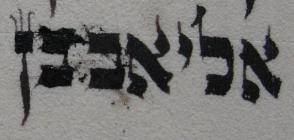
When re-inking letters, do not forget and plonk your stupid elbow down on them.


The days were the days of the ripening of the grapes.

IMG_5296You haven’t had time to forget the story of the spies yet. Moses sends twelve good men and true out of the wilderness to check out the Promised Land; they come back reporting that the land is full of scary giants; the people decide that they actually don’t want to invade right now thanks all the same; and God is wroth.

The end of the first aliyah:

וּמָ֣ה הָ֠אָרֶץ הַשְּׁמֵנָ֨ה הִ֝וא אִם־רָזָ֗ה הֲיֵֽשׁ־בָּ֥הּ עֵץ֙ אִם־אַ֔יִן וְהִ֨תְחַזַּקְתֶּ֔ם וּלְקַחְתֶּ֖ם מִפְּרִ֣י הָאָ֑רֶץ וְהַ֨יָּמִ֔ים יְמֵ֖י בִּכּוּרֵ֥י עֲנָבִֽים׃ And what the land is, whether it be fat or lean, whether there be trees therein, or not. And be ye of good courage, and bring ye of the fruit of the land.” And the days were the days of the ripening of the grapes.

Here’s something interesting. Various nineteenth-century chasidic commentators, such as Hekhal Ha-berakha (Rabbi Isaac Judah Jehiel Safrun, 1865) say that this is a Bad Place to end the aliyah, because it refers to harsh judgement, and you aren’t supposed to end aliyot on negative notes.

What is negative about grapes?! The season is that of blooming and flourishing, when the harvest is full of fine promise and the land full of beauty. Why is this bad?

Enter Seder ‘Olam Rabba, an early rabbinic text attributed to the Tanna Eli‘ezer ben Yosé Ha-gelili, which calculates biblical chronologies. The Israelites spent a year less ten days at Sinai (Numbers 10:11), thirty days at Qivroth-Ha‑ta’ava (11:19-20), and seven days at Ḥatzerot (12:15). And then, the spies left the camp on the last day of Sivan — late June or early July, the days of the first ripening of the grapes. They returned forty days later, on the Ninth of Av. And on that day God declared that none of that generation would enter the land.

In later sources, the months of Tammuz and Av, especially between the 17th of Tammuz and the 9th of Av, become understood as forboding, dangerous, or even demonic. A time of gathering wrath and impending curse. The Zohar even ties the verse to the Tree from which the Sin of Adam was committed, which some rabbinic sources identify as a grape-vine (the source of wine, which leads to sin). The author of the Zohar sees these weeks as the time when the universe re-lives the Sin of Adam.

In the 17th century, R’ Samson of Ostropolia even reads the word ‘anavim, grapes, as a reference to Samma’el, the Devil himself: through a caesar cipher, the word ענבם converts to סמאל, when each letter of the word is replaced by the preceding letter in the alphabet. Surely the chasidic sources who refuse to end the aliyah on this word are worried about something extremely frightening.

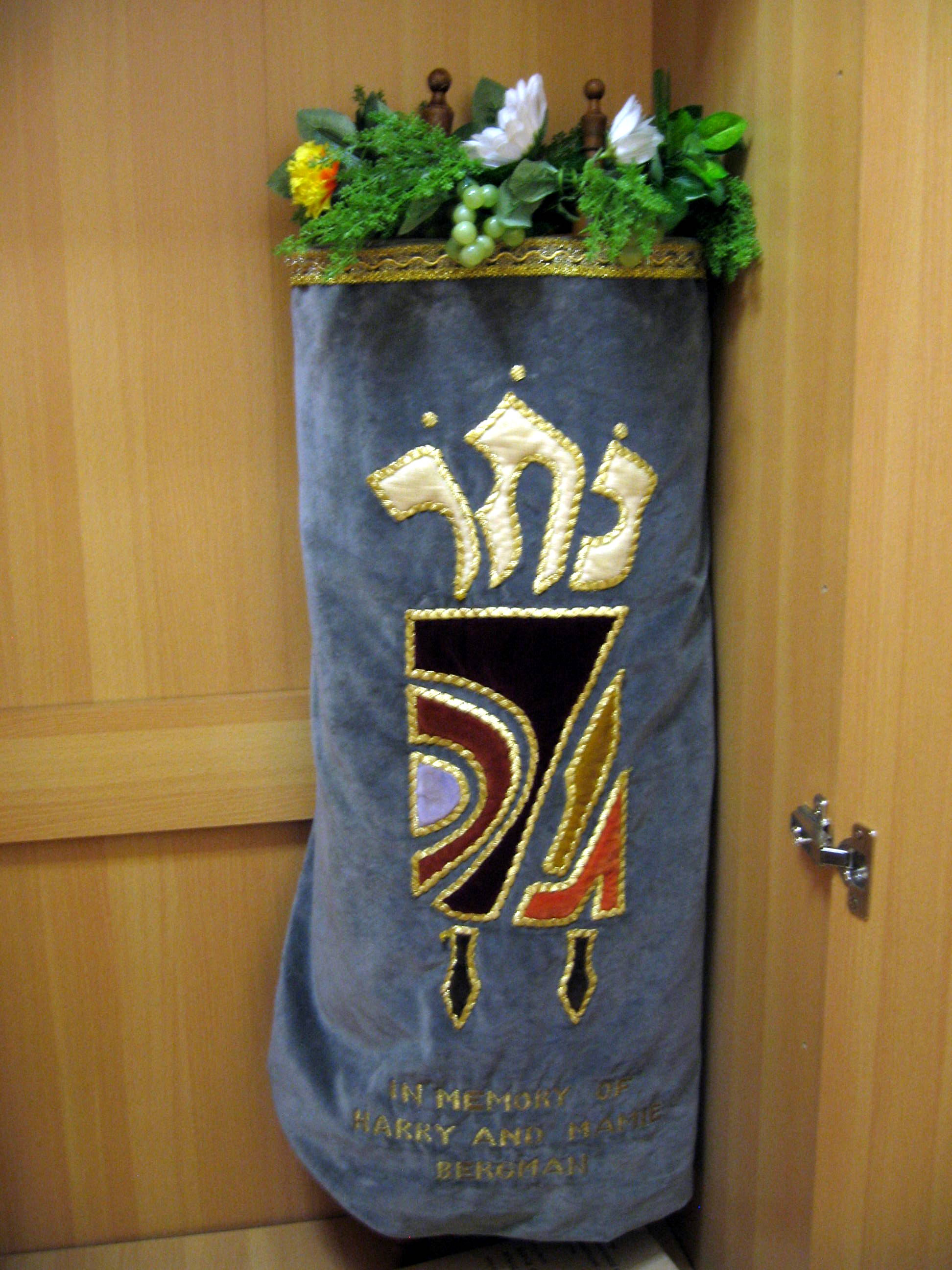
But we who end the first aliyah on these words are surely seeing the grapes as a positive thing. We’re more like the view of the Keli Yaqar (Ephraim of Luntshitz, 1550-1619) which views the ripe grapes in our verse as symbolizing the state of the Israelites at this point in their narrative; their time had come to enter the land, for they had already ripened, like grapes; their perfection had become complete from the Torah which they had learned at Sinai. And so it is that the sefer Torah is wearing a leafy crown with grapes; we put it on for Shavuot, and we will take it off only before the Ninth of Av.

IMG_5297

This view is based on Psalm 80:9-16, which has an extended metaphor of Israel as a grape-vine:

גֶּ֭פֶן מִמִּצְרַ֣יִם תַּסִּ֑יעַ תְּגָרֵ֥שׁ גּ֝וֹיִ֗ם וַתִּטָּעֶֽהָ׃
פִּנִּ֥יתָ לְפָנֶ֑יהָ וַתַּשְׁרֵ֥שׁ שָֽׁ֝רָשֶׁ֗יהָ וַתְּמַלֵּא־אָֽרֶץ׃
כָּסּ֣וּ הָרִ֣ים צִלָּ֑הּ וַֽ֝עֲנָפֶ֗יהָ אַֽרְזֵי־אֵֽל׃
תְּשַׁלַּ֣ח קְצִירֶ֣הָ עַד־יָ֑ם וְאֶל־נָ֝הָ֗ר יֽוֹנְקוֹתֶֽיהָ׃
לָ֭מָּה פָּרַ֣צְתָּ גְדֵרֶ֑יהָ וְ֝אָר֗וּהָ כָּל־עֹ֥בְרֵי דָֽרֶךְ׃
יְכַרְסְמֶ֣נָּֽה חֲזִ֣יר מִיָּ֑עַר וְזִ֖יז שָׂדַ֣י יִרְעֶֽנָּה׃
אֱלֹהִ֣ים צְבָאוֹת֮ שֽׁ֫וּב נָ֥א הַבֵּ֣ט מִשָּׁמַ֣יִם וּרְאֵ֑ה וּ֝פְקֹ֗ד גֶּ֣פֶן זֹֽאת׃
וְ֭כַנָּה אֲשֶׁר־נָֽטְעָ֣ה יְמִינֶ֑ךָ וְעַל־בֵּ֗֝ן אִמַּ֥צְתָּה לָּֽךְ׃
8 Thou hast brought a vine out of Egypt: thou hast cast out the heathen, and planted it.
9 Thou preparedst room before it, and didst cause it to take deep root, and it filled the land.
10 The hills were covered with the shadow of it, and the boughs thereof were like the goodly cedars.
11 She sent out her boughs unto the sea, and her branches unto the river.
12 Why hast thou then broken down her hedges, so that all they which pass by the way do pluck her?
13 The boar out of the wood doth waste it, and the wild beast of the field doth devour it.
14 Return, we beseech thee, O God of hosts: look down from heaven, and behold, and visit this vine;
15 And the vineyard which thy right hand hath planted, and the branch that thou madest strong for thyself.

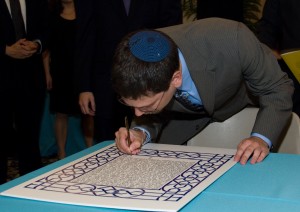
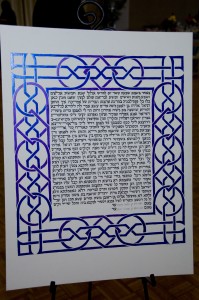
Fun with ketubot – sighting a ketubah in the wild

Stolz 0559

Stolz 0554


Scenes from the inbox

Here’s an interesting question:

Dear Ms. Friedman,

this is not specifically about religious scrolls, but as a scribe, could you tell me how many handwritten letters can usually fit on the parchment made from one cow, or on the parchment made from one goat,
or on the parchment made from one sheep? Assuming the letter sizes, lines distances, and margins that were usually used before the invention of printing, so that the result is readable and doesn’t look
rushed or squeezed.

I’m asking out of curiosity; I was wondering what kind of short stories, treatises, poems or articles could fit on one hide.

Answer:

“Assuming the letter sizes, lines distances, and margins that were usually used before the invention of printing, so that the result is readable and doesn’t look rushed or squeezed.”

That’s a huge assumption, which may be shaping your thinking in an unhelpful way. If you look at different manuscripts from the appropriate period you will see an enormous variation in letter sizes. A skilled scribe with good materials can write a truly tiny book which nonetheless doesn’t look “rushed or squeezed.” The style of writing also makes a difference; for instance, black-letter takes up a great deal less space than uncial letters of the same height, so one can fit more letters in. Speaking as a scribe, the amount of text I have to write and the size of the available media often dictates my choice of script and size.

An instructive exercise would be to look at, for example, a small psalter or prayer-book; note the page dimensions, and count the average number of letters per line and lines per page. Many libraries have online collections, see below. Find out how much writing surface one generally gets from a hide by asking parchment suppliers. Use your page dimension to calculate number of pages per hide; remember you can write on both sides. You might also find the fields of book history and codicology fruitful.

Links: http://www.bl.uk/manuscripts/Default.aspx
http://digitalgallery.nypl.org/nypldigital/explore/dgexplore.cfm?topic=arts&col_id=173


What are you doing on Tuesday evenings this summer?

You could be taking my class at Yeshivat Hadar!

Or one of the half-dozen other Tuesday night classes which will also be happening. Here’s what mine is going to look like:

Apprentice with a Sofer

Learn basic Torah repair and maintenance skills which will enable you to keep your community’s Torah scrolls in good working order. We will learn halakha from the sefer Keset haSofer, and practical skills by working with real Torah materials and a real Torah scroll. Skills will include proper use of tape, sandpaper, alcohol and erasers; replacing broken seams; how to identify and tackle pasul letters; and the use of the internet for seeking advice.

In order to work on the Torah scroll you must be traditionally shomer Shabbat and punctilious about the mitzvah of tefillin. Alternatives will be provided for those who are not currently at this level.

When: Tuesday nights, June 21-August 2, 2011 (Note: the beit midrash will not meet on July 19 due to 17 Tammuz)
Time: 7:15pm – 8:45pm; (Arvit will take place at 8:45pm)
Cost: Free
Where: Mechon Hadar, 190 Amsterdam Avenue (at 69th St.)

First class this week! With desserts and a talk from R’ Ethan Tucker, Toward a Sustainable Egalitarian Judaism.


Like snow at harvest-time

So how was your Shavuot? I spent it in Washington Heights, davening at Breuer’s.

Breuer’s looks like this on Shavuot:

Green velvet draperies, all hung about with boughs and flowers, with trees in tubs, and a chuppah-thing over the amud made from green branches. When it is a hundred degrees out and you walk into the cool air-conditioning and you breathe the pine scent and see all the greenery and the flowers, it’s a most beautiful feeling.

Breuer’s also does poetry, and this year I was struck by one of the piyutim for the first day of Shavuot. The poet has been talking for several pages about the various travails of the Israelites; the tough times the patriarchs went through, and he mentions the smiting of the rock, which made me think of the Israelites being hungry and thirsty in the desert, and he talks about the scary thunder and lightning and mountains being torn up by the roots and voices of trumpets waxing loud and louder. It is somewhat overwhelming.

And then he says:

צִיר אֱמוּנִים נִתְעַלָּה בִּבְחִירִים
כְּצִנַּת שֶׁלֶג בְּיוֹם קְצִירִים
חָכָם עָלָה לְעִיר גִּבּוֹרִים
וַיּוֹרֶד עֹז מִבְטֶחָה לַהֲדוּרִים
אֲמָרִים נְעִימִים מִפְּנִינִים יְקָרִים
The messenger of the reliable ones was elevated among the chosen,
Like the cold of snow in the time of harvest.
The wise man ascended to the City of the Mighty [angels].
And brought down Strength [the Torah] as a stronghold, for the beautified ones –
Sweet words, dearer than pearls.

It’s referencing a line from Proverbs (25:13) –

כְּצִנַּת-שֶׁ֨לֶג׀ בְּי֬וֹם קָצִ֗יר צִ֣יר נֶ֭אֱמָן לְשֹׁלְחָ֑יו וְנֶ֖פֶשׁ אֲדֹנָ֣יו יָשִֽׁיב׃ As the cold of snow in the time of harvest, so is a faithful messenger to them that send him: for he refresheth the soul of his masters.

The Israelites have been having rather a tumultous time of it, hitherto. Like navigating crowds of people at an outdoor market with a zillion errands to run in boiling hot humid weather. Then Moses gets the Torah and it’s like the cold of snow in the time of harvest – like walking from hundred-degree heat into a spacious, pine-scented, air-conditioned room and not having any errands to run any more.

I’m put in mind of a friend I once had, who was formerly an egal-type Jew, but then became very chareidi, very Traditional Women’s Roles. Why? we asked her. Why have you done this to yourself? And she replied, with a contented serenity, “Everything is so simple now.”

I think it was like that for the Israelites, a bit. Now they had the Torah, they had rules and goals and guidelines. They didn’t have to do anything at all except what they were told. Everything had become simple now. And when you walk into Breuer’s, and you feel the delicious coolness of snow but see the lush green of the harvest, you’re reminded – via the poem – of Torah, and everything being clear and refreshing and simple.

Of course it’s not that easy – it never is – but the poet is giving a vision, and one that it doesn’t hurt to be inspired by now and again.


יששכר – joint post with MarGavriel

I can’t remember which of you asked me about the word יששכר last week, but MarGavriel just sent me a translation of part of S. S. Boyarski’s work Ammudei Shesh and it had a tangent about יששכר in it, so here goes.

The question was “What’s the deal with there being two letter shins in יששכר but our only pronouncing one of them?” That is, why’s it pronounced yissåkhår rather than yissåsskhår or anything else you might come up with?

So, today I learned that it’s okay to be confused about it, because it’s confusing.

It’s kind of like the name Catherine (which started out as Greek Aikaterinẽ, according to Wikipedia) – Cath-er-ine and Cath-rin are both legitimate ways of saying it depending on what sort of attitude your dialect has towards extra syllables. Around the end of the first millennium CE there were at least two ways of saying יששכר floating about; yissåkhår and yish-såkhår.

This period is important because it’s when the masoretes were doing their enormous project of recording the scriptural canon. They went out and listened to people chanting the scriptures, and they wrote down what they heard.

In particular, they were very interested in how things sounded. Their job was one of listening to people, experts, reading the Torah and Nakh, and recording what they heard – aiming for the best, most accurate, most precise record of How The Torah Is Pronounced. We have them to thank for our vowel notations; before the Masoretes, we just didn’t have a way of recording vowels.

There were different centres of masoretic activity – in Babylon, Jerusalem, and Tiberias – and within the centres, different schools. And sometimes they heard different things. There are lists of Differences Between Masoretic Traditions which we still have.

For instance, the school of Ben Asher recorded a tradition of spoken Hebrew in which יששכר is pronounced yissåkhår, and the school of Ben Naphtali recorded a tradition of yish-såkhår.

I have a feeling that as the vowel notation became more canonical – more recognised as part of the apparatus accompanying the Written Torah – our comfort with having variant, equally valid traditions receded. It became important to us to have one, and just one, way of doing things.

Whether justly or no, the Tiberian centre came to be regarded as the most authoritative centre, and the school of Ben Asher its most authoritative school. Our manuscripts today are vocalised in accordance with Ben Asher; there are no surviving Ben Naphtali manuscripts, barring perhaps a few geniza fragments and the aforementioned lists.

Our friend Boyarski quotes one M. di Lonzano: “All Jews have the custom to rely on Ben-Asher, as if a heavenly voice had gone forth, and declared that the halakha was in accordance with Ben-Asher.

Now, here’s a funny thing. MarGavriel says that Yossi Peretz says that in the early modern period, there was a new wave of interest in things masoretic. A general surge of faith in the wisdom of the ancients combined with said wisdom being newly accessible in print, and in particular people noticing that goodness, there used to be a tradition where יששכר was pronounced with two shins!

And so a custom arose among Ashkenazim sometimes to pronounce יששכר with two shins – perhaps as per Ben Naphtali, yish-sokhor, perhaps simply – intuitively – yisoschor. Some did it only for its first appearance in Torah, in Genesis 30:18. And some did it all the way up to – but not including – Parshat Pinchas.

Why?

Look at Genesis 46:13 and compare it to Numbers 26:23-24. Who are יששכר’s children?

In Genesis, his third child is יוב. But in Numbers, his third child is ישוב. Extra shin, see?

So here’s the story. Issachar named one of his sons יוב. Then, somebody told him that this was the name of an idol in some country, and he was upset.

In order to get rid of the idolatrous name, he took one of the shins from his own name, and generously gave it to his son. So Yishsåkhår became Yissåkhår and Yov became Yåshuv – but until he does that, in parshat Pinchas, you still have to pronounce the extra shin in the father’s name.

Cute, but in no way authoritative. In any case, it’s more common to say it with two shins just the first time, but don’t start doing either of them just because you read it here. You aren’t living in early modern Ashkenaz; you don’t live in historical circumstances which justify you mispronouncing a word to invoke a mostly-forgotten Tiberian Masorete. You start doing that, you’ll never stop.

I am sort-of considering, for my next sefer Torah, giving crowns to both letters shin in יששכר up to Pinchas, and then crowning only one of them thereafter, but that’s rather a liberty, so it may remain a dream. But one does have more leeway with crowns than with pronounciation.


Tanakh On Klaf

Although scrolls of the Pentateuch have been common among almost all groups of Jews throughout the millennia, scrolls of the rest of the Tanakh have been much more rare.

One colorful individual in the story of Tanakh scrolls was a character in the Old Yishuv of Jerusalem, in the 19th century.

He insisted on returning to the original forms of Scripture — parchment scrolls of all the books — as preparation for the messianic era, when the biblical prophets would be resurrected, and would want to find everything as they expected, from their own day.

Here’s a Wikipedia article about him: http://en.wikipedia.org/wiki/Shemuel_Shelomo_Boyarski.