Fun with piyutim – Iti Milvanon, 4/4

Part 1, Part 2, Part 3

adjusted

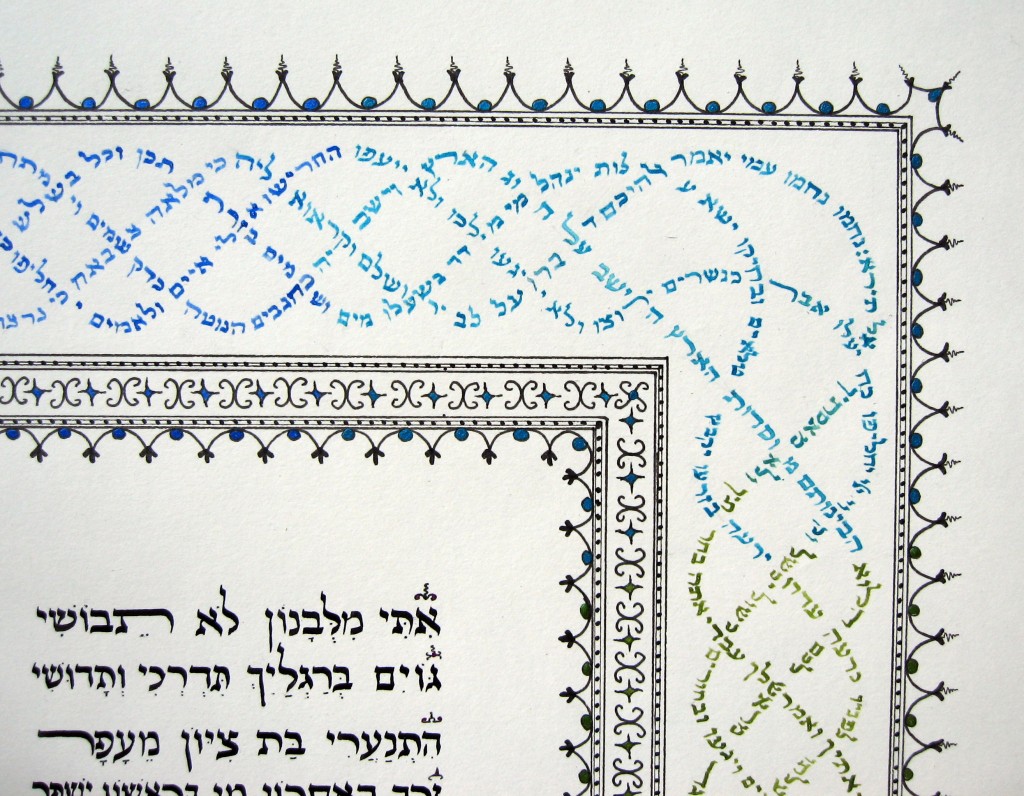
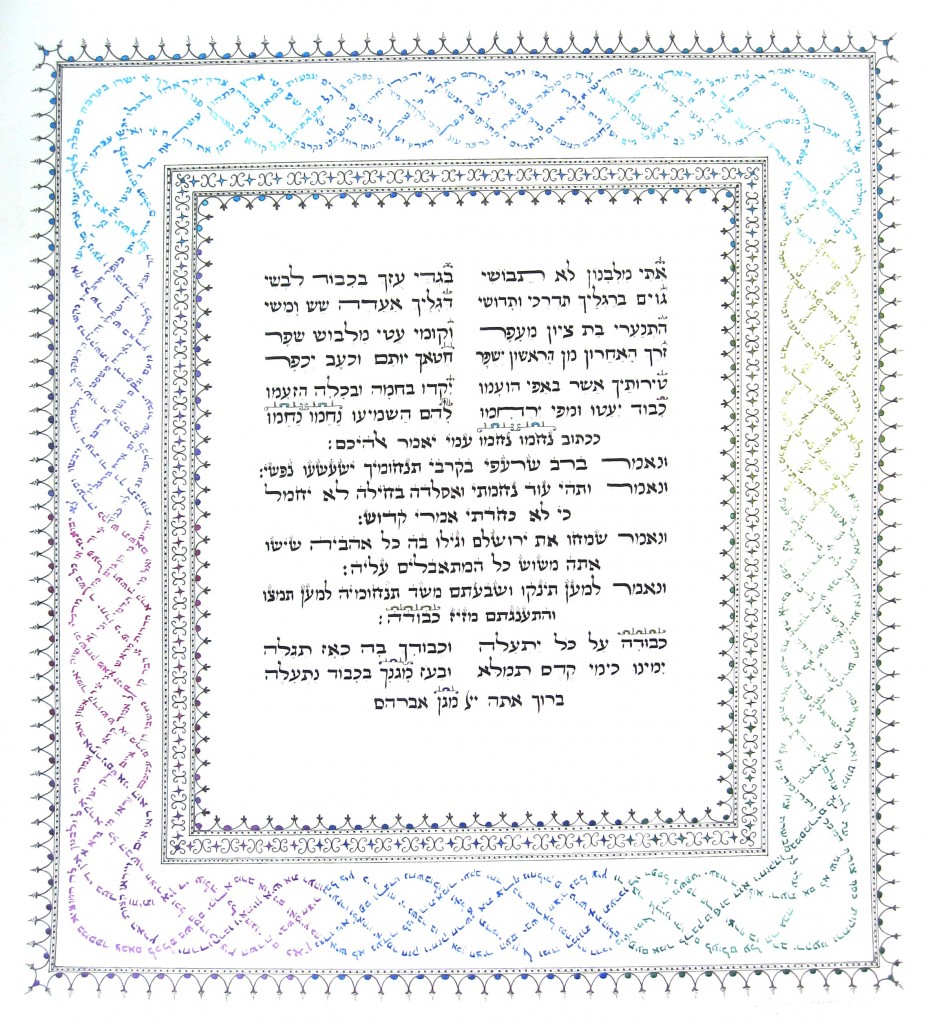
The hardest part was getting the braid around the outside right. I wanted it to be just one line, going round and round, but if you just run a sinewave around the edge, you get either two or four lines, and I very much wanted only one line, because I only wanted to have the one text in the border.

It frustrates me no end that I no longer have the mathematical vocabulary to articulate the problem and thus find the solution easily. I contemplated asking a certain chap I know who works with knot theory, but didn’t want to admit defeat, and eventually figured it out the painful way, by drawing it on squared paper.

If you look carefully, you can see that there are eleven troughs along the top border but only ten along the bottom border. This is because a one-strand braid works if your border isn’t a whole number of wavelengths but is something-and-a-half wavelengths. The easiest way to do that is remove one of the troughs on one of the short edges and stretch the others a bit to make up for it – you could say, ok, the border is 100cm and the wavelength is about 4cm which would come out to 25 phases so let’s make it 24.5 okay divide 100 by 24.5 that’s 4.08 rightio let’s make the wavelength 4.08cm and figure out how to centre that so that the side borders are level with each other…but that’s very tiresome, so I didn’t bother.


Fun with piyutim – Iti Milvanon, 3/4

Part 1, Part 2

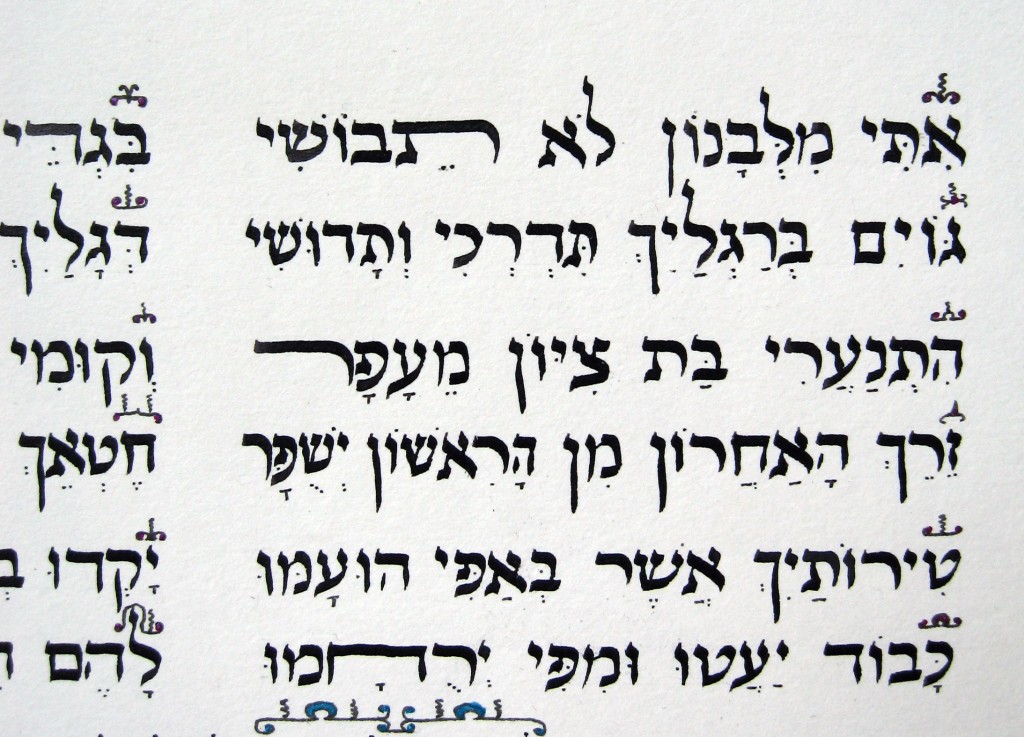
One of the clever things about piyutim is all the little linguistic tricks they use. Rhyme, of course; I tried to use white space between stanzas to show the rhyming structure, but I think I didn’t use quite enough of it. So, there’s rhyme.

alefbet

Then there’s alphabetical acrostic, which I’ve indicated with little pink-highlighted squiggles, and anadiplosis. Anadiplosis is also called שירשור, and it’s when one line begins with the same words as the previous line. I’ve used bigger squiggles for anadiplosis, coloured in pairs. See how the alphabetical poem connects to the verse block, which connects to the last stanza, which connects to the blessing?

anadiplosis

The squiggles are from an old sketchbook, which I take to exhibitions and things for the express purpose of collecting squiggles and patterns and whatnot. The note in the sketchbook says “Ramban, Rome, 1469,” but I looked that up on the JNUL site (cheers, Gabriel) and I didn’t see my squigglies in it. So they must be from something else. I’ll find them one day.

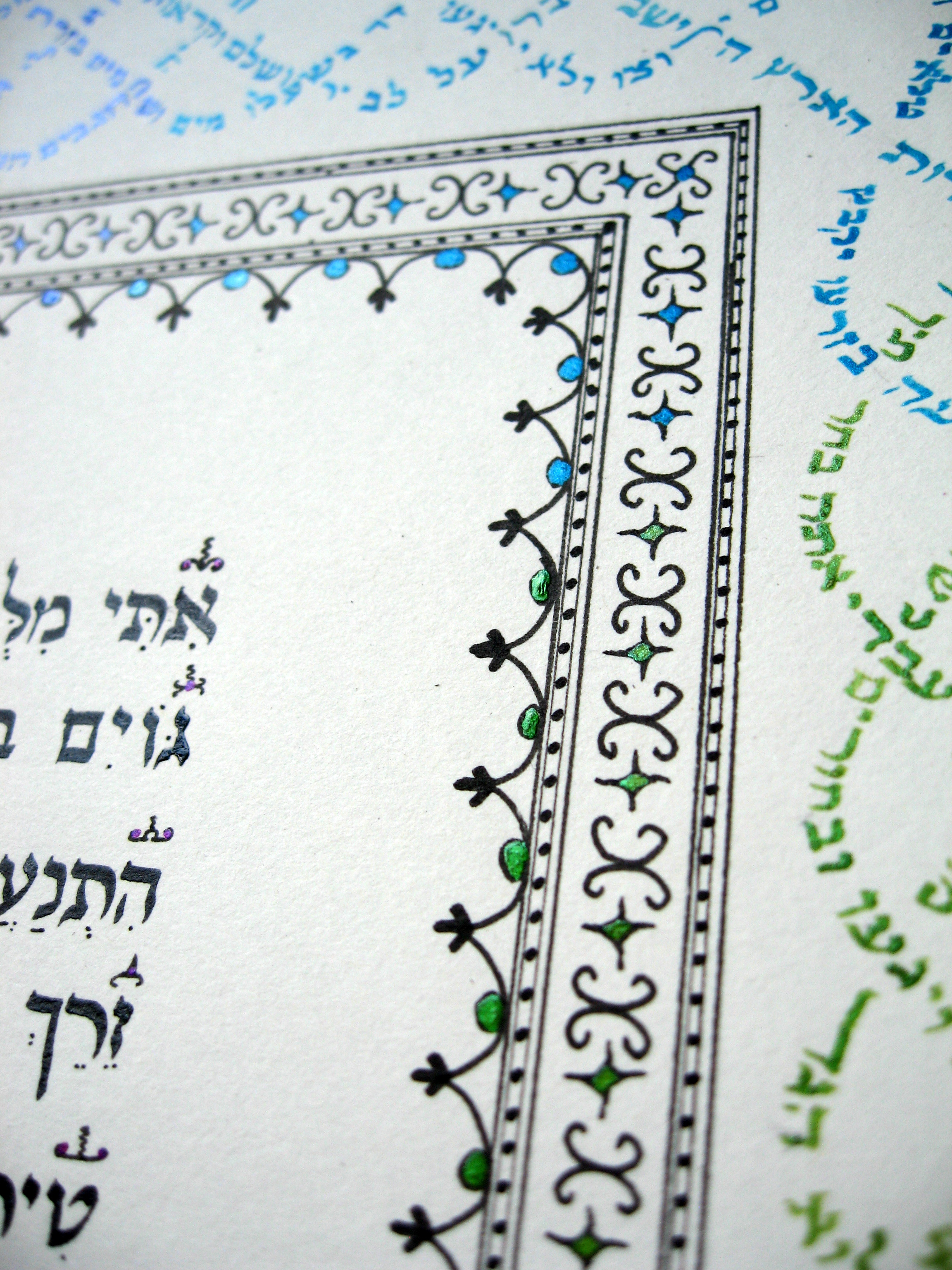
The border elements are a combination of something I pulled from a museum catalogue (Adoration of the Magi, Fitzwilliam Museum) and New York City ironwork (always buy the catalogue, if it’s pretty, and always carry a sketchbook). The little coloured bits are the same colours as the writing nearby.

I used three weights of Pigma Micron pen for the border, that’s all. You can have a lot of fun with contrasting-weight pens. The coloured parts are my beloved sparkly watercolours, which shine and gleam and are HAPPY. Yay art supplies!

shiny


Fun with piyutim – Iti Milvanon, 2/4

Part 1

Since this is a poem for Shabbat Nachamu, a poem which references the first verse of the haftara we say that day, I wanted to have that haftara in the border. It’s Isaiah chapter 40:2 ff and a bit of 41; it starts in the top right-hand corner.

top corner

There are a couple of scribal errors in the haftara part (click here for closeup of entire thing). It’s hard copying a text you’re not totally familiar with into a pattern, when your attention is largely focused on getting the pattern right. I could have avoided that by writing it all out in pencil first, but…well, I just didn’t want to bother, and I paid the price!


Fun with piyutim – Iti Milvanon, 1/4

This is a liturgical piece, a Magen by Qallir for Shabbat Nachamu. A Magen is the first in a sequence of poems adorning the first three berakhot of the Amidah, up to the Kedusha; the Magen adorns the first berakha, “Magen Avraham.”

adjusted

Translation from the ever-estimable Mar Gavriel:

With Me, from Lebanon, you shall not be shamed;
Your raiments of strength you will don with honor;
Nations you will trample with your legs, and trod over them;
Your flags I shall adorn with linen and silk.

Rouse yourself up, O daughter of Zion, from the dust,
And get up and enrobe in beautiful clothing!
Your later halo will be more beautiful than your first;
Your sin will be over, and atoned like [the passing of] a cloud.

Your palaces, which were dimmed due to My fury,
Burned in anger, and with destruction were wrathed –
They shall be robed in glory, and given compassion from My mouth.
Announce to them: “Give ye comfort, give ye comfort!”

As it is written: Give ye comfort, give ye comfort to my people, saith the LORD. (Isaiah 40:1)
And it is written: Though there be a multitude of [anxious] thoughts within me, thy consolations charm my soul. (Psalm 94:19)
And it is written: And let this be my consolation, though I be anxious with unsparing fear: I have not rejected the words of the Holy One. (Job 6:10)
And it is written: Rejoice with Jerusalem, yea, be glad with her, all who love her; celebrate a celebration with her, all who mourn for her. (Isaiah 66:10)
And it is written: So that ye may nurse, be satisfied from the teat of her consolations; so that ye may suck, and enjoy the breasts of her glory. (ibid.,
verse 11)

Her glory will be elevated above all,
And Thy glory shalt Thou then reveal in her.
Our days – may you fill them, like the days of yore,
And in the strength of Thy shield may we be uplifted in glory.

More tomorrow :)


on planning rituals

I write Torah scrolls for congregations, and part of my job is working closely with the congregation to make appropriate programming. Such as, for instance, an opening ritual.

A good ritual starts by speaking to who the community is, and inspires them with a vision of who they want to be. My job as the consulting scribe is to come up with Torah-related ideas that will make that connection.

The clergy and lay leaders have some idea of both ends (you hope), but since I’m not part of the community, I don’t. A meeting with the Torah committee to plan the ritual can be rather intimidating, because it’s my job to figure out, in an hour, what sorts of things they are likely to find familiar, relevant, exciting, and inspirational, and to present those in ways which will fit into the logistical and emotional parameters of ritual.

They have classes on this stuff in rabbinical school, you know. I could ace one of those classes.

Well, so. This is a community that’s celebrating its fiftieth anniversary, its jubilee year. It recently-ish (within communal memory) moved into a shiny new building, and walked the Torah scrolls from the old building to the new. The dedication is right after Simchat Torah.

Elements that got thrown into the mixing bowl, when talking with clergy and lay leaders:

* Children (or perhaps adult bat mitzvah class, convert class, etc) bringing the blank parchment sheets into the sanctuary
* 42 sheets, for the 42 journeys made by the Israelites, and the 42 lines per column. The rabbi has a dvar Torah connecting the 42 journeys to the poem Ana b’koach.
* Collecting turkey feathers from local turkeys beforehand; a quill-cutting moment
* There are pre-writing kavvanot which include Ana b’koach. A kavannah moment.
* Another pre-writing thing is vidui. Since we will just have had Yom Kippur, Ashamnu will be fresh in people’s minds. A solemn moment.
* Blank sheets, Book of Life, fresh starts (see “Jubilee”). Journeys (see “New building”).
* Having six different people write the letters of the first word, images projected onto screen
* Having those people share a minute or two each of their stories
* Talking about the symbolism of each letter, matching that up with their stories
* Having the kids sing alphabet and Torah songs
* Having cards and envelopes under each chair and getting people to write about what their Torah journey this year might be; cards to be sent to participants after the completion ceremony

Yes, that’s not a complete list of every possible element of an opening ritual. That would be cumbersome. This is a good starting list, tailored to this community. Now the clergy and Torah committee will figure out how they’d like to put all this together, and we’ll go from there.


A Torah Named George – from the Torah repair mines

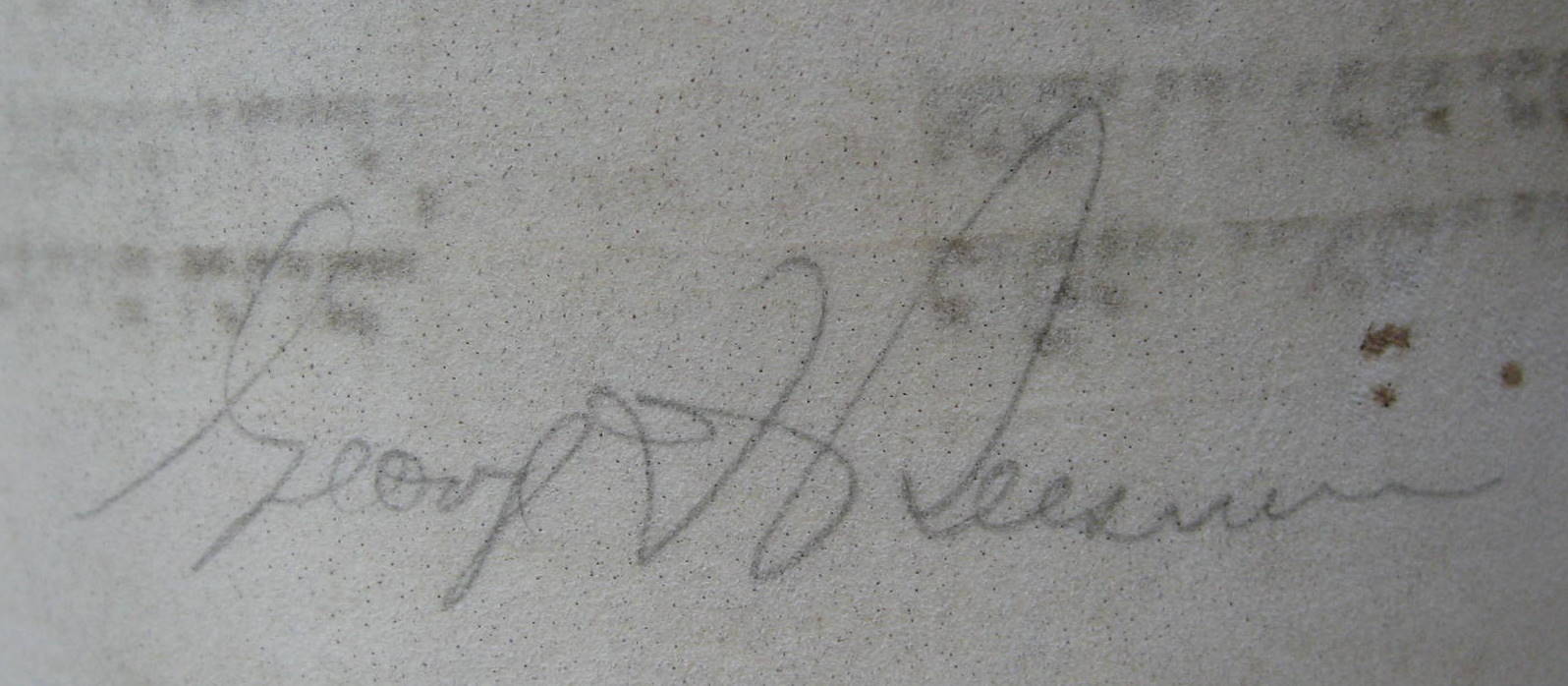
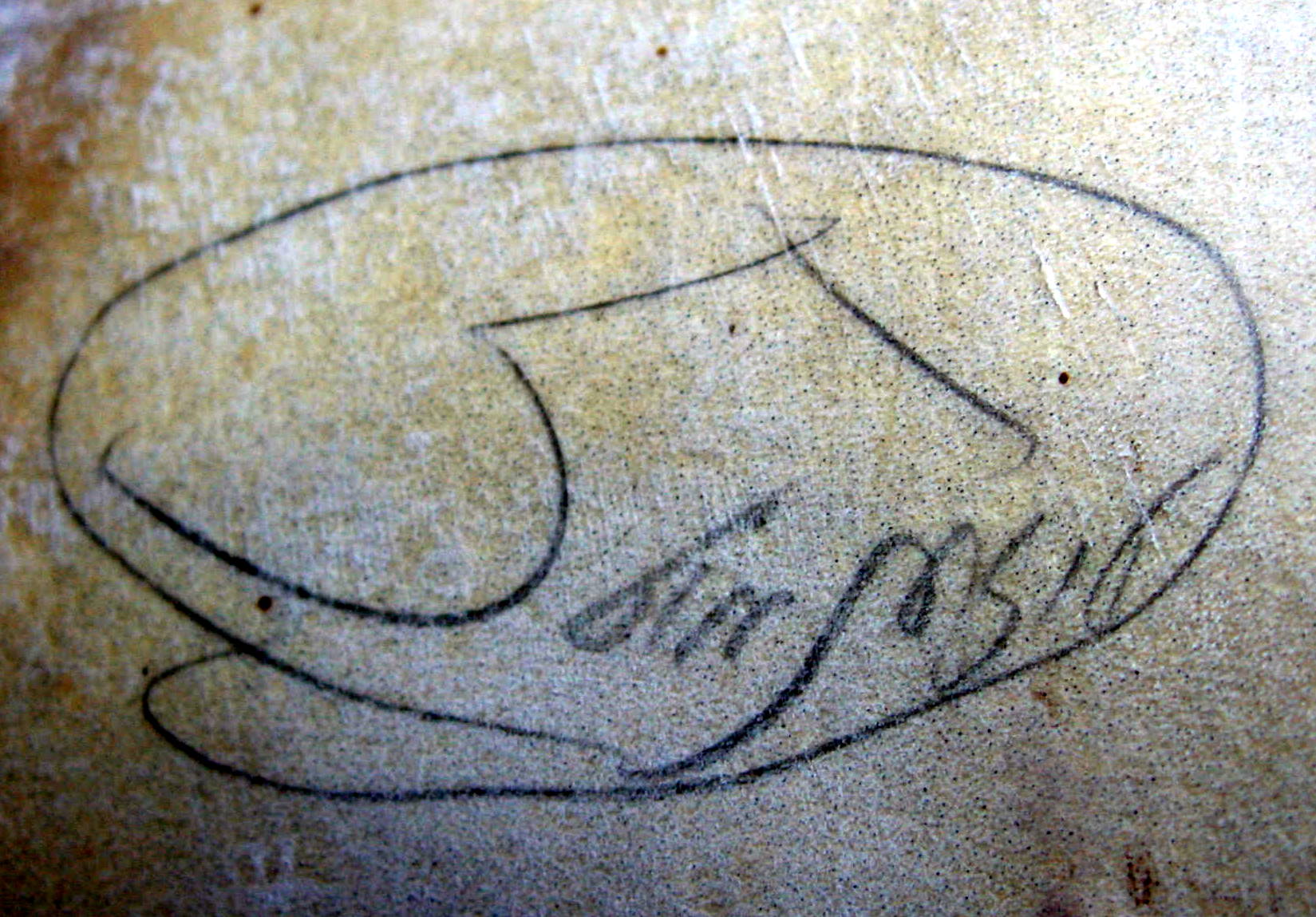
This is why we call him George. Who signs Torahs?

This is why we call him George. Who signs Torahs?


You’re not supposed to write your name on the back of a sefer Torah, just in case you were wondering.
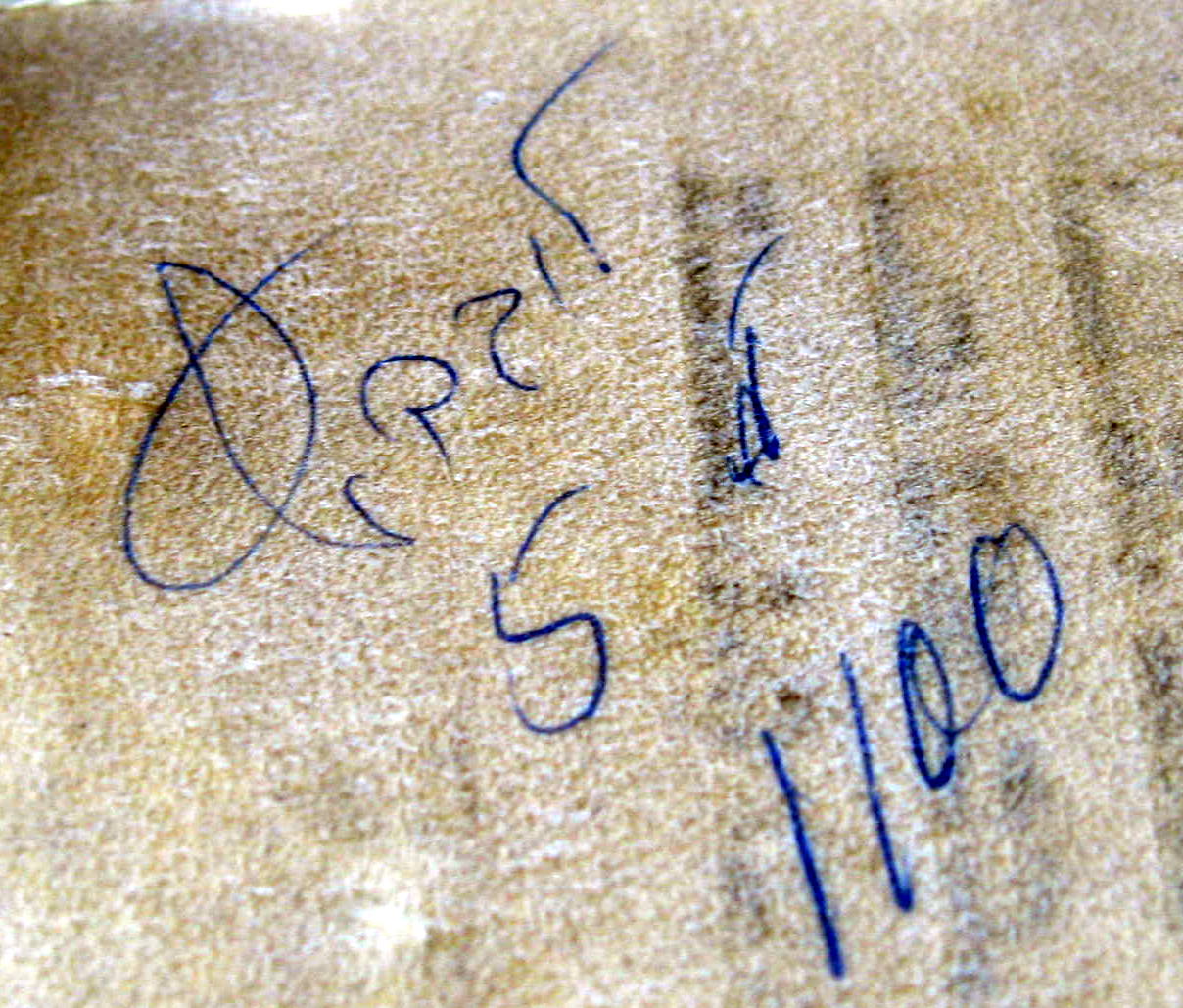
Blue ink.

Blue ink.


What *is* this? And what is it doing scribbled on the back of a sefer torah?
Say what?

Say what?


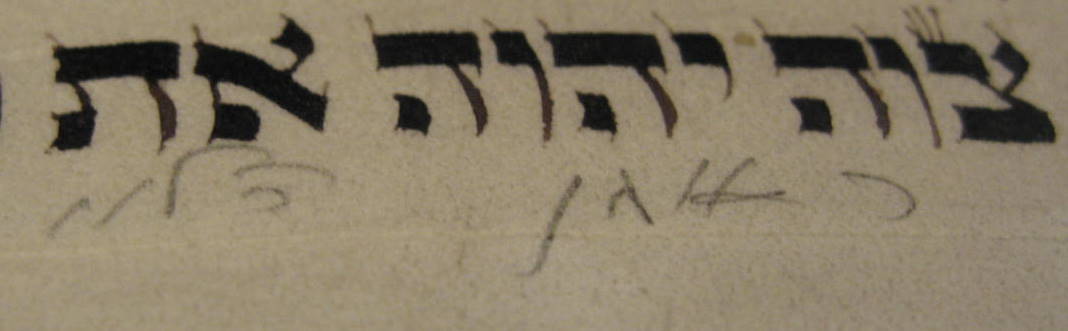
By the way, if anyone can decipher these, I’d be delighted to hear about it. I really do wonder what they’re doing there.
I hate not being able to read people's writing!

I hate not being able to read people's writing!


At least they used pencil on the front…
Same again...

Same again...


Got rid of all these with erasers and knifework. But took pictures, for posterity. Hullo, posterity!


Rabad of Posquieres – Isidore Twersky – notes

6 sections: Life; Works; Works II: Criticism of the Mishneh Torah; Sources; Disciples and Followers; Relation to Philosophy and Kabbalah

Life:

Twelfth-century Provence becomes a relatively exciting Jewish scholarly scene – context of a) Christian intellectual activity b) influence from Spanish Jewry.

Most of what we know about his Life comes from clues in his writing (and those of others) and data about the general context. Jews have “comparatively favourable” sociopolitical status (hah) and the community has enough money that it can sustain quasi-monastic kollelim, for example.

Book headings – Family and Teachers (he has them; we know some stuff about some of them); Provence in the twelfth century (see above); Teaching and Writing (he does lots of it); Personality (balanced (apologetics?)); Influence (considerable).

Works

Early Writings (sometimes it is rather hard to date his works); Talmud Commentaries (abundant but not extant); Codes (code literature is starting to flourish at this point); Commentaries on Halakhic Midrashim (not extant, for the most part); Mishnah Commentaries (on obscure masechtas); Sermons and Responsa (he has them); Hassagot on Alfasi, Razah, and Maimonides (he wrote them).

Works II: Criticism of the Mishneh Torah

Literature on the Mishneh Torah (Rabad starts the excavation process of figuring out where M. got it all); Corroborative or Explanatory Hassagot (some of his hassagot are these – “critical quest for sources”); Critical Glosses and Animadversions (some of his hassagot are these); Rabad’s Motives in Composing the Hassagot (a) jealousy/pugilism/desire to discredit M because disapproving of his other works b) ideological – disagreeing with content or method of MT “there is no certitude in halakha” – anti-authoritative-codes project c) irritated by lack of sources; the antagonism is protagonism, refining in fire)

Interesting comment on girsaot: that in general, there are a lot of divergent texts of rabbinic literature floating around, and Rabad (and other scholars of his time) know this very well. Sometimes they go to some trouble to find a version which agrees with some statement in the
MT. On the whole, Spanish mss are more reliable and Rabad knows this; sometimes he goes witth a French version because he thinks it is actually better. Crass to say ‘the MT is superior because it is grounded in superior Spanish texts and Provencale scholars have inferior texts so are generally wrong’. Also interesting:”…admissibility of two parallel, equally valid and
defensible readings was a widespread methodological canon which contributed a measure of tolerance and restraint to halakhic controversy”.

There are lots of hassagot which aren’t printed on the page. Also lots of places where he just doesn’t say anything; we sometimes suppose silence is acquiescence, but sometimes he is known to have held conflicting views.

This chapter builds towards Twersky’s Argument – that Rabad’s hassagot on the MT are of the nature of constructive criticism – the forerunner of the nosei kelim, wanting to identify its flaws so as to correct them. He supports this argument in various ways (Rabad basically likes codes, he likes things to be clear and well-explained, he isn’t as bitchy as he was about Razah, for example).

Sources

Talmudic; Post-talmudic

This bit was interesting because it talks about availability of books in 12th-c Provence – they’re pretty scarce; often people have to suspend discussions because they haven’t got the source text; borrowing books and running about trying to find a book are common (will of Judah ibn Tibbon). Rabad never mentions not having access to a text and often mentions having several copies of things; he has a library at Posquieres containing lots of things (p.198, but he doesn’t say how we know this).

Chapter in general an interesting and apparently thorough discussion of the state and availability of various sources in 12th-c Provence.

Literary, if not personal, contact with scholars of northern France. Evidence for early influence: Rashi using Provencale responsa and vocabulary.

Disciples and Followers

Disciples (he has an academy); Contemporary Followers and Correspondents (he has lots); Descendants (he has a couple who become notable for various things).

Relation to Philosophy and Kabbalah

In the latter part of his life Provence is a “scene of great intellectual fermentation” but it’s still in its very early stages so you couldn’t expect Rabad to be very much part of it.

Attitude towards Secular Learning (he’s basically a talmudist; not anti-philosophy, perhaps even pro-philosophy, just apparently not all that into it); Use of Philosophic Literature (“reservedly benevolent attitude”; much speculation); Rabad and Kabbalah (no extant kabbalistic works; contemporaries attribute him as a kabbalistic inspiration; much speculation).

Soloveitchik’s review

Well, Gabriel’s advisor said it was a review, but it isn’t exactly. It’s talking about the same subject, but its drift is more or less “Everyone thinks Rabad was awesome because he wrote glosses on the Mishneh Torah, and they present his life as a build-up to that event. This is a really stupid way to frame his life; historically he is part of the foundation of contemporary Talmud study, a man who broke free from the Gaonic vision and formulated a completely new way of thinking about Talmud; that’s far more exciting than a bunch of notes he made on the Mishneh Torah, a book based in Gaonic thought and therefore already obsolete. Better far to look at the state of Talmud study before Rabad and after, and explore how the man influenced the change.”

It’s kind of a review because it came out right after the second edition of Twersky, and it describes Twersky’s book as “a definitive portrait of the regnant conception of the man,” which is pretty damming since his whole thing is about how the regnant conception is totally misguided.

Fun with ketubot – Kells-inspired micrography

keren-kayemet
(Click to see bigger)

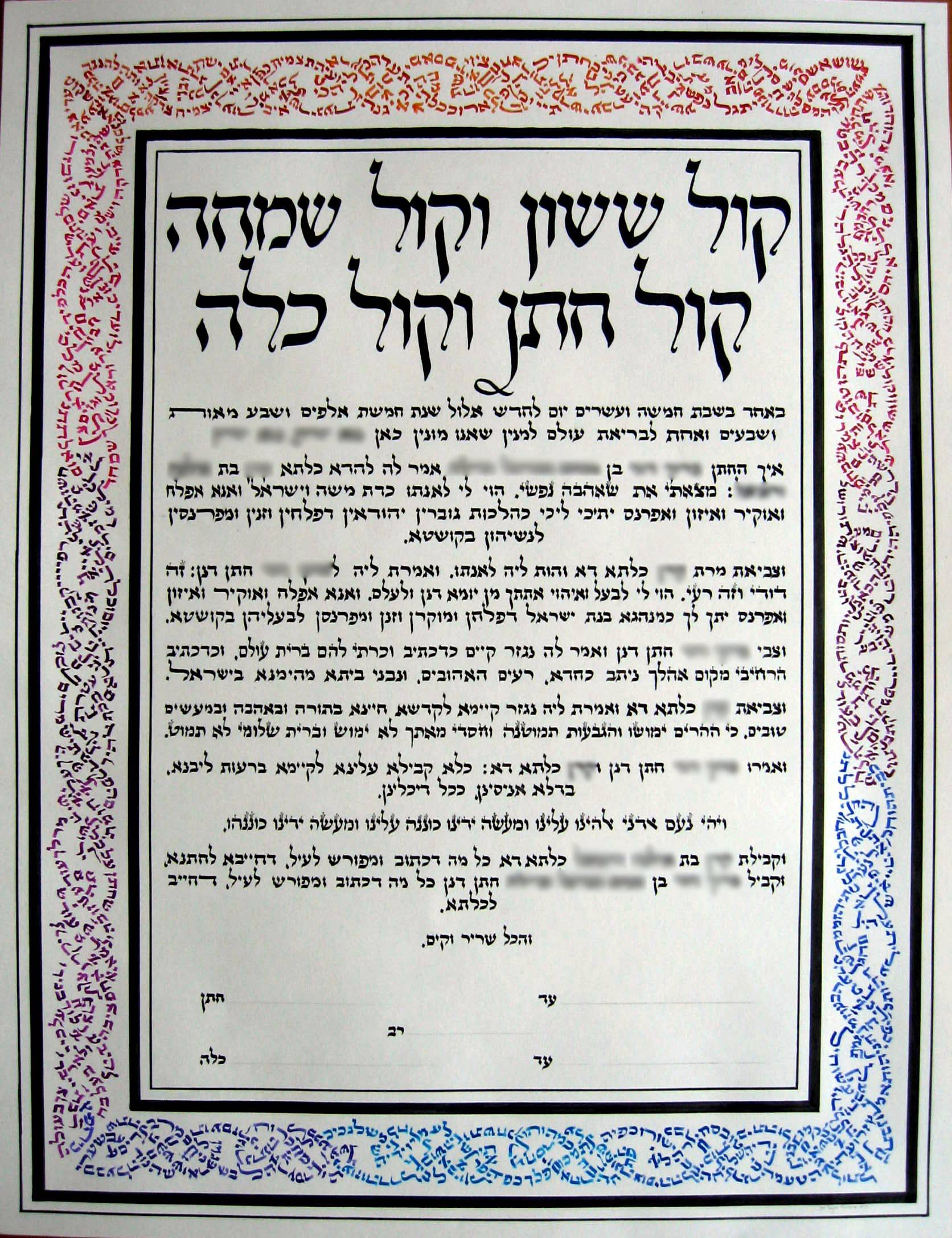
Bride and groom,

When we started this process, you said “I don’t think it could possibly work out, but I just had to give it a try.” You asked for something you thought was impossible, and it turned into something quite lovely. May your marriage have many similar shots at seemingly-impossible targets.

The text you chose for your ketubah is a modern one, reflecting your commitment to each other as equals. Yet you chose to have it translated into Aramaic, reflecting your awareness of your heritage. May your marriage be as strongly rooted.

Your text has traditional legal language sprinkled with phrases from Tanakh. The legal language is written in an ordinary book-hand, but the Torah phrases are written in Torah script – distinctive when you look for it, but subtly blending into the broader context. May your marriage have joyous discoveries of the divine amongst the everyday.

The texts adorning the edge of your ketubah are also traditional texts for ketubot. Although the border seems to be one gloriously intricate swirl of letters, if you look carefully, you will see that the two texts are in fact still distinct. May you each preserve your individuality, yet blend together into a harmonious whole.

One of the texts is Sos asis – a haftarah for the Seven Weeks of Consolation, and also traditionally recited on the Shabbat before the wedding. It starts with Isaiah 61:10: “I will greatly rejoice” and goes up to 62:10, a verse whose wordplay means it can read “Lift up a flag over the people” or “Raise a miracle over the people.” May your marriage have whichever you need of consolation and rejoicing, inspiration and miracle.

The other text is Eshet Hayil, Proverbs 31:10-31. Eshet Hayil sings the virtues of a fine wife, and in doing so it shares its vision of a well-balanced, comfortable, smoothly-functioning household. May your marriage also have this contentment.

Eshet Hayil wasn’t quite enough to fill up the space allotted to it, so I also added a line or two from the sheva berakhot, the wedding blessings – “Blessed is the one who created joy and gladness, groom and bride, mirth, song, delight and rejoicing…” The blessing continues: “…love and harmony and peace and companionship.” As your text contains only the beginning of the blessing, may your wedding contain only the beginning of a life of love and harmony, peace and companionship.


from the Torah repair mines – scribal archaeology

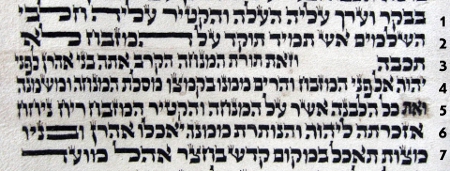
You’re merrily checking through a sefer Torah, one in which the scribe tends to underestimate his lines, and has to stretch at the ends to compensate (lines 1, 2, 6, 7). And you see a chunk (lines 3, 4, 5) of squishied-up writing. Why?

vezot torat hamincha edited

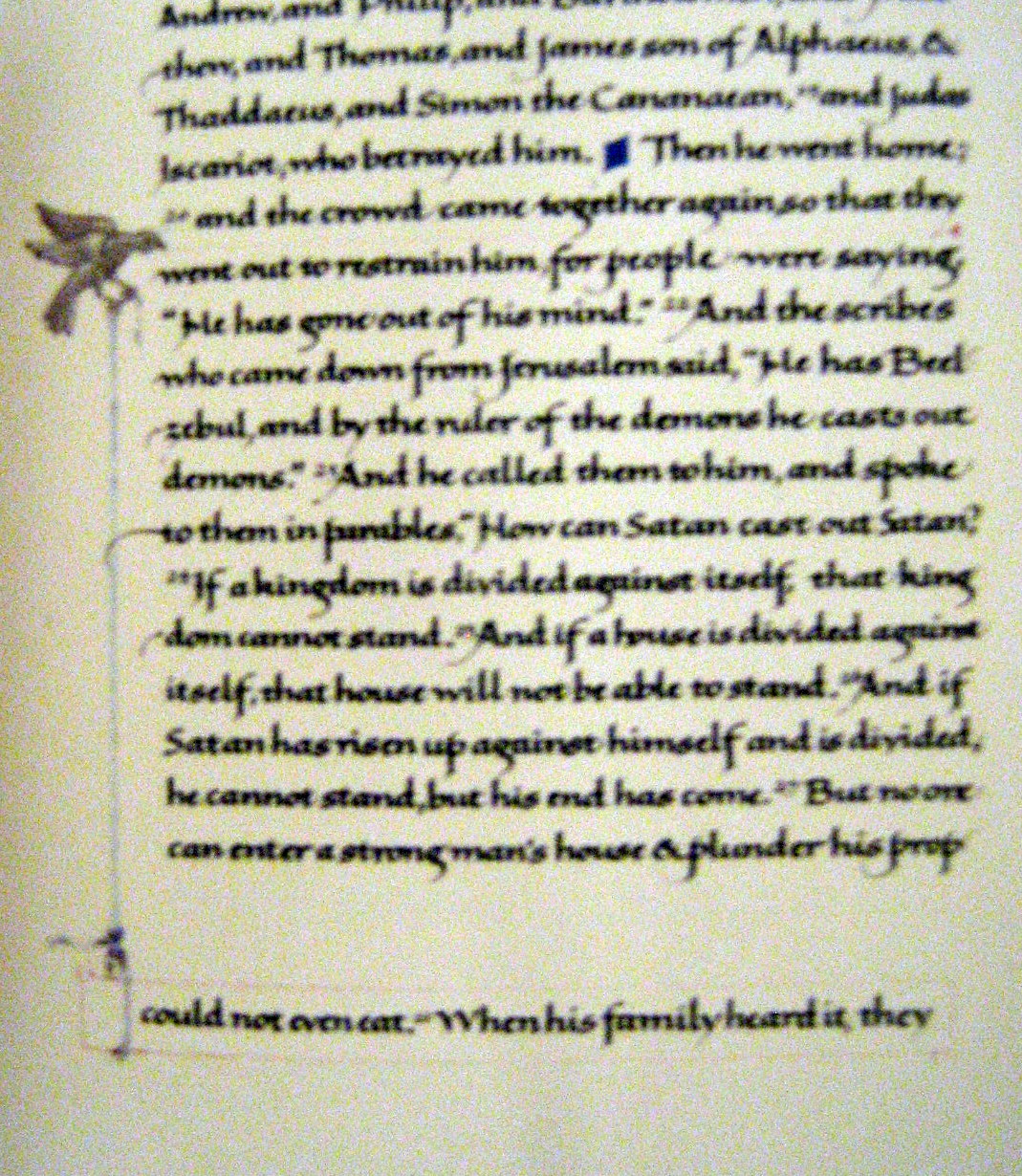
This usually happens when you accidentally leave words out. Calligraphers have various ways of dealing with missing lines; here’s a particularly sweet example from the St John’s Bible, where the missing words are written in the margin and flown into place by a little bird:

Homoioteleuton in St John's Bible

Homoioteleuton in St John's Bible

Torah scribes don’t have such luxury. No writing words in the margin for us.

We do, technically, have the option of writing the missing words above the line, but a) that’s Not Done these days b) if there are a lot of words, that’s not going to work.

So what options remain? Either start the sheet over, or erase words from the surrounding text, and make enough space that we can squish the extra words in.

Note that the second item in line 3 is an obligatory space. The space has to be in the middle of a line. I expect he started erasing after the space because repositioning the space would have been even more tiresome than not.

Also, note that the second item in line 6 is a Divine Name. These can’t be erased. So the scribe erased the two-and-a-bit lines of 3, 4, and 5 to write in the proper text, unless he realised his error before he got to the divine name.

So what was his mistake?

From the shadows, I can sort of see where some letters used to be:

vezot torat hamincha 3

But whatever did he write first? I’m stumped by those apparent two kufs. Maybe we’ve got two rounds of erasing to contend with? Certainly that “et” is on a double erasure – maybe it’s actually on a triple erasure?

Real scribal archaeologists have UV lights and all sorts of toys for reading the underneath writing on palimpsests. If this was actually important we could use some of those toys, but it isn’t really – just fun. So – any thoughts?


Appoint a rabbi – exercise in communal calligraphy

I like a bit of a challenge now and again.

Here’s a community that wants to honour its rabbi by giving him a piece of artwork.
crop1
Since the rabbi is well-beloved by the families with children, the Surprise Committee wanted to have the children participate in creating the artwork.

Unfortunately, that doesn’t usually result in something you want to frame and hang on the wall.

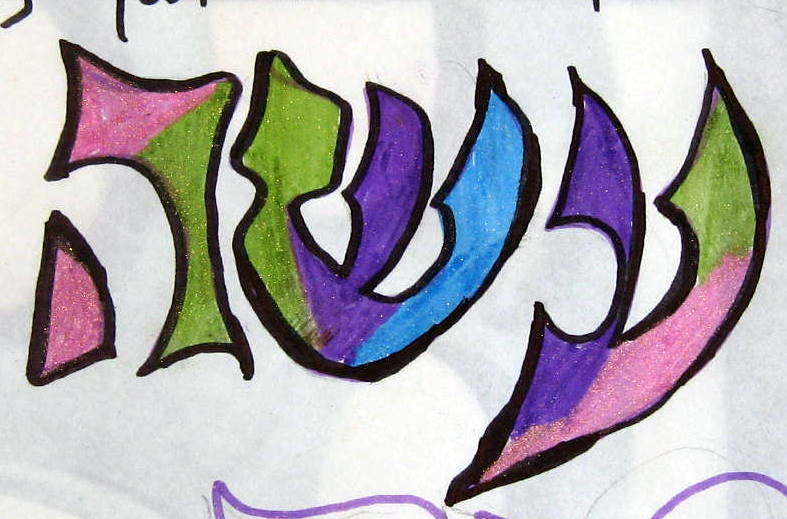
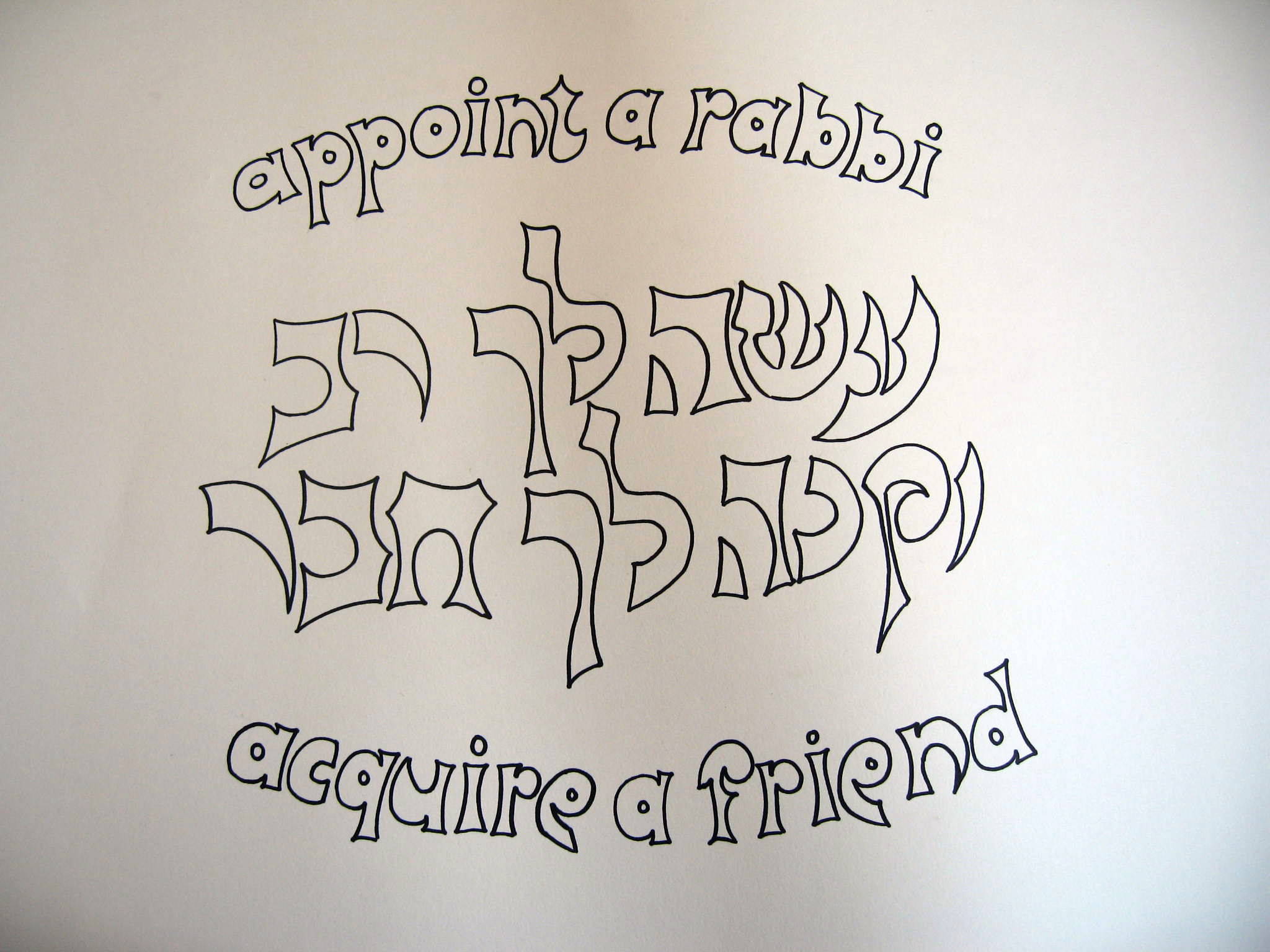
Enter a fun, bubbly style of calligraphy. These letters are outlined with marker, and they’re intentionally idiosyncratic. The children can help colour the letters in, and if they overshoot the edges, the outlines can just be thickened to compensate, and it’ll still look fine because it’s designed that way. Each letter can have several colours, increasing the number of possible identifiable contributions.

IMG_4799

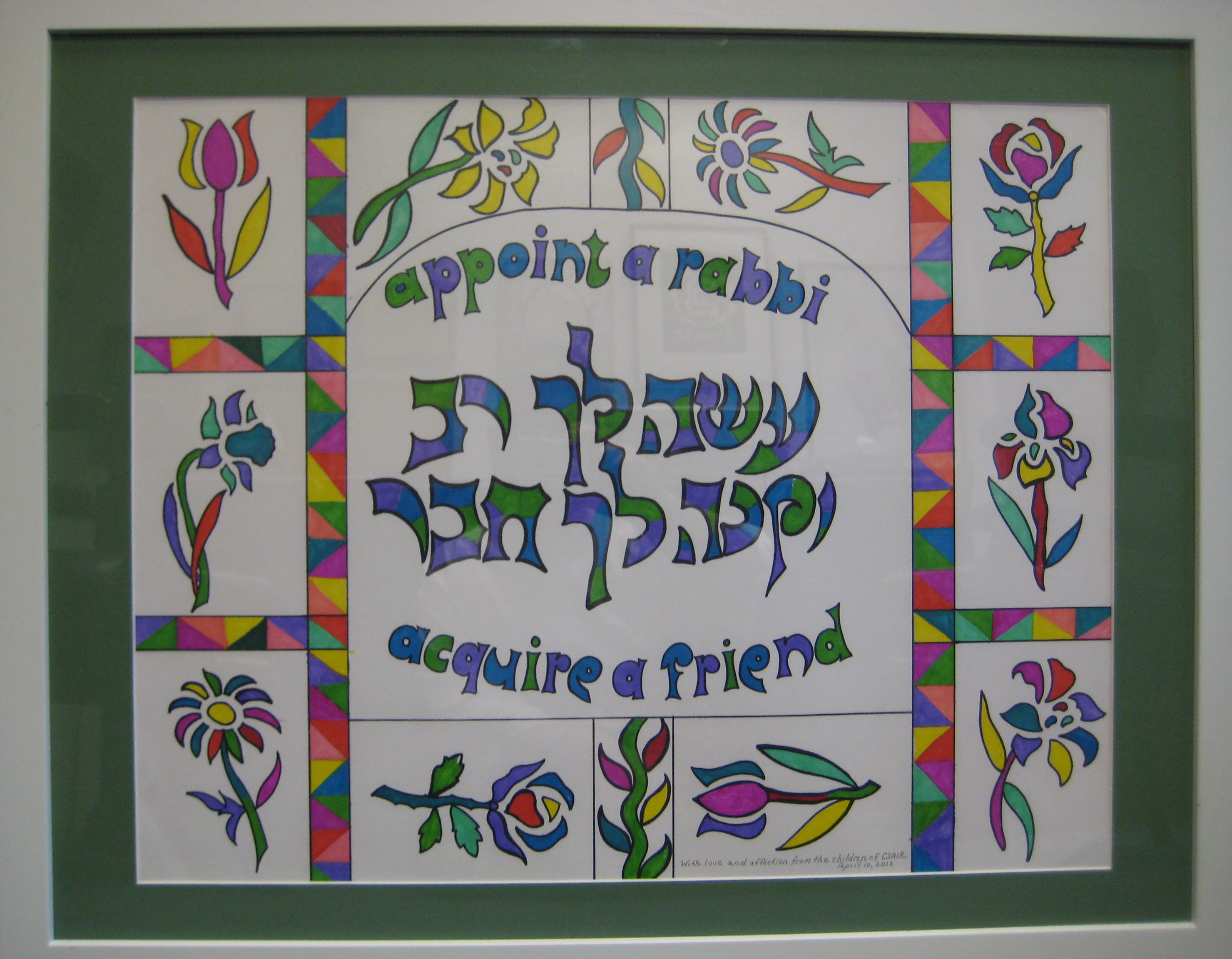
I provided the calligraphy, as an ex-member of the community. I left a lot of room around the edge; a current member of the community provided the border, in much the same style.

Then the community had a Making The Surprise day, and they made the surprise, and here it is:

appoint-a-rabbi