Mazel tov Hanna

Dear everyone,

Thanks for all the emails. No-one else needs to send me the article about Hanna, okay? Yes I know her, yes I’ve seen the article(s), we’re good.

Hanna recently started her first complete sefer Torah; she works in Israel, which makes her braver than me, given how hard it is in Israel for women to do even comparatively ordinary things like riding the bus. Another female Torah scribe of my acquaintance in Israel keeps her head down because she’s afraid that if articles appear about her, she’ll become the target of misogynist hate crimes. So Hanna is being rather courageous, making her project all public. Good for her.

I’ve not met Hanna in person; my student Linda has, when they were working together on the Women’s Torah Project. We’ve corresponded, naturally. It’s great having colleagues.


Tools and travelling

I generally write at home in Manhattan, on a sloping table (good for your back), but sometimes I feel like getting out of the apartment.

As many of you will have seen by now, a Torah scroll starts out as individual sheets of parchment upon which I write. The sewing together of the sheets into a scroll comes later. Single sheets are much more portable creatures than large Torah scrolls, so it often happens that I will take a single sheet and go and write somewhere different.

This week, actually, I had to go to England on family business, but most weeks I’ll maybe go down to my yeshiva, hang out at the Jewish Theological Seminary, maybe take in the Drisha Institute or the Yeshiva University Library. There’s something very delicious about writing Torah in a place of Torah surrounded by the sounds of Torah learning, and more prosaically, if one has to go to England on short notice (all is well, don’t worry), it’s good to be able to stay on schedule.

For these excursions, I have a fabulously professional-looking Torah transport bag. It’s actually a chess championship bag, of all things. I had no idea such things even existed until I got a student who’d done chess championships; she used her old chess bag to bring her parchment to lessons. Me, I know a good idea when I see it, so I got online and got a chess bag (sans contents).

Chess tournament players use a roll-up chessboard, which is about the same size as a piece of parchment. So you roll your parchment up and secure it in the straps for the chessboard. There are handy little slots for chess-players’ pens and a drink (or quills, knives, and ink); a nice zipper compartment designed for a tournament clock which is just the right size for holding my lunch; another compartment for chess pieces which holds miscellaneous things like my camera,* bits of tile, gum sanderac, teabags, erasers, and so forth; even a dear little windowed pocket for business cards. And a document flap which holds my sketchbook and Kindle for keeping busy on the subway. Really, it’s perfect. I used to use a yoga-mat bag, but this is just so much classier. Lends a certain gravitas to tooling around the city with my bits of Torah.

A journalist was interviewing me the other week (this, thankfully, does not happen as often as it used to; not that I mind exactly but certain story angles got very old very fast) and asking how I avoided making mistakes whilst writing Torah. I left the interview with the uncomfortable feeling that we’d been talking at cross-purposes; from my perspective, your job is to write the words and you do that as best you can in every aspect, and the mistakes you take in your stride. She seemed to think that the main thing is to avoid mistakes, and then maybe you can focus on doing a good job of the rest of it, which is not really how I see it at all.**

This is, perhaps, illustrated in the matter of accessories. To take a sheet of Torah to the yeshiva, you can roll it up and stick it in a cardboard tube and wrap that in a garbage bag and fill your purse with your writing kit. This keeps the parchment from getting battered and gets all your stuff there, certainly. But it’s just nicer if you can leave in the morning knowing you’ve got everything you need neatly stashed in your bag. No scrambling, no forgetting things, just being prepared and confident.

There’s a profound conclusion (or several) lurking here, I feel sure, among the miscellaneous vignettes of soferet life and musings on the difference between tools and accessories. But the jetlag is catching up with me, and the conclusion by the same distance escaping me. You’ll have to put it together yourself. This is called “empowering the student to create their own custom learning experience” in modern pedagogical-speak, so you can rest assured you have the very latest in educational blogging experiences. Shavua tov.

* It’s always good to have a camera with you. You never know when someone is going to show you something interesting in a sefer Torah, and you’ll kick yourself if you can’t take a picture.

** Yes, if you can’t convey what you’re thinking, you didn’t interview very well. I know. Not her fault.


Sefer Shemot and the Semitic Scripts

The start of Sefer Shemot finds us in Egypt and returning to the story of the alef-bet.

Hieroglyphic for "scribe"In Egypt, as everyone knows, they wrote with hieroglyphs, an intensely complex system of writing based on pictograms. Literacy in hieroglyphs is relatively hard to attain; literacy also endows power, such that an Egyptian scribe occupied an elite position in society and had a god devoted to his efforts.

At the other end of the social scale in Egypt, we have people like the Israelites–migrant workers, slaves, people with no power. Also monotheistic, and if you need a god to keep track of your writing system, you need a simpler writing system if you’re going to stay monotheistic.* An alphabet, a system of representing constituent sounds of a language, is a good solution, because you can make phonetic represnations by memorising only a couple of dozen symbols rather than a couple of thousand.

At the end of last time, I had just introduced the idea of acrophonic writing, in which a (stylised, abstracted version of a) picture comes to represent the first sound of the associated word. Hieroglyphics developed in this direction, to a degree, so from about the seventeenth century BCE you find alphabetic hieroglyphs.

No-one quite knows how our particular alphabet came into being, but there’s a theory cautiously advanced that possibly Semitic workers in Egypt had something to do with it. There isn’t really enough data, and we also run into scholarly tangles concerning the definition of an alphabet. What concerns us now is that sometime around 1500 BCE symbols now known as Proto-Canaanite or Proto-Sinaitic script were in use, assigning sounds to symbols based on what the symbols represent.

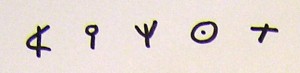
Henceforth I’m going to be using five letters for examples; alef, vav, khaf, ayin, and tav. Remember that alef used to be a guttural consonant and not just the silent vowel-carrier it’s become. Here’s the Proto-Canaanite symbols:

Proto-Canaanite symbols, c. 1500 BCE (Ada Yardeni)

Reading left to right (since our base language right now is English), these are pictures of an ox, a hook, a hand, an eye, and a (tally-type) mark. In Hebrew the words are ‘alef, vav, khaf, ayin, tav; the people who used these systems were not speaking Hebrew, but a remote ancestor thereof, but my impression is that those particular words didn’t change much.

Five hundred years later, around 1000 BCE, the Proto-Canaanite symbol set has become a true alphabet, the Phoenician alphabet. You can see how the symbols have become somewhat more abstract. (The right-to-left text direction has also been established by this point, interestingly.) Again: alef, vav (or waw), khaf, ayin, tav.
Phoenician letters c 1000 bce

The Phoenicians were a widely-spread culture with a powerful and pervasive economic and cultural system. As such, their writing system got spread all over the ancient world; the Phoenicians’ influence declined after about the eighth century, and the script ceased to exist in any form after about the third century. The cultures which replaced them, and the descendants of their script, however, kept right on going. Israelite tribes settled in Canaan around the 12th century BCE, adopted the local script, and it came to look something like this:

hebrew letters c. 1100 bce

This is the period of the monarchy (united and divided); Israelite national identity is an independent thing, so language and script and culture are all somewhat distinctive. Tangentially, Phoenician used 22 consonants, so their alphabet had 22 letters; the Israelite dialect had more than 22 consonants, so some letters had to do double duty, and this is why shin and sin are both represented by the same symbol.

By about 600 BCE (the period where Assyria and Babylon are vying for supremacy and the children of Israel are getting repeatedly squashed in the struggle), Hebrew letters look something like this:

Hebrew 600 BCE

For those thinking “This looks nothing at all like the alef-bet”: yes, you’re correct, it looks nothing at all like the alef-bet. After Babylon absorbed the Israelites and exiled them, national culture was rather hampered, and use of this Hebrew alphabet began to decline. The Hebrew script (or Paleo-Hebrew, to aid disambiguation) was preserved in religious writings, a last pocket of national identity. Thus it is that we have examples of the Paleo-Hebrew script from about 100 BCE, from Qumran:

hebrew 100 bce

Paleo-Hebrew was revived as a national Jewish script by Bar-Kokhba, but the script ultimately fell out of use with the failure of the rebellion. Jewish textual identity had long since taken a different direction, which we will follow next time.

Further reading:
Paleo-Hebrew
Phoenician alphabet
History of the alphabet

* That was a joke.


Vayehi–a bit of a chat

Well, this has been a busy week. As well as working on your Torah, I’ve been apprentice-master-ing–my sometimes-apprentice has winter break from her yeshiva, so she’s back being my apprentice, which means I’m spending a good deal of time supervising her.

I’ve got a number of other women I’m invested in in this way. It’s something to do with how, when I was trying to learn, I didn’t have much company–once I got knowledge and skills, I wanted to share them, so that I’d have company. (Also noble ideas about making the world a better place, etc, but that sounds kind of pretentious so we’ll put that bit in parentheses.) Three of them are working on Torah scrolls of their own now, and various others are engaged in repair and other projects.

So I didn’t get time to write the history of the alef-bet post I wanted to write, but the world is an incrementally better place because of my apprentice. Good trade?
Instead, I’m going to share some thoughts that came into my head as I was writing the parsha, Vayechi.
When I’m writing, I’m paying some attention to the content as it goes through my fingers. If I’m studying Torah, I’m thinking about it in an intellectual way; when I’m writing, it’s more of a musy kind of thinking.

The exception to this is when it’s poetry. There you are, scribing along, and suddenly you don’t understand more than half the words. This is how you know you’re in a poem. The translations and the printed chumashim use layout to denote poetry–that and the sudden slew of footnotes “Meaning of Hebrew uncertain”, so it’s not just me that gets confused.

Since I want to understand what I’m writing, poetical bits usually go slower because every few words I’m referring to a translation or a dictionary.

This bit in particular struck me, this time round:

Dan shall govern his people,
As one of the tribes of Israel.
Dan shall be a serpent by the road,
A viper by the path,
That bites the horse’s heels
So that his rider is thrown backward.

I wait for your deliverance, O Lord! (Genesis 49:16-18)

Check out Rashi there, if you’re wondering what on earth that’s all about. Lots of stuff about Samson.

Just made me chuckle, though–here’s Jacob saying semi-prophetical things to his sons, and the basic meaning of this part is “Dan will be a judge. Of sorts. God help us all.”


Why there are no vowels in the Torah, part 1

I wanted to do you a post about why there aren’t any vowels or musical notation-marks in a sefer Torah, but when I came to study the subject, I realised it’s a good deal more complicated than can fit into one post. It seemed to require a brief history of vowel-marks, which in turn required a brief history of the alef-bet, which in turn required a brief history of writing in general.

So we’re going to start with a brief history of writing, and then we’ll do the alef-bet, and then we’ll do vowel-marks, and then we’ll be sorted.

Let’s get into it by way of Yosef. This week’s parsha and last week’s, Vayigash and Miketz, tell us about Yosef, employed in a high administrative position tracking and controlling food supplies for an enormous region through fourteen years of plenty and famine.

This kind of activity is how writing was invented, we think. People wanted to keep track of how many things they had (or were owed), so they used tallies, with one-to-one correspondence between the number of marks and the number of things; tally marks have been in use since the Stone Age, a matter of some forty thousand years.

Writing seems to have evolved independently in various areas. We’re ultimately interested in the alef-bet, so we’re going to take that route, but it’s worth remembering that this isn’t the only history of writing out there.

Between 8000 and 4000 BCE people used a token-based kind of abstraction for record-keeping: pebbles or clay tokens representing quantities. One pebble in a jar means one goat in the field; two pebbles in a different jar represents two baskets of grain, and you’d better remember which is which. During these four millennia, the level of abstraction expanded somewhat, such that instead of sixty-three pebbles in a jar meaning sixty-three I-think-it-was-goats-or-is-that-the-grain-jar-damn, you had one sixty-goat token and three one-goat tokens in your jar, and maybe some grain-tokens too, if you had any grain.

Keeping your goat record in a jar leaves you a bit open to your accountant hooking some of your goats, though, so people developed the habit of sealing their tokens in clay containers. Very nice and secure, right?

But a bit tiresome when you want to check up on how many goats you’ve got, that being the whole point of this record-keeping business anyway. Rather than keep on breaking open and resealing the clay containers, around 3500 BCE people started marking the containers while the clay was still wet, using a stylus to carve representations of the contents’ type and quantity.

The next step was to realise that once you have those marks in the clay, the tokens inside the jars are obsolete. The marks are now fully representing real-life objects, without the intermediary stage of tokens; they are no longer mnemonic but pictographic.

Once you’re writing things like “60 goats,” you might also want to convey “Belonging to me” or “When I counted them in the springtime”. Marks come to convey not just objects but ideas and situations.

The next step in the history of writing is using marks to represent sounds. You’ve read the Just So Stories, I take it? If not, go read the one under the link, and then come back.

Say a culture has a symbol :) okay? It starts out representing someone with a smiley face, so when you see it, you think of someone smiling. How do you speak it? :) also stands for the sound which comes out of your mouth when you say “smileyface.” Eventually, we might abbreviate :) to be the sound “sm”.

This is how alphabetic writing systems are born. More about that next week.


Why there are no vowels in the Torah, part 1

I wanted to do you a post about why there aren’t any vowels or musical notation-marks in a sefer Torah, but when I came to study the subject, I realised it’s a good deal more complicated than can fit into one post. It seemed to require a brief history of vowel-marks, which in turn required a brief history of the alef-bet, which in turn required a brief history of writing in general.

So we’re going to start with a brief history of writing, and then we’ll do the alef-bet, and then we’ll do vowel-marks, and then we’ll be sorted.

Let’s get into it by way of Yosef. This week’s parsha and last week’s, Vayigash and Miketz, tell us about Yosef, employed in a high administrative position tracking and controlling food supplies for an enormous region through fourteen years of plenty and famine.

This kind of activity is how writing was invented, we think. People wanted to keep track of how many things they had (or were owed), so they used tallies, with one-to-one correspondence between the number of marks and the number of things; tally marks have been in use since the Stone Age, a matter of some forty thousand years.

Writing seems to have evolved independently in various areas. We’re ultimately interested in the alef-bet, so we’re going to take that route, but it’s worth remembering that this isn’t the only history of writing out there.

Between 8000 and 4000 BCE people used a token-based kind of abstraction for record-keeping: pebbles or clay tokens representing quantities. One pebble in a jar means one goat in the field; two pebbles in a different jar represents two baskets of grain, and you’d better remember which is which. During these four millennia, the level of abstraction expanded somewhat, such that instead of sixty-three pebbles in a jar meaning sixty-three I-think-it-was-goats-or-is-that-the-grain-jar-damn, you had one sixty-goat token and three one-goat tokens in your jar, and maybe some grain-tokens too, if you had any grain.

Keeping your goat record in a jar leaves you a bit open to your accountant hooking some of your goats, though, so people developed the habit of sealing their tokens in clay containers. Very nice and secure, right?

But a bit tiresome when you want to check up on how many goats you’ve got, that being the whole point of this record-keeping business anyway. Rather than keep on breaking open and resealing the clay containers, around 3500 BCE people started marking the containers while the clay was still wet, using a stylus to carve representations of the contents’ type and quantity.

The next step was to realise that once you have those marks in the clay, the tokens inside the jars are obsolete. The marks are now fully representing real-life objects, without the intermediary stage of tokens; they are no longer mnemonic but pictographic.

Once you’re writing things like “60 goats,” you might also want to convey “Belonging to me” or “When I counted them in the springtime”. Marks come to convey not just objects but ideas and situations.

The next step in the history of writing is using marks to represent sounds. You’ve read the Just So Stories, I take it? If not, go read the one under the link, and then come back.

Say a culture has a symbol :) okay? It starts out representing someone with a smiley face, so when you see it, you think of someone smiling. How do you speak it? :) also stands for the sound which comes out of your mouth when you say “smileyface.” Eventually, we might abbreviate :) to be the sound “sm”.

This is how alphabetic writing systems are born. More about that next week.


Brush-up post on erasing…

I’ve been neglecting you a bit, I’m afraid. This is because I’ve been posting regular posts for my current Torah client at their special blog, and I haven’t had energy to do two lots of posts or to set up proper cross-posting. Check out last week’s post A single mistake invalidates the entire sefer Torah (with spiffy new photographs) and then continue reading below:

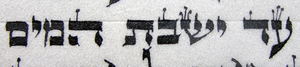
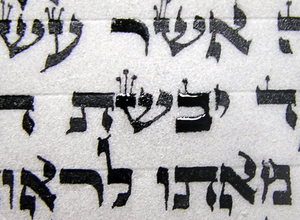
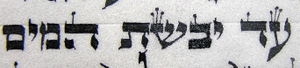
A few weeks ago I wrote this in the Torah:
Ad yashovet hamayimעד ישבת המים, the nonsensical phrase until the feminine singular water sat [thanks Heloise for pointing that out]. The passage in question is וישלח את הערב ויצא יצוא ושוב עד יבשת המים מעל הארץ, He sent forth the raven, and it went out repeatedly and returned, until the waters had dried up from the earth.

יבשת vs ישבת, you see. Both versions make sense, but one of them is wrong, and so it has to be fixed.

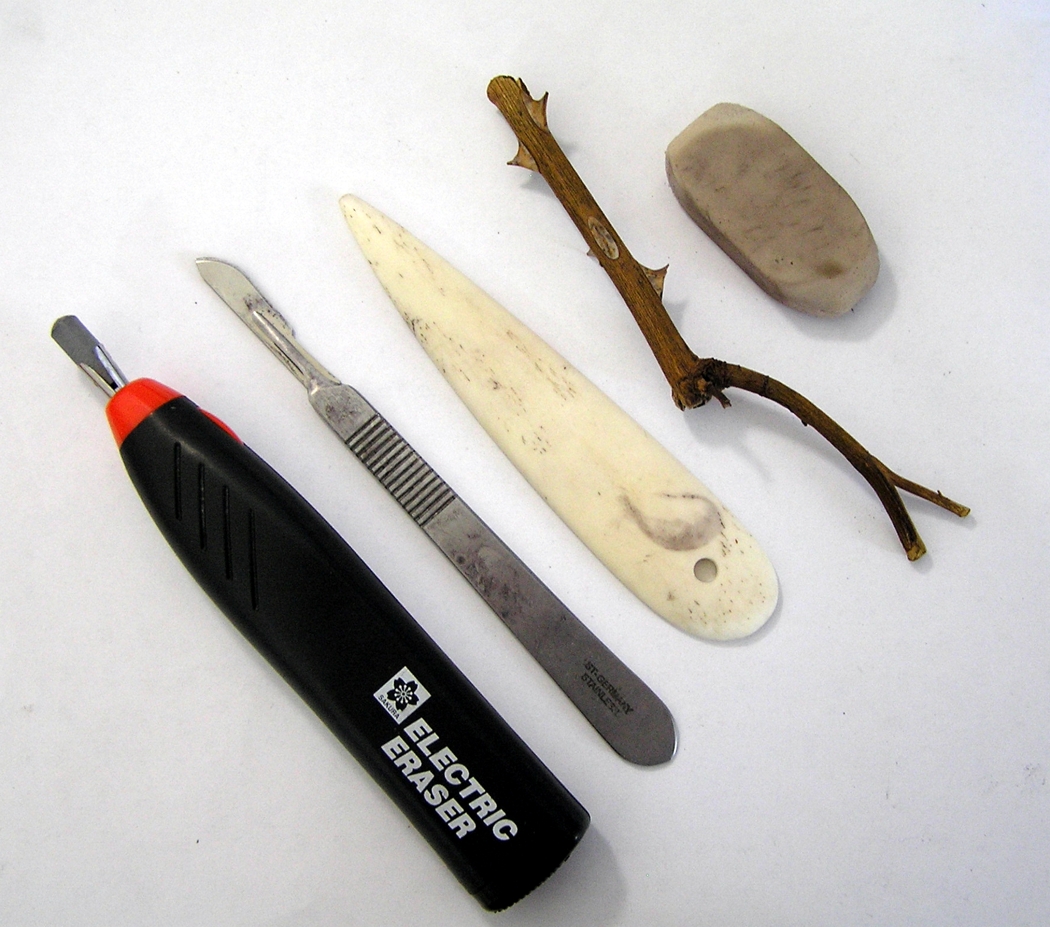
Tools for fixing, left to right: electric eraser, scalpel, burnishing tool, rose thorn, eraser.

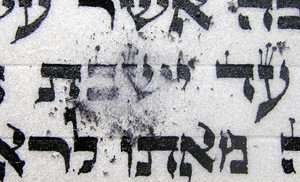
As discussed last week, you first remove the ink. Some like to use electric erasers for this; with the right grade of abrasive tip, the electric eraser makes short work of the ink. At present I’m in a phase of preferring a scalpel; what you lose on speed, you gain in finesse.
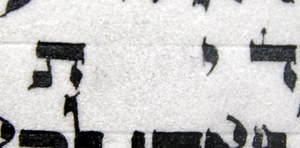
Eventually it’s all gone. At this point, you use the eraser to clear any bits of ink that didn’t brush off. Then you burnish the surface so that it’s good to write on. You use the rose thorn to re-score the line (it’s hard and about the right thickness to match the existing lines, plus extensive biblical/poetic symbolism of roses).
Rewrite properly. They stand out a bit while they’re still wet…
…but once they’ve dried you can’t really tell the difference.

Well, looks like I’m writing a mezuzah tonight

I thought that crash was just Them Upstairs dropping something.

Turns out it was the mezuzah falling off my bedroom door. I’d taken it off for a Hebrew school on Sunday, and apparently not stuck it back on hard enough.

I found the mezuzah case some hours later, in the middle of the hall. That’s where the dog leaves things she’s stolen.

It’s empty.

I can’t see the scroll anywhere.

Since mezuzot are made from parchment, and parchment is first cousin to rawhide, and the dog loves rawhide, I rather suspect that the dog has eaten it.

There are few things more annoying than discovering that the dog has eaten your mezuzah. Perhaps first among them is discovering that the dog has eaten your very small mezuzah that it took you hours and hours to write and the accompanying realisation that you will have to do it all over again.

The moral is: use nails instead of sticky pads when attaching mezuzot.


Sylvanian Families

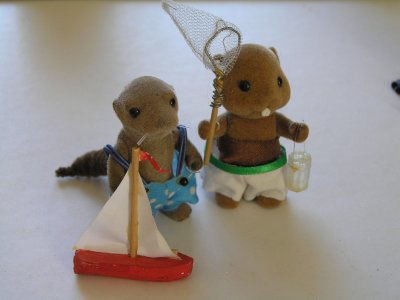
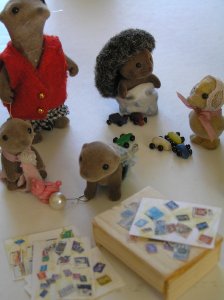
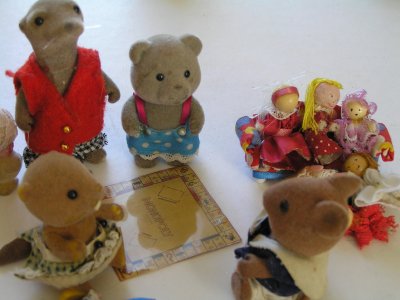
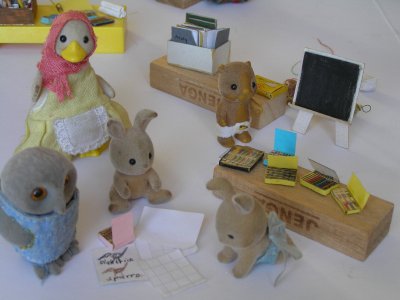
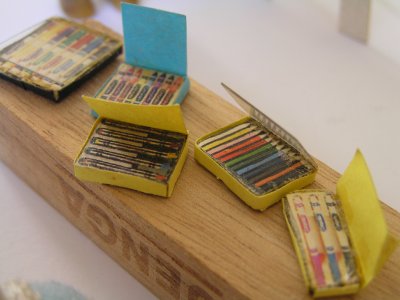
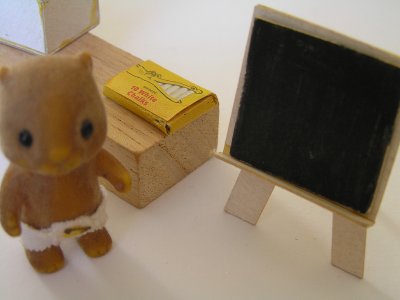
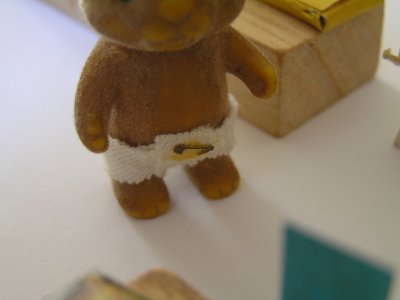
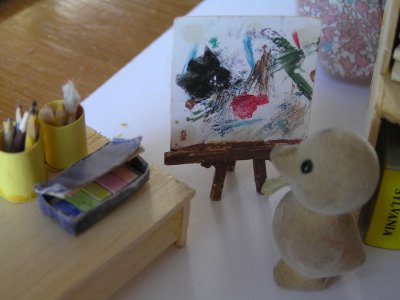
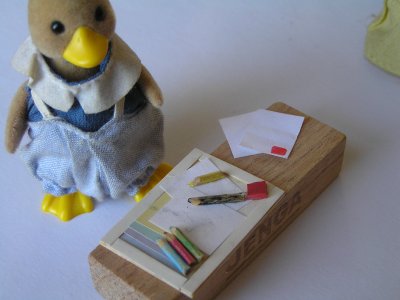
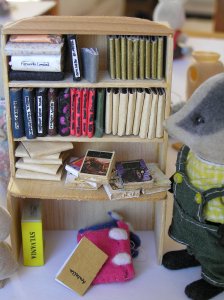
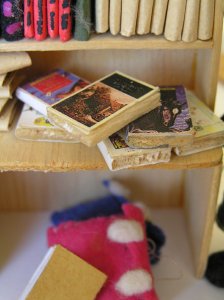
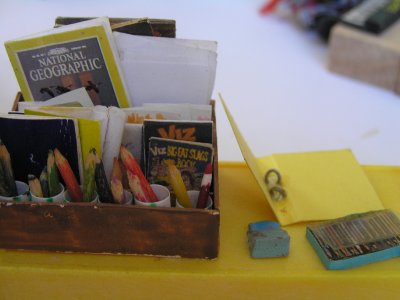
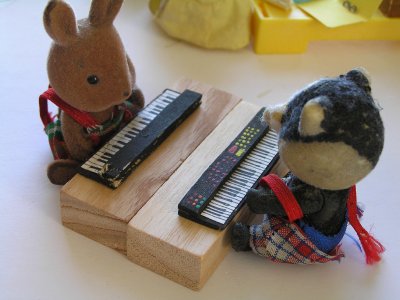
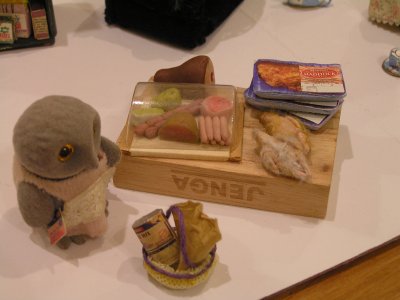
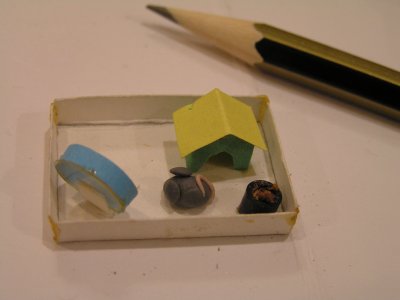
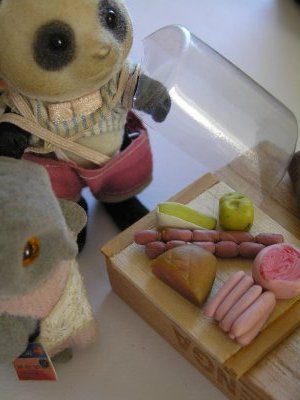
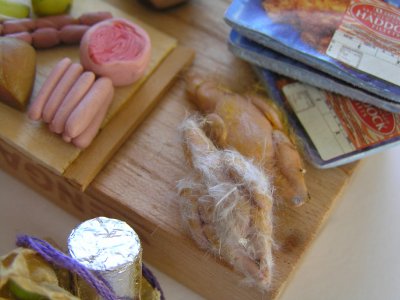
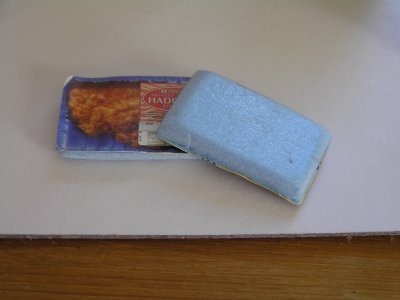
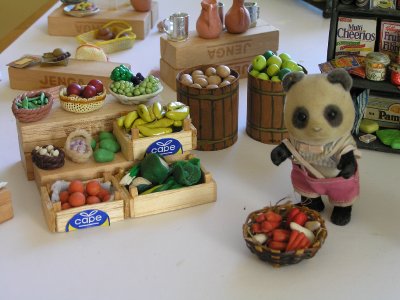
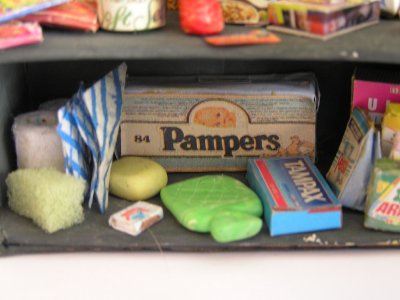
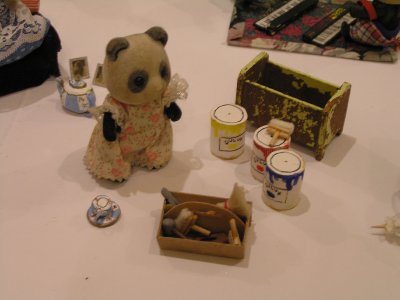
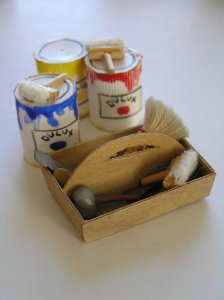
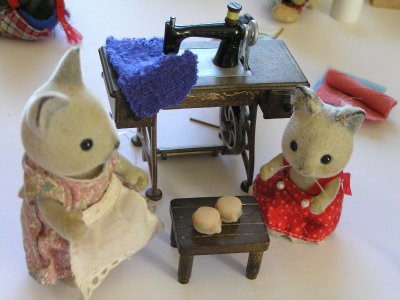
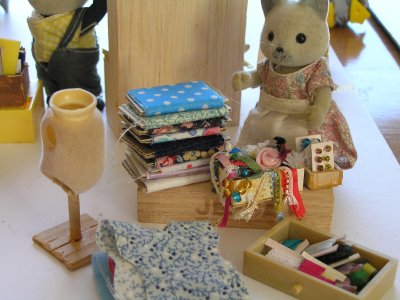
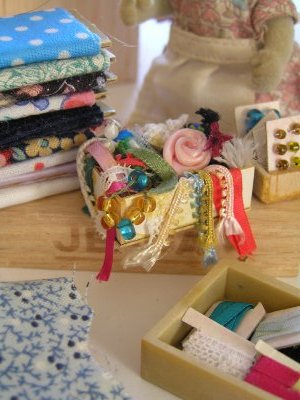
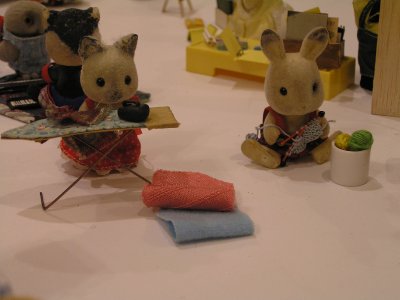
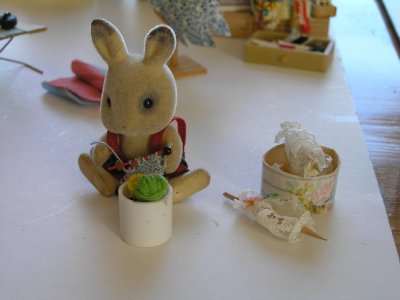
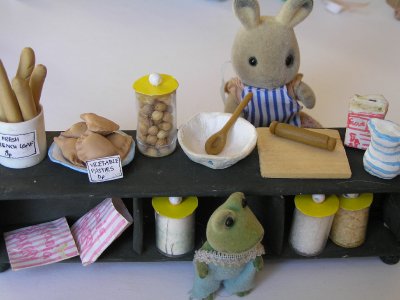
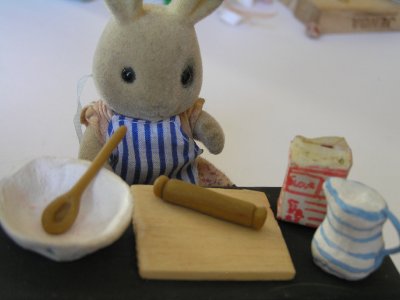
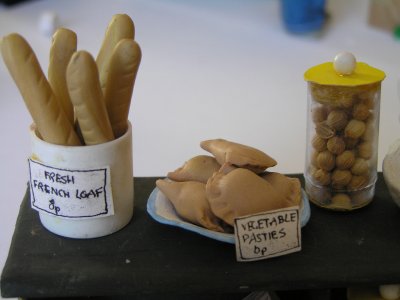
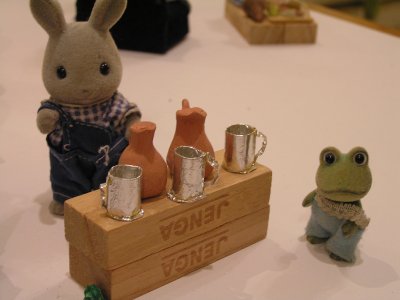
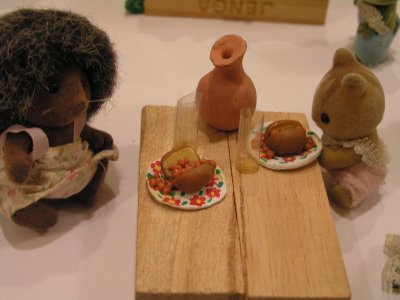
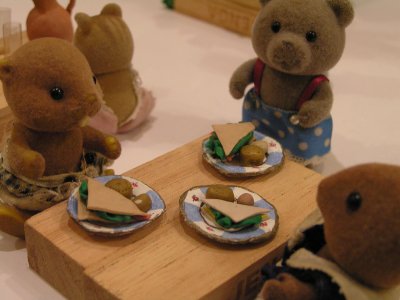
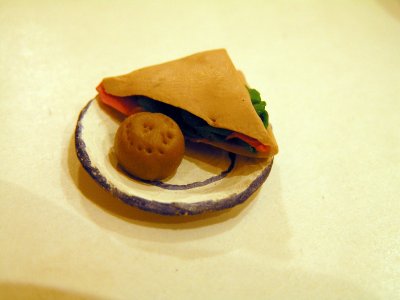
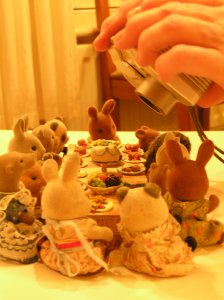
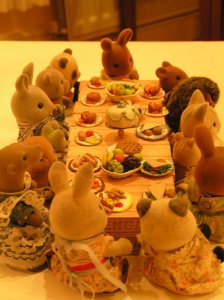
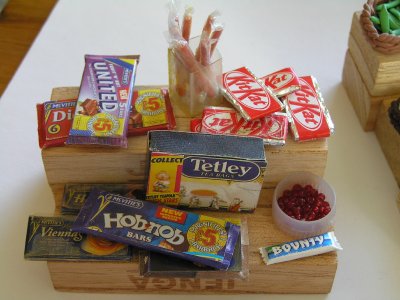
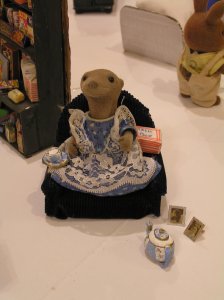
Following a visit home, during which old toyboxes were opened and photographs taken, here’s a window into my childhood. I spent uncountable hours making this kind of stuff–not only accessories, but a whole village of wonderful houses, none of which have survived the years. When you’ve seen all this, you should realise that the question is not “How did you come to make Tefillin Barbie?” but rather “What took you so long?” Most of what’s pictured is from when I was between twelve and fifteen years old.

You should click the pictures and read the captions.


Computer Engineer Tefillin Barbie

ceb1The original Tefillin Barbie was a 2006 model with a long denim skirt.* She’s getting increasingly difficult to find, but people are still buying Tefillin Barbies. So I’ve bought a dozen Computer Engineer Barbies to play with instead.

Computer Engineer Barbie wears leggings, which is a bit of a change from the frummie skirt. Still, I do know legging-wearing women who lay tefillin, even if it’s not my thing personally. So it’s ho and away for Definitely-Not-A-Rabbi Tefillin Barbie. She also wears a phone headset, which I’ve removed, because who wears a phone headset while they’re davening, for heaven’s sake? Finally, she has Bright Pink Glasses; please note the Very Correct Placement of the tefillin strap, behind her glasses.

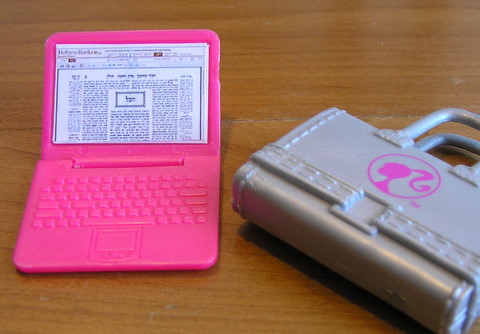
ceb2She comes with a laptop and a smartphone; I’ve adjusted the laptop so that it shows a daf gemara from Hebrewbooks.org, and the smartphone so that it has shacharit.

This Barbie comes with a chunky pink wristwatch, but I’ve tossed that, because the time shown on the watch is 10.59, and this Barbie would totally be at work by 10.59. Unless it was Rosh Chodesh and a public holiday, maybe, and her minyan had had the longest Hallel ever, but as your basic everyday thing, Computer Engineer Tefillin Barbie’s going to be done davening by 8, maybe 8.30, and off to the office. She probably arrives ten minutes early so that she can eat the granola she keeps stashed in her desk drawer. Except on Tuesdays, when the old guys at shul have breakfast with herring and bagels; she stays for that because the old guys are pretty awesome and she likes herring.

*For those new to the saga, all Barbies are Mattel dolls, fitted out by me with tallit and tefillin. Media links here at wikipedia. They’re available for purchase at my Etsy store.