DRBR 7: In which the Upper West Side is told its Duty

Image copyright Jewish Theological Seminary of America. Used with permission. Click to see larger version.

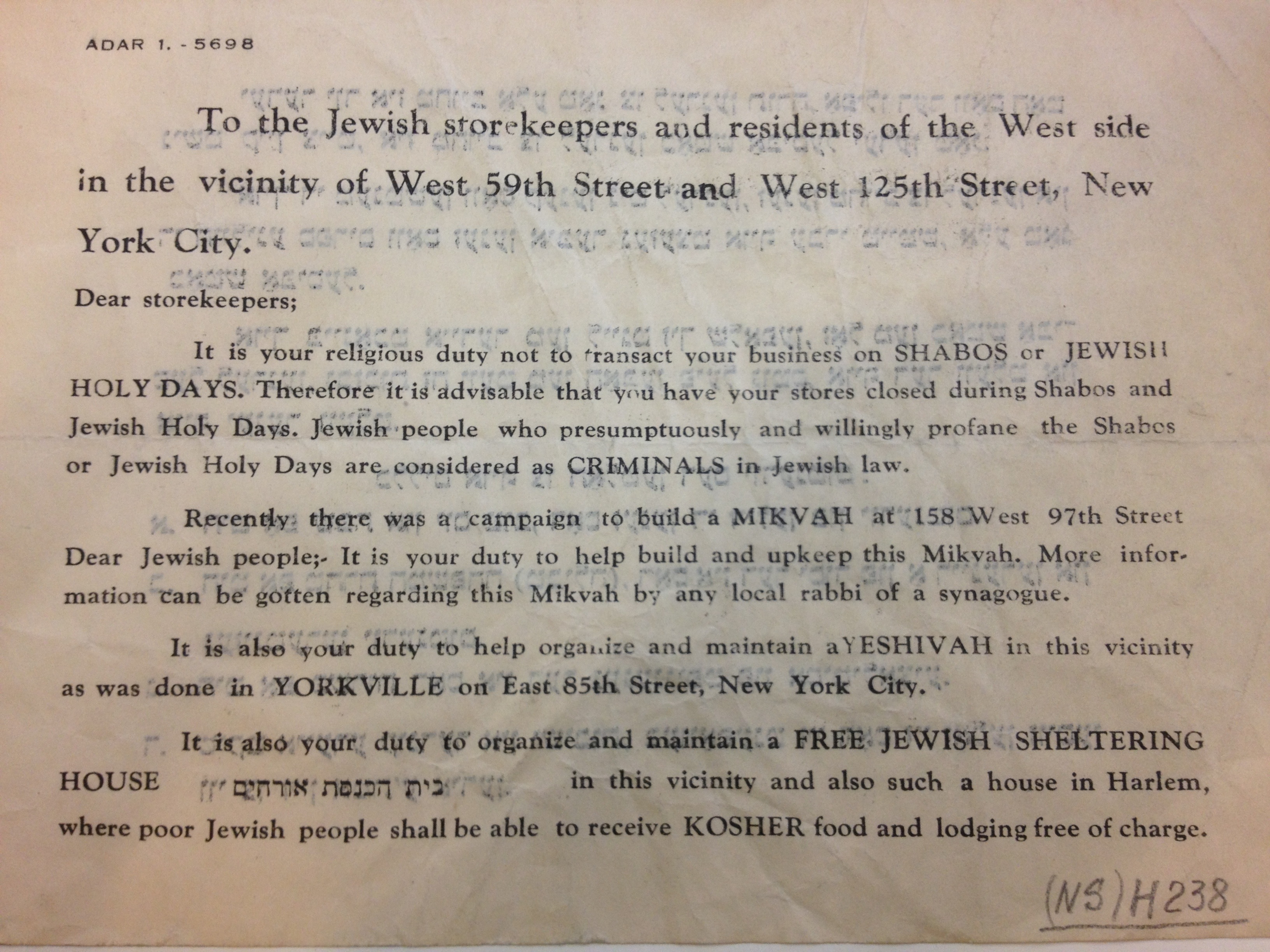
Adar 1, 5698
To the Jewish storekeepers and residents of the West Side in the vicinity of West 59th Street and West 125th Street, New York City.

Dear storekeepers;
It is your religious duty not to transact your business on SHABOS or JEWISH HOLY DAYS. Therefore it is advisable that you have your stores closed on Shabos and Jewish Holy Days. Jewish people who presumptuously and willingly profane the Shabos or Jewish Holy Days are considered as CRIMINALS in Jewish law.

Recently there was a campaign to build a MIKVAH at 158 West 97th Street
Dear Jewish people;- It is your duty to help build and upkeep this Mikvah. More information can be gotten regarding this Mikvah by any local rabbi of a synagogue.

It is also your duty to help organize and maintain a YESHIVA in this vicinity as was done in YORKVILLE, on East 85th Street, New York City.

It is also your duty to organize and maintain a FREE JEWISH SHELTERING HOUSE בית הכנסת אורחים in this vicinity and also such a house in Harlem, where poor Jewish people shall be able to receive KOSHER food and lodging free of charge.

I don’t like being told that it’s my duty to organise things, personally. Seems like the more you accommodate that, the more you end up organising, and the people doing all the shouting never seem to want to help.

However, happily, there is a yeshiva in the vicinity of 59th St. Yeshivat Hadar, at 69th St. Full-time, part-time, and summer learning. Check them out.


DRBR 6: In which satin flowers feature

Image copyright Jewish Theological Seminary of America. Used with permission. Click to see larger version.

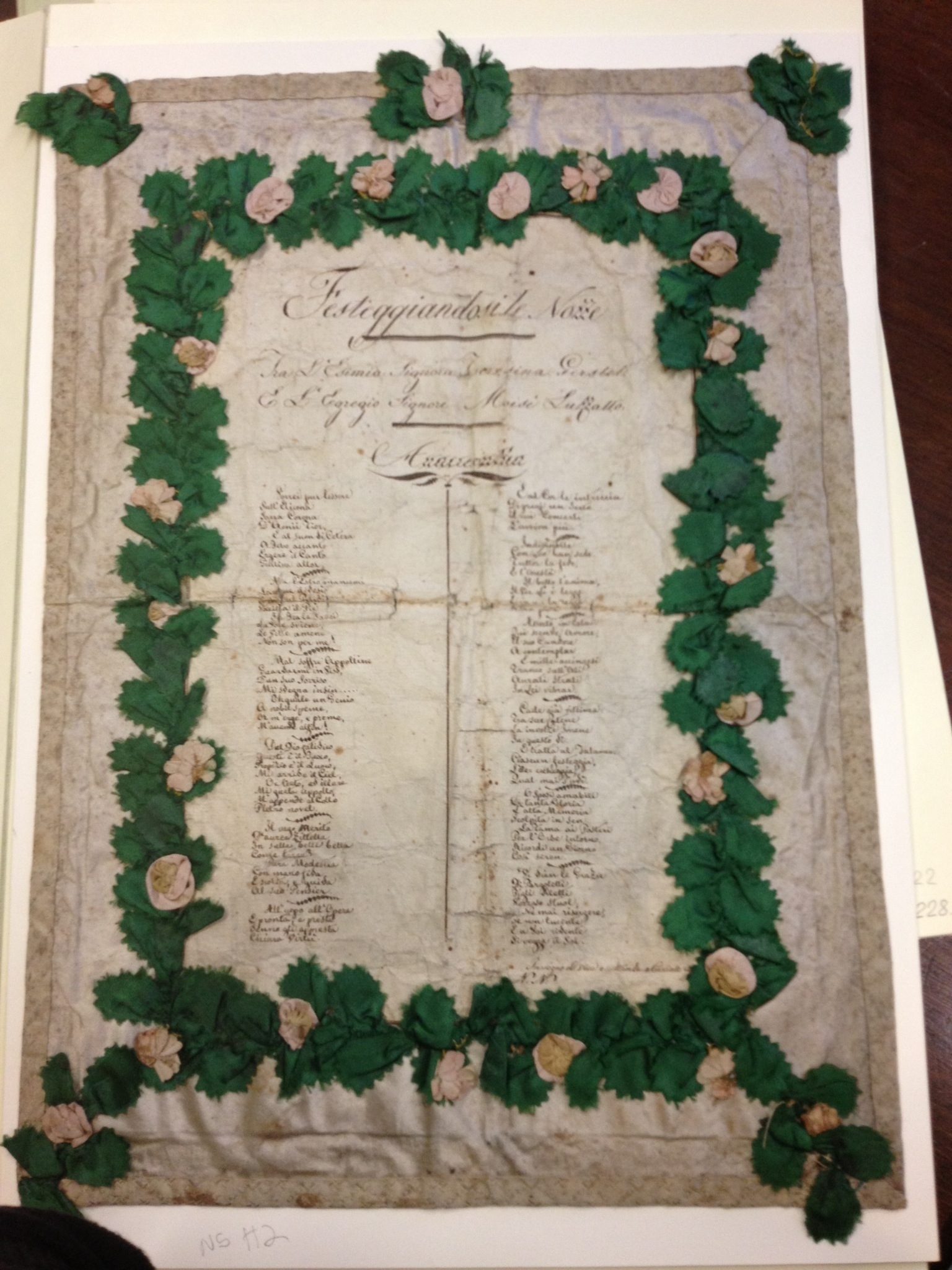
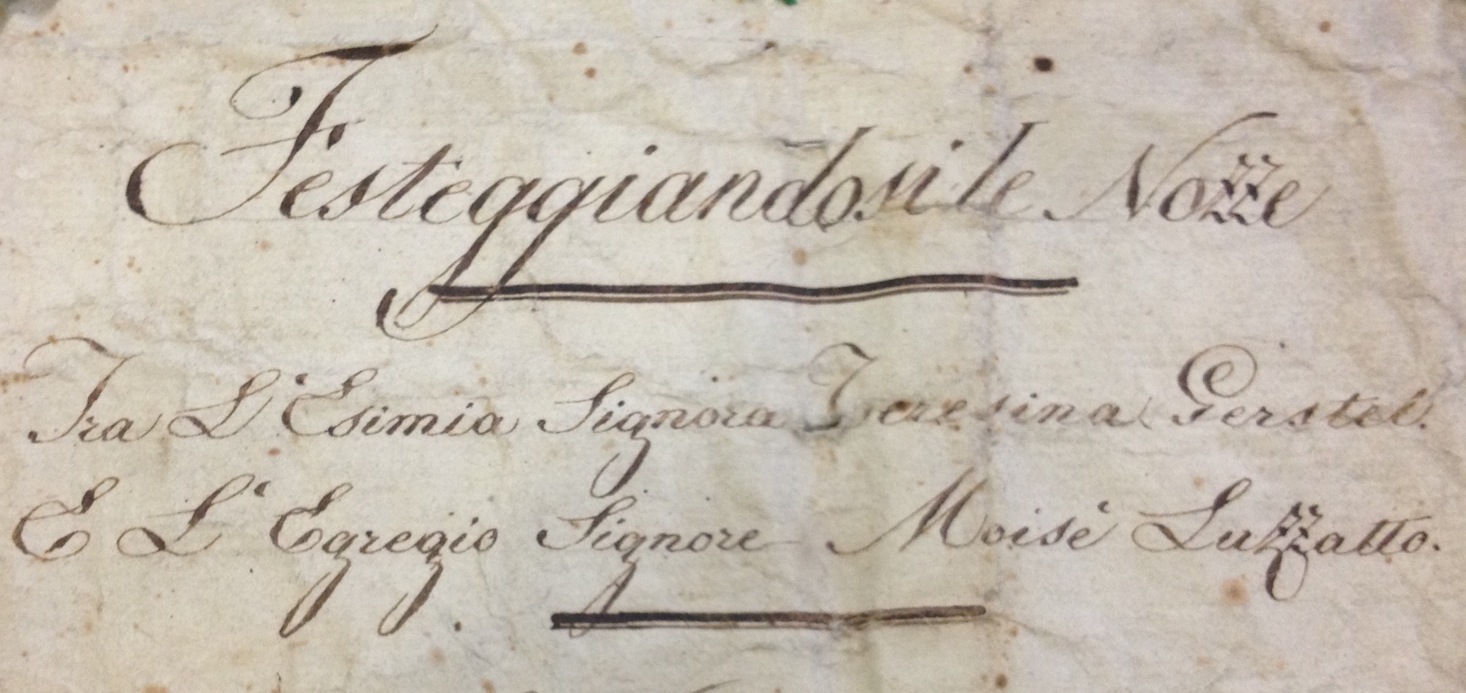
I’m not exactly sure what this one is. It says festiggiandosile nozze at the top; looks like a poem, or perhaps a song, but it’s in Italian so I don’t know really. For a wedding, I know nozze.

Image copyright Jewish Theological Seminary of America. Used with permission. Click to see larger version.

Image copyright Jewish Theological Seminary of America. Used with permission. Click to see larger version.

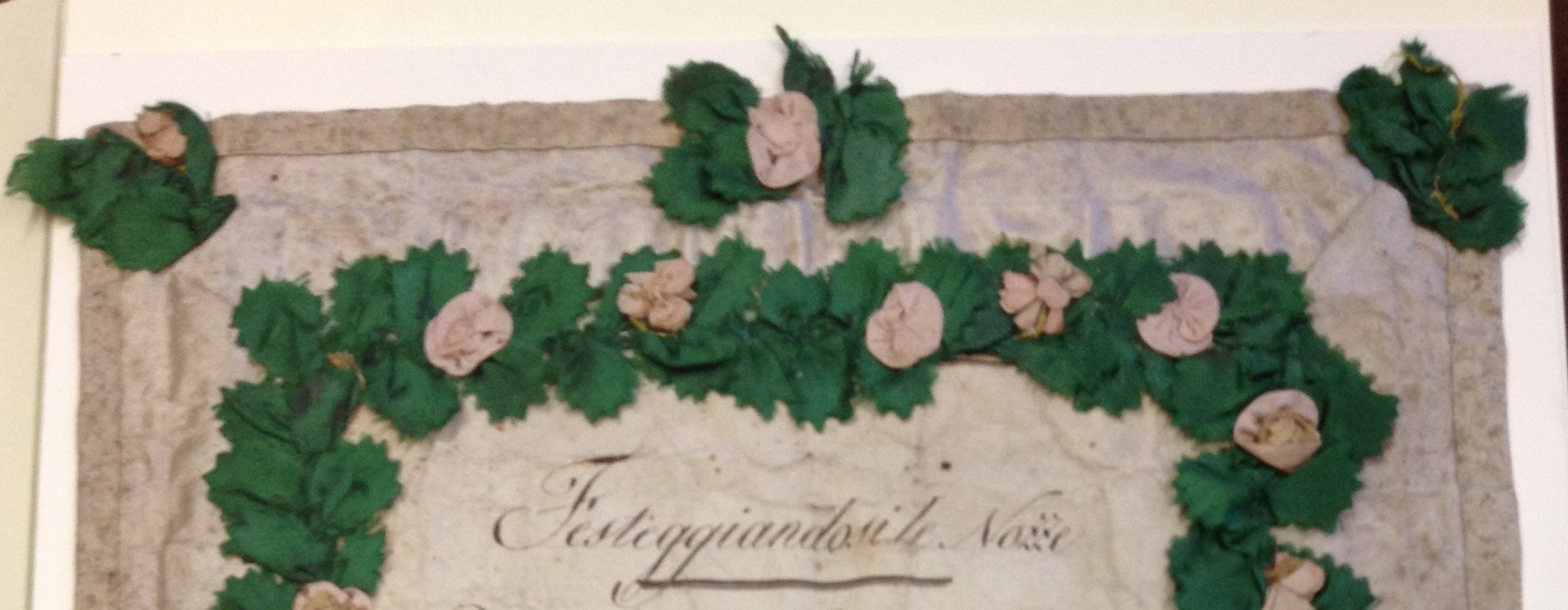
I’m dispatching it here because I liked the multimedia aspect. You can see the poem part is handwritten on paper, but then the paper is pasted to a satin frame, and the join is covered by fabric leaves and ribbon roses.

Note how the leaves have held their green colour but the roses, once red or pink, have faded almost beyond recognition. Lightfast red dyes were jolly hard to do before advances in chemistry in the nineteenth century.

Anyway, something to consider for you fabric artists.

The call number’s nsh2, from drawer 4 again.


DRBR 5: In which the Oppenheimers leave Vienna

Image copyright Jewish Theological Seminary of America. Used with permission. Click to see larger image.

The RBR has a good many decrees resembling this one. They’re all printed on that kind of heavy paper which makes the letter depressions palpable, and some of them have seals and such too. They’re in German, but note how they’ve set the Latin jargon in a Roman typeface, and the German in Fraktur:

This one (DR5-R48) expels the family of Emanuel Oppenheimer from Vienna, in 1723.

Emanuel Oppenheimer was the son of Samuel Oppenheimer, an influential banker, mover, and shaker. Jews hadn’t been allowed to live in Vienna since 1670, but Oppenheimer père lent vast amounts of money to the emperor, funding an expensive war against the Turks, so he was given a special privilege to live there along with his family and associates.

What I found fascinating about this one was that the war didn’t go well; pressure was applied to Oppenheimer père to forgive the debt. Which he did not do, even after rioters trashed his house. The debt passed with his death to Emanuel, who tried to get the state to pay back what it had borrowed.

The state simply could not do that, though; it seems its financial credibility was more or less completely based on the idea that the Oppenheimer family were a never-ending fountain of money. Instead of paying Emanuel, it claimed that he owed them, and since the family were no longer a source of ready cash, they were expelled from Vienna like the rest of the Jews.

In this decree, people are informed (on March 20) that after June 25, the Jews associated with the late Emanuel, including his widow Judith, will be exiled from Vienna. Anyone who has any outstanding business with them had better settle up by then. If you want to take them to court, get it sorted before the exile date because after then the court won’t hear your case.

One of Emanuel’s brothers had gone and established a bank in Hanover, so some of the exiles went there, but it seems that Judith, Emanuel’s widow, stayed on; she apparently died in 1738 in Vienna.

This sort of thing was pretty normal for Jews. They were allowed to live in Christian countries so long as they were useful; when they were not useful, they were expelled.

Full transcription and translation follow, with profuse thanks to my Mum for translating old high German legalese into English legalese and my chum Adam for being enthusiastic about Fraktur capitals.

Wir Karl der Sechste von Gottes Gnaden Erwälter Römischer Kayser/ zu allen Zeiten Wehrer des Reichs / in Germanien / zu Hispanien / Hungaren / Böheim / Dalmatien / Croatien / Sclavonien / zc. König / Erz-Herzog zu Oesterreich / Herzog zu Burgund / Steyer / Kärnten/ Crain / und Wuürtenberg / Graf zu Habspurg / Flandern / Tyrol und Görss/ zc. zc. Entbieten allen und jeden Unseren getreuen Landsassen / Geistlich- und Weltlichen / was Würden/ Standes / oder Wesend die seynd / Unsere Gnad; und geben euch hiemit gnädigst zu vernehmen / was gestalten Wir uns untern 18ten bis Monats Martii Allergnädigst entschlossen / und resolviret haben; dass weilen des abgeleibten Hof-Juden Emanuels Oppenheimersverleihen Lands-Furstliche Privilegium in hiesiger Unserer Residenz-Stadt Wien mit seiner Familia stehen zu darffen / den zweyten fünftigen Monats Junii dieses Jahrs sich endiget / und Wir nun sothanes Privilegium weiters zu prolongiren / nicht gemeinet seynd / sondern alle unter diesem Schutz bishero gestandene Juden / nemlichen Judith Oppenheimerin Wittib / Wolf Moyses Oppenheimer / Löw Oppenheimer / Lehemann Herz / Emanuel Drach / und Löw Manasses mit all deren Familien, wie auch alle andere ohne Privilegio oder Schutz dahier eingeschlichene und sich aufhaltende Juden von hier abgeschasset wissen wollen;

Als haben wir allen und jeden / insonderheit diese Unsere anbefohlene Emigrirung aller sowol ohne Privilegio oder indulto stehender / als auch deren obernennten Juden-Familien biemit zu Ende publiciren lassen wollen: auf dass / so wer an selbe Juden etwas zu forberen haben wurde / solches in dem bangesessten Termin, nemlichen bis anderten Junii dieses Jahrs zu der Richtigkeit bringen / widrigen fahls / der oder dieselbe alhier nicht mehr gehöret werden sollen: masten auch diese Emigrirung besagten Juden durch besondere Hof-Decreta unter obigen Dato intimiret worden: Wornach dann alle / und jede sich zu richten / und ihrem Recht zu invigiliren wissen werden: dann hieran beschiehetUnser Ernstlich – auch Gnädigster Will und Meinung. Geben in UnseredrHaupt-und Residenz-Stadt Wien den Zwanzigsten Monats-Tag Martii im Siebenzehenhundert und Drey und Zwanzigsten / Unserer Reiche des RömischenKonischen im Zwolften / deren Hispanischen im Zwanzigsten / deren Hungarisch – und Böhmischen auch im Zwölften Jahre.

Sigmund Friderich Graf Khevenhuller / Statthalter.
Christoph Friderich Schmid v/ Mayenberg / Canzler-Umts-Berwalter.
L.S.
Commissio Domini Electi
Imperatoris in Consilio.
Johann Ferdinand Edler von Lewen-Egg.
Franz von Harrudern.

We Charles VI by the grace of God Holy Roman Emperor / for all time protector of the realm/ King of Germany/ Spain / Hungary / Bohemia / Dalmatia / Croatia / Slavonia / etc / Archduke of Austria / Duke of Burgundy / Steyer / Kärnten / Krain / and Würtenburg / Count of Habsburg / Flanders / Tyrol and Görss/ etc etc, our gracious majesty greets each and every of our loyal vassals / both spiritual and secular / of whatever office, rank or kind they be; and we herewith graciously give you to learn / what has transpired since the 18th day of the month of March and what we have most graciously decided / and resolved;

The duration of the late Court Jew Emanuel Oppenheimer’s special concession of a royal land grant allowing him to stay here in our town of residence Vienna with his family / expires on the twenty-fifth of the month of June of this year / and we now are not minded / to extend that concession longer / but we want all the Jews hitherto staying under this protection / namely Judith Oppenheimer, widow / Wolf Moyses Oppenheimer / Löw Oppenheimer / Herz Lehmann / Emanuel Drach / and Löw Manasses with all their families, as also all other Jews staying without a special concession or protection, to know that it is abolished from now on.

Whereas we have hereby desired to let one and all know / in particular this our ordained expulsion of every person staying without a concession or pardon / and whereas that of these aforementioned Jewish families has hereby come to an end; hence any person who might have something to demand from a particular Jew / should bring it to justice by the aforesaid deadline, that is to say by the end of June this year / otherwise / he or she shall no longer be heard: also these Jews ordered to exile by special royal decree must be banished by the above date: so each and every person has been notified to abide by this and safeguard their rights.

Herewith our earnest and most gracious wish and intention. Given in our capital and home city of Vienna on the twentieth day of the month of March in seventeen twenty three, in the twelfth year of our reign over the Roman Empire, in the 20th over the Spaniards / and also in the twelfth over the Hungarians and Bohemians.


DRBR 4: In which lights are bidden to shine

Somewhere in drawer 4, but I didn’t note the reference. Two little snippets, today.

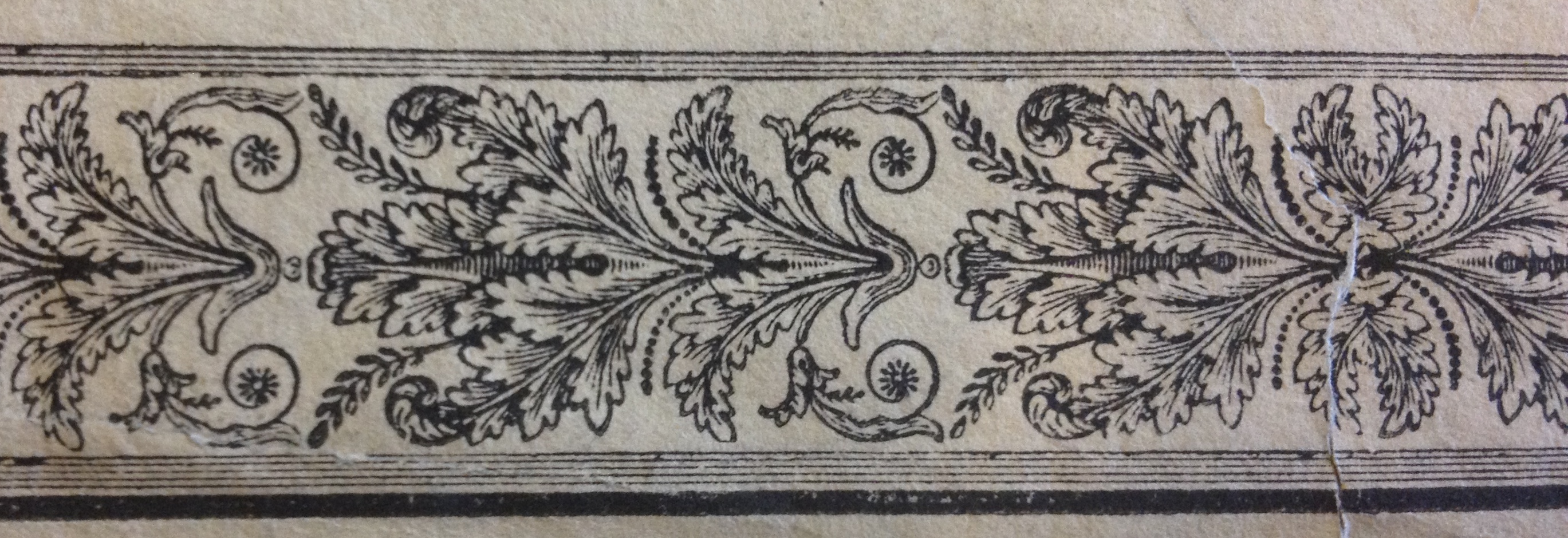
One random prettything:

Image copyright Jewish Theological Seminary of America. Used with permission. Click to see larger image.

Note how you can take segments of the image and stick them together to make a slightly different look.

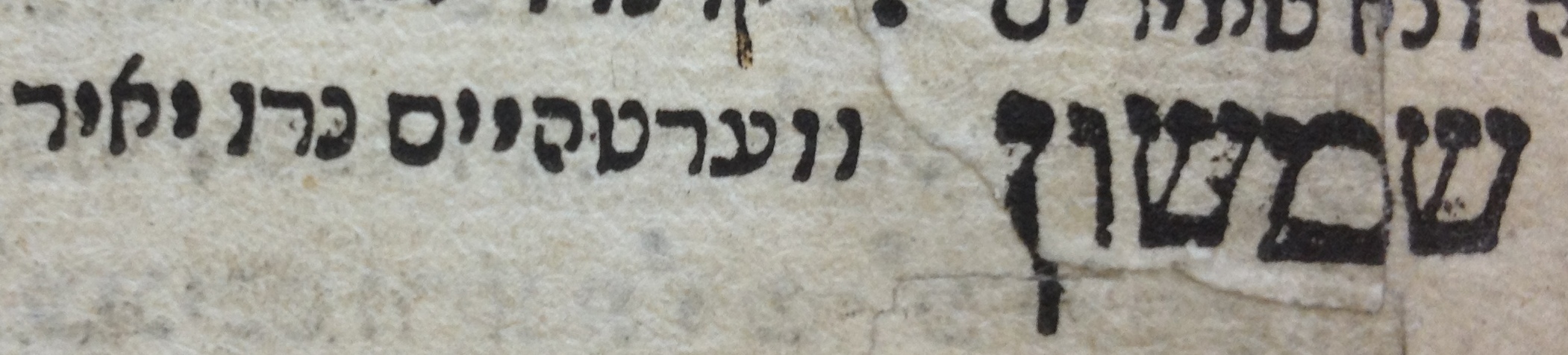
The other thing is vocabulary; often you see נ”י after a name, and it’s clearly an honorific, but I’ve never been quite sure what it means. Someone said “Maybe Ner Yisrael?” (Light of Israel) but here it’s Nero Yair (his light should shine). I should have noted the reference for time and place. Oh well.

Image copyright Jewish Theological Seminary of America. Used with permission. Click to see larger image.


DRBR 3: In which a ketubah is pre-printed and passed by the censor

Image copyright Jewish Theological Seminary of America. Used with permission. Click to see larger image.

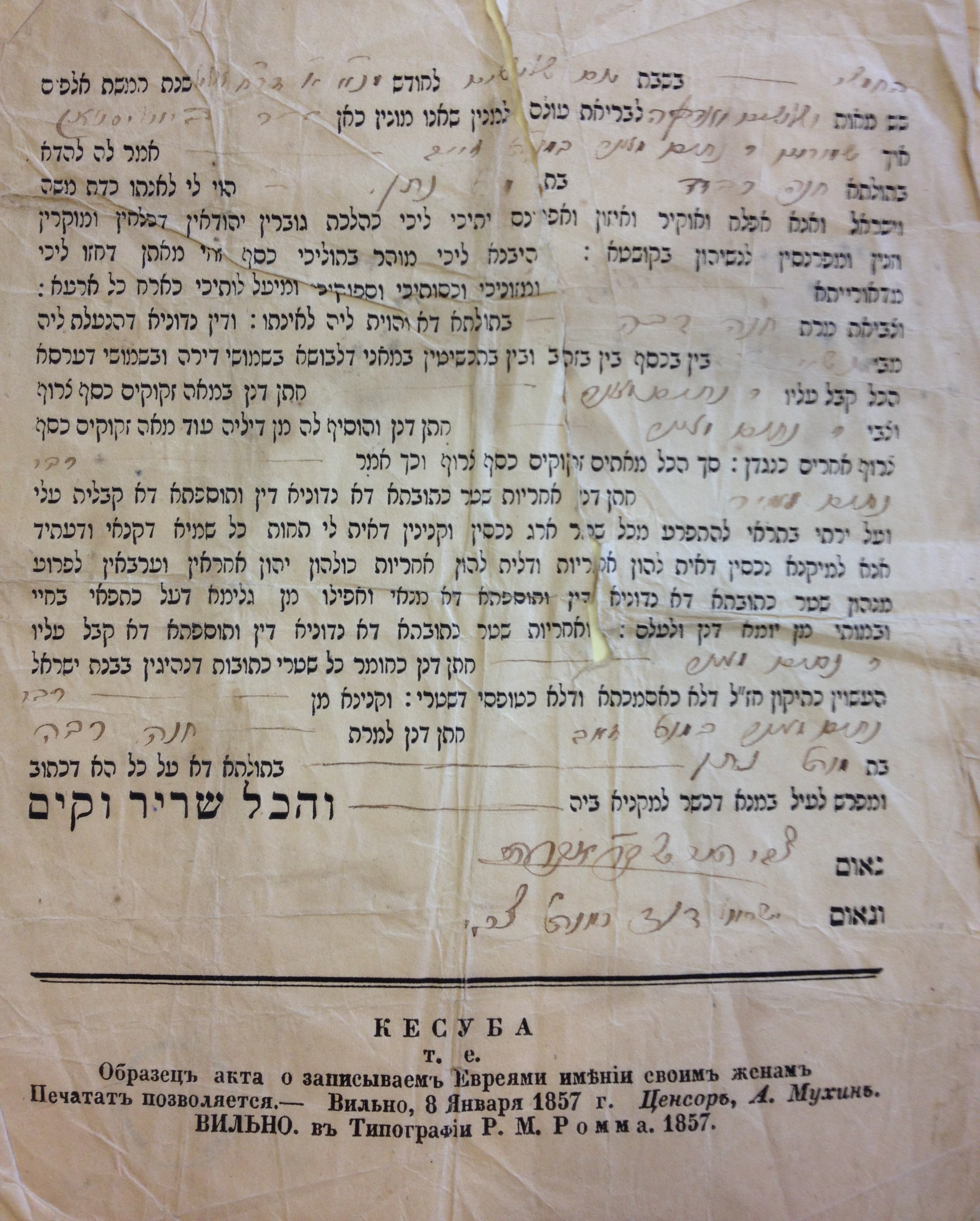
DR4-L5 is a pre-printed ketubah from Russia, 1857, with gaps left for the names and date. We do this today. Nice to know we’ve been doing it for a long time.

The ketubah’s in a folder with the passport of its owner, who was a cantor. One supposes he travelled a bunch; you’re supposed to take your ketubah with you when you go away travelling, so presumably he kept it tucked inside his passport.

A loyal reader translated the Russian at the bottom for us. It says:

KESUBA
i.e.
An example of the property registered by Jews for their wives
Printing permitted.— Wilno, January 8, 1857. Censor, A. Mukhin
WILNO, in the Typography of R. M. Romm. 1857

I didn’t know that Hebrew printing in mid-nineteenth-century Russia was censored. Lots of governments have historically been suspicious of ethnic groups printing things in foreign languages, and they employ bilingual people as censors, but I’d not considered Russia. It makes sense, given that restrictions on Jews were piling up.

Thanks, Amir E. Aharoni! (Visit Amir’s blog at http://haharoni.wordpress.com/otiyot-niqqud/)

Concerning the text itself, I typed it out for you, so that you can see it’s basically just the same as today’s regular ones. I didn’t transcribe the handwriting.

____בשבת__________ לחודש_______ שנת חמשת אלפים שש מאות ________ לבריאת עולם למנין שאנו מונין כאן____________ איך ________________ אמר לה להדא בתולתא ______ בת _____ הוי לי לאנתו כדת משה וישראל ואנא אפלח ואוקיר ואיזון ואפרנס יתיכי ליכי מוהר בתוליכי כסף זוזי מאתן דחזו ליכי מדאורוותא_____________ ומזוניכי וכסותיכי וספוקיכי ומיעל לותיכי כארח כל ארעא: וצביאת מרת _______ בתולתא דא והוית ליה לאינתו: ודין נדוניא דהנעלת ליה מבי______ בין בכסף בין בזהב ובין בתכשיטין במאני דלבושא בשמושי דירה ובשמושי דערסא הכל קבל עליו________חתן דנן והוסיף לה מן דיליה עוד מאה זקוקים כסף צרוף אחרים כנגדן: סך הכל מאתים זקוקים כסף צרוף וכך אמר_______ חתן דנן אחריות שטר כתובתא דא נדוניא דין ותוספתא דא קבלית עלי ועל ירתי בתראי להתפרע מכל שפר ארג נכסין וקנינין דאית לי תחות כל שמיא דקנאי ודעתיד אנא למיקנא נכסין דאית להון אחריות ודלית להון אחריות כולהון יהון אחראין וערבאין לפרוע מנהון שטר כתובתא דא נדוניא דין ותוספתא דא מנאי ואפילו מן גלימא דעל כתפאי בחיי ובמותי מן יומא דנן ולעלם: ואחריות שטר כתובתא דא נדוניא דין ותוספתא דא קבל עליו__________חתן דנן כחומר כל שטרי כתובות דנהיגין בבנת ישראל העשוין כתיקון חז”ל דלא כאסמכתא ודלא כטופסי דשטרי: וקנינא מן__________חתן דנן למרת________בת_______בתולתא דא על כל הא דכתוב ומפורש לעיל במנא דכשר למקניא ביה________והכל שריר וקים


DRBR 2: In which cherubs sit on a cloud

Image copyright Jewish Theological Seminary of America. Used with permission. Click to see larger image.

JTS manuscript DR4-R82 is a pen-and-ink drawing of cherubs sitting on a cloud, which floats beneath a shining crown. The cherubs are singing music from a scroll and above them float the words “To the Queen, with Her Majesty’s most Gracious Permission this Work is most respectfully inscribed by Her Majesty’s most faithful obedient and humble servant Harriett Abrams, Park Lane 1803”.

Ever heard of Harriett Abrams? I hadn’t either, but here’s Wikipedia:

Harriett Abrams (born c. 1758- died 8 March 1821, Torquay) was an English soprano and composer. Particularly praised for her performances in the repertoire of George Friderich Handel, Abrams enjoyed a successful concert career in London during the 1780s. Music historian Charles Burney praised the sweetness of her voice and her tasteful musical interpretations…Abrams composed several songs, two of which, “The Orphan’s Prayer” and “Crazy Jane”, became very popular…A collection of songs published in 1803 was dedicated by Harriett to Queen Charlotte.

Note the sealing-wax blob on the manuscript. Presumably this is the cover letter to that collection.


DRBR 1: Azulai raises funds

Image copyright Jewish Theological Seminary of America. Used with permission. Click to see larger version.

Drawer 4, item DR4-R57.

This is a form letter, signed by Hayyim Yosef David Azulai.

Azulai is also known as the Hida, the acronym of his name. He’s a famous rabbi and scholar. But he also spent a lot of time fundraising, asking people for money for specific good causes, and tis here is a pre-printed form letter which he used to that end. You can see the place at the top where he’s written in the name of the person he’s hitting up, in fancy calligraphy.

Wikipedia:

His mission: Raise money for the support and survival of the beleaguered Jewish community of Hebron. At that time, the Jewish community of Hebron, as well as other communities in Israel, suffered the brutal and constant privations of Arab and Turkish landlords and warlords who demanded exorbitant sums of money in the form of arbitrary and draconian taxes…Without the missions of people like the Hida, the very physical survival of these communities came into question.

…The right candidate for the mission, ideally, combined the characteristics of statesmanship, physical strength and endurance, Torah knowledge and understanding and the ability to speak multiple languages. They had to have the right stature and bearing to impress the Jewish communities they visited, they often had to be able to arbitrate matters of Jewish law for the locals and, ideally, they were multi-lingual so that they could communicate with both Jew and Gentile along the way.

If you plug through some of the text, you see אין חדש תחת השמש, there is nothing new under the sun; flowery language for teasing open wallets, pleas for money for starving children and naked women in the streets, calling down blessings upon those who donate. (If anyone wants to type some of it up and translate for the benefit of all, feel free.)

He’s also raising money for redeeming captives. There was something of an industry in capturing Jews and hitting their communities up for ransom. I suppose אין חדש תחת השמש again, but these days it’s more for prisoner exchange than money. Ketubot of the period sometimes had stipulations that if the bride was captured, the husband’s estate was required to redeem her.

There are loads of these form letters in the Rare Book Room. The Hida was a busy guy.

I like this particularly because I know the Hida mostly as an halakhist. That is, from my perspective, the Hida’s existence has been boiled down to a few rules and regulations. But really, he was an enormously busy chap, doing all kinds of things that I’m familiar with rabbis today doing. I find this broadened perspective oddly reassuring.


Dispatches from the rare book room

I volunteer at the Rare Book Room at JTS. I’m helping do an inventory of the flat media. Since many interesting things are flat, I am getting to see many interesting things.

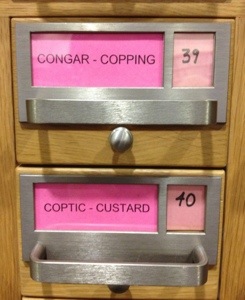
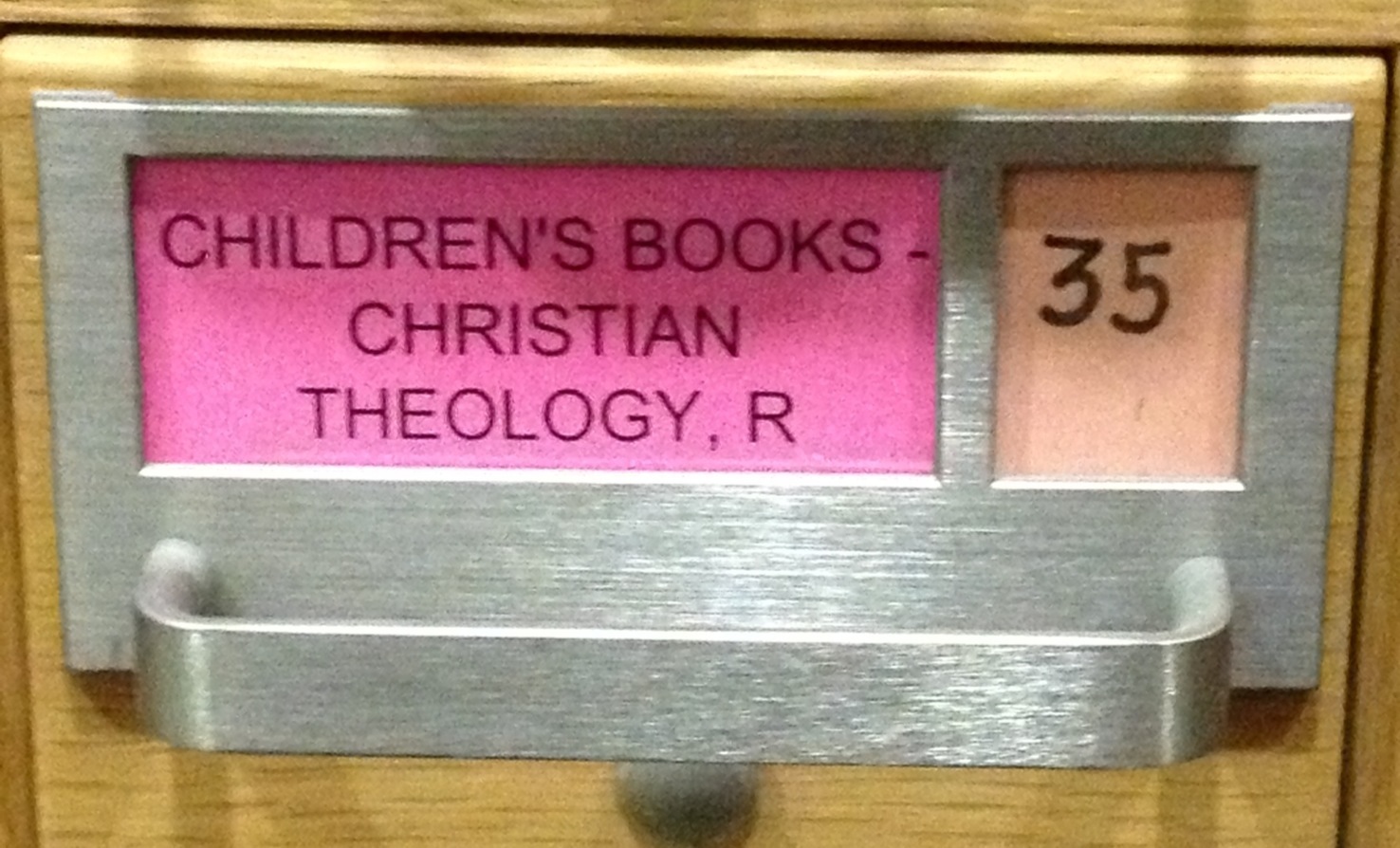
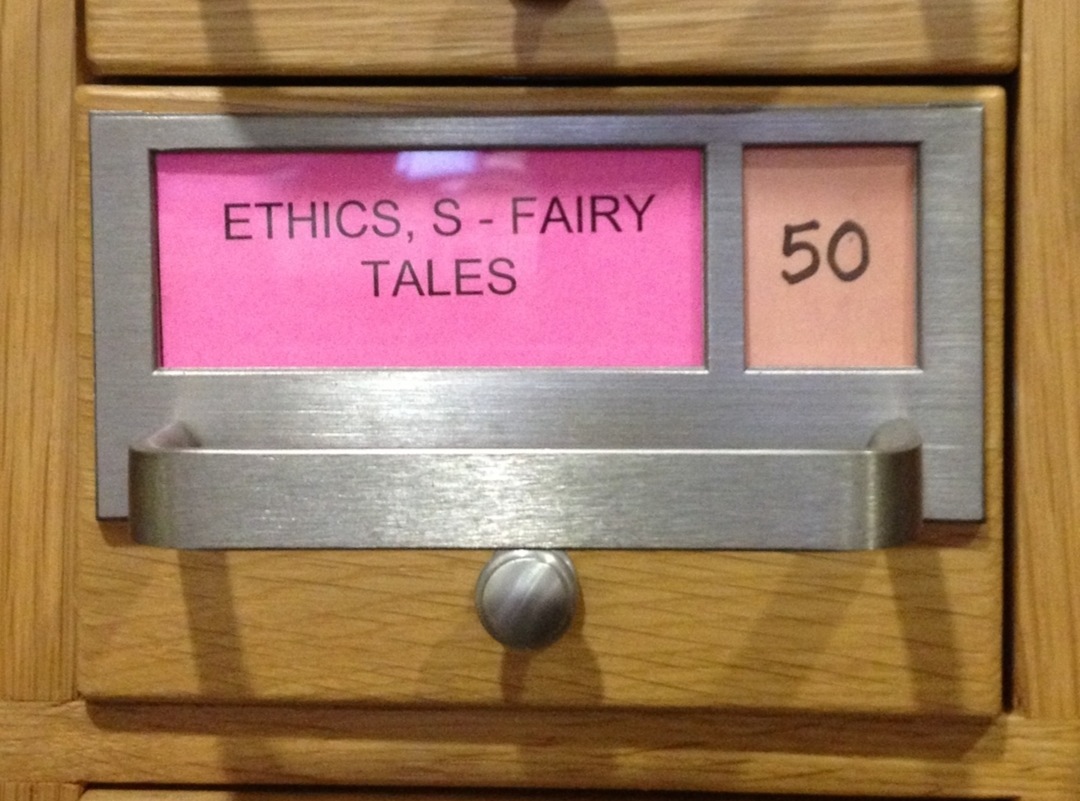
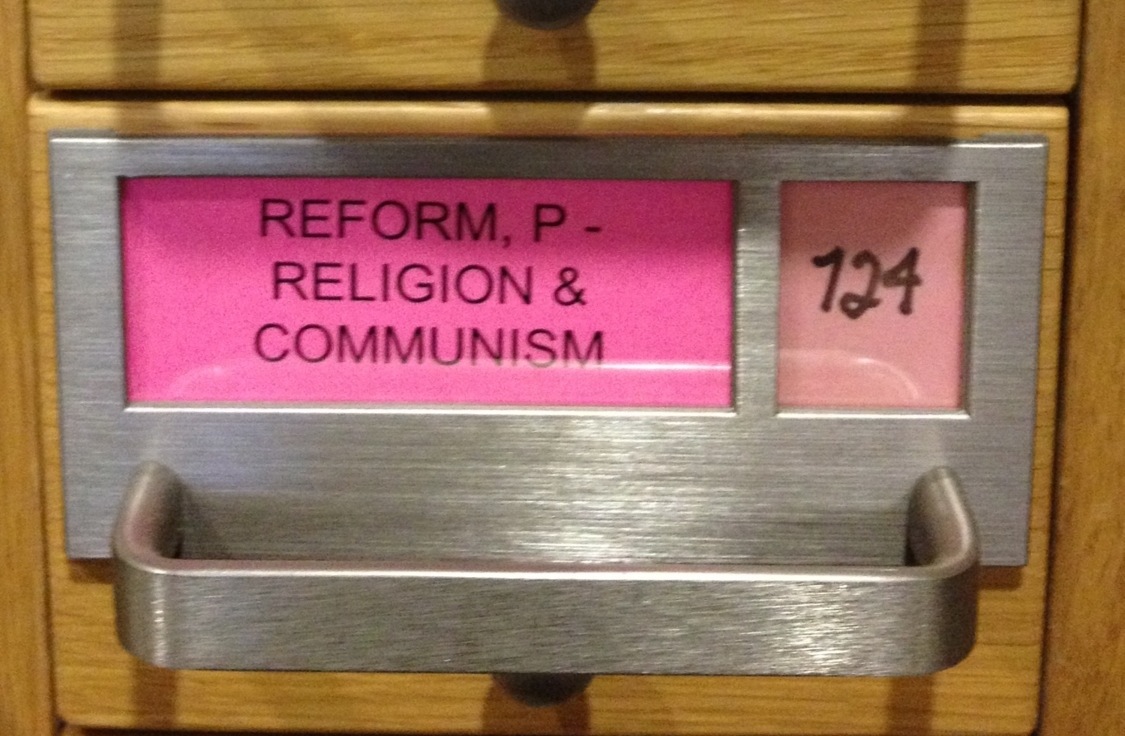
But before we go into the stacks, some fun with the card catalogue drawers.

I don’t know what Coptic Custard is, but I’m sure a nice bowl of it would be welcome after an energetic session of Congar Copping.

Perhaps for very advanced children.

A bit nihilistic?

I think this is not actually a very accurate way of describing the Reform Movement.

Right. Next time, we go into the broadside drawers.


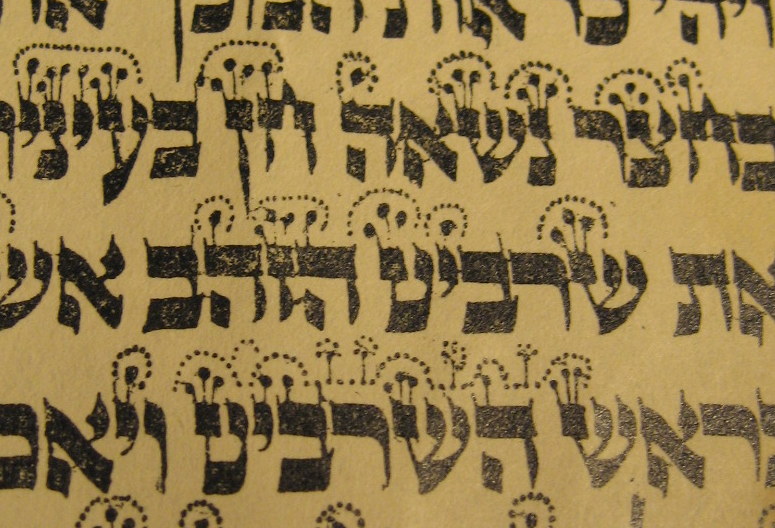
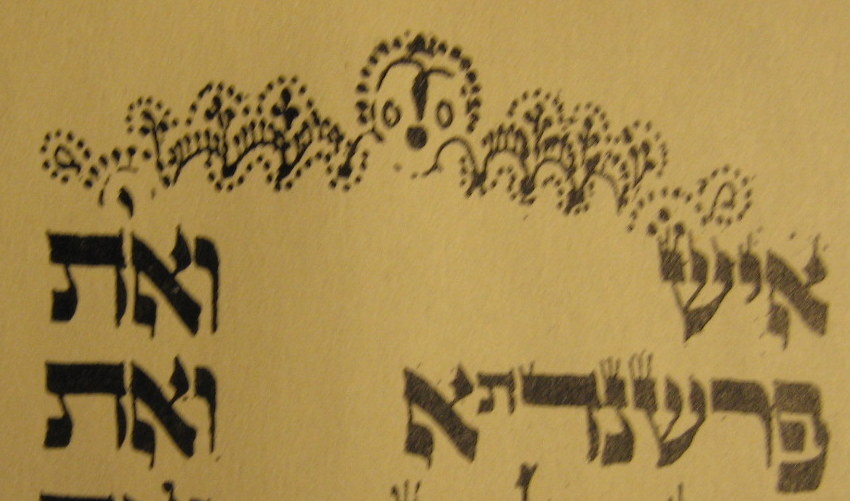
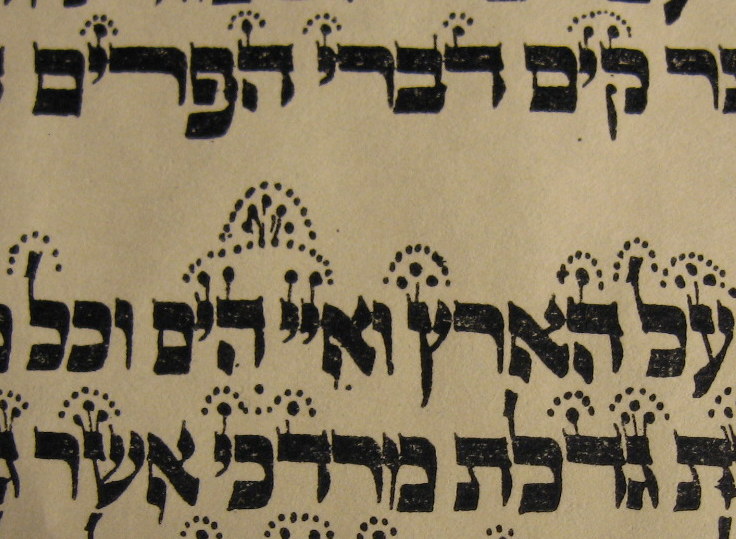
Fun with megillot

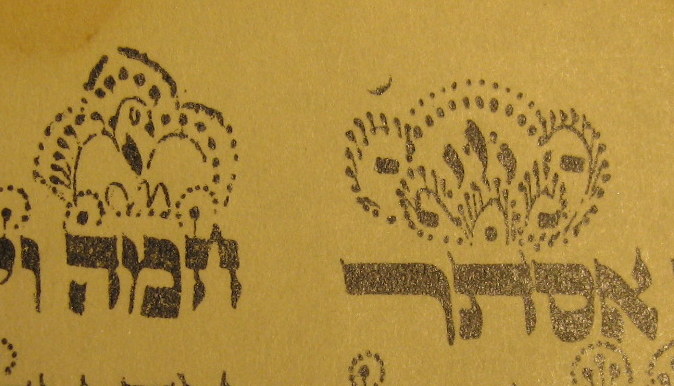
It’s megillah-writing season. So here are some fun pictures from a megillah. A photocopy of a megillah, actually, whose provenance I do not know (other than the obvious “Ashkenaz, Beit Yosef script”).

Students, look and be impressed at the scribe’s creativity, but also take the time to look critically. Notice how you can make a splendid effect without being 100% accurate, symmetrical, etc.? You can do that too.

Also this season, bear in mind that wine carriers make very excellent megillah cases. Some of them don’t even look like wine carriers, they’re just pretty. Some of them have handles. Some are sold blank so you can do your own decoration. And liquor stores will often give you the presentation tubes for very fancy liquors if you ask nicely.

This post is for the upcoming mailing to the Sofrot Google Group. If you are a soferet, or have aspirations in that direction, you can join using the contact information which will be added to this post once Madame la administrator tells me which contact deets to put here.


Ketubot when couples don’t have shared artistic visions

I would normally be out at gay square dancing right now, it being Tuesday evening (it’s really nice; they let straights in to dance), but I’m home nursing a cold so it doesn’t have a chance to turn into bronchitis, so I’m going to tell you about ketubot instead.

Chum R just called, see. She’s getting married to Mr R, and they want a pretty pretty ketubah. Some months ago, I gave them my usual homework: look at other ketubot and see if there’s anything that jumps out at you. Send me pictures of things you both like. This gives us a vocabulary of visual things to get started with while we all work towards designing something you want on your wall while your kids grow up.

So Chum and Mr R have discovered that he likes tree motifs, and she Very Much Doesn’t like tree motifs, and they’re a bit stumped. So to speak.

What we do is this.

Get a handle on what each person likes. What is it Mr R likes about the tree motif, exactly? Is he a botanist? Does he like the wiggly-wavy shapes leaves make? Maybe he likes fractals. Or irregular fractals. Maybe he likes the idea of tree as family. Or maybe he likes the idea of tree as enormous arching biomass. Maybe he likes green. Maybe he likes organic curves.

Why doesn’t Chum like trees? And, just as importantly, what does Chum like? What does she like about what she likes?

Sometimes it’s really hard to break down a feeling into words and ideas. But if you can do it with “I like trees because they are strong, also because I like green and the way the branches do that dividy thing” and “I don’t like trees because they’re overdone and they make me think of bugs and I like steampunk better anyway”, you can probably do it with other things such as FLOWERS or WHAT YOUR MOTHER SAID ABOUT OUR DOREEN AT PESACH THAT TIME.

Maybe we have a solution already. Maybe we can do a design which involves lots of green and has a feel of strong shapes dividing up into complex delicate ones, which overlap and twist around into the kinds of layers of repeating patterns which give the pleasant feeling of visual befuddlement which turns out to be what Chum likes about steampunk because her favourite part of steampunk is mechanical devices.

Maybe we don’t have a solution yet. So now we try to:

Identify some other visuals that both people like. Maybe you both like the teapot, or the shade of green on the bathroom mat, or the china you picked out, or the way the light and shade play together in the railings outside the shul’s windows.

Maybe we can make a ketubah based on some of those visuals instead. You are both extraordinary, complex, exciting people! Your ketubah can express your shared love of cats and the shul’s railings, and Mr R can join a botany club and Chum can take a course in clockmaking.

Or perhaps that conversation will help us learn that if the tree was kind of stylised, with purple leaves, and some rabbits in waistcoats underneath it, both parties would be satisfied. Nay, delighted.

Maybe we still need more steps. Then we:

Identify some things that both people like. You two are proposing to share some decades together. That suggests you like being together. Chances are, you like being together because you have a shared appreciation for some things. The universe is big and contains many beautiful, marvellous, wondrous things. Tell me about some of the ones you both love.

The super thing about this is that it doesn’t have to be visual. You can tell me about how much you both love the High Line Park and I can refer you to my friend Erika who does awesome papercuts and she’ll make you a papercut of the High Line out of solid awesome. (Or I can make you a High Line ketubah, but I wanted to show y’all Erika because wow.)

Back to the point–maybe some of them are visual. I can speak Visual. Visuals go together in my brain and I can think “hmm, they both like Thing1, Thing2, and Thing3. These have some Visual Elements in common. Let me assemble these Elements, free from distracting extraneous trappings, on paper!”

I can’t explain why this works, but it does often result in Good Things. “We thought we had no shared taste in visuals but we both love this” is a phrase I have heard more than once.

I like this situation a lot as a kind of metaphor for handling relationship issues, to be honest. When exploring around a problem (opposite views on trees! secretly thinking steampunk is pathetic!) we can articulate the parts that make us happy as individuals and identify the mutual soul-resonance which is WHY YOU’RE GETTING MARRIED YES and figure out how to express that as common ground and produce something lovely that gives you warm happyfeelings when you have it in your home.