DRBR 13: In which an Important Appeal is responded to

Images copyright Jewish Theological Seminary of America. Used with permission. Click to see larger version.
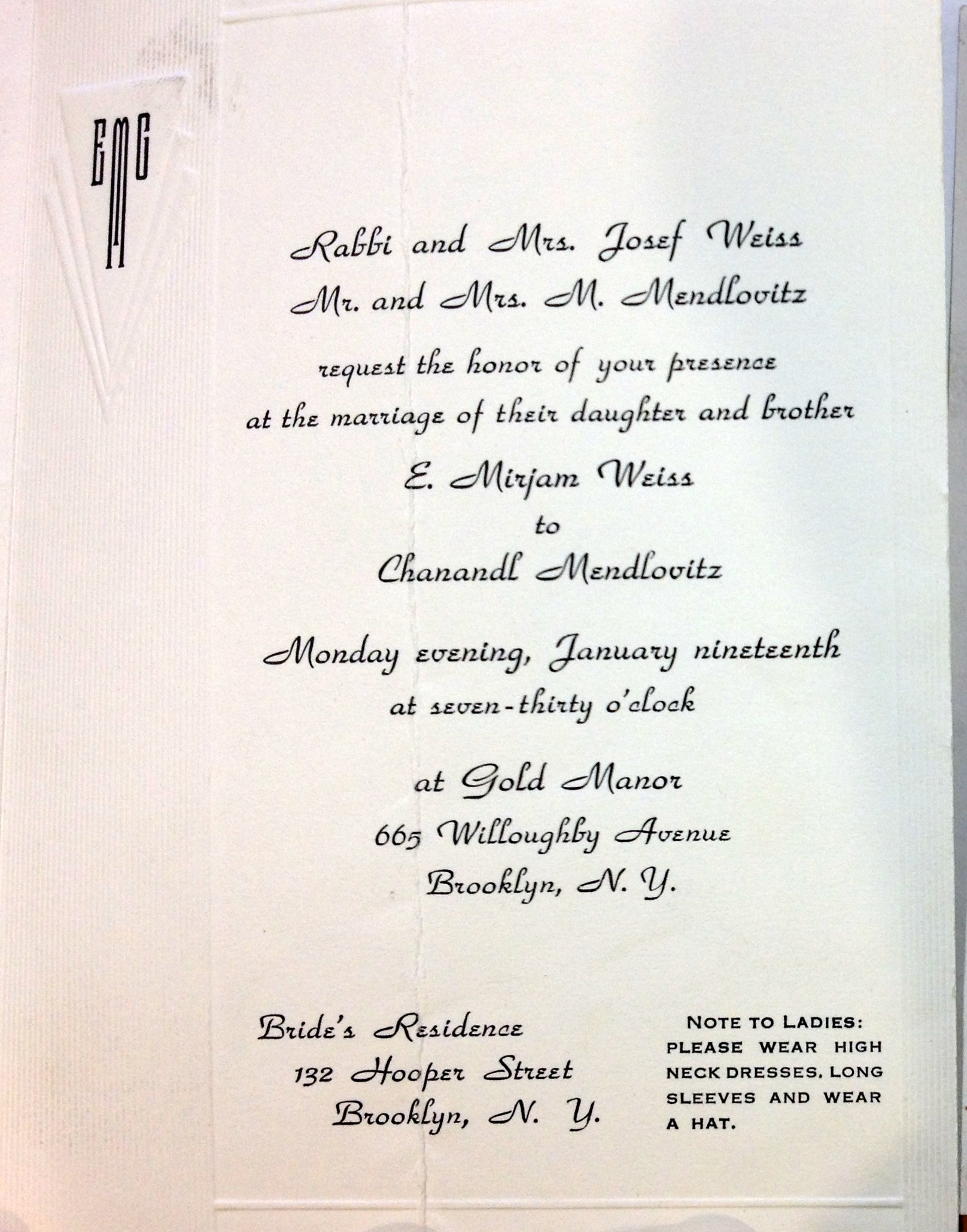
DR6-L16 contains two items: a flyer and a wedding invitation.

IMPORTANT EMERGENCY APPEAL FOR HACHNOSAS KALOH

Dear Brothers and Sisters:
I beg you with great respect. I am a refugee in this country. I have fled from the Iron Curtain (Budapest), where I had my own Beth Hamedrash. Now, I have to marry off my dear daughter very soon. I beg you to help me as much as possible. You should also take part in this Great Mitzvah Hachnosas Kaloh.

In merit of that Mitzvah you should have long life, happiness and luck in every way.

With blessing and best wishes, I am

Very sincerely yours,

RABBI JOSEF WEISS

Hachnasat kallah is about making sure a bride has what to set up house with and funds to have a wedding. If you move in frum circles you get hit up regularly for money for poor brides like this.

“Marry off my daughter” rubs me up the wrong way, honestly. “I need lots of money so that someone will take my daughter off my hands because they wouldn’t take her free with a pound of tea,” is what I hear. Okay, this has been the way of the world for centuries, or millennia, but it’s still annoying.

It also seems sort of chutzpahdik to say “giving me money is a big mitzvah, you should do it,” but I guess you get good at that if you run a yeshiva.

Anyway, he apparently did pretty well out of it; the daughter got married in due course, and note the fancy invitation with embossing and monogram, and the wedding venue was Gold Manor, apparently a Simcha Palace.
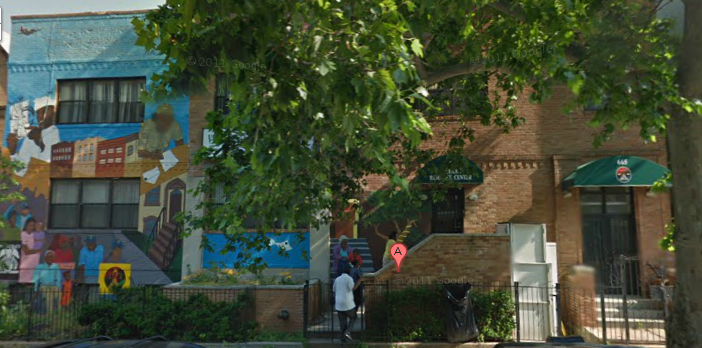
For funsies, I looked up Gold Manor, where the wedding was held. It’s now the site of Black Veterans for Social Justice, but I’m not good enough at American architecture (or Google archaeology) to know whether the building on Google Street View is the one that was there in 1953. But I did find an anecdote about Gold Manor in 1954, from Philip Fishman’s book A Sukkah Is Burning:

…the Tzehlemer Rav was then asked to be the mesader kiddushin (the rabbi responsible for the wedding sacraments). After the wedding ceremony the rav was nowhere to be found. He had left the wedding hall with the ketuba–the traditional wedding document required by Jewish law to be given to the bridge–still in his possession. Apparently, he had not yet been paid for his services. Either my father or my older brother eventually found him outside the wedding hall, wrote him a check, and obtained the ketuba’s release.

I like that.

I couldn’t find anything at all about Yosef Weiss, or E. Miriam his daughter, or Chanandl his son-in-law. Pity. It’s a rather sad reflection on how things went generally; all these scholars who managed to avoid getting killed in the war or trapped by communism, who came to America, where Torah learning was very very different; less of it, for starters, and already-established yeshivot, for another. The lucky ones found money and followers and joined the learning scene, and the unlucky ones sank into obscurity.
DRBR 12e: Desserts

And now, dessert!

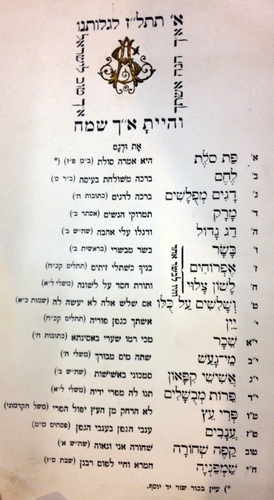
Menu item 13: Frozen Squishies, אשישי קפאין.

Explanation 13: Song of Songs 2:8 says סמכוני באשישות, sustain me with raisin-cakes. Jastrow says that ashisha comes to mean any pressed kind of food, also a jug or contents thereof. So this might be a frozen raisin-cake, or it might be an ice-cream cake (if that isn’t horribly anachronistic) or it might be iced punch.

Menu item 14: Stewed fruit.

Explanation 14: Proverbs 31 says Give unto her the fruit of her hands.

Menu item 15: Tree fruit

Explanation 15: This is a non-rabbinic one; the citation is the proverb “The fruit does not fall far from the tree.” Why a sudden non-rabbinic thing? I have an idea, which we’ll get to.

Menu item 16: Grapes

Explanation 16: (Sow) grape seeds with grapevines, says Pesachim 49a.
Here’s the context. The Talmud is talking about the desirability of marrying certain kinds of people (social commentary like whoa; go learn that whole section, it’s fascinating), and says:

תנו רבנן: לעולם ימכור אדם כל מה שיש לו וישא בת תלמיד חכם, וישיא בתו לתלמיד חכם. משל לענבי הגפן בענבי הגפן, דבר נאה ומתקבל. ולא ישא בת עם הארץ – משל לענבי הגפן בענבי הסנה, דבר כעור ואינו מתקבל.

That is, it is taught in a baraita that one should sell everything he has and marry the daughter of a Torah scholar [and do remember that it is sages writing this], and marry his daughter to a Torah scholar. This is like planting grapes among grapevines; it is fitting and fruitful. And one should not marry the daughter of an ignoramus; this is like planting grapes among scrub, it is distasteful and not fruitful.

So serving grapes at the wedding is commenting that this is a fitting and fruitful match involving a Torah scholar.

Menu item 17 (note that 17 isn’t written י”ז as it usually is, it’s written טוב; I think that’s rather nice): Black coffee.

Explanation 17: I am black and comely, says Song of Songs 1.

Menu item 18: Champagne.

Explanation 18: This is another bit where you really really need to go learn the whole section of Talmud (Shabbat 67a). It’s just fascinating; it’s talking about things which are and are not forbidden on account of being darchei ha’emori–irreligious shtick non-Jews do, unfitting for Jews. For instance, peeing in front of a pot to hasten its cooking is forbidden because it’s darchei ha’emori, but putting a chip of mulberry wood in it is fine.

Saying “Wine and life according to the rabbis!” is another thing that’s not forbidden. Rashi seems to be saying that “Wine and life!” is a general thing the non-Jews say when drinking wine, but if you add “according to the rabbis” that makes it kosher.

So the champagne course here wishes the couple a blessed and frum life.

Note that the family have put in a lot of effort to get the number of menu items up to 18, to the extent of quoting a non-Jewish proverb for item 15. I assume this is because 18 is the number associated with life, luck, etc.

ABD Wasserman said “I don’t know; was Chai a thing then?” and the answer appears to be yes it was; not the yud-chet symbol people wear on necklaces and whatever, but the idea that 18 is a good number, especially for donations, seems to have been around since the early chasids, if not before. So 18 is probably no coincidence, and is yet another symbolic element on this menu.


DRBR 12d: Drinks courses

Today, drinks.

Menu item 10: Wine.

Explanation 10: Psalms 128 says “Your wife shall be a fruitful vine.”

Menu item 11: Beer.

Explanation 11: מכי רמו שערי באסינתא, From the time they put barley into the asinta, Ketubot 8a.

Ketubot 8a is discussing the early formation of the wedding-meal liturgy. Today, the standard practice is that during the seven days after the wedding, if the bride and groom are at a meal with at least one person who hasn’t already participated in the wedding festivities, and a minyan is present, a special Invitation to Recite Grace After Meals is said, and a set of extra blessings is added to the grace. In the Talmud, it seems that all these elements are negotiable.

Regarding the Special Invitation, it seems that possibly you said it whenever your household was infused with weddingish joy, for example if you had a wedding guest staying for up to a year after the wedding (!). And also before the wedding. How long before the wedding? From the time you put the barley into the asinta to soak, to make the beer for the wedding feast.

Menu item 12: Seltzer (מי געש, volcano water).

Explanation 12: Reference to Proverbs 5:18, Let thy fountain be blessed, and rejoice with the wife of thy youth.


DRBR 12c: In which substantial food is served

Back to the menu at this wedding feast.

Menu item 4: מרק, soup.

Explanation 4: תמרוקי הנשים. This one is a pun on Esther 2:12, וששה חדשים בבשמים ובתמרוקי הנשים “six months with scents and ointments for women.”

Menu item 5: דג גדול, a big fish.

Explanation 5: Song of Songs 2 says ודגלו עלי אהבה, his banner over me was love. I guess it’s just a play on dag, diglo, and gadol.

Menu items 6, 7, and 8 are meaty items, grouped together with the phrase from Genesis “And they shall be one flesh.”

Menu item 6: בשר, meat.

Explanation 6: Genesis 2 says ויאמר האדם זאת הפעם עצם מעצמי ובשר מבשר, the man said of the woman, bone of my bone and flesh of my flesh.

Menu item 7: Baby birds

Explanation 7: Psalm 128 says בניך כשתלי זיתים, your children shall be like olive shoots. A touch macabre, perhaps?

Menu item 8: לשון צלוי, roast tongue.

Explanation 8: Proverbs 31 says ותורת חסד על לשונה, the Torah of lovingkindness is on her tongue.

Menu item 9: ושלישים על כלו

Explanation 9: The menu says: אם שלש אלה לא יעשה לה. These are two verses from Torah: And officers (shalishim) over the whole, explained by another verse which explains the three (shalosh) obligations of a husband to his wife. But what does shalishim mean in a food context? Potatoes and two veg? A family joke? Some sort of sauce? From context, it’s something that goes with meat dishes…any ideas?

Tomorrow, the drinks courses.


Writing instruments

(Repeat of an old post, seasonally relevant)

The original stone tablets were written by the finger of God, etzba Elohim.

Nowadays we write their less cumbersome representations, the Torah-scrolls, with quills, but what most people today don’t know is that ideally you don’t use a quill to write sifrei kodesh.

You’re supposed to use the index finger of your dominant hand — why the index finger? because Jewish tradition holds that there is a vein in the index finger leading directly to the heart; this is why in the wedding ceremony we put the ring on the index finger — you grow the nail, and then you shape it into a nib and write with that.

As well as representing the etzba Elohim, this also brings the scribe closer to the mitzvah. The Torah-scroll represents the marriage contract between God and the Jewish people; now, Jewish law states that one may contract a marriage by emissary, but it is obvious to all that it is better to attend one’s own wedding in person, since there is something rather glaringly inappropriate about contracting this closest of bonds by means of an intermediate agent. Similarly, writing a Torah-scroll with a quill, an intermediate agent, is permitted, but it is much better, if one can, to perform the act in person.

Most scribes today aren’t particular about this method of beautifying the mitzvah, and indeed it is hard to observe.

One reason quills are a decent technological substitute for fingernails is because they have very similar mechanical properties, both being made largely from keratin, rendering them tough but flexible, easily shaped but holding that shape. We’ve seen before in these pages that quills need frequent sharpening if they are to write well, and the same is true of fingernails. We’re used to cutting our fingernails, because they grow faster than we wear them down, but if you use your fingernail to write on parchment, it will wear down faster than your body can replace it, and you will run out of pen.

Since the invention of acrylic nail-tips, which are attached to the shortened nail, some scribes have been experimenting with using these prosthetic fingernails as writing tools. Interestingly, it’s following this line of thought that plastic nibs have recently been developed. Like nail-tips, these nibs are attached to one’s regular writing instrument and are designed to be longer-lasting than the original.

I’ve said before that plastic nibs definitely have their place, but they just aren’t capable of the subtlety of the keratin-based originals. Acrylic nibs are ingenious, but they really aren’t ideal. It follows that the careful scribe is forced to observe prolonged rest periods in which the fingernail must re-grow. One may, if pressed for time, use the other fingers of the hand, but this often results in reduced writing quality, given the lesser dexerity of the fourth and fifth fingers, so the truly careful scribe will plan his work such that he does not need to do this. This generally means he writes Torah one day a week and does some other job the rest of the time while his nail is re-growing.

This is why it takes such a long time to write a sefer Torah. If fingernails didn’t wear down with use, it would be possible to write a sefer Torah in an hour or so.

For consider this. We know that Moshe Rabbeinu died on Shabbat afternoon (R. Yosé in Seder ‘Olam Rabba 11), and we also know that Moshe Rabbeinu wrote thirteen Torah-scrolls on the last day of his life (R. Yannai in Devarim Rabba Vayyelekh §9).

Now, writing on Shabbat is a Biblically-forbidden activity, which Moshe Rabbeinu would not have done. But writing with one’s non-dominant hand is only prohibited on a Rabbinical level, at a much later date, which means that in Moshe Rabbeinu’s time it would have been permitted. So, we know that Moshe Rabbeinu wrote thirteen Torah-scrolls with his non-dominant hand in one day. (Clearly, had he been using his dominant hand, he would have been able to write far more Torah-scrolls, perhaps as many as forty.)

We also know that Moshe Rabbeinu had an unusually fast rate of keratin production, because his face had horns, which are, like fingernails, made from keratin. Normal people don’t produce keratin fast enough that they have horns; the best most of us can manage is hair and nails. But Moshe Rabbeinu was special. That’s why his Torah-writing wasn’t hampered by his fingernails wearing down, and how it is that he was able to produce thirteen sifrei Torah on one Shabbat.

Interestingly, the cantillation phrase traditionally used for the words etzba Elohim is a very rare one (occurs only once in Torah) called karnei Moshe – “the horns of Moses” – and this is why.

Wasn’t that educational?


DRBR 12a: In which a Menu is announced

Image copyright Jewish Theological Seminary of America. Used with permission. Click to see larger image.


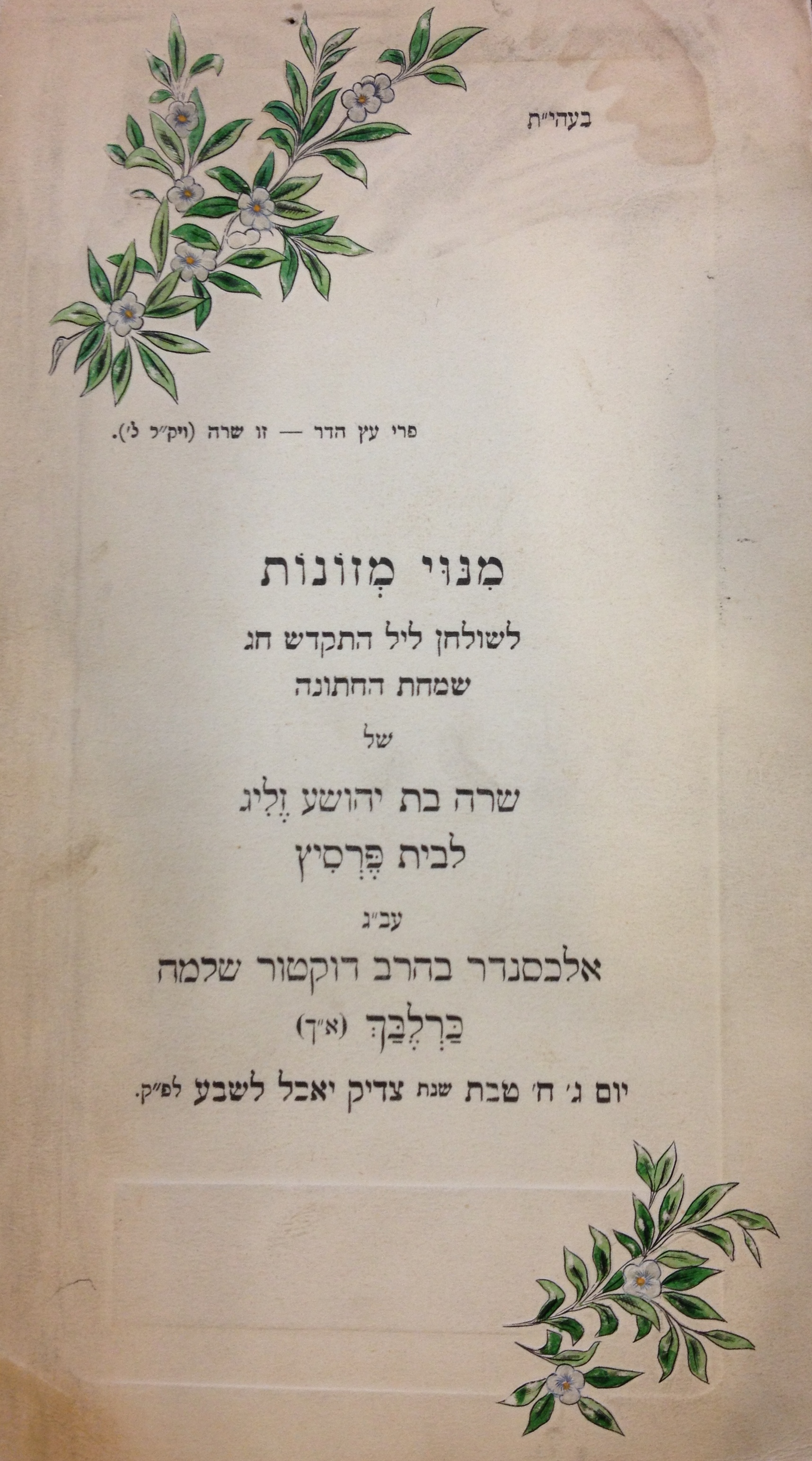
Catalogue reference DR6-L6 is a menu from someone’s wedding. We’ll see the front today, and the inside next time.

בעהי”ת By the grace of God
פרי עץ הדר—זו שרה (ויק”ר ל’) “Beautiful Tree-Fruit”–this is Sarah (Vayikra Raba 30)
מנוי מזונות Menu of Foods

(Compare the blessing for snacks, בורא מיני מזונות)

לשולחן ליל התקדש חג שמחת החתונה For the table of the night entering a holiday, the celebration of the wedding

(Isaiah 30:29, הַשִּׁיר יִהְיֶה לָכֶם, כְּלֵיל הִתְקַדֶּשׁ-חָג; וְשִׂמְחַת לֵבָב, כַּהוֹלֵךְ בֶּחָלִיל, לָבוֹא בְהַר-יְהוָה, אֶל-צוּר יִשְׂרָאֵל. That song will be like the night entering a holiday, and heart’s-joy, when one walks serenaded, to go to the mountain of God, to the Rock of Israel. “Leyl hitkadesh hag” usually means Pesach, since that’s the only festival where we celebrate the night with serenading.)

של שרה בת יהושע זליג לבית פרסיץ Of Sarah, daughter of Joshua Zelig, of the Peretz house
עב”ג עם בן גילה: with her partner
אלכסנדר בהרב דוקטור שלמה כרלבך (א”ך) Alexander, son of Rabbi Doctor Shlomo Carlebach (“AC”)

(No, not that Carlebach. His grandfather, actually.)

יום ג’ ח’ טבת שנת צדיק יאכל לשבע לפ”ק Tuesday, 8 Tevet, year “A righteous man shall eat to satisfaction”

Compare Proverbs 13:25, צדיק אוכל לשבע נפשו, The righteous eateth to the satisfying of his soul. This is a chronogram; if you add up all the numeric values of the letters, you get 667. לפ”ק means “the little numbers,” i.e. “if you can’t figure out which millennium we mean, we aren’t going to tell you”, so the year’s 5667 Jewish, or 1907.

The Carlebachs are an old German-Jewish dynasty. Reading some of the Wikipedia pages about other members of the Carlebach family is interesting; here’s Joseph, one of Alexander’s younger brothers, and here’s Ephraim. He had seven brothers and four sisters, total, and four of his brothers, as well as his father, were rabbis. Our Alexander was a banker.

In the next post, we’ll see the elements of his wedding feast. I’ll tell you now that it contains a huge quantity of rabbinic allusion; I wonder if he came up with it himself, or whether it was a family effort, all those rabbinical brothers planning it in collaboration. And what they did for the other brothers’ weddings, whose menus didn’t make it into the JTS Rare Book Room. And whether they had fun planning it. And whether Sarah liked it.

Next time, we’ll see what they ate.


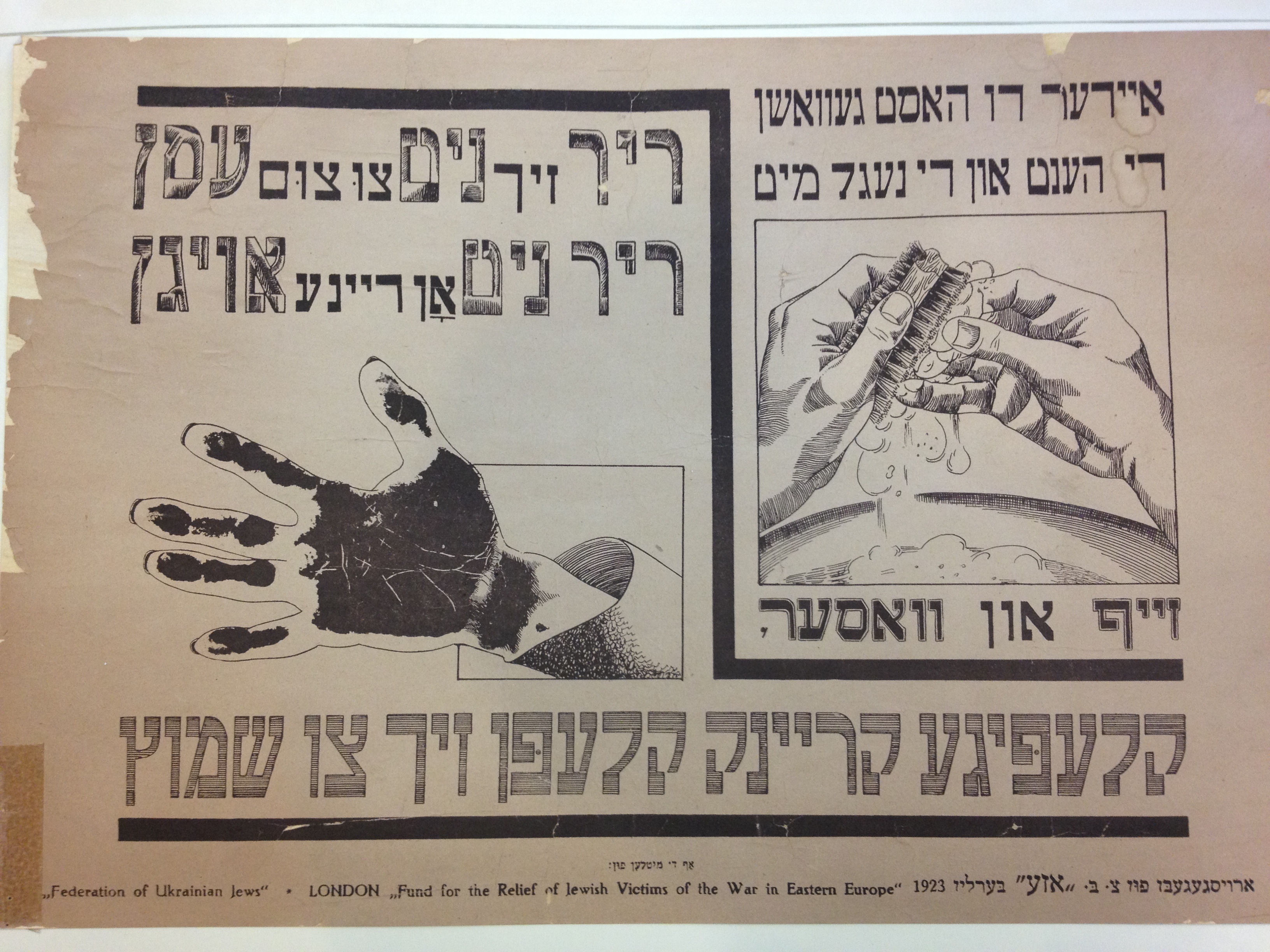
DRBR 11: In which Public Health Announcements are made

Today we have some public health notices from 1923 (DR5-L73 and 74).

Images copyright Jewish Theological Seminary of America. Used with permission. Click to see larger image.

“Either you’ve washed your hands and nails with soap and water, or you mustn’t eat or touch your eyes. Contagious diseases are in dirt!”

Thanks to Alex Casser for translations from Yiddish.

‘Dam, tsfardeya, kinim’–the third plague is the worst! Check yourself for lice! Typhus comes from lice!”

Also observe the interesting font, how the lamed doesn’t rise above the line of type, nor the kuf descend below it.


DRBR 10: In which Shabbetai Tzvi is reported to have died

Images copyright Jewish Theological Seminary of America. Used with permission. Click to see larger image.

This one’s an edition of the London Gazette, from April 1666. I love the line “Published by Authority”. I thought that was hubris, but then I learned that the London Gazette is “one of the official journals of record of the British government,” so it really is Published by Authority.

Genoa, March 6 It is written from Constantinople, That upon the arrival of the Jewish Prophet Sabadai, the Grand Signior consulted with his Mufti, and one of his Judges, what was to be done with him, who resolved that he was to be dealt with as a Traytor to the Ottoman Empire, and his skin to be taken off from him alive: after which sentence, the people fell very severely upon all the Jews they met with, killing a great number of them, the rest saving themselves by flight. The false Prophet was immediately delivered to the Guard, who set him upon an ugly horse, and carried him to the seven Towers. The people all the way insulting over him, and carrying before him halters, and the heads and arms of his slain followers. From the seven Towers, he was in a little while delivered to the Executioner, who first pulled out his Tongue, and then beheaded him, stripping off his skin, and hanging up the carcass by the heeles upon a Gibbet.

I adore the detail of the ugly horse. You couldn’t execute a criminal on a pretty horse, could you?

Anyway, this is a fine example of a newspaper Getting It Wrong; in Constantinople Shabetai was arrested and imprisoned, but not put to death. I expect Jews got killed; they usually do, especially when they turn up to places going “Our leader is going to take over!” and the local top dog has other ideas and imprisons the leader, who is safe behind bars but his followers aren’t.

Wikipedia is rather vague about how Shabetai actually did meet his end:

The death of Sabbatai Zevi is clouded in some mystery because of conflicting accounts about exactly how, when and where he died. There are those who maintain he died of natural causes and others that claim he was executed by hanging. Historians seem to agree that in 1673 Zevi was exiled by the Turkish sultan to the Albanian port of Ulcinj (now in Montenegro), dying there three years later.


DRBR 9: In which tefillin are laid wrongly

Image copyright Jewish Theological Seminary of America. Used with permission. Click to see larger image.

“One who does not learn Shulchan Aruch or Chayei Adam can absolutely not do mitzvos of the Torah as they must be done. We see some Jews are not fulfilling the mitzvah of tefillin and are making invalid brachos because the tefilah shel rosh is on their forehead…the whole tefilah shel rosh must lie where hair grows. And the yod of the tefilah shel yad must be slid against the shel yad. Also, one must have them checked once every three and a half years. Therefore, every Jew who desires to observe Torah and mitzvos must learn every day and understand the rulings that pertain to daily life.”

Some slightly confused logic there.

I just wonder, why would someone go to the trouble of printing this? People Who Lay Their Tefillin Wrong are a perennial peeve of people who take pride in being The Sort Of Person Who Does Things Correctly, but printing a whole flyer? Also, note the weird shape of this piece. Was it nailed on a wall or something and the tatty corners removed later?

(Thanks to Alex Casser for translation).


DRBR 8: In which Jews stay up till midnight

I photographed this one (DR5-L8) because the first line of English at the top made me laugh: IT IS THE DUTY OF ALL JEWISH PEOPLE, TO BE INSPIRED — yes, this does correspond rather directly and unfortunately to the way a lot of Jewish leaders think.

The full English is IT IS THE DUTY OF ALL JEWISH PEOPLE, TO BE INSPIRED AND TO UNDERSTAND THAT ALTHOUGH MANY JEWISH PEOPLE ARE CITIZENS AND RESIDENTS OF MANY LANDS AND COUNTRIES, BUT MUCH BETTER IT WOULD BE TO LIVE IN THE LAND OF ISRAEL! In shouty capitals.

The rest of it’s in Yiddish. This side talks about how in Jerusalem, six hours after sunset, people gather to recite Tikkun Chatzot, mourning the destruction of the Temple (every night!), and exhorts New Yorkers to do the same. Wikipedia says “The Tikkun Chatzot is an individual service; a minyan is not needed for performing it, although some have the custom to recite it with a minyan. At midnight, one sits on the ground or a low stool, takes off his shoes, and reads from the prayer book.”

The other side talks about Shabbat, and kashrut, and family purity, and the importance of sending your children to Jewish schools, so not much new there. No date on this; twentieth-century sometime.