DRBR 20: In which we are Confirmed in Sweden

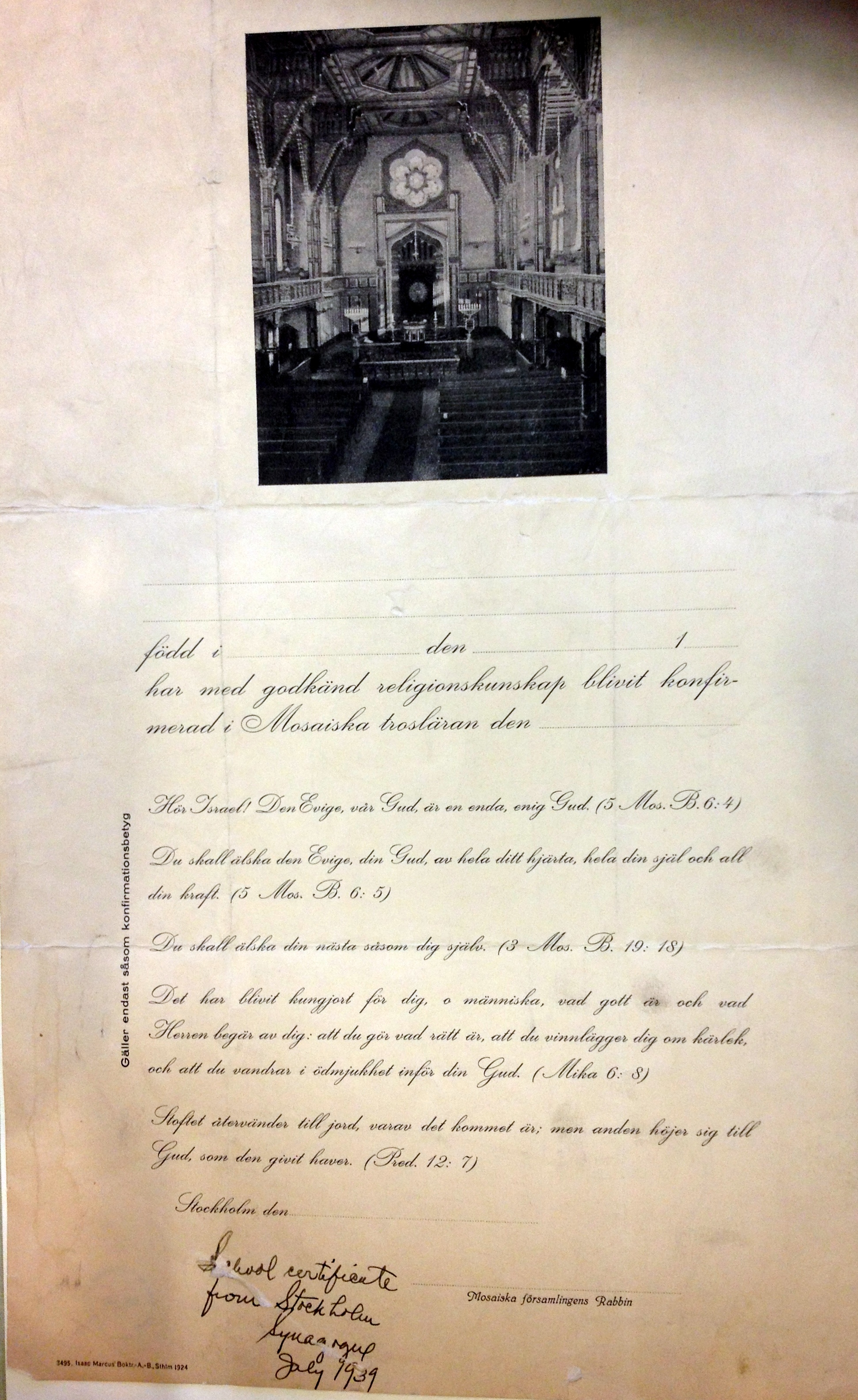
I thought this picture looked familiar when I saw it in the drawer. It’s the inside of the Great Synagogue at Stockholm, which still has organ at its Shabbat services, and is most particular about employing a non-Jewish organist to play.

So what is this? An old-school Reform confirmation certificate, from 1939. (Click image at left to see bigger.)

First it has space for the name and birth-date of the confirmand, and it goes on, in Swedish, “has been confirmed with official religious studies according to Mosaic law on [date]”

Then a bunch of pesukim. First couple of lines of the Shema, you shall love your neighbour as yourself, do justice love mercy and walk humbly from Micah, and a slightly random bit from Kohelet: the dust shall return to the earth it came from, yet the spirit shall return unto God who gave it.

And a space for the signature of “rabbi of the Mosaic community”

It’s also endorsed along the side saying “only valid as proof of confirmation”. I wonder what else they thought people might try to use it for. Proof of Jewishness, for marriage?

With the date as 1939 I wondered if they might be worried about Nazis; I knew Sweden was neutral in the war, but apparently they weren’t clear on to what extent they’d be able to maintain that, and according to Wikipedia Sweden let the Germans use their rail network. They also ended up taking in lots of Jewish refugees, including all the Jews of Denmark–I had no idea about that. But thinking about it, I don’t suppose the Nazis cared especially if you had a confirmation certificate or not. I don’t know. Anyone have information on that one?

[Thanks to Anonymous Friend for translation from Swedish.]


Tefillin and kids

Anyone want to tell me about their experiences with kids and tefillin? In particular:

If they lay tefillin, why you got them started doing it and when you started them
What you told them about why we do it.

If you lay tefillin and they don’t, how/why that works.

Whether they play tefillin.

Who in the family wears them.

If they’re still babies, what you plan to do when they get old enough.

If you have teenagers, whether they do or don’t, whether they’re boy or girl, and what they think about it. (Or if you’re actually a real teen and you’re reading this, hi! and tell me about it yourselves.)

Anything else you think is relevant to parents considering tefillin for their kid?


DRBR 19: In which music is read from right to left

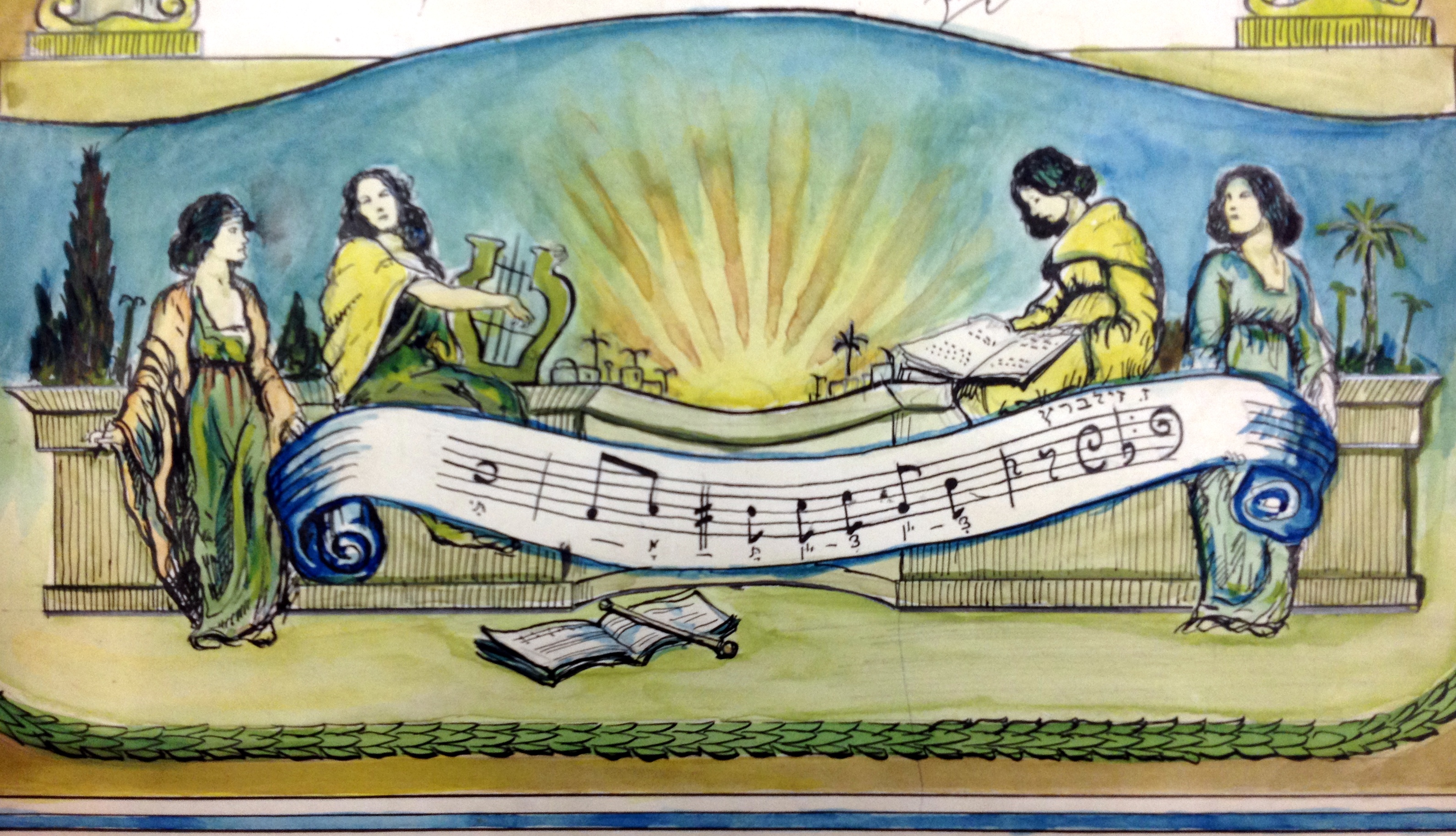
This is an illustration from a larger poster paying tribute to the Jewish composer, Zavel Zilberts, special call number DR8-R22. The poster’s from Lodz, 1918; it’s in Yiddish, which is why I didn’t photograph all of it.

What caught my eye–and hopefully also caught yours–was that the music is written right-to-left. Makes sense, given that Hebrew goes right-to-left and he was a Hebrew liturgical composer, but you more usually see Hebrew music notated by transliterating into a left-to-right alphabet.

There’s a biography of Zilberts at Naxos. It says that Zilberts had been working in Moscow, but had to leave in 1914 when occupations permitted to Jews were restricted. He got stuck in Lodz during the war and worked there, and after the war went on to the USA; I imagine the poster is saying, hey, thanks for all your work here in Lodz, best of luck in your new home.

There’s a synagogue with a choir in Montreal. I wonder if they ever do any of this stuff–the choral music from pre-war Europe.


DRBR 18: In which more Nuptials feature

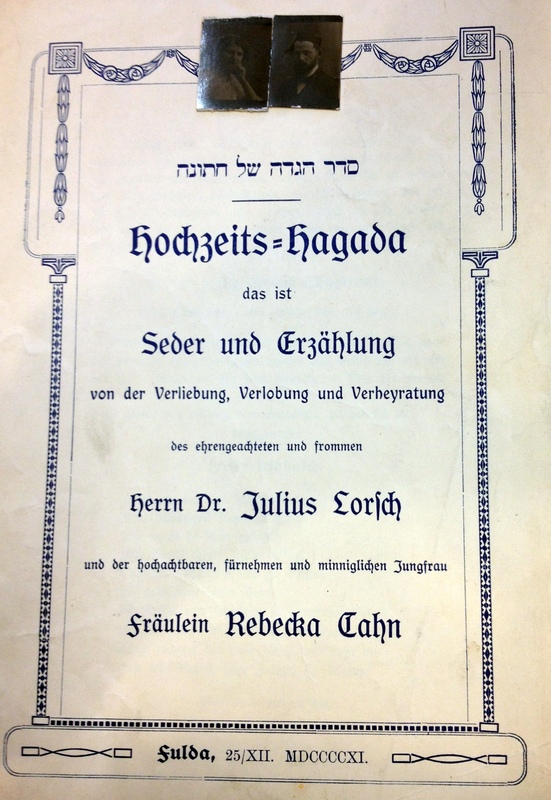
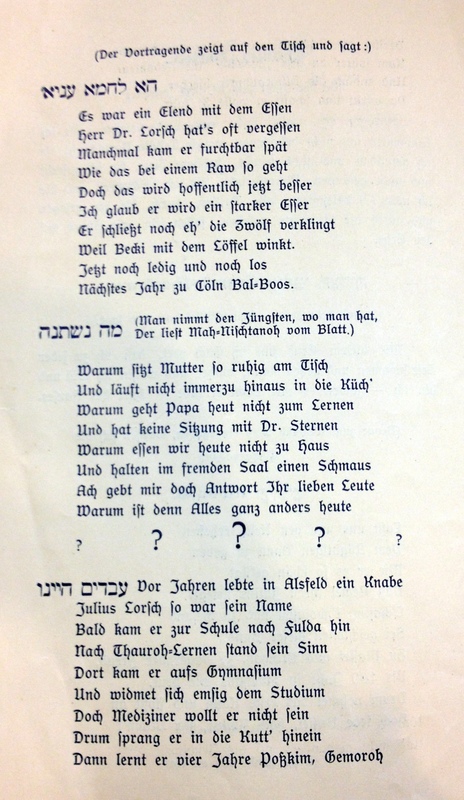
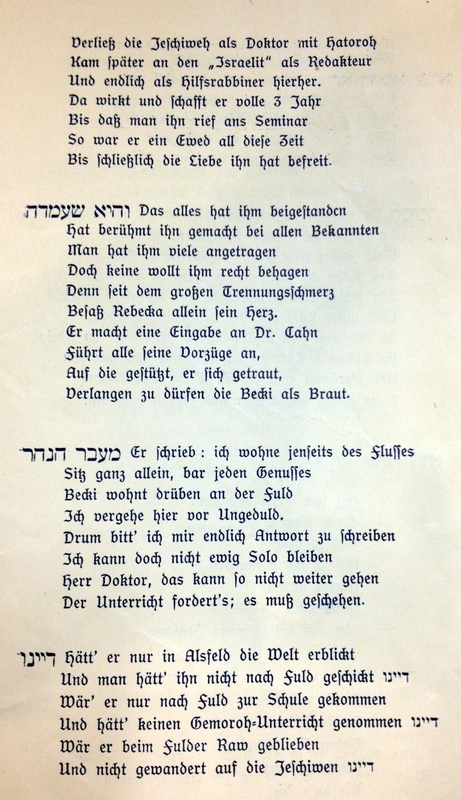
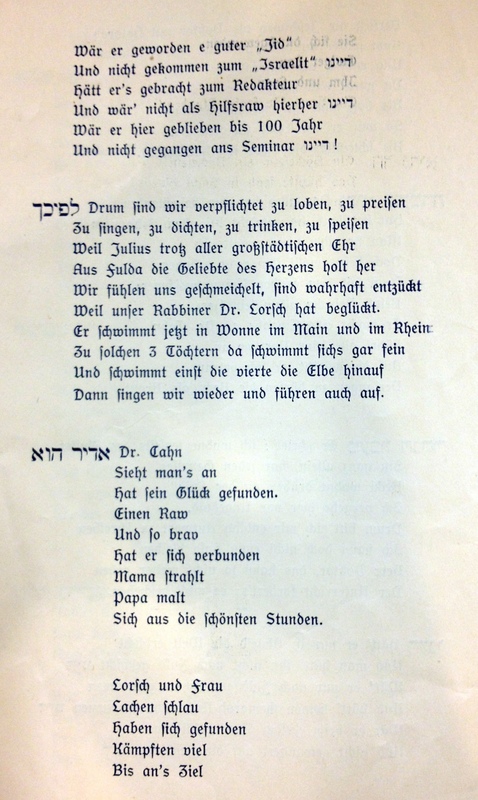
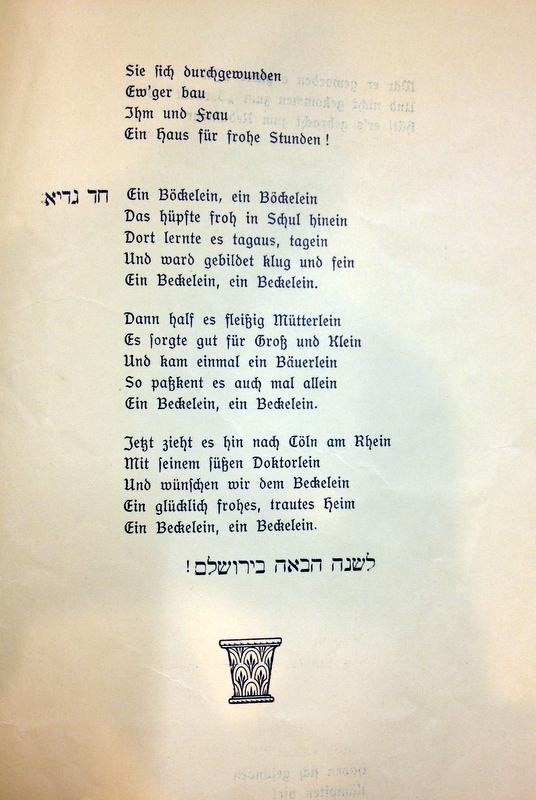
This is from the wedding of Julius Lorsch and Rebecka Cahn, special call number DR6-R36. A Hochzeits-Hagada, dated 1911, Fulda.

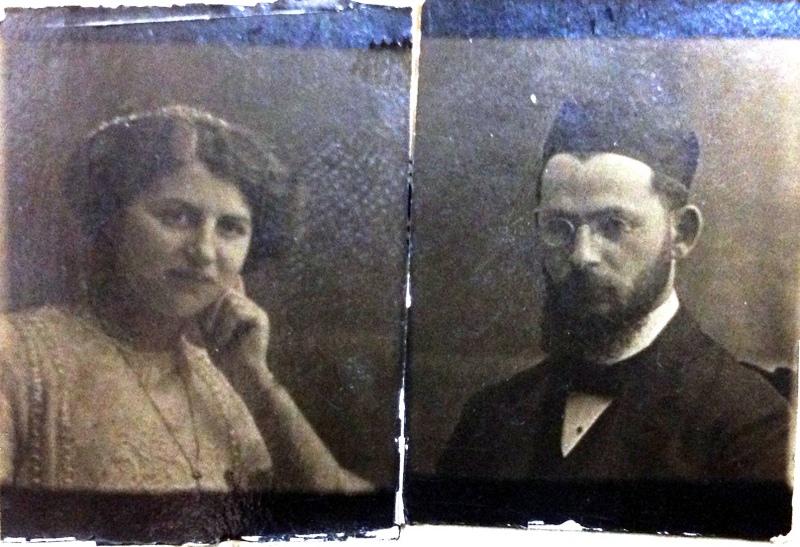
I like the little photos stapled to the top here. Julius has a very traditional German Yekkish käppchen, and Rebecka looks like she has those over-the-ears buns that were in style in the 1920s.

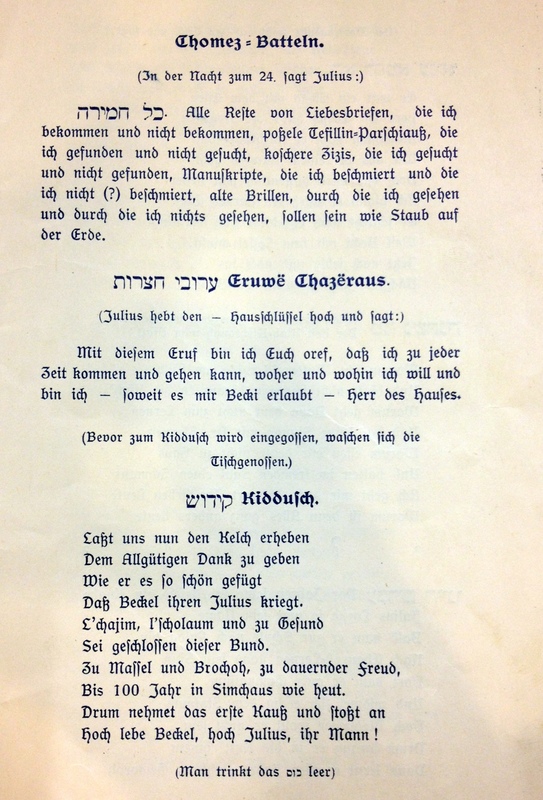
Julius and Rebecka perhaps had a sentimental attachment to Pesach; they have a Wedding Haggadah, which follows the form of the Pesach Haggadah. I assume it featured at the wedding dinner; it’s full of cute little poems about the couple. Maybe written by their friends or family?

The front reads:

Hochzeits-Hagada
das ist
Seder und Erzählung
von der Verliebung, Vehrlobung und Verheyratung
des ehrengeachteten und frommen
Herrn Dr. Julius Lorsch
und der hochachtbaren, fürnehmen und minneglichen Jungfrau
Fräulein Rebecka Cahn

Here’s one of the poems. I chose this one because it shows us that Becki was also Dr. Cahn.

והיא שעמדה
Das alles hat ihm beigestanden
Hat behrümt ihn gemacht bei allen Bekammten
Man hat ihm viele angetragen
Doch keine wollt ihm recht behagen
Denn seit dem grossen Trennungsschmertz
Besas Rebecka allein sein Hertz.
Er macht eine Eingabe an Dr. Cahn
Führt alle seine Dorzüge an,
Auf die gestüsst, er sich getraut,
Verlangen zu dürfen die Becki aus Braut.
All this served him,
Gave him fame among all his acquaintances.
Many have been suggested to him,
But none would be to his liking,
For since the great pain of separation,
Rebecka alone possessed his heart.
He petitions Dr. Cahn,
lists all his advantages,
leaning on which he dares
to ask for Becki as a bride.

Thanks to Phillip Lipman for translation. You see it isn’t Great Poetry or anything, but it’s Telling The Story of The Couple, like the haggada tells the story of the Jews. Which is cute.

For your edification, here are all the pages. All images, as usual, copyright Jewish Theological Seminary of America, used with permission, click through to see larger versions. Anyone with good German who wants to translate the whole story of the couple is more than welcome to share it with the rest of us!

Page 1

Page 2

Page 3

Page 4

Page 5


DRBR 17: In which I am rendered speechless

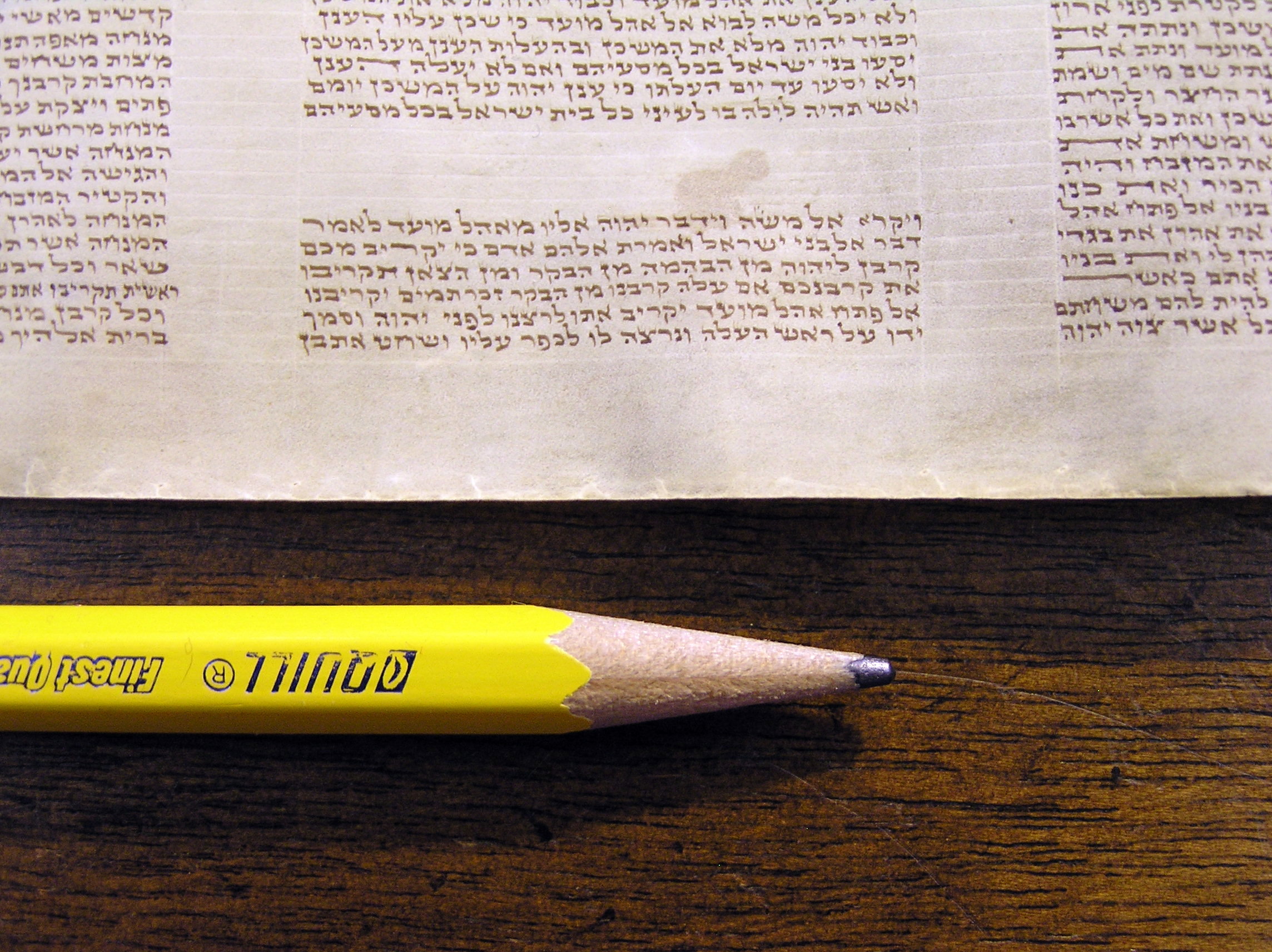
Regard, if you will, this photograph of a Torah scroll.

All images copyright Jewish Theological Seminary of America. Used with permission.

That’s a Metro card under there. A Metro card is the same size as a credit card. This is a real handwritten originally-kosher sefer Torah, and it’s smaller than a credit card. It’s three inches high.

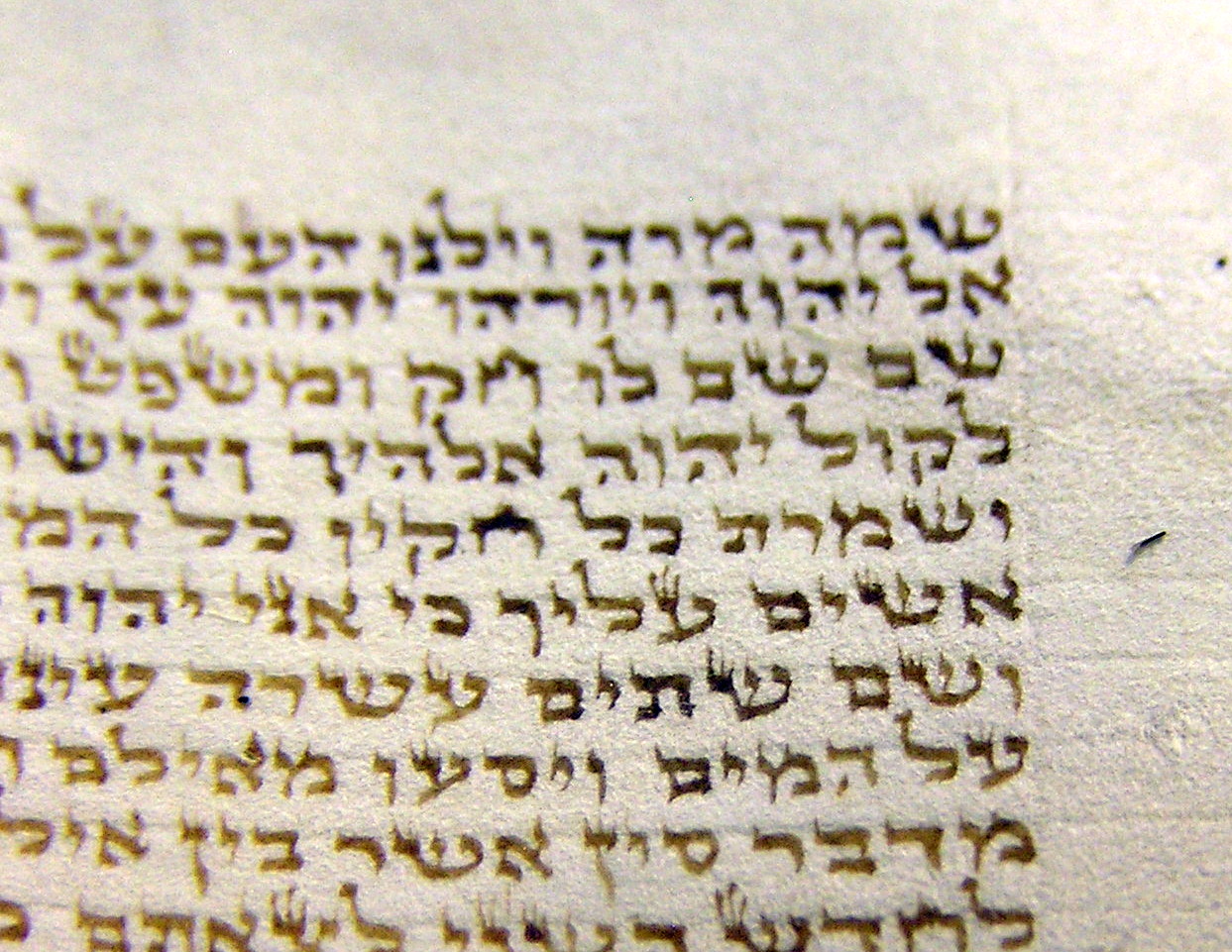
Here’s another picture:

Speechless? I was. When I took it out of the drawer and opened it I was expecting one of those silly paper scrolls they give to kids, and there was this…Just wow.

I’m guessing the scribe was accustomed to writing very small tefillin, in which the script is about this size, and decided to do a Torah scroll. For a commission? For artistry? Don’t know. The rollers are ivory, and it has a cover crocheted from gold thread. (You may remember this video, of a very tiny scroll with beautiful accessories. The scroll there is five inches high.)

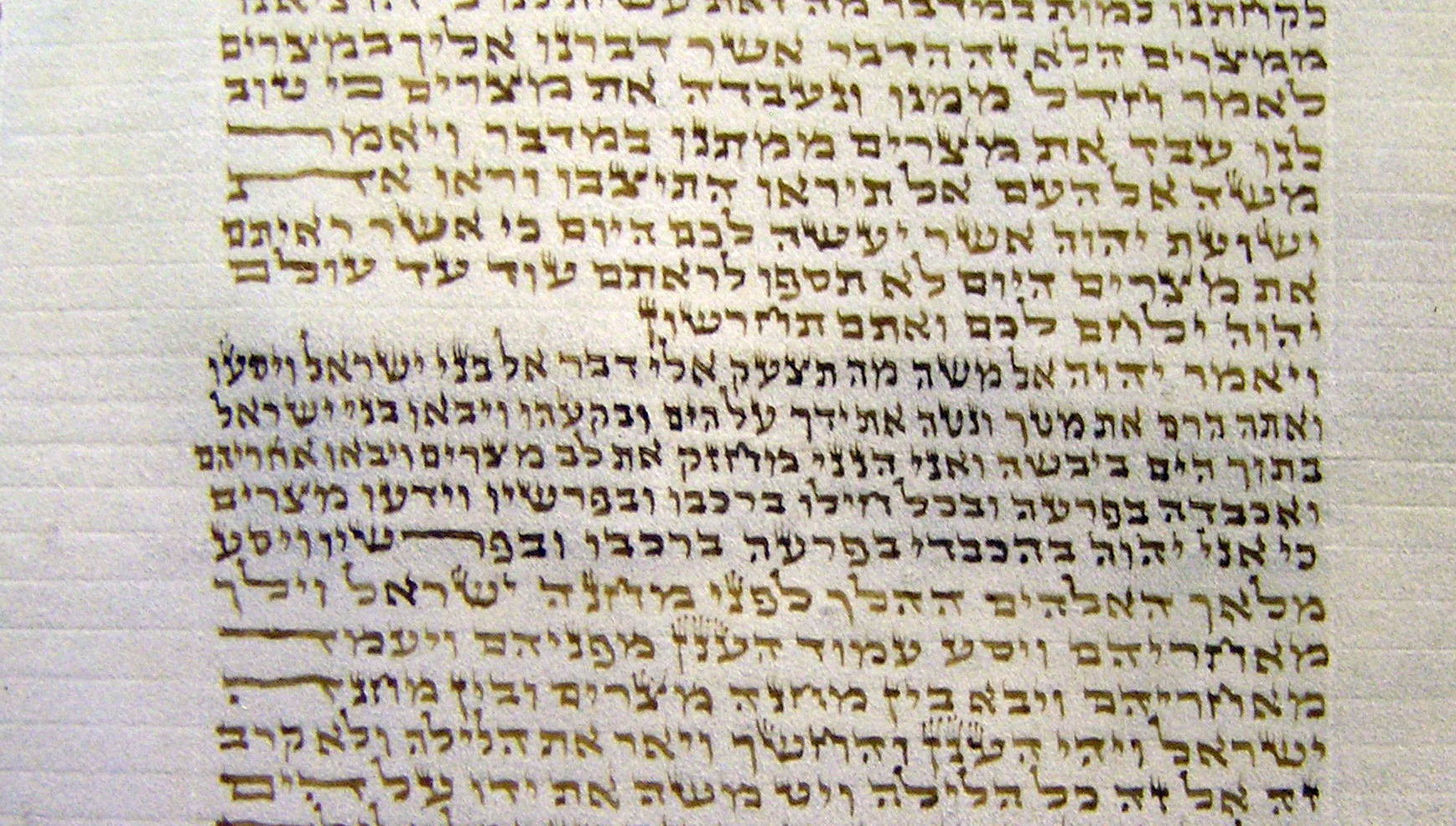
Here’s a close-up of one of the text sections.

What do we know about it? It’s old–the ink is faded, the parchment yellowing. It handles like an eighteenth-century scroll I worked on this summer, although it might not be quite that old. You can tell it’s probably not later than the mid-nineteenth century because the columns start neither בי”ה שמ”ו nor all-vavs, and there is fashion in these things, and probably if you were going to put in the effort to make something like this you’d do it in style, so to speak. It’s written in an Arizal script, which places it in eastern-ish Europe in a Chasidic-influenced community.

The parchment is thinner than printer paper, and in this photograph you can see the altered texture, greyish colour, and squashed-up lettering that denotes an erasure. Take a few moments to marvel, if you will.

Handling this scroll was something special. Don’t mind telling you I was speechless for about five minutes after realising what it was.


DRBR 16: More concerning the Adlers

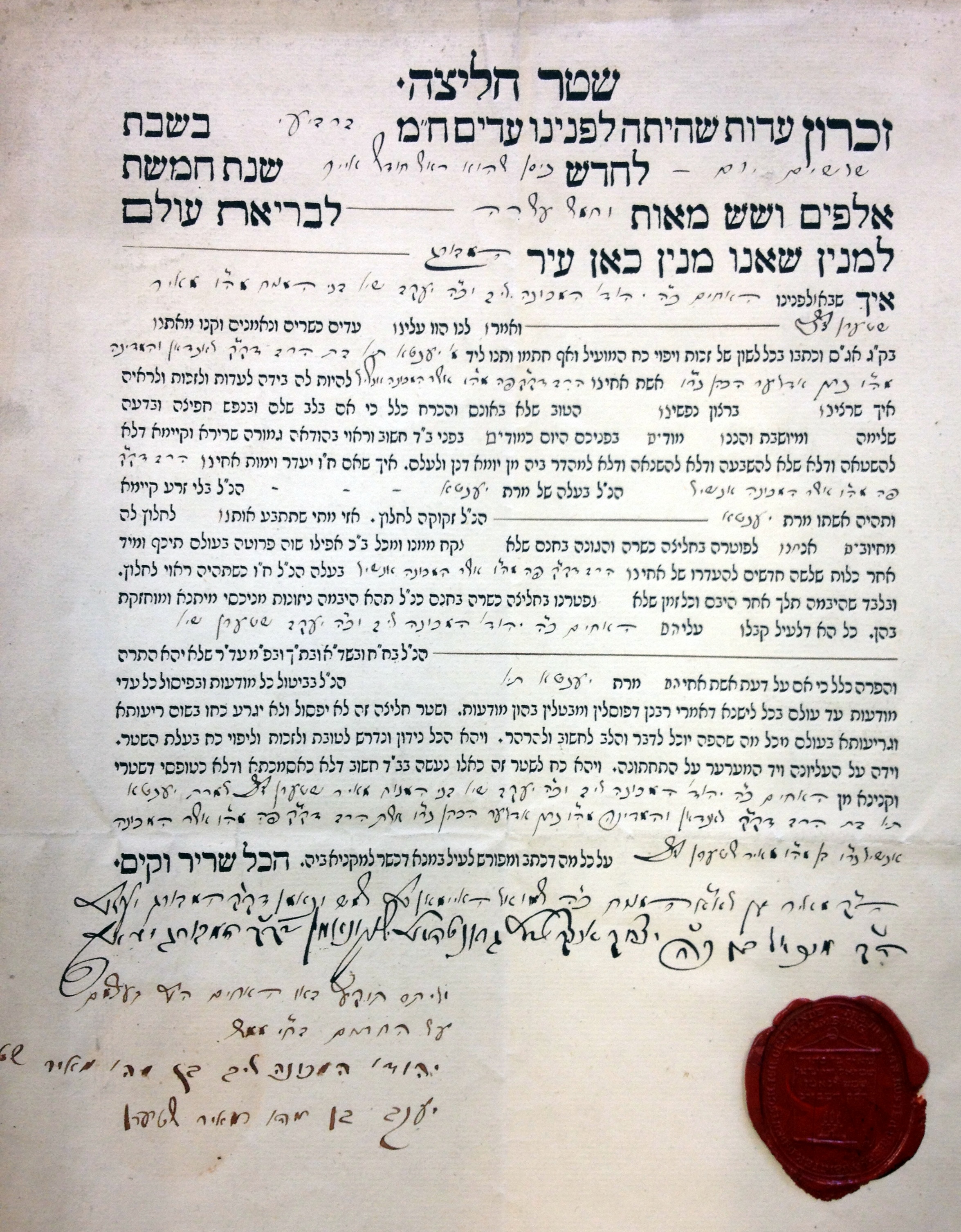
Today we have a Shtar Halitza, which we might translate Contract promising release from levirate marriage. If you recall, Torah says that if I marry Reuven and he dies childless, I have to marry his brother Shimon in order to have children in Reuven’s name. If Shimon isn’t keen on that idea, he does halitza and frees me to go and marry Uri.

If you think about it, levirate marriage brings up some pretty unholy tensions. If Shimon wants to marry me because I’m awesome, that’s kind of icky because I’m his brother’s wife. On the other hand, if Shimon wants to marry me only to do his holy duty of getting a child on me, that’s pretty miserable for me. So in general it’s much better that we should do halitza and just not go there.

Halitza becomes the standard expectation (read this article, A Writ of Release (Weisberg & Sarna), for a lot of background and interesting stuff), but if I don’t have halitza, I’m not free to marry someone else. Religiously speaking. So, if Shimon doesn’t want to give me halitza, I can’t marry someone else. This gives Shimon a horrible amount of power over me, and many men took to requesting extortionate fees from their brothers’ widows.
So, communities had an idea! Before I get married, I should get a contract from Shimon and Levi and all my beloved’s brothers, promising that they won’t do anything of the sort.

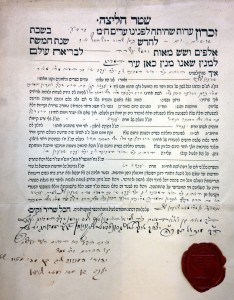
Here’s the contract that Jeanette, daughter of Nathan Marcus haCohen Adler, had with the brothers of Ascher Anschel Stern:

זכרון עדות שהיתה לפנינו עדים ח”מ ברביעי בשבת שלשים יום לחדש ניסן שהוא ראש חודש אייר שנת חמשת אלפים ושש מאות וחמש עשרה לבריאת עולם למנין שאנו מנין כאן עיר המבורג איך שבאו לפנינו האחים כ”ה יהוד’ המכונה ליב וכ”ה יעקב שי’ בני המנוח מה”ו מאיר שטערן ז”ל ואמרו לנו הוו עלינו עדים כשרים ונאמנים וקנו מאתנו בק”ג אג”ם וכתבו בכל לשון של זכות ויפוי כח המועיל ואף חתמו ותנו ליד מ’ יענטא תי’ בת הרב בק”ק לאנדאן והמדינה מה”ו נתן אדלער הכהן אשת אחינו הרב בק”ק פה מה”ו אשר המכונה אנשיל להיות לה בידה לעדות ולזכות ולראיה

On April 19th, 1855, in Hamburg, the brothers Yehudah, known as Leib, and Yaakov, sons of Meir Stern, appeared before us, and instructed us to be true and fit witnesses, and we took from them a symbol of acceptance, and wrote in fit and legal language and signed and delivered to the hand of Miss Yenta, daughter of the rabbi of the community of London and the Empire Nathan haCohen Adler, the wife of our brother, rabbi of the community here, Ascher, who is known as Anschel, for her to keep as proof.

[Note the Ashkenazic spelling of “London”. This isn’t standard; the usual way is לונדון because the Sephardim got there first and established the spelling. These Hamburgers were evidently very Ashkenazic.]

It’s also interesting that the lady is Yenta. The family tree wonks at Geni.com think that the woman who is married to Ascher-Anschel Stern and the daughter of Nathan Adler is named Jeanette. Certainly she could have used both Yenta and Jeanette, but why aren’t both on the document? Did she start using Jeanette at some time after her marriage?

איך שרצינו ברצון נפשינו הטוב שלא באונש והכרח כלל כי אם בלב שלם ובנפש חפיצה ובדעה שלימה ומיושבת והננו מודים בנפשיכם היום כמודים בפני ב”ד חשוב וראוי בהודאה גמורה שרירא וקיימא דלא להשטאה ודלא שלא להשבעה ודלא להשנאה ודלא למהדר ביה מן יומא דנן ולעלם.

That we desire, of our own free will, not coerced or forced, but with a whole and complete heart, a free soul and a complete, settled understanding. And these declarations shall be as those made before a great bet din, absolutely fitting testimony, valid and binding, not a joke, and not a shavua, and not with intent to be bad for her, and not with intent to benefit her, from this day and forever.

איך שאם ח”ו יעדר וימות אחינו הרב בק”ק פה מה”ו אשר המכונה אנשיל הנ”ל בעלה של מרת יענטא הנ”ל בלי זרע קיימא ותהיה אשתו מרת יענטא הנ”ל זקוקה לחלוץ.

That if, God forbid, our brother the aforementioned rabbi of this community here Ascher who is known as Anschel, husband of the aforementioned Miss Yenta, should pass and die with no viable issue, and the aforementioned Miss Yenta should be in need of halitza.

אזי מתי שתתבע אותנו לחלוץ לה מחיובים אנחנו לפוטרה בחליצה כשרה והגונה בחנם שלא נקח ממנו* ומכל ב”כ אפילו שוה פרוטה בעולם תיכף ומיד אחר כלות שלשה חדשים להעדרו של אחינו הרב בק”ק פה אשר המכונה אנשיל בעלה הנ”ל ח”ו כשתהיה ראוי לחלוץ. ובלבד שהיבמה תלך אחר היבם וכל זמן שלא נפטרנו בחליצה כשרה בחנם כנ”ל תהא היבמה נזונית מניכסי מיתנא ומוחזקת בהן.

That when she should request of us halitza, we will be bound to free her with a fit and valid halitza ceremony, freely, and we will not take from him [“Him” is probably a typo, compare the text in the Nachalat Shiva, siman 22, some thirty years later than this document] or from her representative even the value of a pruta, ever. As soon as three months have elapsed since the passing of our brother the aforementioned rabbi of this community here Ascher who is known as Anschel, her husband, God forbid, when she is free to conduct halitza. This provided that the woman comes to the man. While we have not freed her with a fit, freely-granted halitza as above, the yavamah will be sustained from the estate of the deceased and shall control it.

Wives in Jewish law don’t inherit automatically, brothers do; this stipulation makes it inconvenient for them to withold halitza.

כל הא דלעיל קבלו עליהם האחים כ”ה יהוד’ המכונה ליב וכ”ה יעקב שטערן שי’ הנ”ל בחרם חמור ובשבועה דאוריתא ובת”ך בפועל ממש על דעת רבים שלא יהא התרה והפרה כלל כי אם על דעת אשת אחיהם מרת יענטא תי’ הנ”ל בביטול כל מודעות ובפיסול כל עדי מודעות עד עולם בכל לישנא דאמרי רבנן דפוסלין ומבטלין בהון מודעות. ושטר חליצה זה לא יפסול ולא יגרע כחו בשום ריעותא וגריעותא בעולם מכל מה שהפה יוכל לדבר והלב לחשוב ולהרהר.

All the above the aforementioned brothers Yehudah, known as Leib, and Yaakov Stern, accepted upon themselves [various phrases meaning that this is Serious Business] that it shall never be annulled or revoked except by the will of the wife of their brother, Miss Yenta, in annulling all admissions and invalidating all witnesses to admissions, eternally, in language used by the rabbis to annull and invalidate such admissions. And this shtar halitza shall not be invalidated nor its strength lessened by any means at all ever, by anything the mouth can say or the heart think.

ויהא הכל נידון ונדרש לטובת ולזכות וליפוי כח בעלת השטר. וידה על העליונה ויד המערער על התחתונה. ויהא כח לשטר זה כאלו נעשה בב”ד חשוב דלא כאסמכתא ודלא כטופסי דשטרי וקנינא מן האחים כ”ה יהוד’ המכונה ליב וכ”ה יעקב שי’ בני המנוח מאיר שטערן ז”ל למרת יענטא תי’ בת הרב בק”ק לאנדאן והמדינה מה”ו נתן אדלער הכהן נר”ו אשת הרב בק”ק פה מה”ו אשר המכונה אנשיל נר”ו בן מה”ו מאיר שטערן ז”ל על כל מה דכתוב ומפורש לעיל במנא דכשר למקניא ביה. הכל שריר וקים.

And all this is to be judged and interpreted for the good and the benefit and the strengthening of the holder of the shtar. And her hand is above and the hand of any appellant below. And the strength of this shtar shall be as if it were made by a great bet din, and is is not asmachta and not a mere formalism. And we made kinyan from the aforementioned brothers Yehudah, known as Leib, and Yaakov, sons of Meir Stern, on behalf of Miss Yenta, daughter of the rabbi of the community of London and the Empire Nathan haCohen Adler, the wife of our brother, rabbi of the community here, Ascher, who is known as Anschel, son of Meir Stern, concerning all that is written and expounded above, with an appropriate instrument; all is valid and binding.

I find it interesting how hard this document insists that it REALLY IS REAL AND PROPER OKAY. That sounds to me like the language of something aware that it’s standing on shaky ground, something trying rather too hard to sound real. It seems like it’s trying too hard to say “I am enforceable, dammit! Don’t you dare ignore me!”, which I think was probably its main problem. It’s not something I’m aware of being done today.

Weisberg and Sarna seem to suggest that the State of Israel’s declaring halitza mandatory has something to do with it, that and the Holocaustic wiping-out of most communities where it was done. Also I think perhaps longer life expectancies, smaller families, and rising divorce rates have made refusal to grant a get more of a problem. It’s a similar problem; rabbinic courts these days tend to lack enforcement methods, so if a guy says “Shan’t” there’s not a lot you can do about it.

The catalogue number for this piece is SCN DR10-R36, and it says that Jeanette is Yenta bat “Edgar haKohen”, an error which I trust will be fixed post-haste. A little further into the drawer, DR10-R43 contains both of Johanna bat Shraga’s wedding documents, her ketubah and her shtar halitza from her groom’s brothers–I didn’t photograph them because they’re in completely impenetrable handwriting–doubtless Jeanette’s ketubah is somewhere, but I don’t know where.

DRBR 15: In which the Years are Marked

DR8-R12b is a Tribute to Nathan Marcus Adler, from the Jewish community of Hanover. (Check out Wikipedia; he has an epic hat, and even more epic sideburns.)

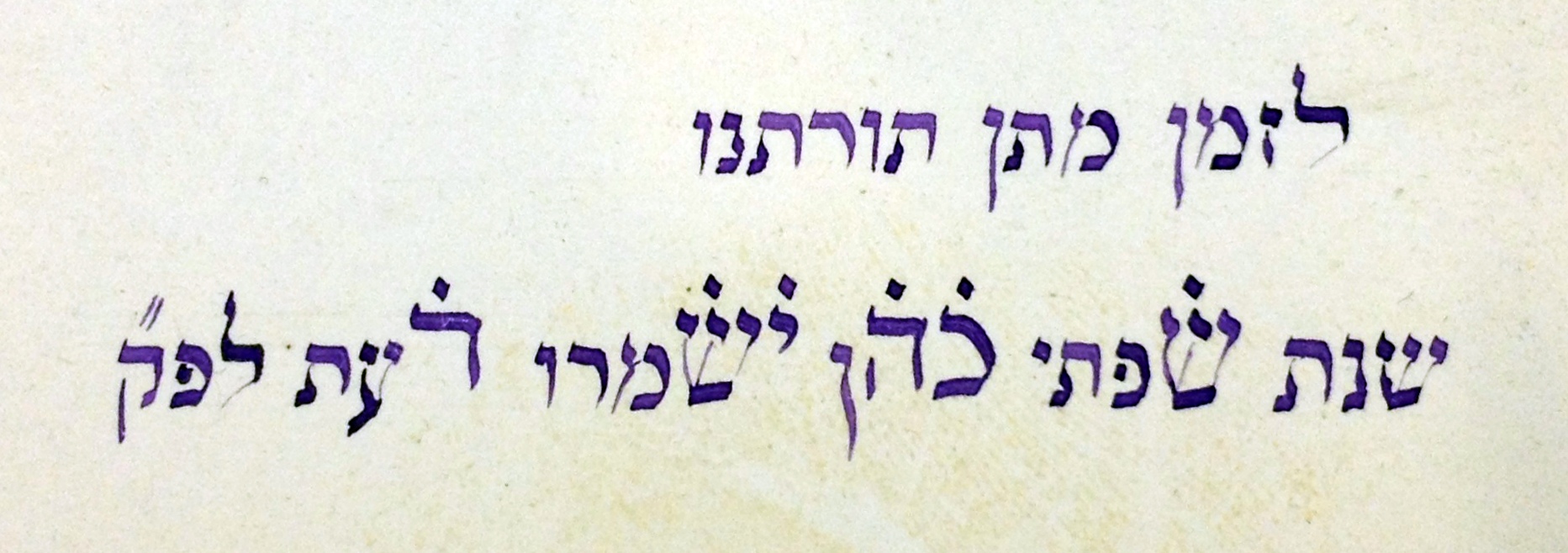
The Tribute is dated 1879, the fiftieth anniversary of his ordination (according to the JTS catalogue). As well as the numerical date, it has a nice Hebrew chronogram:

Image copyright Jewish Theological Seminary of America. Used with permission.

That is, שפתי כהן ישמרו דעת, four words from Malakhi 2:7, For the priest’s lips guard knowledge, and they shall seek the law at his mouth: for he is the messenger of the Lord of hosts. The large letters with dots over them–שכהישד–add up to 639, and 5639 in the Jewish calendar corresponds to 1879 in the Christian one.

My alma mater has a chronogram; one of its alumni went on to build the Dyson-Perrins laboratory building in Oxford, and it has a plaque saying baLLIoLensIs feCI hyDatoeCVs o sI MeLIVs. This means “I, Waterhouse of Balliol, made this. Would it were better.” (Note that this is an extreme of pretentiousness; Waterhouse had to render his name into Latin to get it to work.) Date comes out to 1914.

Latin ones have a different feel; some (or preferably all) of the Roman-numeral letters (you know, IVXLCDM) make up the date. If you can’t get it such that all the number-letters make the date, you have to indicate which ones you want people to read. Since all letters in Hebrew have a numeric value, if you want to do it most elegantly such that all the letters make the date, you have a lot more flexibility in how you compose your date, but much less ability to pad your sentence with filler words.

Anyway, Adler was the Chief Rabbi of the British Empire 1845-1890. He was a scholarly type, with a university degree and all. He was also a cohen. So this is a great verse to attach to him.


Cthulu-trog

At Whole Foods the other week, I found this…It smells exactly like an etrog, but it looks like no etrog ever. Sniff it and become Cthulu!


From the Megillah repair mines

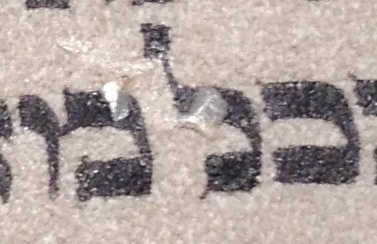
Sometimes you see letters which look broken, pasul:

But don’t freak out. Tilt it up, see what you can see.

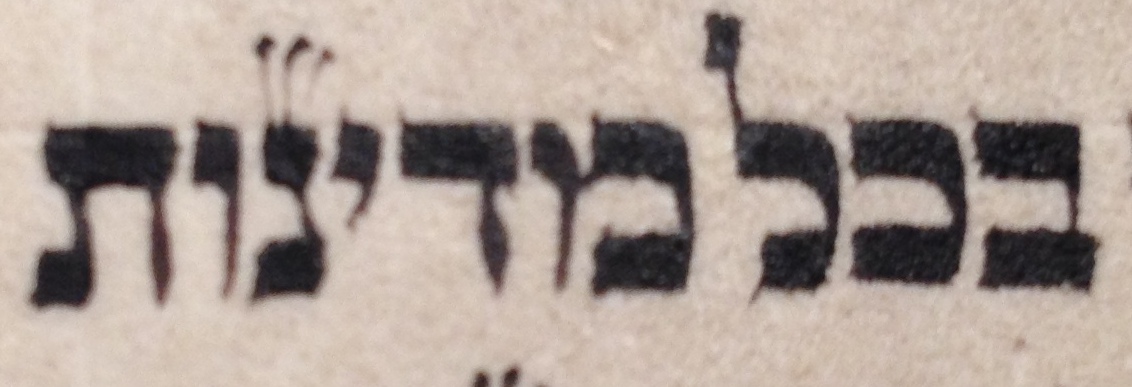
Candlewax tends to gleam. Candlewax you can generally crack off with a scalpel, or X-acto knife, or a plastic spoon if you’ve really got nothing else handy.

Then you can take a blurry picture. A well-focused picture would be better; you’ll just have to pretend that this picture is after the whole Barukh Mordekhai/Arur Haman bit.


DRBR 14: In which we Muse upon Transience

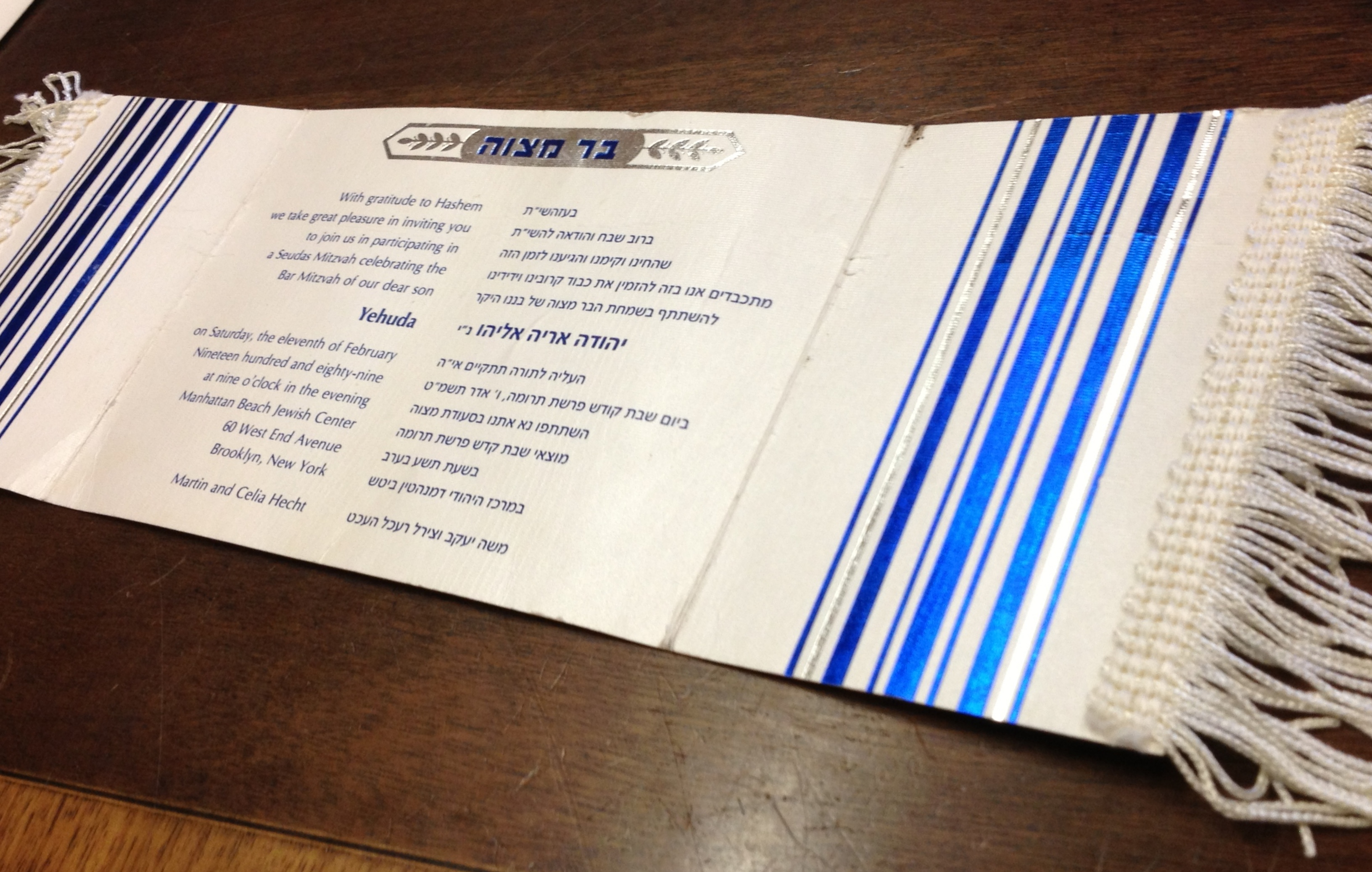
Image copyright Jewish Theological Seminary of America. Used with permission. Click to see larger version.

Today’s picture is of someone’s bar mitzvah invitation, from the early 1980s. Note how the invitation is printed with blue stripes and trimmed with fringe trim exactly like the scarfy tallitot beloved of Reform shuls.

Can’t decide if this is sort of cool or dreadfully cheesy.

The point of bringing you this, though, is that this kid is still alive. I googled him, just out of curiosity, and he went on to be something perfectly ordinary, real estate or something I think. And is married and has kids and lives somewhere in New Jersey.

And this is the case for a great many of these dispatches–they are things belonging to people who were once quite ordinary, getting along with their lives, but now they’ve turned into history.