Proofreading, part 12

As a keen Torah reader myself, I’m well aware of those horrible moments when you’re reading along and you look at the Torah and you think “huh? what on EARTH is that?!” When I’m proofreading, I try to pick up on that sort of thing.

kosher but confusing

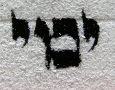
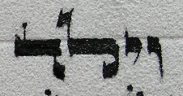
Here’s an example. That mem and nun are a bit too close together for comfort, in my opinion.

kosher but confusing

The letters aren’t actually touching each other, so they are kosher as they stand, but they’re close enough that they’d make me, as a reader, stop and look more closely. Well, I don’t like that when I’m reading, and I’m a huge fan of “What is hateful to you, do not do unto others,” so when I’m proofreading I try to fix that sort of thing, even if technically it doesn’t need to be fixed.


Proofreading, part 11

pasul mem
Pasul letter mem

Proofreading has to pick up on letters which have real problems in their form. Maybe the scribe’s hand slipped, maybe the letter got smudged by accident, maybe the ink spread after being put on – letters can go wrong, and we don’t always notice while we’re writing. So proofreading has to be alert for that kind of thing.

Again, you need knowledge of letter forms. You need to know why the above is a problem.

pasul mem

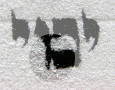
The problem is this little join. Such a little thing, but so important.

I like thinking of it as being similar to electricity. Electricity doesn’t care if it’s only a little tiny wire making the short-circuit; that little tiny wire short-circuits your thing and boom, it isn’t working any more. Same with letters. This mem is short-circuited, and it doesn’t work any more.

And like the more annoying kind of short-circuit, you can’t just take out the offending part and have everything work, no, you have to take the thing apart and rebuild it.

(Super-geekies can read chapter 8, paragraph 6 of the Keset ha-Sofer for info on how to fix a short-circuited mem, but the non-super-geeky may prefer to give it a miss.)

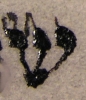
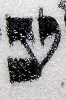
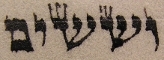
Couple more examples, for your delectation. One’s a shin with a short-circuit, the other is supposed to be a yud followed by a nun, but the short-circuit there has turned it into a mysterious tzaddi-ayin hybrid. Internet cookies for anyone who explains how to fix them.

pasul shinyud-nun


Proofreading, part 10

We saw an example of one sort of thing which proofreading turns up – where the text is Just Wrong:

torah proofreading – just wrong
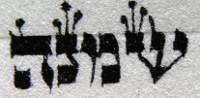
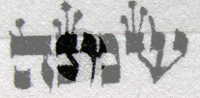
Text should read שמנה מאת שנה.

That was a case where the extra letter vav completely changed the meaning – “eight hundred” became “one hundred and eight.” But in some cases, an extra or missing yud or vav doesn’t actually change the meaning, thanks to the accommodating nature of Hebrew vowels. These are known as haser (deficient) or malei (overblown) spellings. Like this:

Haser spelling
This is a word spelled haser – lacking a vav – where it should be spelled with a vav, ויולד.

If you’re reading in the Torah and you find the first kind of Wrong, it’s a problem, and you have to stop and switch Torahs. But if you find the second sort, you don’t have to switch Torahs. The mistake ought to be fixed soon, because thinking “oh, it doesn’t matter” is the first step on the road to propagating mistakes which jolly well do matter, but you don’t have to stop reading.

This has to do with the extent to which we think the text of the Torah is incorruptible. I simplified a bit earlier – the integrity of the text is a theological principle except for these kinds of spellings. These ones we’re not exactly certain of, and haven’t been since Talmudic times.

So we weigh values. Stopping and switching out Torahs is not good, for various reasons; reading from a Torah with wrong spelling is not good either. With very egregious misspellings, the badness of the mistake outweighs the badness of switching Torahs. But haser and malei misspellings, since we’re not absolutely certain they’re actually wrong, there’s a chance our spelling could be the right one, and on the strength of that chance we swing the balance the other way. Interesting, huh?


Proofreading, part 9

All this place-finding and looking up and down takes time. Only a couple of seconds each time, but that adds up fast, as you can probably imagine.

Holding a string of letters in your mind isn’t efficient either, partly just because one can forget things, and partly because of anticipation; when you’re reading the text as words, you’re much too liable to remember what you think ought to be there rather than what actually is there. That’s how most of these mistakes get in there in the first place.

You’re also liable to confuse phononyms, liable to skip silent letters, liable to attempt to remember too much and thus forget parts unawares.

And all this is only answering “Is the letter there?”. The question of “Is it kosher?” requires more mental processing, as we saw earlier – is it touching another letter, does it have all the parts it needs, does it have the right decoration. The above list doesn’t leave much brain left over for processing these questions.

More about how we deal with that later. First, we’ll see some other cases where such mental processing is required.


Proofreading, part 8

When I’m proofreading my writing for the first time, there are two questions I’m asking regarding each of the 304,805 letters: is the letter there, and is the letter kosher?

The process goes like this.

With a sheet of freshly-written Torah in front of you, you find your place in the tikkun and look at it to see what letters ought to be written.

Carrying those letters in your mind, you look down and find your place on the klaf, and compare the letter string in your mind to the letter string on the klaf.

If they don’t match, fix it.

torah proofreading – just wrong
For instance, this is just wrong, but I didn’t realise it at the time. It ought to read שמנה מאת שנה.

Then look back up and find your place in the tikkun, and repeat.


Proofreading, part 7

Getting back to proofreading proper.

As we’ve heard, in order to encourage integrity of the text, we have a rule that even one wrong letter invalidates the entire Torah.

When you’re writing 304,805 letters, you’re bound to slip up on some of them. So, when you write a Torah, you proofread it extremely carefully, more than once, before you release it into the wild, as it were, and read from it.

Blotting wet ink

Here’s a place where I was merrily writing along, wrote the wrong letter, and realised it at once. The ink was still wet, so I blotted off as much as I could with kitchen paper, that’s why it looks grey and shadowy. Makes the erasing easier.

To fix this sort of thing, you need to let it dry and then scrape off the excess. But letting it dry takes a good fifteen minutes (if you try fixing it sooner you just rub it in and make it worse) and it’s inefficient to sit about watching ink dry for a quarter of an hour. If you’re writing tefillin or mezuzot, you’ve got no choice, you’ve got to fix it before continuing, but when you’re writing Torah you can skip over the mistake and come back to fix it later.

Now we’re in the proofreading stage, it’s “later,” and time to fix.

These pale-grey blotted ones are obvious – when you made the mistake, you realised it at the time, you blotted it, perhaps you made a note in pencil in the margin – these aren’t difficult to see. The really taxing part comes next.


Proofreading, part 6a

Gabriel points out, correctly, that some authorities permit erasing of a Divine Name which was created by hak tokhot.

You see why that should be, of course? The logic goes, if the shapes made by hak tokhot don’t count as letters, then the Divine-Name-like things created thereby cannot be proper Divine Names, and if they aren’t Divine Names, you may erase them.

A coherent position, it’s just not one I would generally apply, particularly not in this kind of circumstance. Being able to justify something doesn’t mean we should go around doing it.


Proofreading, part 6

Ambugious hey-kuf

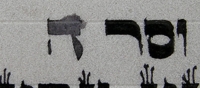
Here’s a case where a small child came in handy, though. The final hey in a Divine Name got smudged accidentally, so it sort of looks like an ugly hey and it sort of looks like an ugly kuf. It’s definitely one or the other, but which?

Remember you aren’t allowed to erase Divine Names or any part thereof. You really, really, really aren’t allowed to do it.

If the letter is a hey, the Divine Name is still, as it were, live. The smudgy part would have to stay there, not be erased to make it tidier. If the letter is a hey, we must leave it alone.

If the letter is a kuf, the Divine Name will have been switched off, and we can remove the smudgy part and make it back into a pretty hey. It can’t stay as a kuf. If the letter is a kuf, we must erase it.

We need a decision. Which is it? Adult brains see the problem in shades of grey, and become unable to reduce it to the necessary black and white. Young child brains only see things in black and white, so we use their eyes. My friend Hillel’s young child told us that the letter was a kuf, so kuf it was.

***Really technical bit coming up***

You have to erase a smudge like this from the top down, not the bottom up. Very important. If you erase from the bottom up, you’ll at some point turn the letter back into hey, but by hak tokhot. A letter made by hak tokhot isn’t a proper letter from the perspective of Torah reading, but it’s definitely a proper letter from the perspective of erasing Divine Names. So if, during your erasing, you make this:

Ambugious hey-kuf

you’ve got a REAL problem – a hey that isn’t valid, but which you can’t erase and write validly.

This is one of the reasons soferim have to study lots of halakha; so that they know how to anticipate and avoid pickles like that.

Proofreading, part 5

Ambugious yud-vav

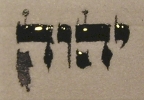
Here we have a something that ought to be a yud, but looks an awful lot like a vav. (This isn’t DE’s Torah, by the way. Just part of my stock of interesting Torah photos.)

This kind of ambiguity can, interestingly, be resolved by showing the ambiguous letter to a small child. Adults are troubled by the shades of grey in the problem, finding the exact point on the continuum between yud and vav where the change of state happens, and therefore can’t decide if it’s yud or vav; a small child still sees the world in black and white, and will decide one way or the other because it can’t see the middle ground between “yes” and “no.”

Small children being in short supply round here, in ordinary Torah proofreading it’s usually quicker just to fix the letter (with appropriate care for hak tokhot, of course). I counted this one as a vav, so I erased its whole tail and then put the tail back in but shorter.


Proofreading, part 4

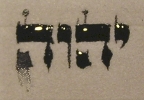
As a proofreader, you have to be rather aware of what you’re dealing with. If you come across, say, a yud which looks far too much like a vav for comfort,

Ambugious yud-vav
like this,

you certainly ought to fix it; everyone agrees that that’s no good at all. But if you’re proofreading something by a Sephardi scribe, and you find that the shins have flat bottoms, you’d be foolish to go through and change each shin to having a pointy bottom.

It’s like American vs British spelling – if you’re a Brit (okay, or a Canadian) editing the New York Times and you find words like “plow” and “theater,” you’d be an idiot to impose British spellings and change them to “plough” and “theatre.” But if you find a word like “rabibt” whilst editing Watership Down, it’s quite appropriate to change it to “rabbit” because “rabibt” is obviously wrong according to absolutely everyone. Is your ambiguity a plow or a rabibt?

The image above, to explain in more detail, has a letter that ought to be a yud, but it’s really a bit too long in the tail to be a yud. It’s more like a vav. More about that shortly.