Category Archives: Writing implements

What is writing?

What does it mean to write? is a question that has always been part of the Torah-writing rules. Could you, for instance, embroider the Torah? Is that writing? What about carving letters into plaster-covered monoliths? Embossing them onto metal headbands? What about printing? Jewish communal narrative recognises these processes as producing letters, more or less, but also recognises that this is not how people normally write: you wouldn’t embroider your account book, and if you were embroidering accounts you wouldn’t say you were writing. Experientially, producing letters is not necessarily the same as writing.

By axiom, the Written Torah has to be written, and if it’s going to be a proper written document, it needs to be properly written. It’s got to be produced by someone having the experience of writing, not someone simply having the experience of doing embroidery or whatever.

But for your average North American Jew, the experience of writing involves a keyboard. It makes absolute intuitive sense that computers would feature in any act of writing, not excluding that of writing a Torah. Computers are how we write things. Handwritten material is positively extraordinary; the skill of penmanship is practically unknown. No-one would expect to see an embroidered book; similarly, people frequently assume Torah scrolls are printed – no-one expects to see a handwritten book. Intuitively, it makes a twisted sort of sense that the Torah should be typed.

Fortunately, we don’t take it that far; even though typing is the more common writing experience these days, pen-and-ink is still, culturally, the more authentic writing experience. Pen-and-ink is associated with real writing in a way that typing is not.

Indeed, way way back in the days of the first Torahs when literacy was limited to an elite few, a Torah scroll – a written document – probably had an air of mystique about it simply because so few people could write, so few people could conceive of producing one. Nowadays also, a Torah has mystique by virtue of being written, because again so few people can write in this way.

An interesting example of history coming full circle, there. Writing the Torah starts as a skill limited to a small group of people; as literacy spreads but before printing is invented, writing sifrei Torah becomes less remote, such that some authorities even equate sifrei Torah with printed books containing Torah material. Then, once printing is ubiquitous, writing again becomes a rare skill and Torahs are elevated back into the inaccessible.
Reed pens

Concerning interaction with one’s fellows, Rabbi Elazar taught: one should be soft like a reed rather than stiff like a cedar, and it is for this reason the reed merited to be used in the writing of sifrei Torah, tefillin, and mezuzot. (Taanit, 20b)

In Rabbi Elazar’s time, reeds were what people made pens from.Indeed, the rabbinic word for a quill, kulmus, comes from the Greek word for a reed, calamus. Feathers didn’t come to be used for pens until about 700CE, in Europe.

Popular lore has it that one may only use a quill from a kosher bird to write Torah, but popular lore is wrong, to put it simply. Modern alternatives include metal and plastic pens, as well as feathers and reeds.

Reeds.

Reeds have been a traditional Sephardi thing, and have contributed to the distinctive Sephardi script.

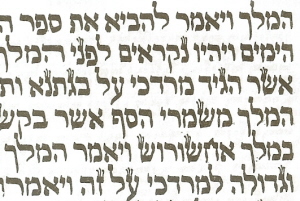
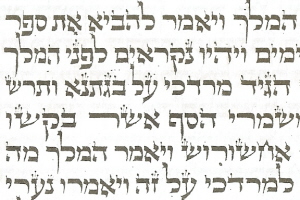
In a nutshell, a reed tends to give less contrast between thick and thin lines than a feather, and reed writing tends to show less contrast between thick and thin lines than feather writing. Compare the images below: the first is characteristically Sephardi reed-influenced script, and the second characteristically Ashkenazi and feather-influenced.

Speaking in general terms, Ashkenazi Jews tended to be in parts of Europe where quills were widely used, and Ashkenazi scripts often make heavy use of techniques and flourishes which rely on having a very flexible, very thin, very sharp writing instrument such as a quill, and trying to write that way with a reed will cause you much heartache. Sephardi Jews, on the other hand, tended to be in parts of the world where reeds were the writing instrument. A reed won’t take an edge the same way a quill does, so it can’t make those hair-thin vertical lines beloved of Ashkenazim, and it isn’t as flexible, so the shapes are bolder and starker. This also makes Sephardi scripts quite a lot quicker to write, incidentally, which is why they are sometimes considerably cheaper to purchase.

A calligraphy marker resembles a reed a lot more than it resembles a quill, so trying to learn an Ashkenazi sta”m* alef-bet with a calligraphy marker will give you limited success. That’s why my worksheets for beginners use markers but concentrate on skills, and don’t go all the way to showing you how to make the fine details – it just won’t really work. The logical thing would be for me to teach Sephardi script with calligraphy markers, but so few of my students are Sephardi that it doesn’t make much sense really.

Here’s a couple of rules from the scribal rule book of the Hida (Hayim Yosef David Azulai, late 18th century, Mediterranean regions), Torat Ha-Shelamim (chapter 18)

8. The quill should be made from a reed, not from a feather.

9. When the quill is ready for writing, he should put its tip in his mouth and roll it around in his spit (rir). He should say: Just as this spit is pure before it leaves the mouth, so shall this quill be pure when I write the holy Torah with it. This is because rir has the same numerical value as kadosh (holy) [210].

I don’t write with reeds, myself, but I’d guess they’re more flexible – easier to write with – if you soak them a bit before use, hence this custom. More of the Hida’s rules here; more on quills shortly.

* sta”m – abbreviation for “sifrei Torah, tefillin, mezuzot.”

Feathers

Bit of a different post, today. A request for feathers.

See, I use turkey for writing, as you may recall. And so do my students. And when students are learning to cut quills, they use up a LOT of feathers.

Goodness, do they ever.

And I have two apprentices this summer, both of whom are still on the quill-cutting learning curve.

So we had about three dozen Davis turkey feathers, that Robyn had collected from Davis turkeys. And now we have about three left.

So. Um. If anyone fancies collecting me some turkey feathers (wing ones, for preference; the big strong ones), and mailing them to 4523 Broadway, apt 5G, New York, NY 10040…I’ll be very grateful and I’ll make you a keyring with your Hebrew name, if you tell me your Hebrew name.

Metal pens

Here’s a quote from Eric Ray’s book Sofer: The Story of a Torah Scroll:

…no “base metals” may be used in making or repairing these texts. Base metals are the metals used in everyday tools. That means that no iron, no steel, no brass, no copper, and no bronze can be used. Base metals are the kinds used to make weapons. Nothing that is used for killing can be used in making a Sefer Torah, a Mezuzah, or a pair of Tefillin.

Strictly speaking, this is something of an overstatement, but let’s explore the sentiment. Our aversion to metal implements starts in the Torah, in Exodus 20:22:

If you build an altar of stones to me, you shall not use dressed stone; if you lift your sword to it you pollute it.

And in 1 Kings 6:7:

In building the House, stones ready-dressed were brought, so that neither hammer nor axe nor any iron tool was heard in the House during its construction.

Rashi, the most widely-accepted biblical commentator, explains:

The altar was made to lengthen man’s days, and iron was made to shorten man’s days; it isn’t appropriate to lift something which shortens against something which lengthens. Also, the altar brings peace between Israel and their heavenly father, so one should not use upon it anything which cuts and destroys.

That’s some pretty powerful anti-iron associations.

Now, from ChinaDaily.com, an element of Chinese culture:

Chinese people, under the cultivation of Confucianism, consider the knife and fork bearing sort of violence, like cold weapons. However, chopsticks reflect gentleness and benevolence, the main moral teaching of Confucianism. Therefore, instruments used for killing must be banned from the dining table, and that is why Chinese food is always chopped into bite size before it reaches the table.

This fascinates me because it suggests that it’s not just Jews who are made uneasy by iron tools. I have no idea how much cross-cultural exchange there may have been, but it’s interesting that such a concept should take hold in such different places.

The haftarah to parashat Behukotai contains a line from Jeremiah 17:

Judah’s guilt is written with an iron pen…

Judah here means the Jews; Jeremiah is talking about how the Jews have messed up again. It seems likely that Jeremiah didn’t choose an iron pen just because of its material properties. Iron has nasty overtones. A set of sinister connotations, if you will.

Looking forward, to today’s sofer. It’s not actually per se forbidden to use base metals, according to various authoritative halakhic sources, but many soferim hold that it’s utterly inappropriate, for their associations with violence and the incompatibility of this with the ideals of Torah; Torah, like the altar, is supposed to lengthen man’s days and promote peace between Israel and God. Hence the widespread use of alternative tools – precious-metal substitutes such as gold and silver; non-metal tools such as glass; tools with positive symbolism such as surgical scalpels.

In particular, the iron pen, associated by Jeremiah with the numerous times the Jews have failed to play straight by God. The iron pen carries not only associations of violence but also of disregarding the Torah. It’s not necessarily the best tool for the process of creating that selfsame Torah. We are encouraged to use quills, so that we can create Torah without these overtones.

Quill pens

Learning to cut and shape quills is one of the most stumbly stumbling-blocks a newbie scribe has to negotiate.

I learned to cut quills from a combination of websites (regia.org, liralen, and the ever-helpful Mordechai Pinchas), assistance in person, and practice.

When you’re starting out, you don’t know what a good quill is supposed to feel like, so you don’t know if you’re doing it right or not. Assistance in person is especially useful at this point.

When I was learning, Mordechai Pinchas was kind enough to send me a couple of ready-cut quills. It really helps. (Also especially worth noting is his tip about the Sharp Click – read his instructions; where he says A loud “click” confirms a good sharp cut and thus a clean edge, pay extra attention.)

Mediaeval re-enactment sites are jolly good for telling you how to recreate the mediaeval way of doing things, but they aren’t very useful for incorporating modern technology. Fair enough, obviously, but one thing it took me a long time to learn was: a razor blade is the best tool for cutting the ink channel. I was shown that particular trick by the sofer at Pardes, and life got easier.

But practice is the main thing. If you’re a beginner, it’s quite normal to spend all morning wrestling with your quill. If you’re a beginner whose teacher is nearby, they can sort you out; if you’re not that lucky, you just have to keep working at it. When I started my first Torah, I could get a decent quill eventually, although it might take me an hour or more; by the end of that year, I could get a decent quill pretty much every time. Practice.

Waan attempts to shape a quill: