
I forget why I wanted her safely out of the way, but this worked nicely.
I forget why I wanted her safely out of the way, but this worked nicely.
I generally write at home in Manhattan, on a sloping table (good for your back), but sometimes I feel like getting out of the apartment.
As many of you will have seen by now, a Torah scroll starts out as individual sheets of parchment upon which I write. The sewing together of the sheets into a scroll comes later. Single sheets are much more portable creatures than large Torah scrolls, so it often happens that I will take a single sheet and go and write somewhere different.
This week, actually, I had to go to England on family business, but most weeks I’ll maybe go down to my yeshiva, hang out at the Jewish Theological Seminary, maybe take in the Drisha Institute or the Yeshiva University Library. There’s something very delicious about writing Torah in a place of Torah surrounded by the sounds of Torah learning, and more prosaically, if one has to go to England on short notice (all is well, don’t worry), it’s good to be able to stay on schedule.
For these excursions, I have a fabulously professional-looking Torah transport bag. It’s actually a chess championship bag, of all things. I had no idea such things even existed until I got a student who’d done chess championships; she used her old chess bag to bring her parchment to lessons. Me, I know a good idea when I see it, so I got online and got a chess bag (sans contents).
Chess tournament players use a roll-up chessboard, which is about the same size as a piece of parchment. So you roll your parchment up and secure it in the straps for the chessboard. There are handy little slots for chess-players’ pens and a drink (or quills, knives, and ink); a nice zipper compartment designed for a tournament clock which is just the right size for holding my lunch; another compartment for chess pieces which holds miscellaneous things like my camera,* bits of tile, gum sanderac, teabags, erasers, and so forth; even a dear little windowed pocket for business cards. And a document flap which holds my sketchbook and Kindle for keeping busy on the subway. Really, it’s perfect. I used to use a yoga-mat bag, but this is just so much classier. Lends a certain gravitas to tooling around the city with my bits of Torah.
A journalist was interviewing me the other week (this, thankfully, does not happen as often as it used to; not that I mind exactly but certain story angles got very old very fast) and asking how I avoided making mistakes whilst writing Torah. I left the interview with the uncomfortable feeling that we’d been talking at cross-purposes; from my perspective, your job is to write the words and you do that as best you can in every aspect, and the mistakes you take in your stride. She seemed to think that the main thing is to avoid mistakes, and then maybe you can focus on doing a good job of the rest of it, which is not really how I see it at all.**
This is, perhaps, illustrated in the matter of accessories. To take a sheet of Torah to the yeshiva, you can roll it up and stick it in a cardboard tube and wrap that in a garbage bag and fill your purse with your writing kit. This keeps the parchment from getting battered and gets all your stuff there, certainly. But it’s just nicer if you can leave in the morning knowing you’ve got everything you need neatly stashed in your bag. No scrambling, no forgetting things, just being prepared and confident.
There’s a profound conclusion (or several) lurking here, I feel sure, among the miscellaneous vignettes of soferet life and musings on the difference between tools and accessories. But the jetlag is catching up with me, and the conclusion by the same distance escaping me. You’ll have to put it together yourself. This is called “empowering the student to create their own custom learning experience” in modern pedagogical-speak, so you can rest assured you have the very latest in educational blogging experiences. Shavua tov.
* It’s always good to have a camera with you. You never know when someone is going to show you something interesting in a sefer Torah, and you’ll kick yourself if you can’t take a picture.
** Yes, if you can’t convey what you’re thinking, you didn’t interview very well. I know. Not her fault.
Well, this week’s post is a bit late, isn’t it? When I got back from CBH on Monday, my little sister and her fiance were visiting NYC, and they only left yesterday. I don’t get to see them all that often, so I prioritised.
I promised you a post about erasing, and here it is. A few weeks ago I wrote this in the Torah:
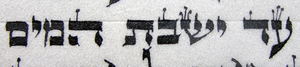 עד ישבת המים, the nonsensical phrase until the feminine singular water sat [thanks Heloise for pointing that out]. The passage in question is וישלח את הערב ויצא יצוא ושוב עד יבשת המים מעל הארץ, He sent forth the raven, and it went out repeatedly and returned, until the waters had dried up from the earth.
 יבשת vs ישבת, you see. Both versions make sense, but one of them is wrong, and so it has to be fixed.
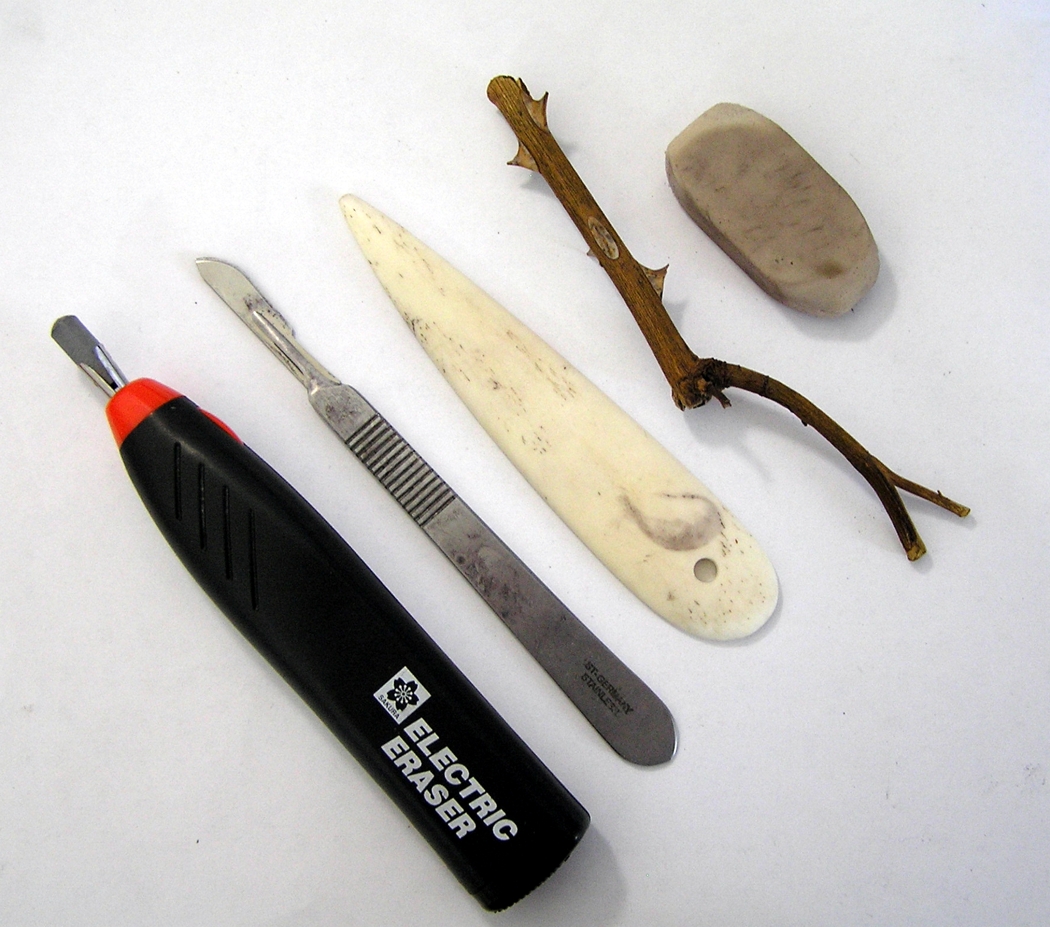
Tools for fixing, left to right: electric eraser, scalpel, burnishing tool, rose thorn, eraser.
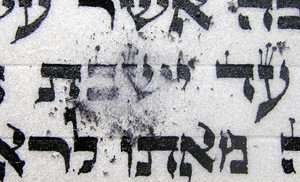 As discussed last week, you first remove the ink. Some like to use electric erasers for this; with the right grade of abrasive tip, the electric eraser makes short work of the ink. At present I’m in a phase of preferring a scalpel; what you lose on speed, you gain in finesse.
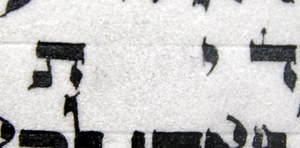 Eventually it’s all gone. At this point, you use the eraser to clear any bits of ink that didn’t brush off. Then you burnish the surface so that it’s good to write on. You use the rose thorn to re-score the line (it’s hard and about the right thickness to match the existing lines, plus extensive biblical/poetic symbolism of roses).
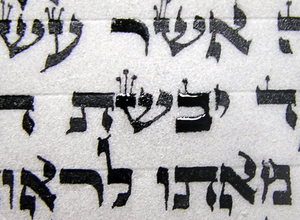 Rewrite properly. They stand out a bit while they’re still wet…
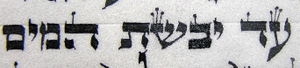 …but once they’ve dried you can’t really tell the difference.
The question you all want answered, of course, is What happens if you make a mistake????, but before we get to that, I’m going to explain how I know what to write.
A Torah has to be copied from another Torah – which was copied from another Torah, which was copied from another Torah, all the way back to the first Torah. Even if someone knows the whole Torah by heart, they still have to copy from something.
This helps to make sure the text is transmitted accurately. If someone has memorised a text, they risk rendering it a little bit differently when they come to write it down. For most texts, that wouldn’t matter an awful lot provided the sense was preserved, but we want the Torah to be rather more accurate than that.
And symbolically – if we’re going to base our lives around a book, we want it to be the actual book, not someone’s memory of a book. Copying from an actual scroll reminds us of the chain of transmitted Jewish tradition which has been handed down since misty antiquity, all the way back to the divine revelation. It reminds us that all the links in the chain were real – real scrolls and real people. It keeps Judaism rooted in the physical world.
Most scribes today copy from a book called a tikkun soferim, which has been put together by expert scribes and has been carefully checked.
The recto page of a tikkun soferim looks like this:

It is printed with vowels and notation, chapters and verse numbers, and directions for the weekly reading in synagogue.
The verso page has the same letters, but with Torah script, as it would appear in the Torah – and with no vowels or other markings. Instead of a verse number, there is a line number. For a copyist, knowing which line you are in is much more useful than knowing which verse you are in.

The two letters in grey on the right-hand side are the most helpful “extra” information for the scribe. Since not all words are the same length, it’s not possible to make each line have exactly the same number of letters in it – but we want each line to form neat columns. The scribe needs to adjust the spacing of the letters to achieve this, and the little grey letters tell them how.
 Letters are measured in yuds, because yud is the smallest letter. Yud counts as one, obviously. So do the narrow letters (gimel, vav, zayin, and nun), and a space between words. All the other letters count as two yuds when written in the normal way, except shin, which counts as three.
The person who put the tikkun together looked at this Torah that someone with a lot of experience wrote once, and counted the number of yuds to a line. The standard length is taken as 62 yuds, and sometimes a line will have the exact equivalent of 62 yuds; in that case it will be labelled ש”ת, shin-tav, which stands for “shita temima,” or “complete line.”
Otherwise, it will be labelled by the number of yuds it has gained or is lacking. The line above is labelled yud-hey. Yud stands for yoter, which means “extra,” and hey has the numerical value of 5, so we know that the line is over by 5 – it would measure 67 yuds if you wrote each letter its usual size. So you have to squish everything up a little bit to make it all fit in nicely. The alternative, when there are fewer letters, will be labelled chet-something, the chet standing for chaser, which means “lacking.” So chet-gimel would mean lacking-three, or 59 yuds.
When you see me writing, you’ll see my tikkun in front of me. Drop by and check it out on one of my CBH visits.
So. If something doesn’t match the tikkun, we’ve got a problem. Next post: what we do about that.