Category Archives: Proofreading

A final post on proofreading

I’ve given quite a lot of space to proofreading, lately, by way of emphasising that proofreading is a terrifically important part of writing a sefer. By way of closing this subject, I’m just going to draw your attention to the combination of tradition and technology we use here.

Some people find it very disconcerting that we use a computer at all. But a computer has a lot of the right skills; it’s a lovely example of using technology to take a traditional process and improve the way we do it.

Other people ask why there is any need for humans at all; “why can’t the computer do it all?” Fortunately, the computer has limitations.

For instance, the letters are very slightly three-dimensional; a human, with stereo vision, can tell the difference between ink and shadow, and a scanner can’t always. Sometimes it’ll interpret a shadow as a crucial fine line, and report a letter kosher when it really isn’t.

So a scan is an excellent tool – I think it’s one of the finer syntheses of technological development and ancient ritual – but it does not replace all the other proofreading tools we use, and it is not a substitute for hard work and knowing your stuff. We still need the subtlety which humans can bring to the task.

Final fact: proofreading takes about 1/12 of the total project time.
Computer-aided proofreading, type 2

The other form of computer checking involves much more sophisticated software, and further reduces the chance of human error. In the process we’ve just been talking about, the letters were fed to me automatically, but I still had to use my brain to identify them and see that they were kosher. In this process, there’s barely any brain involved at all.

In this process, the operator uses a hand-held scanner to get the columns of text into the computer. Then it is run through OCR software – very clever software, which not only recognises letter glyphs but can also be taught to handle variations in glyphs caused by its being hand-written. Because it is a computer, it can also be taught some of the laws of whether a letter is kosher or not, so it can apply those mechanically to each glyph and flag up any doubtful cases.

Finally, the OCR output is compared to a Torah text, and any discrepancies are flagged up along with the doubtfully-kosher ones. A report with all problems is generated and given back with the scroll to the sofer, who then goes through the list and fixes everything on it.

Scan report
Scan report

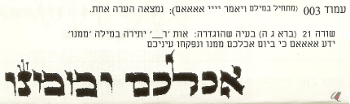
Here’s a piece of the scan report from my first Torah. Column 003, says the first entry on this report, which starts “Vayomer Adonai Elohim” – one comment. Line 21 (Bereshit 3:5), problem, thus: extra letter vav in the word “mimenu,” where it should say “…yodea Elohim ki b’yom akhalkhem mimenu v’nifkedu eineikhem…” and then in the picture you can see it’s got “v’mimenu,” for some reason or other.

I think I probably started writing the mem, got distracted mid-stroke, forgot I’d already started it, and started it over, but I don’t remember now.

Computer-aided proofreading: type 1

When proofreading, you need to make sure every letter is present; one letter too many or too few invalidates the sefer.

One method of proofreading involves two people; a Reader has a tikkun and a Sofer has the klaf. The Reader reads the letters from the tikkun one by one, and the Sofer checks them off.

Proofreaders know that one of the problems of proofreading is you often see what you expect to be there, not what actually is there. Checking off a string of letters fed to you by a reader more or less eliminates this problem.

There’s still chance for human error though – misspeaking, mishearing, losing the place, saying “hang on a minute” when marking an error and needing to re-establish the place afterwards, going too fast and missing bits, going too slow and wasting time.

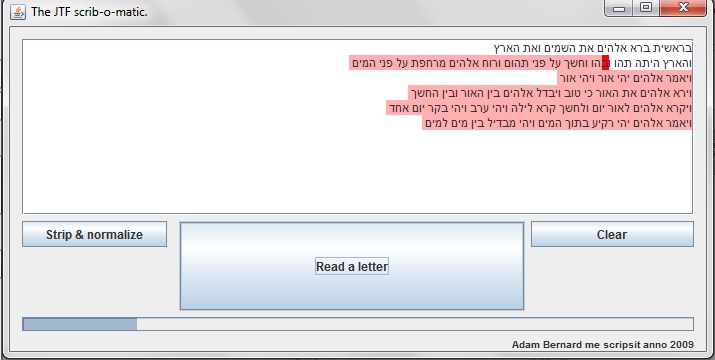
This is why I had a friend write me a program which plays the part of the Reader. He called it the scribomatic, which I find vastly pleasing. I have the Torah text in my computer; I copy and paste in the portion of text I want to check, the scribomatic reads the letters one by one, and I check them off on the klaf as we go.

A funny thing about checking the letters like this is that you completely lose track of where you are in the Torah.

When you’re writing, you say the words out loud as you’re going along. You’re going very slowly, so you might forget what was happening a few paragraphs before, but you know what’s happening in the part you’re writing.

When you hear the letters coming at you, one after the other, and you’re focusing on them as individual letters and not as words, as a string and not as a text, you don’t have that awareness. At least, I don’t. Try it with a friend and a lump of English sometime, see what you make of it. It’s very interesting, I think – yet another perspective on the Torah text that I wouldn’t have suspected was there.

More on proofreading

pasul mem
Pasul letter mem

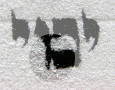
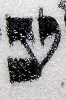
Proofreading has to pick up on letters which have real problems in their form. Maybe the scribe’s hand slipped, maybe the letter got smudged by accident, maybe the ink spread after being put on – letters can go wrong, and we don’t always notice while we’re writing. So proofreading has to be alert for that kind of thing.

Again, you need knowledge of letter forms. You need to know why the above is a problem.

pasul mem

The problem is this little join. Such a little thing, but so important.

I like thinking of it as being similar to electricity. Electricity doesn’t care if it’s only a little tiny wire making the short-circuit; that little tiny wire short-circuits your thing and boom, it isn’t working any more. Same with letters. This mem is short-circuited, and it doesn’t work any more.

And like the more annoying kind of short-circuit, you can’t just take out the offending part and have everything work, no, you have to take the thing apart and rebuild it.

(Super-geekies can read chapter 8, paragraph 6 of the Keset ha-Sofer for info on how to fix a short-circuited mem, but the non-super-geeky may prefer to give it a miss.)

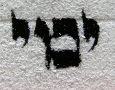
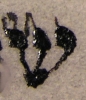
Couple more examples, for your delectation. One’s a shin with a short-circuit, the other is supposed to be a yud followed by a nun, but the short-circuit there has turned it into a tzaddi. Internet cookies for anyone who explains how to fix them.

pasul shinyud-nun

Letter forms

A scribe today has an exhaustive list of rules for how each letter ought to look – here’s an example for letter shin, from the Mishnah Berurah:

Shin has three heads. The first head, with the leg which is drawn out of it, is like a vav, and its face is tilted slightly upwards. The second head is like yud; its head is tilted slightly upwards, and ideally it has a little prickle on it. The third head must be made like zayin, and it has three taggin on it. The left heads of all the letters שעטנז גץ are like zayin. One must take care that the heads do not touch each other. The leg of this left head should lekhathilah be particularly vertical…

and it goes on, I won’t give you all of it here.

Specifically, it’s interesting that the later authorities – i.e. the ahronim, post-Shulhan-Arukh, more or less – devote a lot of space to defining how the letters should look, but the rishonim and earlier (including the Shulhan Arukh) don’t seem too interested in that – they know how the letters ought to look, and they content themselves with reminding you particular ways in which you ought not to stray, like not making alefs ayins and suchlike.

Alef-bets differ with region and period. We’ve already seen some of the ways Ashkenazic and Sephardic alef-bets differ, when we were discussing influence of writing implement on letter style. We didn’t discuss there how those styles relate to the laid-down rules for letter forms.

Letter shin is a case in point. Literally.

Sephardi letter shin
Sephardi shin
Ashkenazi letter shin
Ashkenazi shin

Shin, for Ashkenazim, has to have a pointy bottom. But Sephardim don’t necessarily agree with that, and many Sephardi styles give shin a rounded or flat bottom. Now, most Ashkenazim don’t think that this is a deal-breaker; you can still recognise the letter as shin, after all, but a few Ashkenazim do think it’s very much a deal-breaker. They may even avoid Torah readings from a Sephardi-style Torah on this basis. Some Sephardi scribes add a nominal point to their shins, as here, for compatability:

Sephardi letter shin

This is a formalised example of how minor variation in letter forms can affect how kosher it is – formalised because the variation is accepted as valid by different branches of the tradition. Accidental variation is more likely for the sort of proofreading I’m doing.