Category Archives: Scribal technicalities

More on proofreading

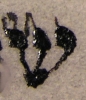
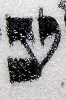
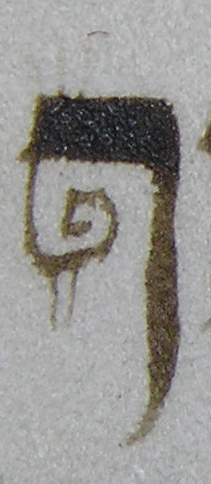
pasul mem
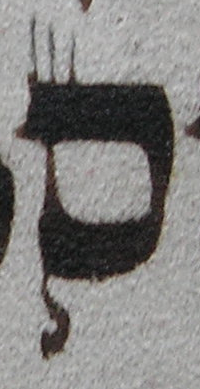
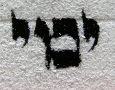
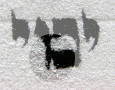
Pasul letter mem

Proofreading has to pick up on letters which have real problems in their form. Maybe the scribe’s hand slipped, maybe the letter got smudged by accident, maybe the ink spread after being put on – letters can go wrong, and we don’t always notice while we’re writing. So proofreading has to be alert for that kind of thing.

Again, you need knowledge of letter forms. You need to know why the above is a problem.

pasul mem

The problem is this little join. Such a little thing, but so important.

I like thinking of it as being similar to electricity. Electricity doesn’t care if it’s only a little tiny wire making the short-circuit; that little tiny wire short-circuits your thing and boom, it isn’t working any more. Same with letters. This mem is short-circuited, and it doesn’t work any more.

And like the more annoying kind of short-circuit, you can’t just take out the offending part and have everything work, no, you have to take the thing apart and rebuild it.

(Super-geekies can read chapter 8, paragraph 6 of the Keset ha-Sofer for info on how to fix a short-circuited mem, but the non-super-geeky may prefer to give it a miss.)

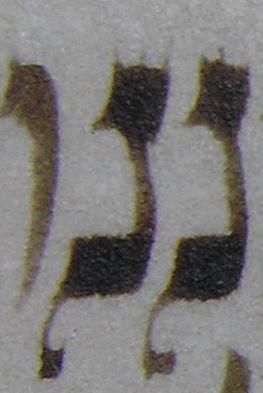
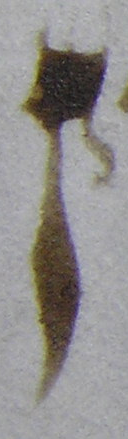
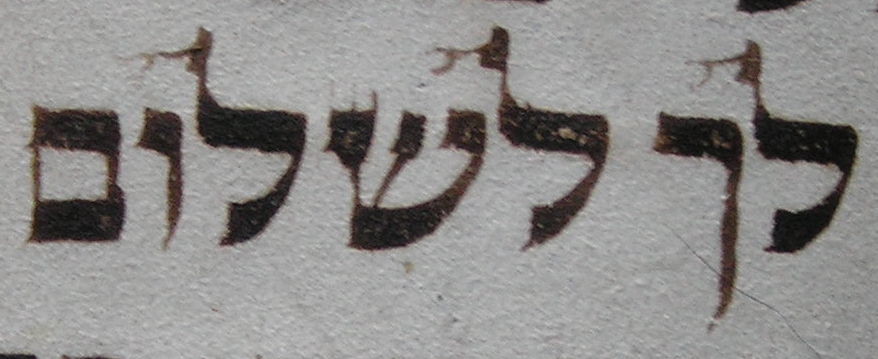
Couple more examples, for your delectation. One’s a shin with a short-circuit, the other is supposed to be a yud followed by a nun, but the short-circuit there has turned it into a tzaddi. Internet cookies for anyone who explains how to fix them.

pasul shinyud-nun

Letter forms

A scribe today has an exhaustive list of rules for how each letter ought to look – here’s an example for letter shin, from the Mishnah Berurah:

Shin has three heads. The first head, with the leg which is drawn out of it, is like a vav, and its face is tilted slightly upwards. The second head is like yud; its head is tilted slightly upwards, and ideally it has a little prickle on it. The third head must be made like zayin, and it has three taggin on it. The left heads of all the letters שעטנז גץ are like zayin. One must take care that the heads do not touch each other. The leg of this left head should lekhathilah be particularly vertical…

and it goes on, I won’t give you all of it here.

Specifically, it’s interesting that the later authorities – i.e. the ahronim, post-Shulhan-Arukh, more or less – devote a lot of space to defining how the letters should look, but the rishonim and earlier (including the Shulhan Arukh) don’t seem too interested in that – they know how the letters ought to look, and they content themselves with reminding you particular ways in which you ought not to stray, like not making alefs ayins and suchlike.

Alef-bets differ with region and period. We’ve already seen some of the ways Ashkenazic and Sephardic alef-bets differ, when we were discussing influence of writing implement on letter style. We didn’t discuss there how those styles relate to the laid-down rules for letter forms.

Letter shin is a case in point. Literally.

Sephardi letter shin
Sephardi shin
Ashkenazi letter shin
Ashkenazi shin

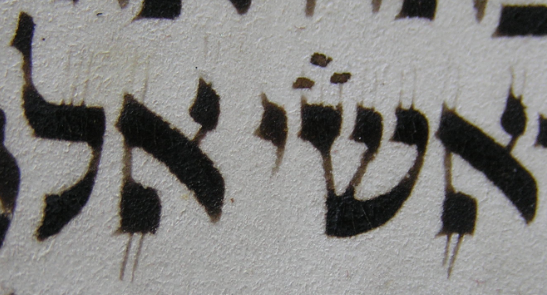
Shin, for Ashkenazim, has to have a pointy bottom. But Sephardim don’t necessarily agree with that, and many Sephardi styles give shin a rounded or flat bottom. Now, most Ashkenazim don’t think that this is a deal-breaker; you can still recognise the letter as shin, after all, but a few Ashkenazim do think it’s very much a deal-breaker. They may even avoid Torah readings from a Sephardi-style Torah on this basis. Some Sephardi scribes add a nominal point to their shins, as here, for compatability:

Sephardi letter shin

This is a formalised example of how minor variation in letter forms can affect how kosher it is – formalised because the variation is accepted as valid by different branches of the tradition. Accidental variation is more likely for the sort of proofreading I’m doing.

Proofreading

I’ve talked a bit about how it’s okay to fix mistakes, in most circumstances.

The sages were well aware that when you copy a document, and then copy from the copy, and so on, mistakes are likely to creep in over time. This is why we have a rule that even one mistake in a Torah scroll renders the entire scroll invalid for use until the mistake is fixed – zero-tolerance is really the only policy you can have if you want to ensure that your document will be absolutely unchanged.

This, incidentally, is also why we have the rule about copying from a copy. The scribe simply isn’t allowed to write the scroll down from memory – he may have it more or less accurate, but in a culture where each letter has the status of being divinely dictated, even a variation of one letter can’t be accepted, and recall from memory might meaan whole words or phrases were a little bit off.

Relatedly, the roles of scribe and editor were pretty much interchangeable throughout much of history, and in most other documents, the occasional variation here and there doesn’t matter much, or is even expected (for further reading on this subject, see for instance Scribal Culture and the Making of the Hebrew Bible). But the Torah’s integrity was, for rabbinic Judaism, a theological principle, and as such, deviation from the text could not be accepted.

So it is that when you write a Torah, you have to proofread it extremely carefully.

You have to go through the scroll and check that each and every one of the 304,805 letters is there and has its proper form. Ambiguity in form can be a bit of a disaster, since it can turn one word into a completely different word rather easily. More about that later.

Planting

(Meant to post this last week, sorry.)

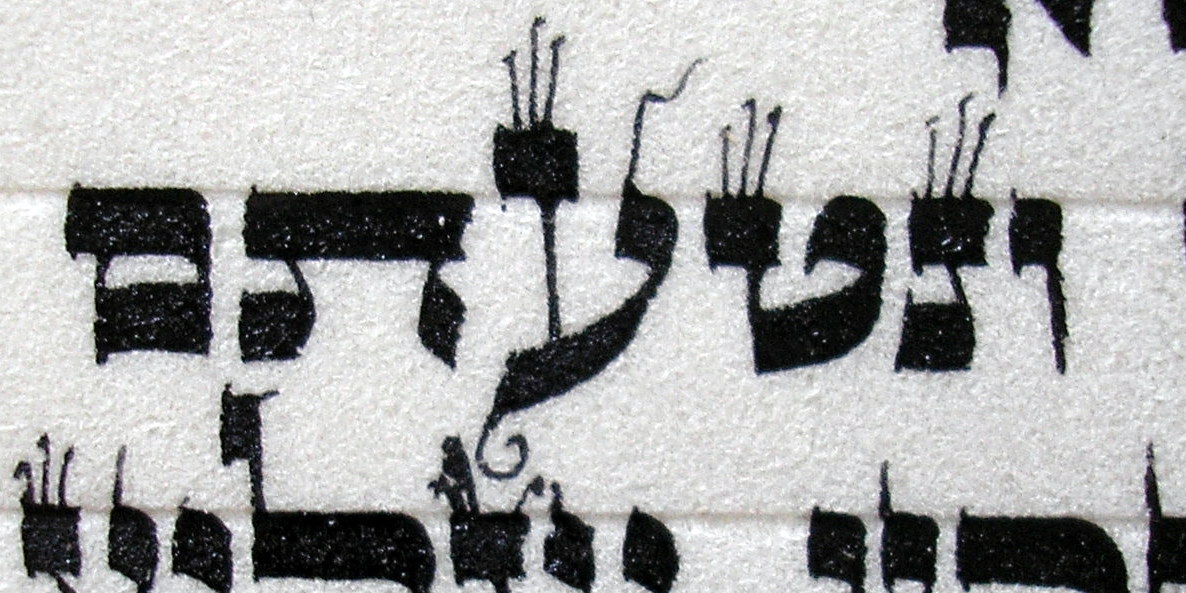
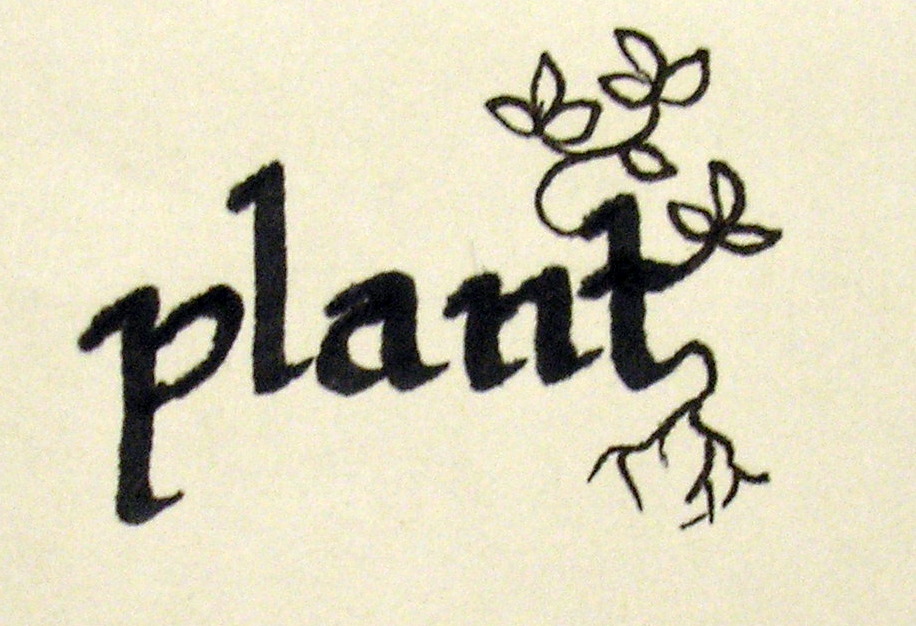
Leviticus 19:23–And when ye shall come into the land, and shall have planted all manner of trees for food, then ye shall count the fruit thereof as forbidden; three years shall it be as forbidden unto you; it shall not be eaten.

Except in our sefer it’s more like this:

Kind of as if the text read …plAnted…, or:

I just like that.

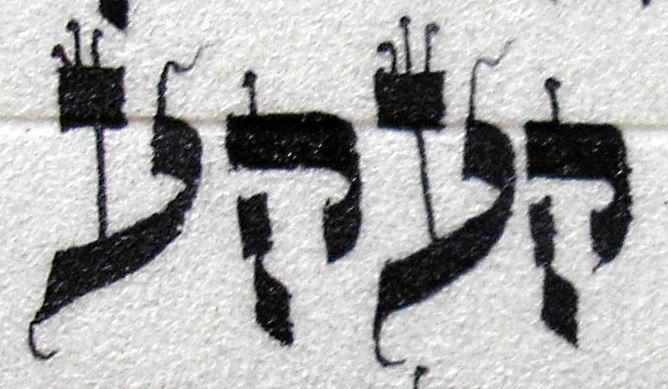
That kind of ayin doesn’t always indicate growing, I don’t think; later in the same paragraph (19.28) we have Do not put soul-cuts in your flesh, and do not make tattoo-writing in yourselves…:

and I don’t think that’s talking about growing. Unless it’s hinting at a meaning which involves growing, i.e. scarification rather than tattooing, but that is most unscientific, so don’t quote that.

Halfway

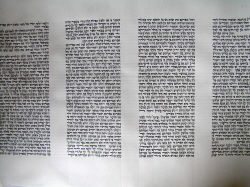
We reached a halfway point this week; 122.5 columns of 245.

As it happens, 245 is also the number of words in the Shema (full text here). The Shema is the cornerstone of the liturgy; the Torah is the cornerstone of the religion. The Shema says, bring God into all your doings; the Torah is the guide as to how. The Shema declares faith in God; the Torah symbolises God’s presence. 245 words; 245 columns.

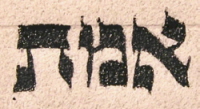
We could leave it there, and that would be very nice. However, the Shema in liturgy has an interesting peculiarity, thus: when praying as individuals, we precede it with the three words אל מלך נאמן, God truthful King. When as a community, three words are added after its silent recitation – the last two words ה’ אלהיכם the-Lord your-God are repeated aloud, and the word אמת, emet, true added.

Why’s this?

Well, 245+3=248, and 248 in the rabbinic narrative corresponds to the number of pertinent parts of the human body. Proverbs 3 says of the Law It shall be health to thy navel, and marrow to thy bones; how better to map the fundamentals of the Law onto the fundamentals of the body than by reference to the Shema? One word for each body part, says Rav Nehori,** and everything will be good above and below.

248 is also the number of positive commandments in the Torah, as it happens. 248 imperatives, 248 vital body parts, and 248 words in the vital liturgical element.

245 columns in the Torah seemed jolly nice a few paragraphs ago, but now it seems we’ve got three bits missing.

Well, the Torah lives on a pair of rollers. Some call them spindles, some call them atzei hayim, trees of life – and some call them amudim, columns.

Recall that the three words added to the 245 in the Shema are אל מלך נאמן, God truthful King or ה’ אלהיכם אמת the-Lord your-God [is] true. Both times, it’s two words and emet, truth. With our Torah, we’ve got 245 columns of words, 2 wooden columns, and…and something.

What is it, this final something?

Our clue comes from another “column,” the amud, the desk from which the Torah is read. Torah reading is, after all, the link between the scroll and the life of the community, both now and in all the generations before. The Torah does not mean much if it is not part of people. The Shema is only 247 mumbled words without the emet. The 248 body parts aren’t much without the spark of life.

* Not all Torahs have 245 columns. Column height and width can vary, and therefore so can the total number of columns. People are often surprised to learn this.

** Midrash Ne-elam (Zohar Chadash to Ruth), via the Mishnah Berurah on this aspect of Kriat Shema (61:6), see also Virtual Beit Midrash.

Darosh Darash–Shemini

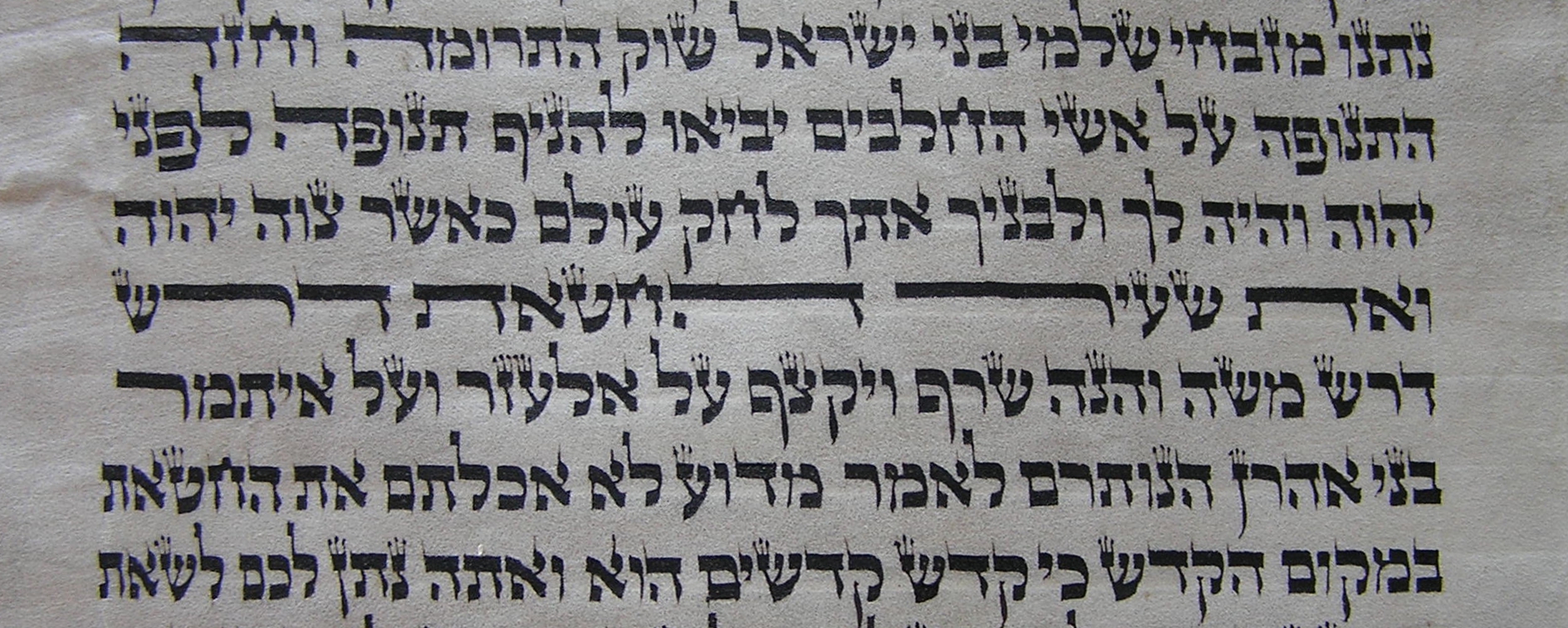
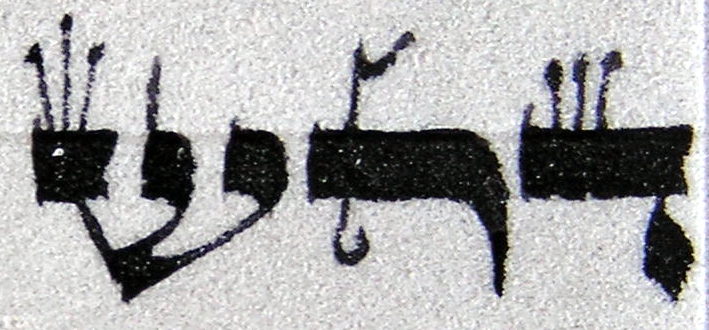
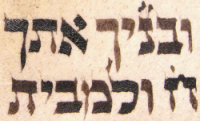
Here’s a section of parashat Shemini, from Leviticus 10:16: וְאֵת שְׂעִיר הַחַטָּאת דָּרֹשׁ דָּרַשׁ מֹשֶׁה וְהִנֵּה שֹׂרָף – And Moses he inquired diligently concerning the goat of the sin offering, and, behold, it was burnt. See how the scribe has stretched out the first words of the verse so dramatically? What’s going on there?

An early masoretic note, preserved in the Talmud (Kiddushin 30a) says that the words דרש דרש, he inquired diligently, are the middle words of the Torah.

By the time of the 1525 Mikraot Gedolot, we see the masoretic note in the form חצי התורה בתיבות דרש מכא ודרש מכא – Half of the Torah in words. Darosh from here, and Darash from here. You might well see this version in your printed chumash. The Masoretes are concerned with arithmetical questions: what’s the middle letter, the middle verse, the middle word? This note makes it plain that דרש finishes one half of the Torah, and דרש starts the second half.

In Masechet Sofrim, we see this note listed in chapter 9. Chapter 9 concerns itself with layout ideas—big and small letters, tagin, line breaks. It’s not a chapter about arithmetical concerns at all, so what is our arithmetical masoretic note doing here? It seems that the editor of Sofrim interpreted the masoretic note not arithmetically but spatially; Half of the Torah in words; Darosh from here [the end of the line], and Darash from here [the beginning of the new line].

Sofrim’s words are דרש דרש חצי תיבות של תורה, דרש בסוף שיטה דרש בראש שיטה– Darosh darash are the half[way point] of the words in the Torah; Darosh at the end of a line, and Darash at the beginning of a line. The verse must contain a line break! A layout rule has been created by interpretation.
This rule is not authoritative. Many Torah scrolls do not have a line break between דרש and דרש. But many do, and some scribes will stretch their letters, as above, to accomplish it.

But this is not the end of the story. After being interpreted arithmetically and spatially, our idea undergoes another transformation and is interpreted homiletically, by the 18th-century polymath R’ Hayyim Joseph David Azulai. He says:

Darosh at the end of a line, and Darash at the beginning of a line

This means – when you have expounded (darosh) the Torah to the point that you think you have exhausted all its meaning, and you think that you are at the very end of the “line” – not the line of layout, but the line of enquiry and scholarship – you should realize that you are really only “expounding the beginning of the line”.

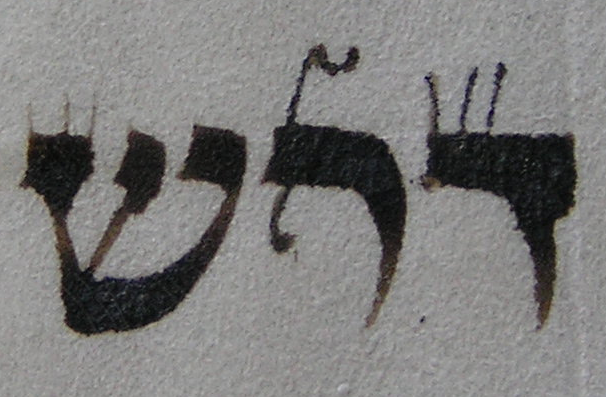
Our sefer has something extra–both instances of דרש look like this:

With profuse thanks to Gabriel Wasserman.

More letter adornments

Following on a bit from last week’s post, here are a few of the other things this sefer contains. Descriptions are mine, not hallowed by tradition.

Nuns pointing their feet backwards
Samekhs with tails and crowns
Letters with all kinds of tagin, top and bottom
Winged reishes
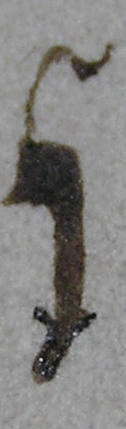
Vavs growing leaves and tendrils
Exuberant ayins and tzaddis
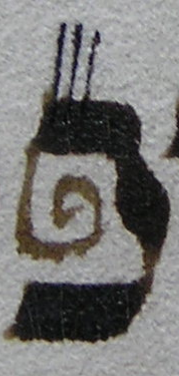
Mini peh-inside-a-pehs
Pehs with beards
Nuns trailing scarves
Lameds flying banners

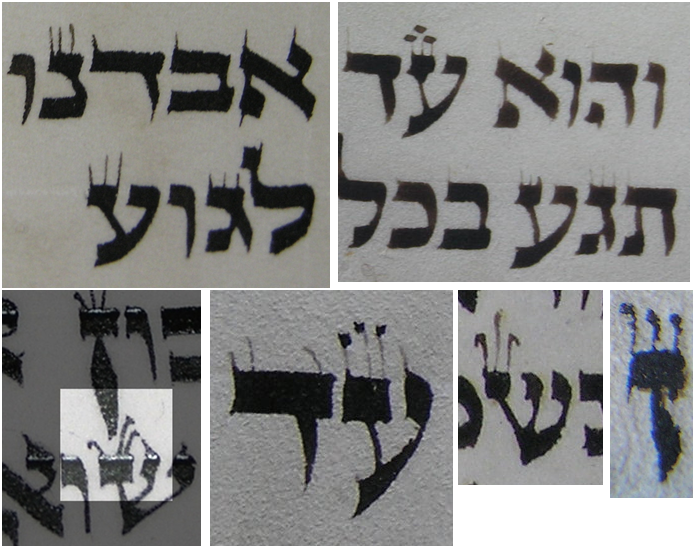
Tagin: the crowns on the letters of the Torah

When we look at words in the Torah scroll, we notice unusual decorations on the letters.
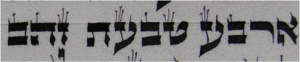
What are they? Why are they there? A very few seconds’ thought tells us that they are not vowels or cantillation, the more usual “decorations” of Hebrew letters.

The fourth-generation amora Rava states [Men 29b]: There are seven letters that each have three zayins: Shaatnez Gatz.

One of the places in Torah where the seven crowned letters cluster together:
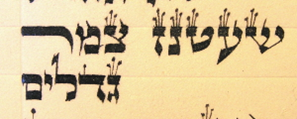
One of the places in Torah where the seven crowned letters cluster together

As interpreted today, the “zayins” come in all sorts of forms, sometimes several forms in the same sefer:
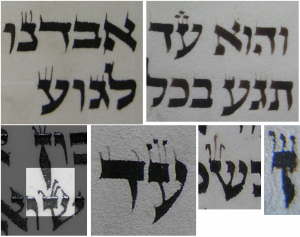
Some choose to connect these zayins to kabbalah. Part of the kabbalistic apparatus is the set of sefirot, sort-of divine levels of understanding. The ultimate one is Infinity, the utterly-unknowable-unless-you’re-God, then you get revelation and understanding (the intellectual realm, apparently), then a bunch of things like mercy and grace (the emotive realm), but this is a very bald rendering and properly it is terribly nuanced and subtle. And there are ten altogether.

Zayin is the seventh letter in the alef-bet, and it has three taggin. That makes ten sefirot! So one interpretation of a zayin is that the seven part, underneath, corresponds to the seven sefirot in the emotive realm, and the three part, the three higher.

In which case, the three taggin correspond to Keter (Infinity), Hokhmah (Wisdom), and Binah (Love). The middle one is the tallest, and represents Keter, which is the highest possible state of being; Hokhmah is the next tallest and the next most important so it sits on the right, and Binah is the shortest and sits on the left (Understanding the Alef-Beis, Dovid Leitner).

There is a famous story about tagin, told of the third-generation tanna Rabbi Akiva.

When Moses ascended Mount Sinai to receive the Torah, he found God tying crowns onto the letters.

“God,” said Moses, “surely you don’t need those?”*

God replied: “After many generations, there will be a sage named R’ Akiva, who will derive heaps and heaps of halakhot from them.”

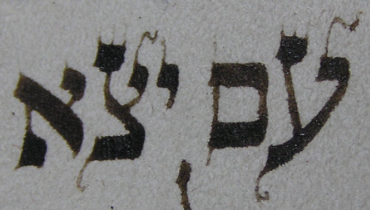
Because in some Torah-writing traditions, letters other than שעטנ”ז ג”ץ have adornments. For instance, Exodus 6:2-3 saysוַיְדַבֵּ֥ר אֱלֹהִ֖ים אֶל־מֹשֶׁ֑ה וַיֹּ֥אמֶר אֵלָ֖יו אֲנִ֥י יְהוָֽה׃ וָֽאֵרָ֗א אֶל־אַבְרָהָ֛ם אֶל־יִצְחָ֥ק וְאֶֽל־יַעֲקֹ֖ב בְּאֵ֣ל שַׁדָּ֑י וּשְׁמִ֣י יְהוָ֔ה לֹ֥א נוֹדַ֖עְתִּי לָהֶֽם — God spoke to Moses, and said to him, I am YHVH. I appeared to Abraham, Isaac, and Jacob as El-Shaddai, but by my name YHVH I was not known to them.

That second YHVH looks like this, in some traditions:
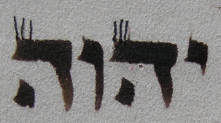
Three tagin per hey, see? This doesn’t happen on all heys, nor yet on all instances of YHVH–just on certain ones. Why?

One scholar explains: There are tagin on the Name to indicate that this is the crowned, distinguished Name, the superior, explicit Name. And why on the heys specifically? Twice hey is ten, and ten are the modes of existence: (1) Utter height, (2) utter lowness, (3) utter east, (4) utter west, (5) utter north, (6) utter south, (7) utter good, (8) utter bad, (9) utter firstness, (10) utter lastness.**

These tagin are altogether more obscure than the straightforward שעטנ”ז ג”ץ. It is probably these the midrash alludes to.

The sefer I am writing for CBH is following one of these traditions of special tagin. I am copying from a sefer owned by my synagogue in Washington Heights. I don’t know much about that sefer, except that it is old, beautiful, and part of my community, and I think the tradition of adorned letters it represents is probably worth preserving.

* Only You can understand them, God, so why give them to me? alternatively, isn’t the Torah already perfect with just its letters?
** G. Wasserman, trans.
Ink

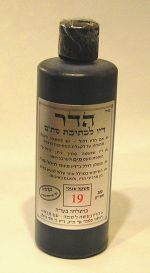
Sofer's inkThe main thing about Torah ink is that it has to be black and it has to stay black. If it changes colour within fifty years, it wasn’t kosher to begin with.

Generally, Torah ink (דיו, in Hebrew, like dye) is what’s called an iron gall ink. Iron gall inks have been used in a great many places during a great many periods in history. They last a long, long time (think Dead Sea Scrolls kind of longevity). They have an unusual property among pigments in that they form chemical bonds with the parchment, which makes them symbolically very appropriate for use on Torahs. They are lightfast, the ingredients are cheap, and they are very indelible.

I don’t make my own; making good ink is hard, and I don’t have anyone willing to share their recipe. Anyway, it’s supposedly rather a pain, so I buy it in bottles, as shown. I don’t know if it’s also available in cake form – cake is much easier to transport, of course, and lasts longer, and is entirely traditional. I suspect perhaps not, because I have a feeling that buying ink like this is kind of For Dummies, and real hardcorers, the kind who would want cake ink, probably do make their own.

As you might expect, there are hundreds of different recipes for this kind of ink. However, they have some things in common, viz.: gallnuts, iron (II) in solution, something runny, and something sticky. The following descriptions are indebted to an excellent article by Cyntia Karnes.

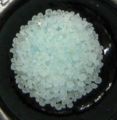
Gallnuts on oak leavesGall nuts

See the Wikipedia entry, but basically gallnuts (also called oak-apples) are a sort of arboreal tumour. A gall wasp comes along and lays its egg on the tree, and the tree goes “whoa” and swells up around the egg, into this little hard ball. The larva sits inside the swelling, munching away, and when it grows up it eats its way out and leaves the ball on the tree.

The balls have to be turned into a gloopy solution. This basically involves grinding, dissolving, and fermenting, and there are about a zillion ways of accomplishing this. Depending how it’s done, what you end up with is a liquid containing tannic acid, gallotannic acid, or gallic acid.

Iron II sulphateIron (II) sulphate

This is where the iron comes from. It tends to be known as copperas, or coppervasser if you are the Mishnah Berurah, because iron sulphate and copper sulphate tended to come out of the ground together, but the copper isn’t important and the iron is.

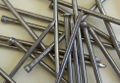
NailsThis is why some recipes call for boiling up nails with the gallnuts. In an acidic solution, you get the right sorts of reactions. It’s apparently quite dangerous if you do it properly.
Gum arabicRunny and sticky

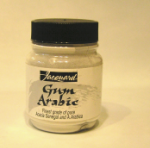
Fairly obviously, ink needs to be runny, but it also needs to stick to the page. Gum arabic, the sap of certain sorts of acacia tree, dried, ground, and dissolved in water, is commonly used as a binder in all sorts of things – ink, paint, food – and has been for centuries. It stops the ink being too runny, and helps stick it to the parchment when it dries.

WineRunny can be distilled water, but it can also be wine (including idolatrous wine, isn’t that interesting?) or vinegar, or presumably most other sorts of liquids. Vinegar helps to make the ink shiny, I am told (the gum arabic goes on shiny, and the vinegar helps keep it shiny, something like that), and indeed one of the shiniest brands of ink out there smells very vinegary indeed.
Chemistry

This is the fun bit. You mix all these things up, apply them to parchment, and let the oxygen in the air do its thing. It’s incredibly complicated and I don’t understand it all, but basically what goes on is: the gallotannic acid bit reacts with the parchment; part of it grabs onto the parchment, and part of it floats about. The floaty bit reacts with that iron solution, and iron (II) oxide gets precipitated. Iron (II) oxide is black.

Iron-gall ink made like this is pale grey in colour, and it gets darker when these reactions have had time to happen – about a day, I understand, but I’ve not tried it.

Letters in Torah fading to brownIncidentally, iron (II) oxide isn’t terribly stable, and over time it tends to turn into iron (III) oxide. This is the same stuff rust is made of, and it’s red. This is why letters in old Torahs go brown or orangey-red, as the black iron (II) compound oxidises to the red iron (III) one. They’re just starting to go brown in the picture here.
Soot

For whatever reason, the inks I buy have had stuff added to them so that they are black when they go on, and presumably they get blacker with oxygen, but not so’s you notice. I think this is soot – burnt olive oil is referenced in one source, or just burnt wood. They say specifically you mayn’t use burnt ivory (ivory-black), since elephants aren’t kosher.

Pilot gel penNon-iron-gall inks

The rule is that the ink has to be black and permanent, and for the longest time the way to make permanent black ink that would work on a scroll (wouldn’t fall off when rolled) was like this. However, these days we have all manner of funky synthetic blacks that are entirely lightfast and suitably adherent and flexible. Can we use those?

The discussion then takes two paths.
a) The sources talk about using the ingredients for iron-gall ink, so this must be part of what kosher ink is, and to use kosher ink is a requirement from Sinai.
b) That is by way of description, it’s true that in those days they couldn’t make good ink without iron galls etc. But the point is that the ink be indelible and black; synthetics accomplish this just as well, and there are times when they’re a better tool, in some ways.

Interestingly, the right of the denominational spectrum seem to be more okay with b) than the left. The left wing and the ultra-right seem to share a visceral aversion to b), I’ve noticed.

To finish, here’s the Keset ha-Sofer, the scribes’ handbook, on basic laws pertaining to ink.

Parashat Teruma and vavei ha’amudim

This week’s parasha describes the worship-tent that God commands the Israelites to construct in the wilderness.

Around the tent, they are to construct a courtyard, of panels held between columns.

Perhaps you’ve seen a Torah scroll being unrolled around a sanctuary at Simchat Torah. You’ve seen how it’s long enough to go around the whole room, the panels of Torah surrounding the congregation like the panels surrounding the worship-tent.

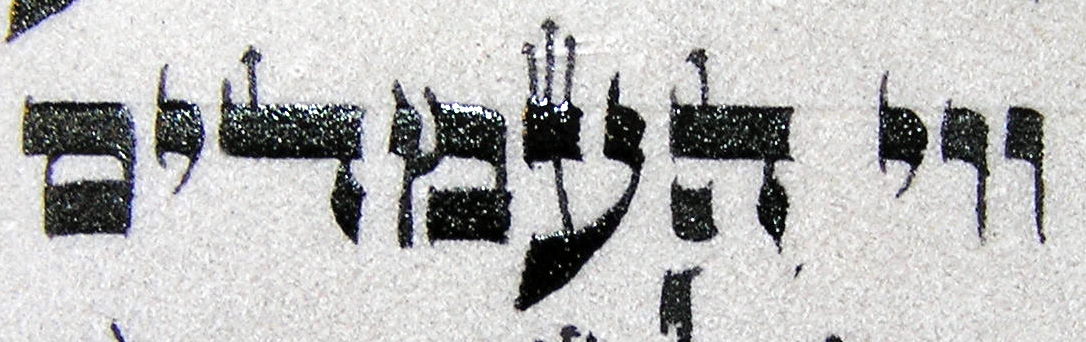
It’s here in our parasha that we find the phrase ווי העמדים. Vavei ha’amudim, the hooks of the columns.

We haven’t made a worship-tent for millennia, but this particular little phrase lives on today in our Torah scrolls in an unexpected way. Scrolls have columns–of writing. And they have hooks–letter vav.

Most new scrolls today, CBH’s being no exception, are written such that almost every column starts with the letter vav.

It wasn’t always so. As late as the 1830s we find scribes’ rulebooks faithfully repeating that it is more or less forbidden to arrange the columns thus. In order to contrive a vav at the top of the column, scribes would perform tremendous feats of stretching and squishing, at the cost of uniform script and column width. Since a Torah is supposed to be a beautiful scroll and not a cutesy word game, scribes were vigorously discouraged from doing it.

By now, it has become an entrenched custom, such that I occasionally get panicked phonecalls from people who have noticed that their scrolls don’t have every column starting with vav, and I have to reassure them that it is perfectly all right.

How did it start? There seems to have been a rather early (gaonic?) custom of arranging for six particular words to appear at the tops of columns, for added significance. As it happened, these six words began with the letters ביה שמו. Over time, some scribes started to arrange their scrolls so that every column began with one of those six letters (53% of the words in Torah begin with one of those letters, so it’s not so difficult to arrange). And at some point, the idea of doing this just with vav (17% of the Torah’s words begin with vav) seeded and took root, becoming widespread sometime in the past 300 years.*

When did it start? Not clear. The Maharam of Rothenberg (thirteenth-century Ashkenaz), fulminating against it, said that there was no evidence the gaonim ever thought of doing it.** Rather, he said, the idea originated with one Leontin of Milhausen, who was showing off his skills.

Not everyone was against the custom. Various kabbalistic authors wove marvellous romances around the letter vav and its numerical representation, six, and the mystical and messianic relationships therein. The Hida has an interesting comment:*** he asks howcome vavei haamudim has become a widespread custom even though respected authorities say it is forbidden? Paraphrasing him a little, the answer is that Jewish communities are blessed with insight from God, so if communities are drawn to a thing, that thing must have some deep significance, and its existence is somehow divinely sanctioned.

The word vav literally means a hook, and the letter vav is also how we say “and” in Hebrew. Hooks hold physical constructs together, and vavs hold linguistic constructs together. What do the vavei haamudim hold together?

Some say the sheets of Torah–yeriot; curtains, veils—are held up by the hooks between heaven and earth. The columns of Torah form the metaphorical worship-tent in which Israel dwell, watched over by God above.

We might also suggest that the vavs of the columns are a reminder that times change. From being a minority position disapproved of by generations of Torah greats, vavei haamudim Torahs have become the default, with layers of meaning woven into them. Every generational vav, every individual “and”, contributes to incremental change; the old still hooked into the new, all held together, but the despised becoming beloved.****


* Yonatan Koletch (p392 footnote 200) quotes R. D. Yitzchaki: the concept of vavei haamudim scrolls “was introduced only during the past several hundred years by R. Ezra of Pisa”, but this seems to be an oversimplification.
** Quoted in the Hagahot Maimoniot, hilkhot sefer Torah, 7:7, but remember this is polemic and we don’t know how much evidence he was looking at.
*** Birkei Yosef, YD 273.
**** Add your own hobby-horse here. Social justice, feminism, disabled rights, race equality…