Category Archives: Erasing

Proofreading

I’ve talked a bit about how it’s okay to fix mistakes, in most circumstances.

The sages were well aware that when you copy a document, and then copy from the copy, and so on, mistakes are likely to creep in over time. This is why we have a rule that even one mistake in a Torah scroll renders the entire scroll invalid for use until the mistake is fixed – zero-tolerance is really the only policy you can have if you want to ensure that your document will be absolutely unchanged.

This, incidentally, is also why we have the rule about copying from a copy. The scribe simply isn’t allowed to write the scroll down from memory – he may have it more or less accurate, but in a culture where each letter has the status of being divinely dictated, even a variation of one letter can’t be accepted, and recall from memory might meaan whole words or phrases were a little bit off.

Relatedly, the roles of scribe and editor were pretty much interchangeable throughout much of history, and in most other documents, the occasional variation here and there doesn’t matter much, or is even expected (for further reading on this subject, see for instance Scribal Culture and the Making of the Hebrew Bible). But the Torah’s integrity was, for rabbinic Judaism, a theological principle, and as such, deviation from the text could not be accepted.

So it is that when you write a Torah, you have to proofread it extremely carefully.

You have to go through the scroll and check that each and every one of the 304,805 letters is there and has its proper form. Ambiguity in form can be a bit of a disaster, since it can turn one word into a completely different word rather easily. More about that later.
Erasing mistakes

Well, this week’s post is a bit late, isn’t it? When I got back from CBH on Monday, my little sister and her fiance were visiting NYC, and they only left yesterday. I don’t get to see them all that often, so I prioritised.

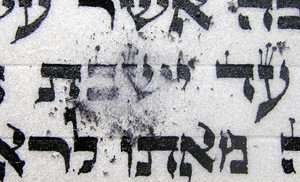
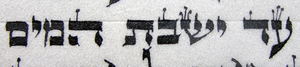
I promised you a post about erasing, and here it is. A few weeks ago I wrote this in the Torah:
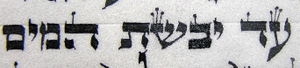
Ad yashovet hamayimעד ישבת המים, the nonsensical phrase until the feminine singular water sat [thanks Heloise for pointing that out]. The passage in question is וישלח את הערב ויצא יצוא ושוב עד יבשת המים מעל הארץ, He sent forth the raven, and it went out repeatedly and returned, until the waters had dried up from the earth.

יבשת vs ישבת, you see. Both versions make sense, but one of them is wrong, and so it has to be fixed.

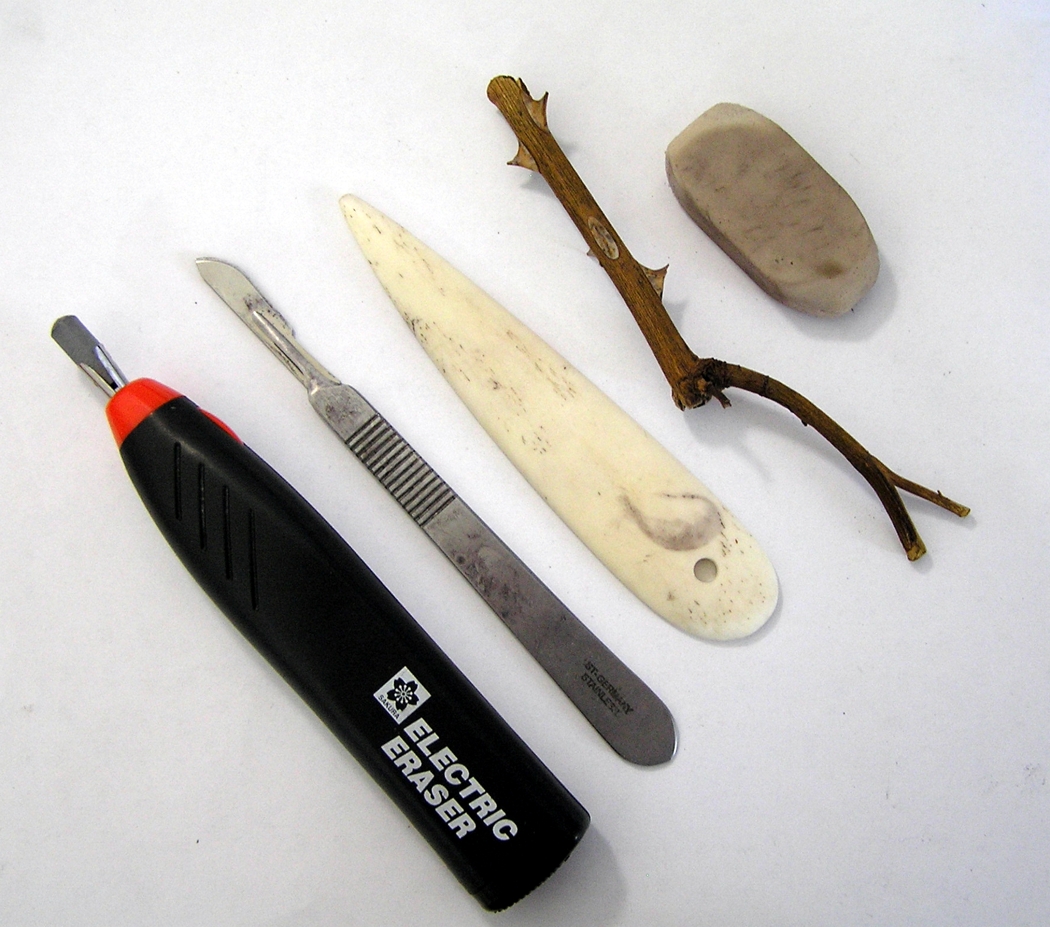
Tools for fixing, left to right: electric eraser, scalpel, burnishing tool, rose thorn, eraser.

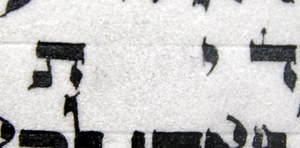
As discussed last week, you first remove the ink. Some like to use electric erasers for this; with the right grade of abrasive tip, the electric eraser makes short work of the ink. At present I’m in a phase of preferring a scalpel; what you lose on speed, you gain in finesse.
Eventually it’s all gone. At this point, you use the eraser to clear any bits of ink that didn’t brush off. Then you burnish the surface so that it’s good to write on. You use the rose thorn to re-score the line (it’s hard and about the right thickness to match the existing lines, plus extensive biblical/poetic symbolism of roses).
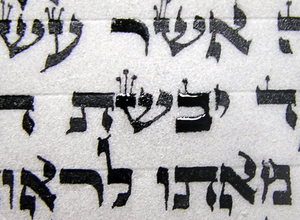
Rewrite properly. They stand out a bit while they’re still wet…
…but once they’ve dried you can’t really tell the difference.

A single mistake invalidates the entire sefer Torah

Many people are under the impression that if a scribe makes a mistake, they have to toss out the whole sefer and start over. This isn’t true. A mistake does invalidate the whole Torah – but not permanently. If there’s a mistake in a Torah, you can’t use it until it’s fixed – but you can almost always fix it.

Think about it. A Torah is a huge thing to write; it takes a whole year to write a Torah, working normal office hours for a normal working year. No-one can work that many hours and not make any mistakes at all, so during that time, most scribes will miss out an occasional word or letter. If we couldn’t fix those, we probably wouldn’t have any Torahs at all.

Perhaps you know the word palimpsest. A palimpsest is a piece of parchment from which the words have been removed, so that the parchment can be re-used. When we fix a mistake in a Torah, we make a localised palimpsest. We take a knife, and scrape away the ink.

Let’s compare paper and parchment.

Here’s a letter tet written with marker pen on regular paper.

When you flip it over, it looks like this. The ink soaks all the way through the paper. If you scraped away the ink, you’d scrape away the paper.

So we’re used to thinking of ink as something it’s impossible to erase.

But Torah parchment is thicker than paper, and Torah ink doesn’t soak in. This is a letter bet written on parchment (magnified quite a lot–notice the texture of the parchment).
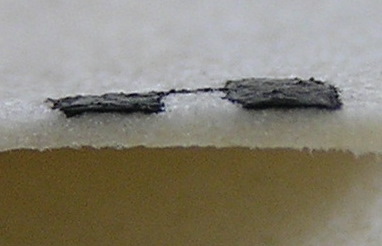
Here’s that same bet, cut sideways. See the three-dimensional nature of the letter, and the way it sits on top of the parchment (there’ll be more about how that works when I make a post about ink). By no means is the ink soaking all the way through. Not even close.
So erasing Torah ink from parchment is a totally different proposition from erasing marker ink from paper.

When we fix a mistake, we use a knife to remove a thin layer of the parchment and the ink with it:

And there is still plenty left for us to write on. In the next post, we’ll see that happen.