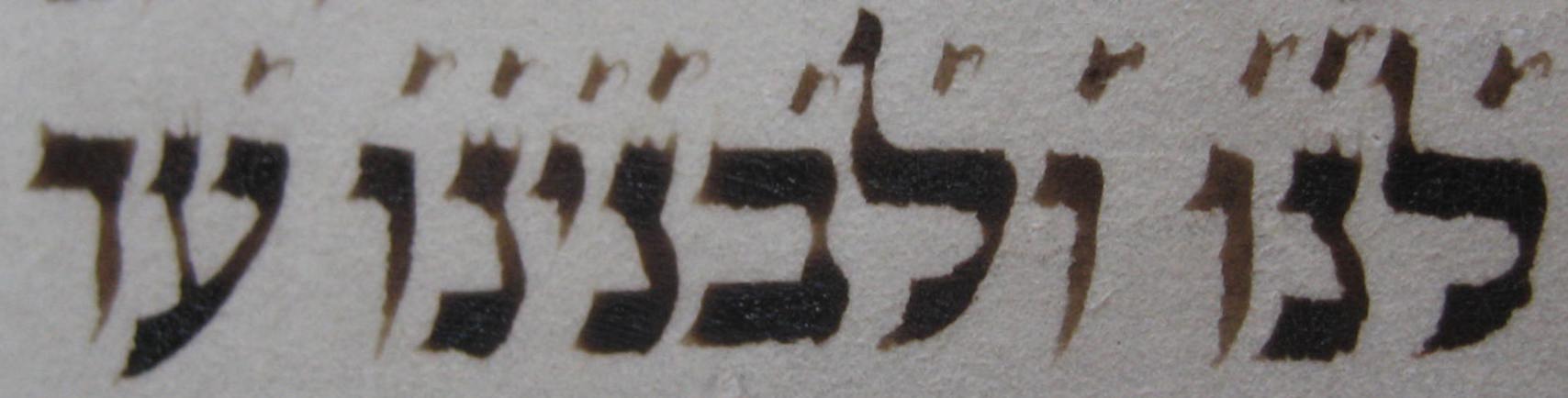
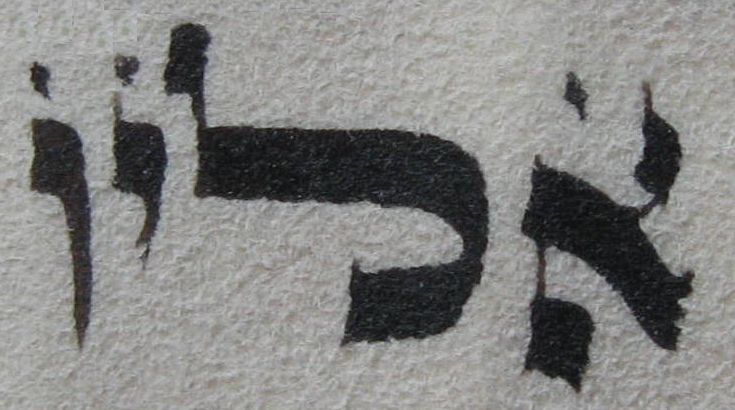
I said I’d talk about dots this week. For no particular reason, I just feel like talking about dots. So here goes.
There are ten places in Torah where some letters have dots above them, variously styled puncta extraordinaria, nekudot, Extraordinary Points, or just “those dots in the Torah.” For reference, the verses are: in Genesis, 16:5; 18:9; 19:33; 33:4; 37:12. In Numbers, 3:39; 9:10; 21:30; 29:15; in Deuteronomy, 29:28.
principal
Dots here serve much the same function as lines like – do in Roman letters; to delete or to highlight. I might use an underline to point out something you wouldn’t necessarily have noticed, thus:
Found ermine, deer hides damaged (Wikipedia example of cryptic crossword clue)
and I might use a strikeout to indicate that a word doesn’t belong at all, but nonetheless it’s saying telling you something.
Dots are used similarly; here’s a manuscript of Ketubot 14b. The text should be תנא קמא סבר כל פסול דקרו ליה ושתיק, and you can see how the scribe has started to write איזוהי א, from the phrase תנו רבנן איזוהי אלמנת עיסה later in the text. Realising he was in the wrong place, he’s put dots over it (this is much quicker than erasing and redoing it), and continued in the right place:
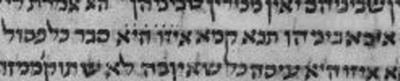
Here’s an example where the scribe was supposed to write רב נחמן בר יצחק אמר ראשון דמעיקרא משמע, but left out the word ראשון – realising this later, he put a dot where it should be, and wrote the missing word in the margin:

I know I’ve seen a manuscript where dots were being used to highlight particular letters, but I can’t quite remember which one just now, so no picture of that one. These are mediaeval, not ancient, but mediaeval’s easier to get pictures of – similar sorts of things do appear in ancient manuscripts, see for e.g. Emanuel Tov’s Textual Criticism of the Hebrew Bible, pp 56, 214.
pietistic
Underpinning much of rabbinic tradition is the idea that every single letter of the Torah was given by God to Moses, and that each and every letter is loaded with meaning, even to the very crowns on the letters. This gave rise to the great exegetical traditions, divining the divine will from the placement of a yud or a vav. Comprehending a confusing passage is a communion with the Creator.
Hence, we view the dotted letters as exegetical markers, indicators that the text contains more than simply the letters. Sometimes the dots tell you there’s something more to look for, sometimes they even show you what it is, like the examples above, thus:
Yerushalmi Pesahim, 9:2
The Sages say, when there are more [undotted] letters than dots [dotted letters], expound upon the letters and don’t read the dots, and when there are more dots than letters, expound the dots and don’t read the letters. Rabbi says, even when there is only one dot above them, expound the dot and don’t read the letters.
Bereshit Rabba 48 – 16, ויאמרו אליו, see also Rashi to Bereshit 18:9
Rabbi Shimon ben Elazar says, any place you find more letters than dots, you expound the letters; more dots than letters, you expound the dots
The dots tell you there’s something going on. There’s an example of this kind of mouseover Torah in last week’s post on Genesis 18:9, Vayomeru elav, ayei Sarah ishtekha? vayomer, hineh baohel – They [the angels] said to him [Avraham], where is Sarah your wife? And he said, see: in the tent.
practical
Interestingly, rabbinic culture retains the memory of a period during which the Torah was written down not under divine dictation, when significant errors may have crept in. This part of our narrative says that after the return from exile in 538BCE, Ezra the scribe pulled the fractured Jewish tradition together as best he could, redacting the Torah text, but not completely accurately:
Avot d’Rabbi Natan, v. 2, ch. 37, s.v. עשרה נקודות
Why are there dots over all these letters? This is what Ezra said: If Elijah comes and says to me, why did you write this? I shall say to him, I made marks over them. And if he says to me, You wrote it well, I shall take the marks off them.
So if you like, you can take what we know about dots in a text-critical frame of mind, and say the dotted letters appear to be the result of early fluidity in versions of the Torah meeting the emerging principle of the immutable text (see for instance Karel van der Toorn’s Scribal Culture and the Making of the Hebrew Bible, especially chapter 8). Basically, they’re scribal errors that never got corrected – a reminder that the Torah is, in a very real sense, a very human document.
perorational
The dots are interesting on their own, and it’s interesting that you can read them from two entirely different perspectives – human error versus divine signalling – and it’s also interesting that the two are compatible. I’ve said it before and I’ll say it again – it’s awfully easy to be terribly pragmatic and say “these indicate scribal errors, isn’t that interesting,” but if you stop there, you miss all the meta-layers that rabbinic tradition added, and that’s very silly. Coming from the other direction, it’s easy to say “These are flags from God,” and then you have to ignore history, and that’s not so sensible either. They work together, and the way they work together is also part of what the text means. If the dots are mouseover Torah, the context is mouseover-mouseover Torah. Watch out, you might get blown away.