This is based on a talk I gave a few weeks ago, on Shabbat Bereshit. It concerns the reading for the second year of the triennial cycle, which starts in chapter 4, in which God creates beings with plurality, male and female.
זה ספר תולדות אדם ביום ברוא אלקים את האדם בדמות אלקים עשה אותו, זכר ונקבה בראם, ויברך אותם ויקרא את שמם אדם ביום הבראם
This is the book of the generations of mankind. On the day that Elohim created mankind, in the image of elohim he made it; male and female he made them. And he blessed them, and he called their name mankind on the day of their creation.
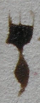
 In the sefer Bet Haverim read from this year, the first letter of the paragraph looks like the image at left, ordinary zayin.
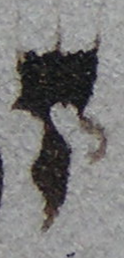
In their new sefer, the first letter looks like the image at right. The zayin has a little curl on its right-hand side.
This new sefer has a lot of little annotations like this. The annotations invite you to look deeper.
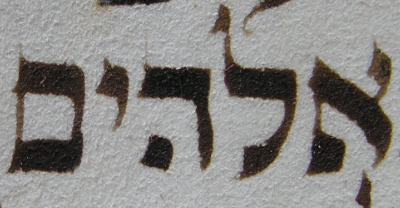
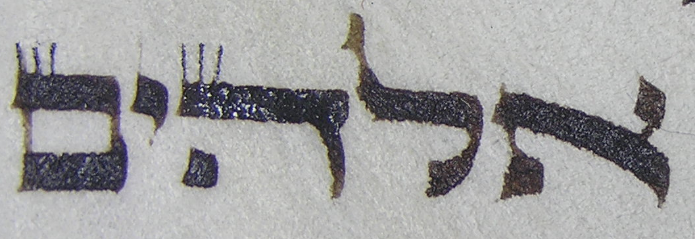
One commentator says these may be functioning as delete marks; if you ignore the letters marked up by the tagin, you are left with the singular word El, making the point that although Elohim seems to be a plural word, you should be in no doubt that it is a singular quantity. In context, this could be a commentary on the nature of the beings created by God; although the language suggests that they are plural (compare the interpretation that says originally these beings were multi-gendered dual-body creatures which were separated only at a later date), you should make no mistake that they were actually singular.
Tagin also invite us to think about additions, rather than deletions. What does a set of three tagin bring to mind? Maybe it invites us to look for threes. For instance, look in the verse, at the letters following the three instances of the word adam. Alef-bet, alef-bet, alef-bet. Av, av, av. Three fathers. What other threes come to mind?
We’re asking what might be hinted at by three tagin on top of the regular letters. This might remind us of pardes–peshat, remez, drash, sod–and the three extra exegetical layers which ride above the plain text.
You might ask why all this exegesis is necessary. Why not just write it all out explicitly? Surely that would be easier. Well, one answer is that God was being merciful–has hakadosh barukh hu al mamonam shel yisrael–if it was all written out explicitly, it would be all but impossible to fulfil the mitzvah of ketivah sefer Torah.
Which sounds like a joke, until you consider the Talmud, which is the fifth-century attempt to do just that, write everything down explicitly, and how many complete copies of the Talmud–the central text of rabbinic Judaism–survived the Middle Ages? One. Just one. The bigger the book, the harder it is to ensure its survival.
So the traditions of extra tagin serve as easy-to-write reminders of extra content. Footnote markers, a hint that something extra is going on. The challenge is to remember the footnotes, a challenge which we have largely failed at this point.
So in our verse, what’s going on? To explain one idea, first we need to talk about the mechanics of writing God’s name.
Before writing the combination of letters representing God’s name, a scribe has to have the intention that God is the subject. Consider the letter string alef-lamed; sometimes it means God, sometimes it means a god in general, sometimes it means towards, sometimes it means don’t. Before you write it, you need to know which it is; we say it’s the thought that counts and the scribes’ code takes that literally.
Generally, the meaning is clear from context; it is holy, or it isn’t. But sometimes it isn’t clear. Sometimes it’s ambiguous, and will remain so till the coming of Elijah. In our verse, the first Elohim has the status of definitely-holy, and the second has the status of permanently-ambiguous. Was man really created in the literal image of God?
Consider those three fathers, above; one opinion thinks that the three fathers were created in the literal image of God, but subsequent generations were not. We also find these tagin in the first paragraphs of the first creation story, where three tagin emphasise hu v’lo malakh, hu v;lo saraf, hu v’lo shaliach–words we recognise from the Passover liturgy: He and not an angel; He and not a seraph; He and not a messenger. It’s possible that the tagin here, on the ambiguous Elohim, are a tradition expressing an opinion on the question.
There are a great many threes that three tagin could be hinting at. We’ll finish with another three, the three judges on a bet din. Elohim means judge, and the commentator Sforno says that our verse means mankind was created baal bechira, a master of choice, a possessor of free will. Three tiny lines serve as a powerful reminder of humanity’s capabilities and responsibilities.
Caring for your sefer
Bava Metzia 29b discusses what my responsibilities are if you leave your possessions with me while you’re away.
For instance (the Talmud would have said, if it could have) if I look after your car while you’re away on sabbatical, I ought to start it up every once in a while and drive it round the block, but it’s not cool for me to take it on vacation or use it to run errands. Unless you gave me permission in advance, obviously. When taking care of a valuable item, there are ways we expect people to behave.
Specifically, the Talmud discusses the most valuable item one might take care of; a sefer Torah.
1. If Reuven borrowed Shimon’s sefer Torah, he may not lend it to Levi. He may open it and read from it, but he may not read something for the first time, and another person may not read with him.
2. If Shimon left his sefer Torah with Reuven to look after, Reuven must roll it every 12 months, during which process he may open it and read from it. If he opened it for his own needs, he may not read from it.
3. Sumchus says a new sefer Torah is rolled every thirty days, and an old sefer Torah is rolled every twelve months; R’ Eliezer ben Yaakov says, new or old, it is rolled every twelve months.
From which we learn that there are minimum standards of care for a sefer Torah; if you are taking care of a sefer which does not belong to you, you must roll it at least every twelve months, possibly every month if it is new. You must also bear in mind that using the scroll causes wear and tear, just like using someone else’s car to run errands causes wear and tear.
I have mentioned the benefits of rolling before. Rolling keeps a sefer Torah flexible and prevents damage. I cannot emphasise enough the importance of regularly rolling your new sefer.
during sukkot
During Sukkot, one doesn’t write Torah. So instead, I’ve been making other fun things, and this week’s post is a shameless plug for said things.
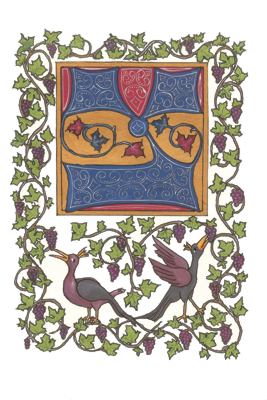 Postcards. Inspired by the illuminators of the Middle Ages, this series illustrates each letter of the Hebrew alphabet with awesome borders, yummy patterns, and the most darling little animals. Here’s the full set.
These postcards are 4×6 inches on heavy card stock – they look jolly nice framed, or they do actually work as real postcards, not that anyone really sends postcards these days, but in principle, you know.
I’m coming to CBH next week, so I decided to make a special offer for CBH people. Postcard set $15, which I’ll bring to the synagogue on my visit, provided you order before 11.59pm (Pacific time) on Thursday October 11th.
And here are some of the other things I’ve been up to:
Calligraphy is fun.
Jubilees
Well, it’s my Queen’s diamond jubilee weekend, so I’m going to post about jubilees this week.
This is Bet Haverim’s fifty-year anniversary, their proper jubilee. The concept of jubilee comes from the Torah, from Leviticus. So when we were discussing which section of the Torah Bet Haverim would be writing as a community, we naturally came to the section describing the original jubilee.
On the visits I’ve made to Davis, we’ve been writing that section, letter by letter. Last time I was there, we also had a discussion session talking about the concept of jubilee from a slightly different angle.
The biblical jubilee features, amongst other things, the idea that everyone should go home, back to their family lands. But Bet Haverim’s jubilee features the fifty-year mark of a community. Some people have been at Bet Haverim right from the beginning.
I wanted people to explore that tension, between the idea of jubilee as homecoming on the one hand, and as home-creating on the other hand.
Here are the different texts we looked at. You might like to print the sheet and discuss it with family or friends.
This is one of the songs we talked about:
After the discussion, Elaine sent me this very interesting article, which adds a whole other perspective to the discussion.
Writing in the Torah with the Soferet
 What’s it like writing a letter with the Soferet?
I like to work with small groups, seven or eight people, for half an hour at a time. Before any writing at all happens, we sit down together for a bit of a chat. We eject any schmoozers or noisemakers, and make the time and space ours.
Part of the point of my visiting communities is to help connect the individuals in the community with the Torah I’m writing for them. Can’t connect without relationship. Talking together is each person’s special connecting time with me and their Torah.
I ask people to share what brings them to write a letter in the Torah. Sometimes people have complex, intense stories. Sometimes they haven’t got words. Regardless, I like hearing it.
People are always nervous about mistakes. They’re carrying the idea that they could be responsible for ruining the Torah project. So I take some time to explain that there’s nothing they can do that we can’t fix, and why that is.
Then there’s time to expand into whatever things the group members want to know about. Sometimes it’s questions about Torah-writing. Sometimes it’s questions about me. Sometimes it’s sharing stories with each other.
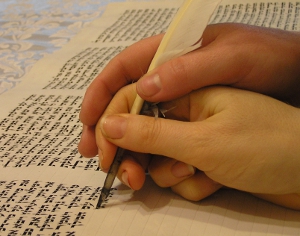
When I write with people, I want it to be a special experience. I fold the person’s hand over mine, so that they’ll be able to feel the movements of my fingers as their letter is created.
 I also make sure they’re positioned so that they can see their letter being formed. With lefties, that’s sometimes a bit tricky, but we manage. With kiddies, it means fetching a stool or a chair so that they can lean in and see over our joined hands to their letter. It’s sort of surprising how often this happens:
“Can you see?”
“Yes”
“Are you sure?”
“Well, no, I can’t really see.”
But I want people to see! We’re not running a writing factory here, we’re connecting people to the Torah. We allow lots of time specially so that people can have the fullest experience possible. So I make sure they can see what’s happening.*
We take time to say the kavvanah Ani kotev/et leshem kedushat sefer Torah. I divide it up by people-who-use-masculine-grammar and people-who-use-feminine-grammar–started doing that at CBST, where you often can’t tell which the heck people are identifying as–and we repeat it together and take time to focus.
While we’re actually writing, there tends to be a photographer leaping about. I think this detracts from the moment rather, but what you lose in the moment you make up in the long-term; it’s kind of nice to have a memento. I also like to arrange for keepsakes which show, for each person, exactly which letter they did in which part of the Torah and what it means, so that they’ll be able to remember, should they wish. CBH is planning some very nice certificates with all kinds of photos.
CBH partner Robin Frank put it rather well:
I will admit that initially I was not that excited about a new Torah. I thought “OK, a new Torah. Why do we need a new Torah?” But today I understand that this is about the *process*. About *engaging* with the Torah. Literally. But also intellectually and emotionally. On many levels. With each other.
Exactly. So I hope people will sign up for writing slots over the next few visits and be part of the process.
* I’m planning a special approach for the blind or partially-sighted. Stay tuned.
First visit to CBH
Well! That was fun. I spent the weekend–as anyone reading this is probably aware–in Davis, connecting with people as we moved into Torah-writing time.
Lots of this sort of thing:

Teaching and learning with all age groups. More of that on later visits! (If anyone wants to cover anything particular, speak to your Torah committee, okay?)
This, of course:

My favourite bit of the ceremony: realising that if forty-two children shake blank parchment sheets, it sounds kind of like the thunder which accompanied the original Giving of the Torah.
We were writing the first six letters of the Torah, the word Bereshit, In The Beginning. Communities often choose six people to help write the letters; Bet Haverim, unusually, decided to choose representatives from across the spectrum of the community. They also shared a little bit about their stories, and we connected that to the letter they’d chosen to write. This was nice.
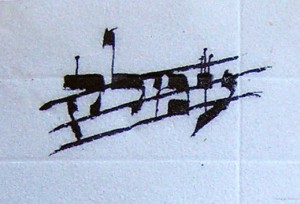
Before we started to write the Torah, I wrote the name of Amalek and symbolically crossed it out. I think most people didn’t get to see that up close, so here’s a picture:
After the ceremony, we spent the afternoon writing letters with individuals. I’m planning another post about just what that involves. In the meantime, a picture:

Images in this post, except the Amalek one, are from the album at CBH’s Facebook page. Check there for copyrights, attributions, etc.