 What’s it like writing a letter with the Soferet?
I like to work with small groups, seven or eight people, for half an hour at a time. Before any writing at all happens, we sit down together for a bit of a chat. We eject any schmoozers or noisemakers, and make the time and space ours.
Part of the point of my visiting communities is to help connect the individuals in the community with the Torah I’m writing for them. Can’t connect without relationship. Talking together is each person’s special connecting time with me and their Torah.
I ask people to share what brings them to write a letter in the Torah. Sometimes people have complex, intense stories. Sometimes they haven’t got words. Regardless, I like hearing it.
People are always nervous about mistakes. They’re carrying the idea that they could be responsible for ruining the Torah project. So I take some time to explain that there’s nothing they can do that we can’t fix, and why that is.
Then there’s time to expand into whatever things the group members want to know about. Sometimes it’s questions about Torah-writing. Sometimes it’s questions about me. Sometimes it’s sharing stories with each other.
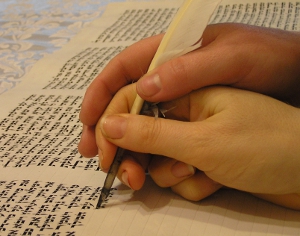
When I write with people, I want it to be a special experience. I fold the person’s hand over mine, so that they’ll be able to feel the movements of my fingers as their letter is created.
 I also make sure they’re positioned so that they can see their letter being formed. With lefties, that’s sometimes a bit tricky, but we manage. With kiddies, it means fetching a stool or a chair so that they can lean in and see over our joined hands to their letter. It’s sort of surprising how often this happens:
“Can you see?”
“Yes”
“Are you sure?”
“Well, no, I can’t really see.”
But I want people to see! We’re not running a writing factory here, we’re connecting people to the Torah. We allow lots of time specially so that people can have the fullest experience possible. So I make sure they can see what’s happening.*
We take time to say the kavvanah Ani kotev/et leshem kedushat sefer Torah. I divide it up by people-who-use-masculine-grammar and people-who-use-feminine-grammar–started doing that at CBST, where you often can’t tell which the heck people are identifying as–and we repeat it together and take time to focus.
While we’re actually writing, there tends to be a photographer leaping about. I think this detracts from the moment rather, but what you lose in the moment you make up in the long-term; it’s kind of nice to have a memento. I also like to arrange for keepsakes which show, for each person, exactly which letter they did in which part of the Torah and what it means, so that they’ll be able to remember, should they wish. CBH is planning some very nice certificates with all kinds of photos.
CBH partner Robin Frank put it rather well:
I will admit that initially I was not that excited about a new Torah. I thought “OK, a new Torah. Why do we need a new Torah?” But today I understand that this is about the *process*. About *engaging* with the Torah. Literally. But also intellectually and emotionally. On many levels. With each other.
Exactly. So I hope people will sign up for writing slots over the next few visits and be part of the process.
* I’m planning a special approach for the blind or partially-sighted. Stay tuned.
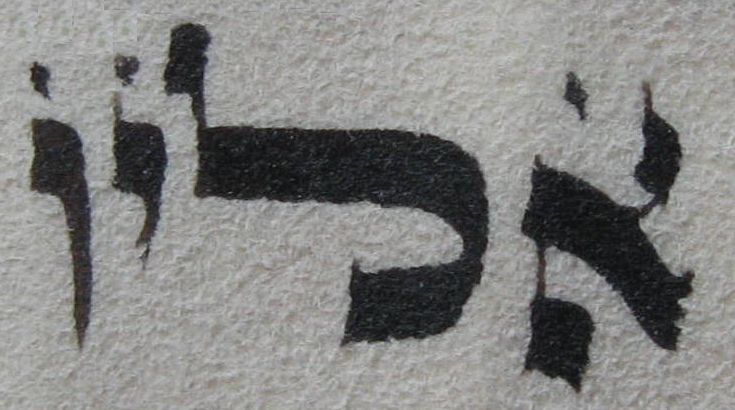 Now, you can see that three letters of אליו – to him – aleph, yud, and vav – have dots over them. What does that spell? איו, ayo. Ayo is a word that means “where is he?” What’s the very next word? איה, ayeh.