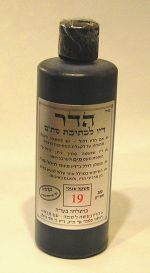
 The main thing about Torah ink is that it has to be black and it has to stay black. If it changes colour within fifty years, it wasn’t kosher to begin with.
Generally, Torah ink (דיו, in Hebrew, like dye) is what’s called an iron gall ink. Iron gall inks have been used in a great many places during a great many periods in history. They last a long, long time (think Dead Sea Scrolls kind of longevity). They have an unusual property among pigments in that they form chemical bonds with the parchment, which makes them symbolically very appropriate for use on Torahs. They are lightfast, the ingredients are cheap, and they are very indelible.
I don’t make my own; making good ink is hard, and I don’t have anyone willing to share their recipe. Anyway, it’s supposedly rather a pain, so I buy it in bottles, as shown. I don’t know if it’s also available in cake form – cake is much easier to transport, of course, and lasts longer, and is entirely traditional. I suspect perhaps not, because I have a feeling that buying ink like this is kind of For Dummies, and real hardcorers, the kind who would want cake ink, probably do make their own.
As you might expect, there are hundreds of different recipes for this kind of ink. However, they have some things in common, viz.: gallnuts, iron (II) in solution, something runny, and something sticky. The following descriptions are indebted to an excellent article by Cyntia Karnes.
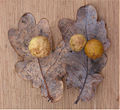 Gall nuts
See the Wikipedia entry, but basically gallnuts (also called oak-apples) are a sort of arboreal tumour. A gall wasp comes along and lays its egg on the tree, and the tree goes “whoa” and swells up around the egg, into this little hard ball. The larva sits inside the swelling, munching away, and when it grows up it eats its way out and leaves the ball on the tree.
The balls have to be turned into a gloopy solution. This basically involves grinding, dissolving, and fermenting, and there are about a zillion ways of accomplishing this. Depending how it’s done, what you end up with is a liquid containing tannic acid, gallotannic acid, or gallic acid.
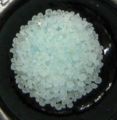 Iron (II) sulphate
This is where the iron comes from. It tends to be known as copperas, or coppervasser if you are the Mishnah Berurah, because iron sulphate and copper sulphate tended to come out of the ground together, but the copper isn’t important and the iron is.
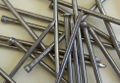 This is why some recipes call for boiling up nails with the gallnuts. In an acidic solution, you get the right sorts of reactions. It’s apparently quite dangerous if you do it properly.
 Runny and sticky
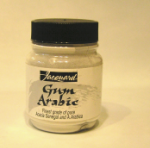
Fairly obviously, ink needs to be runny, but it also needs to stick to the page. Gum arabic, the sap of certain sorts of acacia tree, dried, ground, and dissolved in water, is commonly used as a binder in all sorts of things – ink, paint, food – and has been for centuries. It stops the ink being too runny, and helps stick it to the parchment when it dries.
 Runny can be distilled water, but it can also be wine (including idolatrous wine, isn’t that interesting?) or vinegar, or presumably most other sorts of liquids. Vinegar helps to make the ink shiny, I am told (the gum arabic goes on shiny, and the vinegar helps keep it shiny, something like that), and indeed one of the shiniest brands of ink out there smells very vinegary indeed.
Chemistry
This is the fun bit. You mix all these things up, apply them to parchment, and let the oxygen in the air do its thing. It’s incredibly complicated and I don’t understand it all, but basically what goes on is: the gallotannic acid bit reacts with the parchment; part of it grabs onto the parchment, and part of it floats about. The floaty bit reacts with that iron solution, and iron (II) oxide gets precipitated. Iron (II) oxide is black.
Iron-gall ink made like this is pale grey in colour, and it gets darker when these reactions have had time to happen – about a day, I understand, but I’ve not tried it.
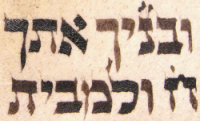 Incidentally, iron (II) oxide isn’t terribly stable, and over time it tends to turn into iron (III) oxide. This is the same stuff rust is made of, and it’s red. This is why letters in old Torahs go brown or orangey-red, as the black iron (II) compound oxidises to the red iron (III) one. They’re just starting to go brown in the picture here.
Soot
For whatever reason, the inks I buy have had stuff added to them so that they are black when they go on, and presumably they get blacker with oxygen, but not so’s you notice. I think this is soot – burnt olive oil is referenced in one source, or just burnt wood. They say specifically you mayn’t use burnt ivory (ivory-black), since elephants aren’t kosher.
 Non-iron-gall inks
The rule is that the ink has to be black and permanent, and for the longest time the way to make permanent black ink that would work on a scroll (wouldn’t fall off when rolled) was like this. However, these days we have all manner of funky synthetic blacks that are entirely lightfast and suitably adherent and flexible. Can we use those?
The discussion then takes two paths.
a) The sources talk about using the ingredients for iron-gall ink, so this must be part of what kosher ink is, and to use kosher ink is a requirement from Sinai.
b) That is by way of description, it’s true that in those days they couldn’t make good ink without iron galls etc. But the point is that the ink be indelible and black; synthetics accomplish this just as well, and there are times when they’re a better tool, in some ways.
Interestingly, the right of the denominational spectrum seem to be more okay with b) than the left. The left wing and the ultra-right seem to share a visceral aversion to b), I’ve noticed.
To finish, here’s the Keset ha-Sofer, the scribes’ handbook, on basic laws pertaining to ink.
Tezaveh and scribal exuberance
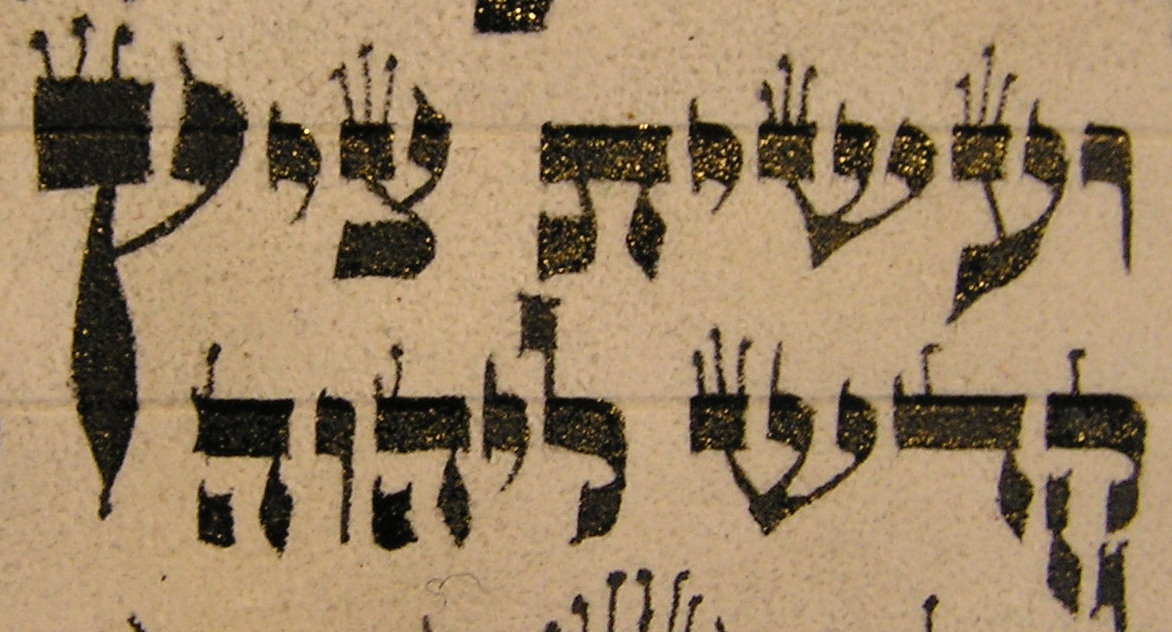
Exodus 28:36, a verse from this week’s parsha; ועשית ציץ זהב טהור… “Make a tzitz of pure gold…” Go look it up.
In some sifrei Torah, the final tzaddi of the word ציץ is writ large, including in the sefer I’m presently writing:
Here’s another one, from a different sefer (presently in Berlin; my last congregation but one donated the sefer to a community in need when they got their new sefer written by me; isn’t that beautiful?):
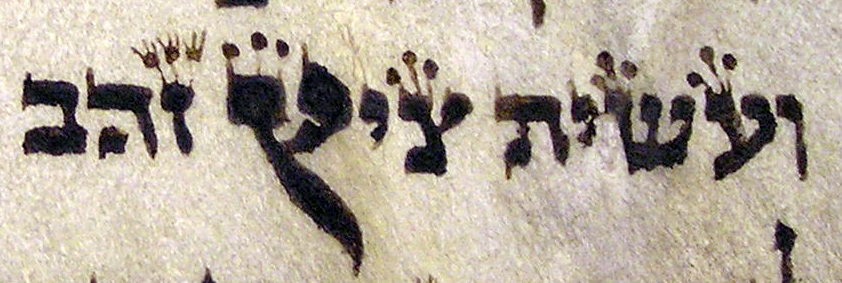
Here, note particularly the little fractal zayins on the word זהב.
I’m not writing about why all this, this week. Have a think about it for now. When I come to CBH in a few weeks’ time, we’ll be learning more about these. Look out for the schedule.
Parashat Teruma and vavei ha’amudim
This week’s parasha describes the worship-tent that God commands the Israelites to construct in the wilderness.
Around the tent, they are to construct a courtyard, of panels held between columns.
Perhaps you’ve seen a Torah scroll being unrolled around a sanctuary at Simchat Torah. You’ve seen how it’s long enough to go around the whole room, the panels of Torah surrounding the congregation like the panels surrounding the worship-tent.
It’s here in our parasha that we find the phrase ווי העמדים. Vavei ha’amudim, the hooks of the columns.
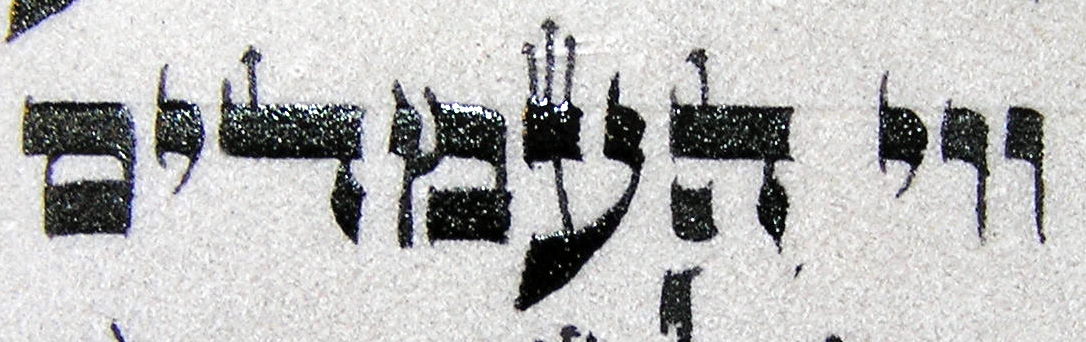
We haven’t made a worship-tent for millennia, but this particular little phrase lives on today in our Torah scrolls in an unexpected way. Scrolls have columns–of writing. And they have hooks–letter vav.
Most new scrolls today, CBH’s being no exception, are written such that almost every column starts with the letter vav.
It wasn’t always so. As late as the 1830s we find scribes’ rulebooks faithfully repeating that it is more or less forbidden to arrange the columns thus. In order to contrive a vav at the top of the column, scribes would perform tremendous feats of stretching and squishing, at the cost of uniform script and column width. Since a Torah is supposed to be a beautiful scroll and not a cutesy word game, scribes were vigorously discouraged from doing it.
By now, it has become an entrenched custom, such that I occasionally get panicked phonecalls from people who have noticed that their scrolls don’t have every column starting with vav, and I have to reassure them that it is perfectly all right.
How did it start? There seems to have been a rather early (gaonic?) custom of arranging for six particular words to appear at the tops of columns, for added significance. As it happened, these six words began with the letters ביה שמו. Over time, some scribes started to arrange their scrolls so that every column began with one of those six letters (53% of the words in Torah begin with one of those letters, so it’s not so difficult to arrange). And at some point, the idea of doing this just with vav (17% of the Torah’s words begin with vav) seeded and took root, becoming widespread sometime in the past 300 years.*
When did it start? Not clear. The Maharam of Rothenberg (thirteenth-century Ashkenaz), fulminating against it, said that there was no evidence the gaonim ever thought of doing it.** Rather, he said, the idea originated with one Leontin of Milhausen, who was showing off his skills.
Not everyone was against the custom. Various kabbalistic authors wove marvellous romances around the letter vav and its numerical representation, six, and the mystical and messianic relationships therein. The Hida has an interesting comment:*** he asks howcome vavei haamudim has become a widespread custom even though respected authorities say it is forbidden? Paraphrasing him a little, the answer is that Jewish communities are blessed with insight from God, so if communities are drawn to a thing, that thing must have some deep significance, and its existence is somehow divinely sanctioned.
The word vav literally means a hook, and the letter vav is also how we say “and” in Hebrew. Hooks hold physical constructs together, and vavs hold linguistic constructs together. What do the vavei haamudim hold together?
Some say the sheets of Torah–yeriot; curtains, veils—are held up by the hooks between heaven and earth. The columns of Torah form the metaphorical worship-tent in which Israel dwell, watched over by God above.
We might also suggest that the vavs of the columns are a reminder that times change. From being a minority position disapproved of by generations of Torah greats, vavei haamudim Torahs have become the default, with layers of meaning woven into them. Every generational vav, every individual “and”, contributes to incremental change; the old still hooked into the new, all held together, but the despised becoming beloved.****
* Yonatan Koletch (p392 footnote 200) quotes R. D. Yitzchaki: the concept of vavei haamudim scrolls “was introduced only during the past several hundred years by R. Ezra of Pisa”, but this seems to be an oversimplification.
** Quoted in the Hagahot Maimoniot, hilkhot sefer Torah, 7:7, but remember this is polemic and we don’t know how much evidence he was looking at.
*** Birkei Yosef, YD 273.
**** Add your own hobby-horse here. Social justice, feminism, disabled rights, race equality…
Stretching letters

Torah columns are fully justified – that is, the text extends tidily to each side of the column.
 The tidiest way to do this is by making letters and spaces ever so slightly bigger or smaller, so that the change in size isn’t even noticeable. However, sometimes that isn’t an option. The image here to the right is part of the Song of the Sea, where the text is constrained by a very specific layout (more on that some other time). There is simply no way to do this line subtly; one has to stretch. So, what can one stretch?
Some letters are obviously not stretchable. (For images of all the letters, you may refer to the Mishnat Soferim.) It’s fairly clear that one can’t stretch vav, for instance; it would turn into reish. So would khaf peshuta. Conversely, one can’t squash reish or khaf peshuta too much, because they’ll turn into vav.


 Some letters, in contrast and by convention, are highly stretchable. Dalet, hey, reish and tav are all good candidates for stretching; the form of the letter isn’t deemed changed by the stretch. For instance, we (essentially) conceive of dalet as having a flat roof, a corner on its top right, and a leg rather shorter than the roof. The leg height is limited by the line height, but the roof length isn’t limited. You can see how our perception of the letter form makes a difference here (images, right). If we thought of dalet as having a roof of about the same length as its leg, we wouldn’t be able to stretch it.
 Indeed, this is one reason we don’t stretch things like zayin; we conceive of zayin as having a head approximately one-third the length of its height. If we thought of zayin as being essentially T-shaped, with the crucial feature being symmetrical extension of the head beyond the leg, we’d be able to extend zayin. But that’s not how we think of zayin, so we don’t extend it. Nun peshuta is similar, just longer vertically, so we don’t extend nun peshuta either. Usually, that is. The image to the left shows a nun which has been desperately stretched; compare its head size to the head of the nun on the bottom line. It’s not invalid, but it’s not really an effect to aim for.
 Het is conceived of being formed from two zayins, and as such, one may not extend het any more than one may extend zayin, either by making the zayins too long, or by putting them very far apart and making a very long peaked roof between them (since if one stretches a peaked roof too far it doesn’t really look peaked any more). The het shown is really pushing the limits of stretching.
 The image above also shows a stretched khaf and mem stuma. By convention, these aren’t deemed invalid if stretched, they just don’t look very nice if you stretch them too much. The weight of the horizontals is too much if you extend them in parallel too far. You see a similar effect if you extend beit (right).

 The form of lamed is the subject of mild disagreement. Lamed is described as being more or less like a khaf with a vav on top. The question regarding stretching is: does the base part have to come forward as far as the top part, like a proper khaf? Or is it sufficient that it be bent round behind? If the former, stretching it would be like stretching khaf – rather uncomfortably heavy. If the latter, stretching lamed would be more like stretching reish. The lameds pictured (left and right) are tending towards the latter opinion, keeping enough of a base that they don’t look completely unbalanced.


So far this post has looked at extending horizontals and double horizontals, which is by far the easiest way to stretch a letter. One can, theoretically, stretch out diagonal strokes, but it really looks awfully weird. For some reason alef is often stretched – perhaps because it has a reasonably thick diagonal, so it doesn’t mess with the black/white balance too much. It still looks rather odd, but not as odd as tzaddi, or ayin, or shin, or peh.
Further reading: Stretchy letters in print.
Pictures of puppies
Not a good week. Between the pointedly audience-defining “Do not go near a woman” parts of parashat Yitro, and the general “Look how far we haven’t come” morality of parashat Mishpatim, I’m already a bit grouchy, and then various rabbis sexually harrassed and otherwise dehumanised various of my friends, which was really not cool at all.
So we’re having a post about puppies, because puppies make everything much better.
 I have a puppy.
Parts of her are tan-coloured like parchment, and parts of her are black and shiny like Torah ink.
She likes to squirm around on the couch.
 I think this is probably meant to be an aleph. Everyone’s first aleph is a bit dodgy.
 This is a much better aleph.
 Unless she meant it as a mem.
 It’s not a proper closed mem unless you actually bite your tail, but we’ll let it pass this time ex post facto.
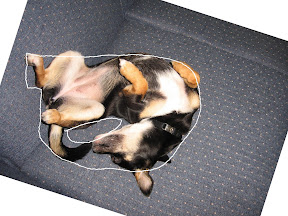 She might have meant it as a samekh, as well, and just forgot to tuck the ear in. These are the small details that make the difference, you see, but if she tucks the ear in next time and gets a good hold on that tail, it’ll be a very nice samekh.
 This is a pretty good yud. It even has the kotz of Rabeinu Tam. Well done, pup!
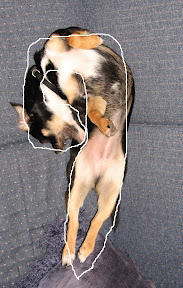 Straight peh – not easy if you’re a dog. A very nice try. The head shouldn’t touch the body, is the thing, so this one’s invalid, but on the plus side, the front paws are very nicely out of the way, and the back paws are beautifully pointed.
 I think this is probably intended as nun, although properly speaking nun has three tagin, not two,and it shouldn’t kick up on the end like that.
 Now, this is a surprisingly successful gimel. Three tagin, a head extending from each side, a good substantial foot well-joined to the body, and a body that extends a little down past the foot. Okay, it’s bent off to the side, but tails are like that, you can’t make them behave.
 This has right-angles on both top and bottom right-hand corners, which makes it technically a beit.
 I think she may have intended it as a khaf, though khaf can’t have sharp corners like that. Beginners often suffer with this kind of khaf/beit ambiguity; you need to learn both halakha and calligraphy skills before you’ll get it right reliably.
 Unless she meant it as a peh. The curly part should be bigger, though, and the Mishnah Berurah would say she should have a smoother curve on the back.
 This would be a pretty nice reish, if she’d tucked that front paw in.
 This has a distinct corner on the back, which means it’s dalet, not reish. That bent head on the left brings it perilously close to being a het – she could improve this just by bending her head up a little, nothing drastic.
 A brave try at lamed. Lamed’s neck ought to be longer really, but this is a dog, not a giraffe.
 I think this is intended as a final nun, but it’s one that’s gone rather wavy. It does have nice crisp edges, and a couple of very assertive tagin.
 A very nice Arizal het, only lacking the left-hand point. She seems to have gone for a whole word this time – חי – that yud is rather dicey, not as good as the yud we saw earlier, but it’s very nice spacing, and she can fix the yud by twitching her ear back.
Good dog.
eBay Torah
Today’s parchment: a bit smooth and slippy, so I want to treat it with gum sanderac before writing. It’s a resin that you grind finely and rub into the parchment.
Grinding gum sandarac in a cereal bowl with a spoon is annoying, because so much of the gum sandarac sticks to the surface of the bowl that you end up with not very much left for yourself. It’s also not great for the bowl or the spoon.
So I have finally got around to buying a small lab-type pestle and mortar on ebay. It is rather amusing how I can get ALL THE SUPPLIES on eBay except for parchment and ink.
In a spirit of procrastination, I searched for “gallnuts” on ebay, to see if one could at least get the ingredients for ink. It altered the search to “walnuts,” which is not quite the same thing. “Gall nuts” it changed to “gill nets” (something to do with basketball).
“Oak galls” actually scored a result: OAK GALL INK 100% HAND MADE ECWS* WICCA. The description says it “darkens to a lovely, rich black/brown colour,” which doesn’t sound too good for us, since we can’t use brown ink.
The “Wicca” bit is viscerally more disturbing, although actually ink doesn’t HAVE to be made for the specific purpose of holy scrolls, and you CAN technically use idolatrous wine in it, so you COULD use Wicca-specific ink…but it looks like “Wicca” is just there to boost his search results, seems the maker is a historical re-enactment nerd.
No raw oak galls though, at least not today. I’ll do you a post sometime soon about how oak galls work in ink; it’s extremely interesting.
* English Civil War Society, apparently.
Did I mention I love my job?
This morning I’m writing chapter 14 of Exodus:
And Moses stretched out his hand, and a strong wind blew all night, and dried up the sea. And the children of Israel came into the sea on dry land, and [this bit is recited with the special tune for the Song of the Sea] the waters were like walls to them, on their right and on their left, וְהַמַּיִם לָהֶם חוֹמָה מִימִינָם וּמִשְּׂמֹאלָם.
It so happens this morning that while I’m writing this piece, I’m listening to the last movement of Berlioz’s Te Deum, Judex crederis, which is remarkably well-placed as an accompaniment to this particular piece of Torah. Have a listen:
Berlioz scored the Te Deum for two orchestras, three choirs, and an enormous organ, which makes it sufficiently breathtaking for the scene at the Sea, all that water and all those people and the mighty strength of God through-and-over all.
The text is pretty appropriate too; in English it starts We believe that you will come to be our judge. We therefore pray you help your servants…. Full English and Latin here.* Berlioz’s musical interpretation certainly reflects how I think the children of Israel must have been feeling at that point. Right at the end, when all the choirs and all the instruments combine in this enormous cry of In te Domine speravi, non confundar in æternum! (O Lord, in you have I trusted, let me never be confounded) as the waters tower over them and the warriors follow them and the strong winds blow and the trop changes to the slow, sweeping, dramatic cadences of the Song of the Sea…
* I admit the bit about redeeming with blood is rather Christian, but it’s not too bad, especially given the blood of the Exodus, and the rest of the text is spot on really.
Milestone–25%
I see, updating the progress meter, that we’re at 25%. A quarter of the way there. Still a long ways to go, but I feel like we’ve got a nice big chunk done now.
Bo and parchment
 This week’s parsha contains the phrase “The Torah of God shall be in your mouth.”
Rabbinic tradition expands this concept: if we are to put the Torah in our mouths, it obviously cannot be made of things that we may not eat. So all animal products used on Torahs are made from the kosher species.
Quills – swan or goose feathers, turkey or duck, but no peacock or ostrich, eagle or crow. Glue – before synthetic glues, sticky stuff was mostly made from animal products, did you know that? – fish glue or cow-hoof glue, but not rabbit-skin glue or horse-hoof glue. Thread, which is made from tendons and glue – cow tendons, but not horse tendons. And parchment.
Torahs are written on parchment, in Hebrew klaf, קלף, (with a kuf). Proper parchment is really a type of leather – here’s a site which talks about how klaf is made. Nowadays most Torah parchment is made from cows, because the meat industry mostly deals with cows; older Torahs are often goat, one also sees deer and occasionally sheep; you could use bison, or chicken or turkey (but that would make very small pieces, and probably not be worth it). You could even use a giraffe, if you could find one.
And yes, I have this dream that one day someone will give me a dead giraffe and I will be able to write a Megillah on it, because you could fit the whole Megillah on one giraffe skin* and that would be unbelievably amazing so if you do know anyone with giraffes that are looking a bit tottery, do introduce me, or if you know a parchment-maker who’s up for an adventure, likewise.
I digress.
The one kosher animal you may not use is a fish. Klaf can be made out of fishskin, but the rabbinic sources say that it smells truly terrible, and for that reason you can’t use it for sacred scrolls – you don’t want your holy books to be stinky. This I like very much.
Goat parchment retains a distinctive goaty tang for a Very Long Time – goats are like that, very assertive – and you can usually identify a goat Torah because it smells like a goat. I like this too, it is a pleasing reminder that the scroll is not just a text, it is a physical object as well.
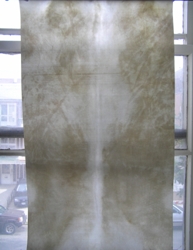
The picture at right is a piece of klaf held up against a window. You can see very clearly where the cow’s backbone was. Sometimes you can also see where the kidneys were, and if it had a fat bottom, sometimes you see that as well.
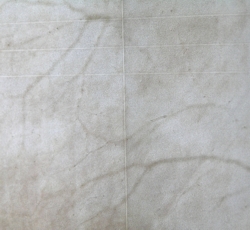
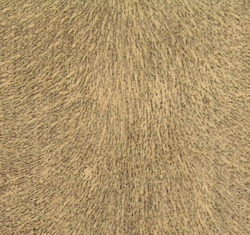 The two images at left are close-ups of the surface of klaf. The top picture is the front side, and the bottom picture is the back side. A word about that, first: if you’re processing parchment for a book, you make both sides the same, because you want to write on both sides of the page. But we only write on one side for our scrolls, so we only bother processing one side. That means that the front side is beautifully smooth and silky, almost like very very fine suede, but the back side is rougher and generally less “finished.”
You can see that the front side has lines on it. All Torahs have to be written with lines – it’s both a scribal aid, to keep the lines straight, and an halakhic (legal) requirement – i.e. even if you’re really good at keeping your lines straight, you still have to have lines. You probably didn’t notice them last time you read Torah, but they’re almost certainly there – you just don’t notice them because you’re looking at the letters.
The lines are scored in. One can score one’s own lines, with a ruler and some kind of scoring tool, such as an awl, or one can have the lines put in by the klafmachers (people who make the parchment). That’s very clever – they have a grid of wires, and they set the wires to the appropriate positions, and then they press it hard into the klaf, bang, and that makes lines. Sort of like when your socks leave a line pattern in your ankle, only the klaf is dead so they don’t fade away quickly like they do on ankles. Sometimes they will fade with extreme age, hence that “almost” above.
So anyway, on the front side of this particular piece you can also see the veins. The front side is generally bleached quite white and nice, but sometimes hints of animal-ness remain.
On the back side of this piece, you can see the hair pattern quite distinctly. The back will often keep some of the colour of the cow – greyish, brownish, whatever. Sometimes it’s splotchy. I think that’s rather lovely.
On most older scrolls, you won’t see the splotching, because for a long time it was the fashion to paint the backs with a substance called log, to make them uniformly white. This undoubtedly makes the backs of the scrolls attractively white and shiny, but unfortunately it also makes the scrolls extremely heavy. Log is some variety of sticky substance mixed with some variety of white powder, for instance boiled klaf and powdered chalk, so when coating, you’re effectively adding a layer of stone to the Torah, and of course that’s going to be heavy.
So these days we don’t coat the backs, we whiten the parchment by bleaching it, and any remaining discolouration serves to remind us of the complex relationship between animals and Jewish ritual worship. We generally get one sheet of parchment per cow, which works out to about sixty-five cows per Torah; that’s a lot of cows.
I have explored the ethical implications of this in two related blog posts, here and here, but the intertwined ethics of the contemporary meat industry and the Jewish community’s response have only just started to develop, so that particular aspect of Torah-making is one which will evolve in the direction we choose to take it.
* Technically you would have to cut it into sheets because you mayn’t have more than eight columns on a sheet, but that’s okay, I’m very good at tiny neat seams, so the pattern wouldn’t be too obviously disrupted.
Tools and travelling
I generally write at home in Manhattan, on a sloping table (good for your back), but sometimes I feel like getting out of the apartment.
As many of you will have seen by now, a Torah scroll starts out as individual sheets of parchment upon which I write. The sewing together of the sheets into a scroll comes later. Single sheets are much more portable creatures than large Torah scrolls, so it often happens that I will take a single sheet and go and write somewhere different.
This week, actually, I had to go to England on family business, but most weeks I’ll maybe go down to my yeshiva, hang out at the Jewish Theological Seminary, maybe take in the Drisha Institute or the Yeshiva University Library. There’s something very delicious about writing Torah in a place of Torah surrounded by the sounds of Torah learning, and more prosaically, if one has to go to England on short notice (all is well, don’t worry), it’s good to be able to stay on schedule.
For these excursions, I have a fabulously professional-looking Torah transport bag. It’s actually a chess championship bag, of all things. I had no idea such things even existed until I got a student who’d done chess championships; she used her old chess bag to bring her parchment to lessons. Me, I know a good idea when I see it, so I got online and got a chess bag (sans contents).
Chess tournament players use a roll-up chessboard, which is about the same size as a piece of parchment. So you roll your parchment up and secure it in the straps for the chessboard. There are handy little slots for chess-players’ pens and a drink (or quills, knives, and ink); a nice zipper compartment designed for a tournament clock which is just the right size for holding my lunch; another compartment for chess pieces which holds miscellaneous things like my camera,* bits of tile, gum sanderac, teabags, erasers, and so forth; even a dear little windowed pocket for business cards. And a document flap which holds my sketchbook and Kindle for keeping busy on the subway. Really, it’s perfect. I used to use a yoga-mat bag, but this is just so much classier. Lends a certain gravitas to tooling around the city with my bits of Torah.
A journalist was interviewing me the other week (this, thankfully, does not happen as often as it used to; not that I mind exactly but certain story angles got very old very fast) and asking how I avoided making mistakes whilst writing Torah. I left the interview with the uncomfortable feeling that we’d been talking at cross-purposes; from my perspective, your job is to write the words and you do that as best you can in every aspect, and the mistakes you take in your stride. She seemed to think that the main thing is to avoid mistakes, and then maybe you can focus on doing a good job of the rest of it, which is not really how I see it at all.**
This is, perhaps, illustrated in the matter of accessories. To take a sheet of Torah to the yeshiva, you can roll it up and stick it in a cardboard tube and wrap that in a garbage bag and fill your purse with your writing kit. This keeps the parchment from getting battered and gets all your stuff there, certainly. But it’s just nicer if you can leave in the morning knowing you’ve got everything you need neatly stashed in your bag. No scrambling, no forgetting things, just being prepared and confident.
There’s a profound conclusion (or several) lurking here, I feel sure, among the miscellaneous vignettes of soferet life and musings on the difference between tools and accessories. But the jetlag is catching up with me, and the conclusion by the same distance escaping me. You’ll have to put it together yourself. This is called “empowering the student to create their own custom learning experience” in modern pedagogical-speak, so you can rest assured you have the very latest in educational blogging experiences. Shavua tov.
* It’s always good to have a camera with you. You never know when someone is going to show you something interesting in a sefer Torah, and you’ll kick yourself if you can’t take a picture.
** Yes, if you can’t convey what you’re thinking, you didn’t interview very well. I know. Not her fault.