Many people are under the impression that if a scribe makes a mistake, they have to toss out the whole sefer and start over. This isn’t true. A mistake does invalidate the whole Torah – but not permanently. If there’s a mistake in a Torah, you can’t use it until it’s fixed – but you can almost always fix it.
Think about it. A Torah is a huge thing to write; it takes a whole year to write a Torah, working normal office hours for a normal working year. No-one can work that many hours and not make any mistakes at all, so during that time, most scribes will miss out an occasional word or letter. If we couldn’t fix those, we probably wouldn’t have any Torahs at all.
Perhaps you know the word palimpsest. A palimpsest is a piece of parchment from which the words have been removed, so that the parchment can be re-used. When we fix a mistake in a Torah, we make a localised palimpsest. We take a knife, and scrape away the ink.
 Let’s compare paper and parchment.
Here’s a letter tet written with marker pen on regular paper.
 When you flip it over, it looks like this. The ink soaks all the way through the paper. If you scraped away the ink, you’d scrape away the paper.
So we’re used to thinking of ink as something it’s impossible to erase.
 But Torah parchment is thicker than paper, and Torah ink doesn’t soak in. This is a letter bet written on parchment (magnified quite a lot–notice the texture of the parchment).
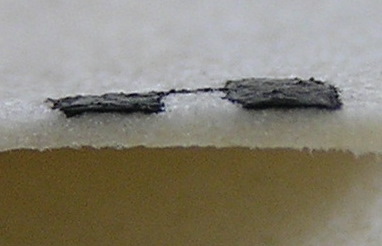 Here’s that same bet, cut sideways. See the three-dimensional nature of the letter, and the way it sits on top of the parchment (there’ll be more about how that works when I make a post about ink). By no means is the ink soaking all the way through. Not even close.
 When we fix a mistake, we use a knife to remove a thin layer of the parchment and the ink with it:

And there is still plenty left for us to write on. In the next post, we’ll see that happen.
Tradition states that those chosen by G-d have many times incurred His anger by breaking His laws. If the sin remained permanently and could not be forgiven or erased, would it not be like ink written on paper which cannot withstand erasure? It seems to me that ink written on parchment when an error occurs, is like sin. It may be erased, and thereby corrected without destroying the parts that are correct and thereby good in the eyes of G-d.