Ketivah tamah

Shabbat 103b/Sifrei Vaethanan

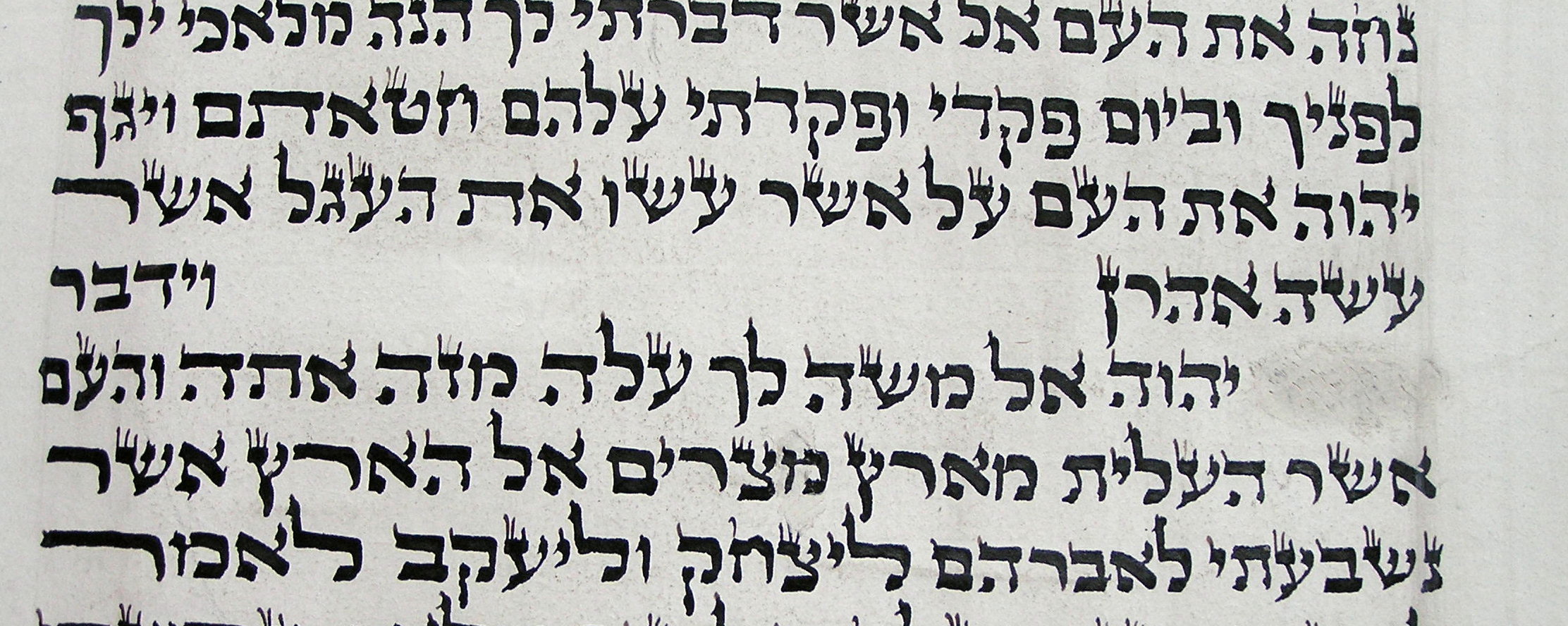
וכתבתם – שתהא כתיבה תמה; שלא יכתוב אלפ”ין עיינ”ין, עיינ”ין אלפ”ין, בית”ין כפ”ין, כפ”ין בית”ין, גמ”ין צד”ין, צד”ין גמ”ין, דלת”ין ריש”ין, ריש”ין דלת”ין, היה”ין חית”ין, חית”ין היה”ין, וו”ין יוד”ין, יוד”ין וו”ין, זיינ”ין נונ”ין, נונ”ין זיינ”ין, טית”ין פיפ”ין, פיפ”ין טית”ין, כפופין פשוטין, פשוטים כפופין, מימ”ין סמכ”ין, סמכ”ין מימ”ין, סתומין פתוחין, פתוחין סתומין. פרשה פתוחה לא יעשנה סתומה, סתומה לא יעשנה פתוחה.

When the Torah says “ukhtavtam,” it means that it should be ketivah tamah – perfect/simple writing. So you shouldn’t make:
alephs into ayins or ayins into alephs.
Nor beits into khafs or khafs into beits.
Nor gimels into tzadis or tzadis into gimels.
Nor dalets into reishes or reishes into dalets.
Nor heys into hets or hets into heys.
Nor vavs into yuds or yuds into vavs.
Nor zayins into nuns or nuns into zayins.
Nor tets into pehs or pehs into tets.
You shouldn’t make bent ones straight or straight ones bent
Nor mems into samechs or samechs into mems.
You shouldn’t make opens closed or closeds open.

If you mix up alefs and ayins, this happens:

(אתון=donkey. עתון=newspaper.)

Not much Torah writing this week

But lots of Torah repair.

It’s Elul, the season of repentance. It’s perhaps no coincidence that at this time of year, many communities want to get their Torah scrolls in good working order.

This involves checking through each and every letter of the scroll, making sure that it’s kosher, and if we can, making it beautiful as well. Elul, for comparison, involves checking through your relationships, repairing broken ones and strengthening existing ones.

To this end, this week I and my apprentices:

* worked on CBH’s Goldman scroll
* packaged up CBH’s Rosh Chodesh scroll for shipping home
* spent two days at a synagogue in Queens, fixing a scroll on-site
* worked on a scroll from Florida
* almost finished a scroll from Indiana
* completed and returned a local scroll
* put new atzei chayim on another local scroll.

I also moved house on Tuesday. I’m still in Manhattan, but further south now, on the Upper West Side.


Shabbat Rosh Chodesh

It’s Shabbat Rosh Chodesh, so there’s an extra Torah reading this week.

I bet most of you reading this have two Torah scrolls in your shul. There’s the one you read from every week, and there’s the Rosh Chodesh Torah. It gets used on Rosh Chodesh and festivals for the seasonal readings, and never gets used for anything else. It’s probably the heavy one, or the old one people don’t really like using.

Talmud study:

המפקיד ס”ת אצל חבירו גוללו כל שנים עשר חדש פותחו וקורא בו אם בשבילו פתחו אסור סומכוס אומר בחדש שלשים יום בישן שנים עשר חדש ר”א בן יעקב אומר אחד זה ואחד זה שנים עשר חדש

If one deposited a sefer Torah with his fellow, he rolls it every twelve months, opens it and reads from it. If he opened it for his own needs, he may not read in it. Sumchus says one rolls a new Sefer Torah every thirty days and an old one every twelve months; R’ Eliezer ben Yaakov says whether new or old, they must be rolled every twelve months.

Bava Metzia 29b; the Talmud is talking about how you keep objects in good order if you’ve been entrusted with their care. To keep a sefer Torah in good order, you must roll it from end to end at least once a year and possibly once a month, and reading causes wear and tear.

People who repair Torah scrolls can always identify a Rosh Chodesh Torah. The Rosh Chodesh section is in unbelievably bad condition, like this:

Sorry for the fuzzy image–if you can see it, the letters are flaking off and the section is in no way kosher.

It is possible to repair damage like this, but it is time-consuming, expensive, and not especially long-lived.

You should be rotating your scrolls. If the big one is the Rosh Chodesh Torah this year, make it the main reading Torah next year (and I don’t care if no-one can lift it; do you want a pasul Torah on your hands? No you don’t). If you’ve got spare ones, get the bar mitzvahs or the ritual committee to roll one of them each month and bring them into the rotation next year.

If you’ve just commissioned a shiny new scroll (hello, CBH!), make it the reading scroll this year and the Rosh Chodesh scroll next year and roll it end-to-end every month to keep it healthy. Otherwise in fifty years it will look like the one in the picture, and you do not want that to happen.


From the Torah repair mines

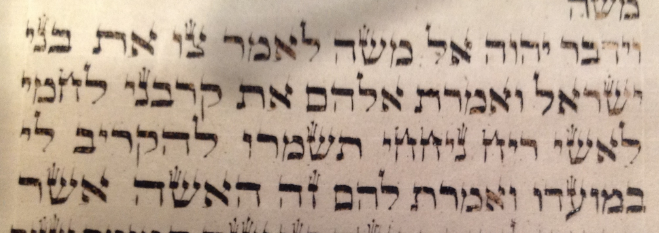
This is interesting. Gives you an insight into how the scribe was forming his letters.

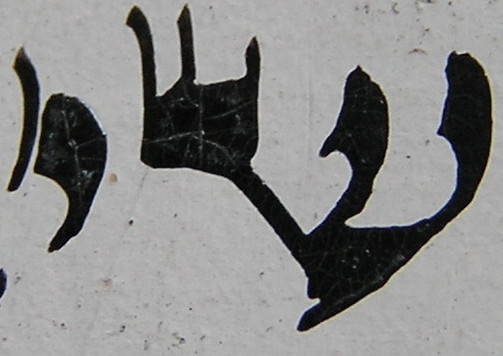
Interestingly formed yud

From the same sefer. Internet cookies to people who can figure out what happened here:


Apprentices

It’s been very busy here chez soferet. For the summer, I’ve taken on two apprentices who want to learn Torah repair. This means that in addition to keeping up with CBH’s Torah, I’ve been finding Torahs to fix, and then steering the apprentices through fixing them.

Here’s a photo of us working on location in Queens, from the other day.

Lady scribes working on Torahs

We’ve also been proofreading a scroll written by another student of mine. We have this nifty generational effect going; I taught Julie, and now I’m teaching the Apprentices how to do proofreading, using Julie’s scroll. It’s like a cute little scribe family.


Work scene

Pup on windowsill

I forget why I wanted her safely out of the way, but this worked nicely.


Feathers

Bit of a different post, today. A request for feathers.

See, I use turkey for writing, as you may recall. And so do my students. And when students are learning to cut quills, they use up a LOT of feathers.

Goodness, do they ever.

And I have two apprentices this summer, both of whom are still on the quill-cutting learning curve.

So we had about three dozen Davis turkey feathers, that Robyn had collected from Davis turkeys. And now we have about three left.

So. Um. If anyone fancies collecting me some turkey feathers (wing ones, for preference; the big strong ones), and mailing them to 4523 Broadway, apt 5G, New York, NY 10040…I’ll be very grateful and I’ll make you a keyring with your Hebrew name, if you tell me your Hebrew name.


Clock?

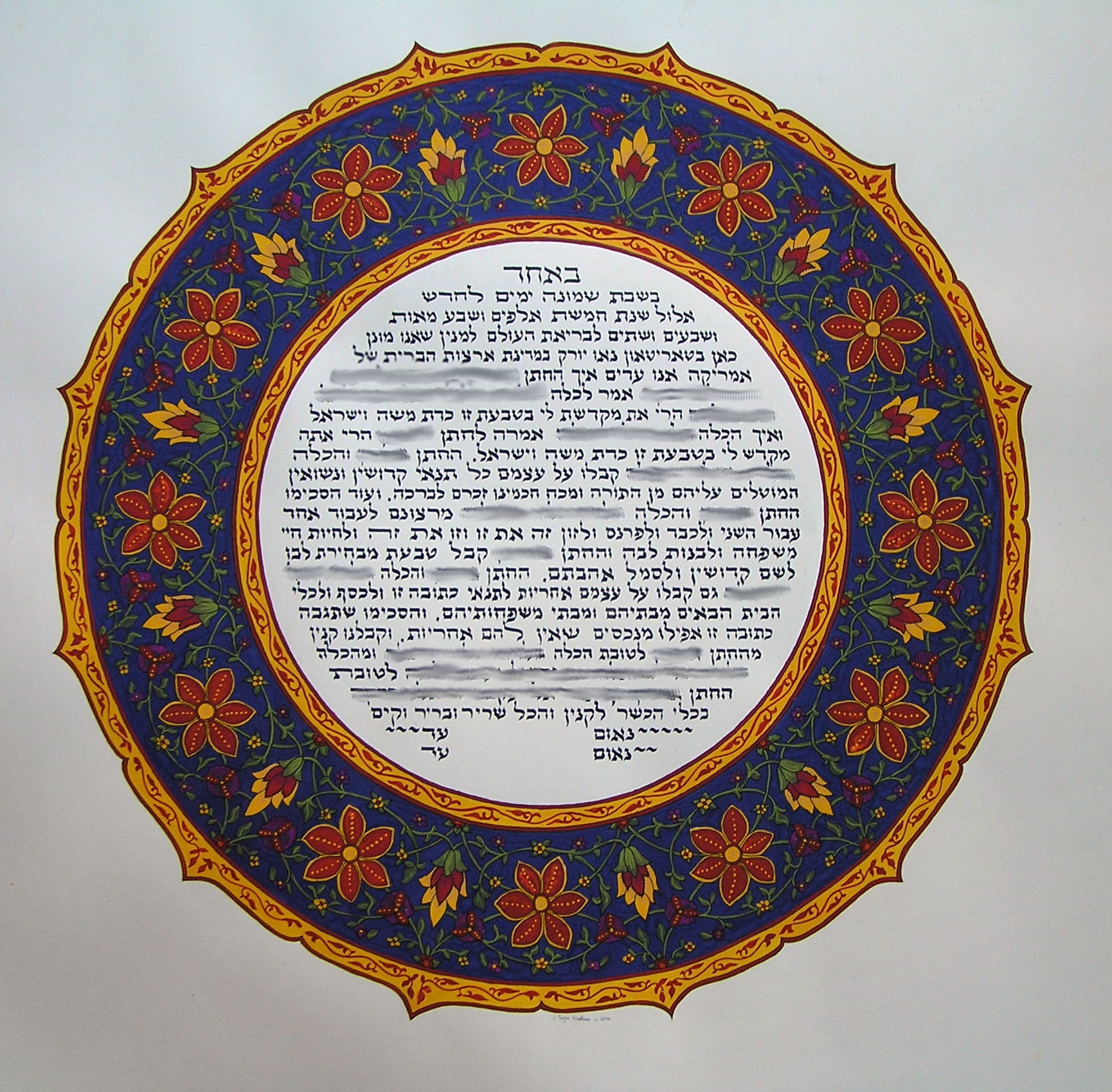
So I did this ketubah recently. It’s round, which is a new thing for me, and it has twelve-fold radial symmetry, and it’s scrumptious (Click the image to see a bigger version).

Once it was done, it occurred to me that it would make a pretty awesome clock. You’d scan the ketubah and photoshop out the middle, and put in the numbers instead. You’d get it printed. Then you’d make a wooden base, cutting it to the shape of those pretty peaked edges. Then you’d stick the print onto the wood (I don’t know the best way of doing this–decoupage techniques?) and seal it, and then add a clock mechanism. Which would be totally yummy.

I commented as much to the happy couple, and they were unexpectedly, gratifyingly, enthusiastic.

This is where you lot come in. I know how to get a scan done; I know how to use Photoshop, and I know how to get a print made. I don’t have woodworking space.

Does anyone have the skills and wherewithal to take it from there? I don’t have woodworking space, but I’m betting there’s at least one person reads this blog who does. Speak up if you want a commission!


Quill pens

Learning to cut and shape quills is one of the most stumbly stumbling-blocks a newbie scribe has to negotiate.

I learned to cut quills from a combination of websites (regia.org, liralen, and the ever-helpful Mordechai Pinchas), assistance in person, and practice.

When you’re starting out, you don’t know what a good quill is supposed to feel like, so you don’t know if you’re doing it right or not. Assistance in person is especially useful at this point.

When I was learning, Mordechai Pinchas was kind enough to send me a couple of ready-cut quills. It really helps. (Also especially worth noting is his tip about the Sharp Click – read his instructions; where he says A loud “click” confirms a good sharp cut and thus a clean edge, pay extra attention.)

Mediaeval re-enactment sites are jolly good for telling you how to recreate the mediaeval way of doing things, but they aren’t very useful for incorporating modern technology. Fair enough, obviously, but one thing it took me a long time to learn was: a razor blade is the best tool for cutting the ink channel. I was shown that particular trick by the sofer at Pardes, and life got easier.

But practice is the main thing. If you’re a beginner, it’s quite normal to spend all morning wrestling with your quill. If you’re a beginner whose teacher is nearby, they can sort you out; if you’re not that lucky, you just have to keep working at it. When I started my first Torah, I could get a decent quill eventually, although it might take me an hour or more; by the end of that year, I could get a decent quill pretty much every time. Practice.

Waan attempts to shape a quill:


Computer-aided proofreading, type 2

The other form of computer checking involves much more sophisticated software, and further reduces the chance of human error. In the process we’ve just been talking about, the letters were fed to me automatically, but I still had to use my brain to identify them and see that they were kosher. In this process, there’s barely any brain involved at all.

In this process, the operator uses a hand-held scanner to get the columns of text into the computer. Then it is run through OCR software – very clever software, which not only recognises letter glyphs but can also be taught to handle variations in glyphs caused by its being hand-written. Because it is a computer, it can also be taught some of the laws of whether a letter is kosher or not, so it can apply those mechanically to each glyph and flag up any doubtful cases.

Finally, the OCR output is compared to a Torah text, and any discrepancies are flagged up along with the doubtfully-kosher ones. A report with all problems is generated and given back with the scroll to the sofer, who then goes through the list and fixes everything on it.

Scan report
Scan report

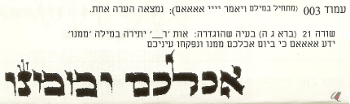
Here’s a piece of the scan report from my first Torah. Column 003, says the first entry on this report, which starts “Vayomer Adonai Elohim” – one comment. Line 21 (Bereshit 3:5), problem, thus: extra letter vav in the word “mimenu,” where it should say “…yodea Elohim ki b’yom akhalkhem mimenu v’nifkedu eineikhem…” and then in the picture you can see it’s got “v’mimenu,” for some reason or other.

I think I probably started writing the mem, got distracted mid-stroke, forgot I’d already started it, and started it over, but I don’t remember now.